Aspect in grammar marks how an action, event, or situation is represented in relation to progression, duration, completion, or a reference point. It adds information that tense alone does not provide, so two verb phrases can refer to the same general time while representing the situation differently.
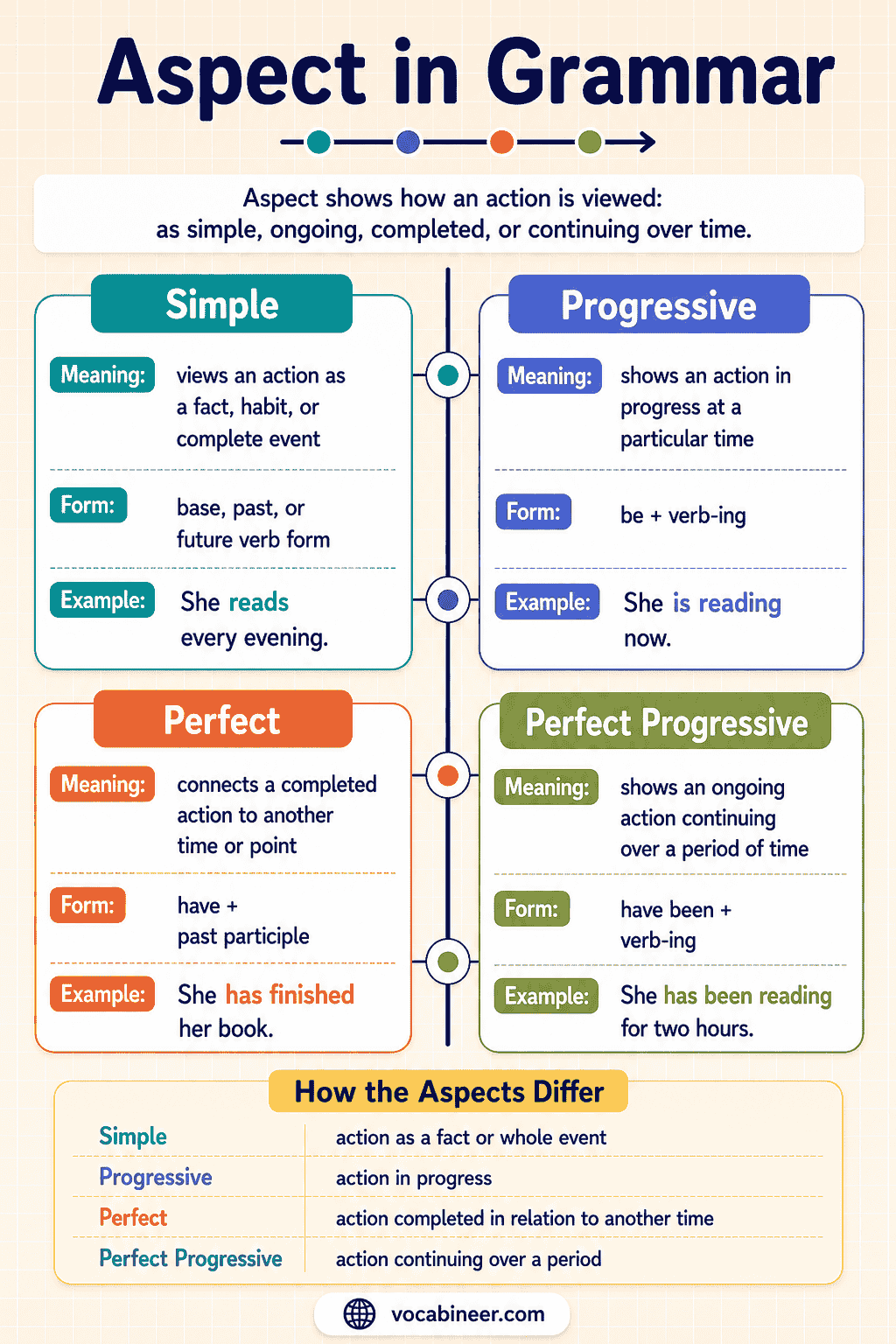
English grammar commonly contrasts simple forms, progressive or continuous aspect, perfect aspect, and perfect progressive aspect. These patterns show whether an activity is ongoing, whether an earlier situation relates to a reference point, or whether duration is grammatically relevant.
In This Page
What Is Aspect in Grammar?
Grammatical aspect marks how an action or situation is represented in terms of its internal temporal structure and its relation to a reference point.
Compare these sentences:
- She works at home.
- She is working at home.
- She has worked at home.
- She has been working at home.
The first sentence uses a simple form to represent the situation generally. The second uses progressive marking to indicate ongoing or temporary activity. The third uses perfect aspect to relate an earlier situation to the present reference point. The fourth combines perfect and progressive marking to indicate earlier ongoing activity or duration in relation to the present.
Aspect therefore adds grammatical information about:
- ongoing activity
- duration
- completion
- earlier situations
- reference-point relationships
These functions distinguish aspect from a simple statement of time.
Tense and Aspect
Tense and aspect are related, but they mark different grammatical information.
Tense primarily marks the temporal location of a situation. Aspect marks its internal temporal structure or its relation to another reference point.
Compare:
She worked yesterday.
and:
She was working at noon.
Both sentences refer to past time. The first uses a simple past form, while the second uses progressive aspect to mark an activity in progress at a stated past time.
Now compare:
She had worked there before she moved.
Here, perfect aspect relates the earlier situation of working there to the later past reference point established by before she moved.
| Concept | Main Function | Example |
|---|---|---|
| Tense | Marks temporal location | She worked yesterday. |
| Aspect | Marks progression or a reference-point relationship | She was working at noon. |
Tense and aspect can occur together inside one verb phrase. For example, was working combines past tense with progressive aspect.
Simple, Progressive, and Perfect Aspect
English learner grammar commonly contrasts simple, progressive, perfect, and perfect progressive patterns. More technical descriptions often treat simple forms as forms without progressive or perfect marking rather than as a separately marked aspect.
Simple Forms
Simple forms contain neither progressive nor perfect marking.
Examples:
- I work every weekday.
- She lived in Boston for six years.
- They will visit us tomorrow.
Simple forms commonly occur with habits, facts, states, repeated actions, and events represented without progressive or perfect structure.
Simple does not necessarily indicate completion.
I live in Chicago.
The situation continues even though the verb uses a simple form.
The term simple also identifies the grammatical pattern rather than its difficulty. Present Simple requires subject-verb agreement, while Past Simple includes both regular and irregular verb forms.
Progressive or Continuous Aspect
Progressive aspect, also called continuous aspect, marks an activity as ongoing, developing, or temporary in relation to a reference point.
Its basic structure is:
be + V-ing
Examples:
- She is reading now.
- She was reading when I called.
- She will be reading at noon.
Progressive aspect is not restricted to present time. It can combine with present, past, or future reference.
Compare:
She works from home.
She is working from home this week.
The simple form represents working from home as a general situation. The progressive form marks it as temporary or ongoing in the stated context.
Many stative verbs do not normally occur in progressive forms when they retain their ordinary state meanings.
Examples:
- I know the answer.
- She owns the house.
- We believe you.
Forms such as I am knowing the answer are normally unsuitable because know expresses a state rather than an activity in progress in this context.
Perfect Aspect
Perfect aspect relates an earlier event, state, or situation to a reference point.
Its basic structure is:
have + V3
Examples:
- She has finished the report.
- She had finished before I arrived.
- She will have finished by Friday.
The reference point changes across these examples:
- has finished → earlier event related to the present reference point
- had finished → earlier event related to a past reference point
- will have finished → earlier completion relative to a future reference point
Perfect aspect should not be defined only as a completed action.
Consider:
I have lived here for five years.
The situation may continue at the present reference point. The perfect form therefore marks a relationship between the earlier beginning of the situation and the present, rather than simply indicating completion.
The grammatical term perfect also does not mean “flawless.” It identifies a specific reference-point relationship.
Perfect Progressive Aspect
Perfect progressive aspect, also called perfect continuous aspect, combines perfect marking with progressive marking.
Its basic structure is:
have + been + V-ing
Examples:
- She has been studying for two hours.
- She had been studying before dinner.
- By June, she will have been studying here for five years.
Perfect marking relates the activity to a reference point, while progressive marking indicates ongoing activity or duration.
For example:
They have been waiting since 8 a.m.
The waiting began before the present reference point and continues at that point.
How Grammatical Aspect Changes Meaning
Aspect changes the grammatical representation of an action or situation even when the main verb remains the same.
| Form | Example | Grammatical Meaning |
|---|---|---|
| Simple | She works here. | general or regular situation |
| Progressive | She is working here. | ongoing or temporary activity |
| Perfect | She has worked here. | earlier experience related to the present |
| Perfect Progressive | She has been working here. | earlier ongoing activity or duration related to the present |
Consider the verb read:
I read every evening.
The simple form marks a regular habit.
I am reading a new novel.
Progressive marking indicates ongoing activity around the present reference point.
I have read the novel.
Perfect aspect relates the earlier reading event to the present.
I have been reading for two hours.
Perfect progressive aspect marks earlier ongoing activity and duration in relation to the present.
The lexical action remains similar, but the aspectual structure changes its grammatical meaning.
How Tense and Aspect Work Together in English
Aspectual patterns can combine with different temporal reference points.
| Aspectual Pattern | Present Reference | Past Reference | Future Reference |
|---|---|---|---|
| Progressive | is working | was working | will be working |
| Perfect | has worked | had worked | will have worked |
| Perfect Progressive | has been working | had been working | will have been working |
Consider the progressive pattern:
She is working now.
She was working at noon yesterday.
She will be working at noon tomorrow.
The reference point changes, while progressive marking continues to indicate activity in progress.
The perfect pattern follows the same principle:
She has finished the report.
She had finished before the meeting began.
She will have finished by Friday.
In each case, perfect aspect relates an earlier event to the stated reference point.
These combinations account for labels such as:
- Present Progressive
- Past Progressive
- Present Perfect
- Past Perfect
- Perfect Progressive
The labels therefore contain information about both temporal reference and aspectual structure.
Perfect vs Perfect Progressive
Perfect and perfect progressive aspect can both relate an earlier situation to a reference point. However, they often differ in whether result, state, activity, or duration receives greater grammatical prominence.
| Perfect | Perfect Progressive |
|---|---|
| Often gives greater prominence to result, amount, state, or achievement | Often gives greater prominence to activity, process, or duration |
| She has written five pages. | She has been writing for two hours. |
| They have painted three rooms. | They have been painting all morning. |
Compare:
Maya has written six emails.
The perfect form gives the completed amount greater prominence.
Maya has been writing emails all morning.
The perfect progressive form gives greater prominence to the ongoing activity and its duration.
The distinction is not always absolute.
For example:
I have lived here for five years.
I have been living here for five years.
Both forms can be natural. The first can represent the situation more as a state or established fact, while the second can mark the ongoing nature or duration more explicitly.
How to Identify Aspect in a Sentence
Aspectual patterns can often be identified from the structure of the verb phrase.
| Verb-Phrase Pattern | Aspectual Pattern | Example |
|---|---|---|
| No progressive or perfect marking | Simple form | She works here. |
| be + V-ing | Progressive | She is working. |
| have + V3 | Perfect | She has worked. |
| have + been + V-ing | Perfect Progressive | She has been working. |
For example:
They were playing outside.
The structure were + playing matches be + V-ing, so the verb phrase contains progressive marking.
They had finished before noon.
The structure had + V3 contains perfect marking.
They had been waiting for an hour.
The structure had + been + V-ing contains both perfect and progressive marking.
Verb-phrase structure indicates the aspectual pattern, while context determines the full interpretation of the situation.
Common Misunderstandings About Aspect
Several aspect terms can cause confusion because their everyday meanings differ from their grammatical meanings.
Aspect is not the same as tense.
Tense primarily marks temporal location, whereas aspect marks progression, duration, or reference-point relationships.
Progressive does not mean only “now.”
Progressive marking can occur with present, past, or future reference: is working, was working, and will be working.
Perfect does not mean “flawless.”
In grammar, perfect identifies a relationship between a reference point and an earlier event, state, or situation.
Perfect does not always mean “finished.”
For example, I have lived here for five years can describe a situation that remains true at the present reference point.
Simple does not mean “easy.”
The term identifies a grammatical pattern rather than its difficulty.
Perfect and perfective are different terms.
Perfect aspect marks a reference-point relationship. Perfective aspect is a broader linguistic category that represents a situation as bounded or whole. The two terms are not interchangeable.
FAQs
Aspect is a grammatical feature that marks how an action or situation is represented in terms of progression, duration, completion, or relation to a reference point.
Tense primarily marks the temporal location of a situation. Aspect marks its internal temporal structure or its relationship to a reference point. For example, worked and was working can both refer to past time, but only the second contains progressive marking.
Learner grammar commonly contrasts simple forms with progressive and perfect patterns. Simple forms contain neither progressive nor perfect marking, progressive aspect uses be + V-ing, and perfect aspect uses have + V3.
Perfect progressive aspect combines perfect and progressive marking. It relates an earlier ongoing activity to a reference point and commonly marks duration or continued activity. Its core structure is have + been + V-ing.
The answer depends on the grammatical framework. Learner grammar often groups Simple, Progressive, Perfect, and Perfect Progressive together. More technical descriptions may treat simple forms as forms without progressive or perfect marking rather than as a separately marked aspect.
Read More
- 12 English Tenses Chart
- All Tenses Rules and Formula
- English Tenses with Examples
- Indefinite Tense (Simple Tense)