

Simple Present Tense sentences help learners describe routines, habits, facts, preferences, jobs, schedules, and other situations that are generally or regularly true. Learning these sentence patterns makes it easier to speak and write clearly about everyday life.
This article includes 100 Simple Present Tense sentences with examples, followed by clear sections on affirmative, negative, and question forms, daily routines, habits, facts, states, frequency expressions, third-person singular verbs, and common mistakes.
In This Page
What Are Simple Present Tense Sentences?
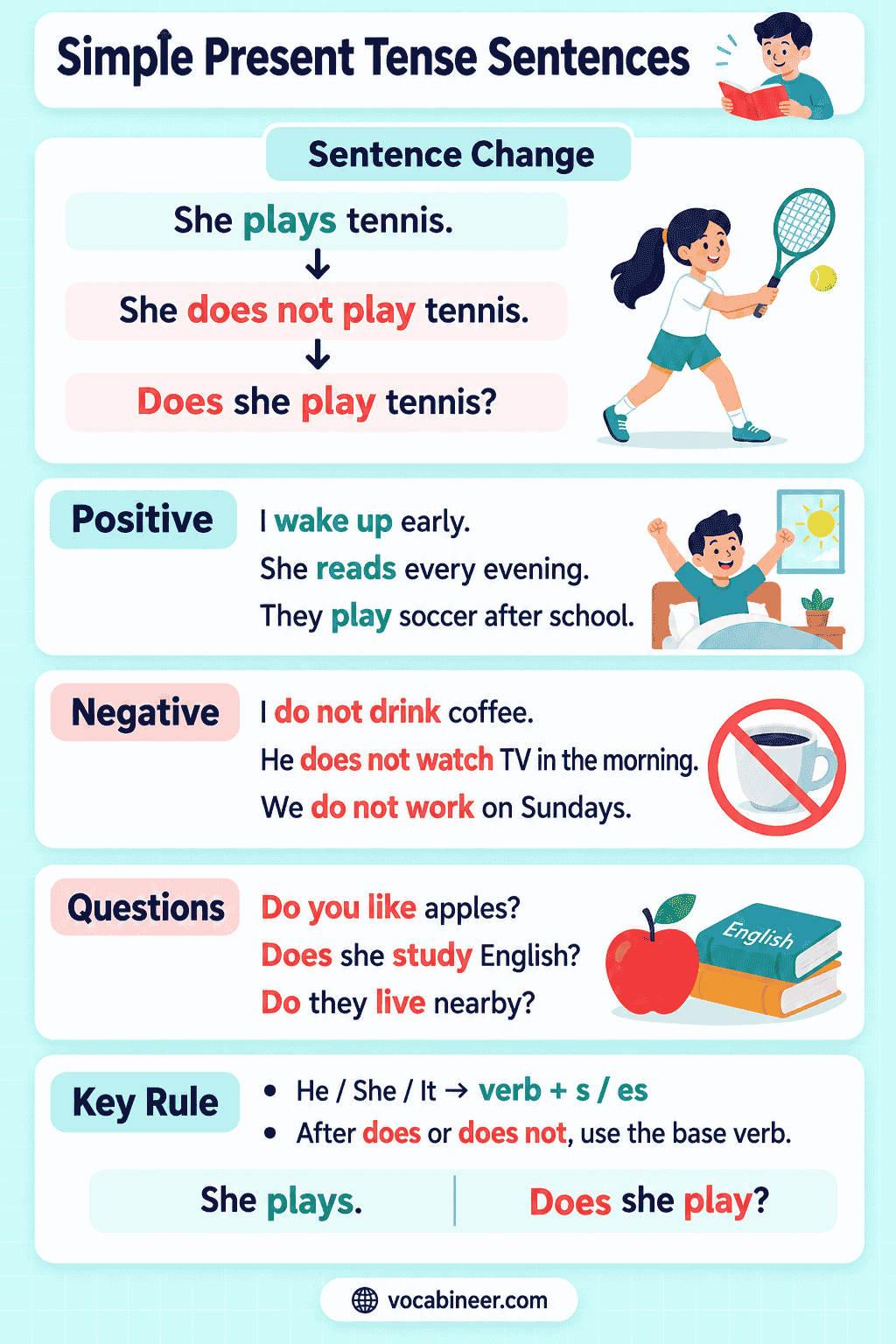
Simple Present Tense sentences describe habits, routines, repeated actions, general truths, present states, preferences, and situations presented as generally or regularly true.
Examples:
- I walk to school every day.
- She likes coffee.
- Water boils at 100°C.
- They live near the station.
The verb form changes depending on the subject and sentence type.
Simple Present Tense Sentences at a Glance
| Sentence Type | Example |
|---|---|
| affirmative | She works every day. |
| negative | She doesn’t work on Sundays. |
| yes/no question | Does she work here? |
| WH-question | Where does she work? |
| routine | We eat breakfast at seven. |
| habit | I read before bed. |
| fact | Water freezes at 0°C. |
| state | He loves music. |
100 Simple Present Tense Sentences
The following examples cover routines, habits, facts, states, jobs, schedules, negatives, questions, and sentences with the verb be.
- I wake up early every morning.
- She drinks tea before breakfast.
- He walks to school every day.
- We play football after class.
- They study English in the evening.
- My mother cooks dinner at home.
- My father reads the newspaper every morning.
- Sara writes in her notebook.
- Ali goes to work by bus.
- The baby sleeps in the afternoon.
- I like fresh fruit.
- She loves music.
- He knows the answer.
- We believe you.
- They need more time.
- My sister wants a new bag.
- This book belongs to me.
- I remember his name.
- She prefers coffee to tea.
- He understands the lesson.
- Water boils at 100°C.
- Ice melts in warm weather.
- Birds lay eggs.
- Plants need sunlight.
- Fish live in water.
- The Earth moves around the Sun.
- The Moon orbits the Earth.
- Bees make honey.
- The heart pumps blood through the body.
- Light travels very fast.
- I always check my email in the morning.
- She usually walks to school.
- He often plays chess.
- We sometimes eat outside.
- They rarely arrive late.
- My brother never drinks coffee.
- I usually read before bed.
- She often visits her grandparents.
- He sometimes watches television at night.
- We always finish our work on time.
- I exercise every day.
- She visits her parents once a week.
- He plays tennis twice a month.
- We meet every Friday.
- They travel abroad once a year.
- My sister goes swimming three times a week.
- The club meets on Mondays.
- I call my grandmother every weekend.
- He cleans his room every Saturday.
- She buys groceries every Sunday.
- My mother works in a hospital.
- He teaches mathematics.
- They live near the station.
- Sarah runs a small shop.
- I study at university.
- We own a small house.
- My uncle drives a taxi.
- She works for a bank.
- He lives with his parents.
- The company employs many people.
- The train leaves at seven.
- The class starts at nine.
- The shop opens at ten.
- The flight lands at six thirty.
- School ends at three.
- The bus arrives every twenty minutes.
- The movie starts at eight.
- The library closes at six.
- The meeting begins at eleven.
- The restaurant opens at noon.
- I don’t drink coffee.
- We don’t work on Sundays.
- They don’t live nearby.
- You don’t need this book.
- He doesn’t drive to work.
- She doesn’t like spicy food.
- It doesn’t happen often.
- My brother doesn’t play tennis.
- Sara doesn’t study at night.
- The shop doesn’t open on Sundays.
- Do you play football?
- Do they work here?
- Do we need more time?
- Does he live nearby?
- Does she speak English?
- Does it rain often?
- Where do you live?
- What time do they start work?
- Why does she leave early?
- When does he study?
- I am tired.
- She is a teacher.
- He is at home.
- We are ready.
- They are busy.
- The room is quiet.
- She isn’t at school.
- We aren’t late.
- Are you ready?
- Is he at work?
Affirmative Simple Present Tense Sentences
Affirmative sentences state what someone does, what usually happens, or what is generally true.
With I, You, We, They
- I drink tea every morning.
- You work very hard.
- We play football on Saturdays.
- They study English after school.
- I write in my notebook every day.
- We visit our grandparents on Sundays.
With He, She, It
- He reads every night.
- She watches television after dinner.
- It rains a lot here.
- My brother plays cricket.
- Sara studies English.
- The shop opens at nine.
With he, she, and it, the main verb usually takes -s or -es in affirmative sentences.
Negative Simple Present Tense Sentences
Negative sentences use do not / don’t or does not / doesn’t before the base verb.
Examples:
- I don’t drink coffee.
- You don’t need this book.
- We don’t work on Sundays.
- They don’t live nearby.
- He doesn’t drive to work.
- She doesn’t like spicy food.
After doesn’t, use the base form of the verb.
Correct:
- She doesn’t like tea.
Incorrect:
- She doesn’t likes tea.
Interrogative Simple Present Tense Sentences
Simple Present questions usually use do or does before the subject.
Yes/No Questions
- Do you play tennis?
- Do they work here?
- Do we need more time?
- Does he live nearby?
- Does she speak English?
- Does it rain often?
WH-Questions
- Where do you live?
- What time do they start work?
- Why does she leave early?
- When does he study?
- Where does your brother work?
- How often do you exercise?
The main verb stays in its base form after do or does.
Short Answers in the Simple Present
Yes/no questions often use short answers with do, does, am, is, or are.
- Do you work here? — Yes, I do. / No, I don’t.
- Do they live nearby? — Yes, they do. / No, they don’t.
- Does she speak English? — Yes, she does. / No, she doesn’t.
- Does he drive to work? — Yes, he does. / No, he doesn’t.
- Is she ready? — Yes, she is. / No, she isn’t.
- Are they at home? — Yes, they are. / No, they aren’t.
Short answers repeat the auxiliary instead of the main verb.
Simple Present Sentences with the Verb Be
The verb be follows a different pattern and uses am, is, or are directly.
Affirmative Sentences
- I am tired.
- She is a teacher.
- He is at home.
- We are ready.
- They are busy.
Negative Sentences
- I am not hungry.
- She isn’t at school.
- He isn’t busy.
- We aren’t late.
- They aren’t tired.
Questions with Be
- Are you ready?
- Is she your sister?
- Is he at work?
- Are they at home?
- Am I early?
The verb be does not normally use do or does in Simple Present questions and negatives.
Simple Present Sentences for Daily Routines
Simple Present is very common for daily routines.
- I wake up at six every morning.
- She brushes her teeth after breakfast.
- He takes the bus to work.
- We eat lunch at noon.
- They study in the evening.
- Sara goes to bed at ten.
- I check my email after breakfast.
- She packs her bag before school.
Simple Present Sentences for Habits
Habit sentences describe actions that happen regularly.
- I exercise every morning.
- She carries a notebook everywhere.
- He visits his grandparents every weekend.
- We eat together on Fridays.
- They watch movies at night.
- I walk after lunch.
- She writes in her journal before bed.
- My brother plays chess every evening.
Simple Present Sentences with Adverbs of Frequency
Adverbs of frequency show how often something happens.
Common examples include:
- always
- usually
- often
- sometimes
- rarely
- never
Examples:
- I always check my email in the morning.
- She usually walks to school.
- He often plays chess.
- We sometimes eat outside.
- They rarely arrive late.
- My sister never drinks coffee.
Frequency adverbs usually come before the main verb but after be.
Examples:
- She often reads at night.
- She is often tired after work.
Simple Present Sentences with Frequency Expressions
Frequency expressions can also show how often an action happens.
- I exercise every day.
- She visits her parents once a week.
- He plays tennis twice a month.
- We meet every Friday.
- They travel abroad once a year.
- My sister goes swimming three times a week.
- The club meets on Mondays.
- I call my grandmother every weekend.
Simple Present Sentences for General Truths and Facts
Simple Present commonly describes facts and general truths.
- Water boils at 100°C.
- The Earth moves around the Sun.
- Birds lay eggs.
- Plants need water.
- Ice melts in heat.
- Light travels very fast.
- Cats have sharp claws.
- The Moon orbits the Earth.
- Fish live in water.
- The heart pumps blood through the body.
Simple Present Sentences for States and Preferences
Simple Present also describes states, thoughts, feelings, possession, and preferences.
- I love music.
- She likes chocolate.
- He knows the answer.
- We believe you.
- They need help.
- This bag belongs to me.
- I remember her name.
- She wants a new phone.
- He understands the problem.
- We prefer tea to coffee.
Simple Present Sentences with Have and Has
The verb have changes to has with third-person singular subjects.
- I have a new bag.
- You have plenty of time.
- We have two classes today.
- They have a large garden.
- He has a bicycle.
- She has blue eyes.
- My school has a library.
- The house has three bedrooms.
Simple Present Sentences for Jobs and Permanent Situations
Simple Present often describes jobs and relatively stable situations.
- My mother works in a hospital.
- He teaches mathematics.
- They live in London.
- Sarah runs a small shop.
- I study at university.
- We own a small house.
- My uncle drives a taxi.
- She works for a bank.
Simple Present Sentences for Instructions and Directions
Simple Present can describe instructions, processes, and directions.
- First, you open the box.
- Then you press the button.
- You turn left at the corner.
- You take the second road.
- You mix the ingredients well.
- You add the sugar slowly.
Simple Present Sentences for Timetables and Schedules
Simple Present can describe fixed schedules and timetables.
- The train leaves at seven.
- The class starts at nine.
- The shop opens at ten.
- The flight lands at six thirty.
- School ends at three.
- The library closes at six.
Simple Present Sentences in Future Time Clauses
Simple Present can refer to future time inside time clauses.
- I’ll call you when I arrive.
- We’ll leave after she finishes.
- Tell me before you go.
The wider sentence provides the future meaning.
Simple Present Sentences for Stories and Commentaries
Simple Present can also appear in summaries and live commentaries.
- The hero enters the room and finds a letter.
- The striker passes the ball and scores.
- The story ends with the family reunited.
Third-Person Singular Simple Present Sentences
Third-person singular subjects such as he, she, it, and singular names usually take -s or -es in affirmative sentences.
Examples:
- He plays football.
- She reads every evening.
- My father drives to work.
- Ali washes the car on Sunday.
- The baby cries at night.
- My sister studies English.
- Tom goes to school by bus.
- She has a new laptop.
- He does his homework after dinner.
- The dog watches the door.
Common spelling patterns:
| Base Verb | He / She / It |
|---|---|
| play | plays |
| watch | watches |
| study | studies |
| go | goes |
| have | has |
| do | does |
I, You, We, They vs He, She, It
The main affirmative verb changes with third-person singular subjects.
| I / You / We / They | He / She / It |
|---|---|
| I work. | He works. |
| They study. | She studies. |
| We watch TV. | He watches TV. |
| You go home. | She goes home. |
| They have lunch. | He has lunch. |
Third-person singular subjects usually change the main verb in affirmative Simple Present sentences.
Affirmative vs Negative vs Question Sentences
The three main sentence patterns can be compared directly.
| Affirmative | Negative | Question |
|---|---|---|
| She works here. | She doesn’t work here. | Does she work here? |
| They play football. | They don’t play football. | Do they play football? |
| He likes tea. | He doesn’t like tea. | Does he like tea? |
| We live nearby. | We don’t live nearby. | Do we live nearby? |
Simple Present Tense Sentences for Kids
These short examples are useful for children and beginners.
- I like apples.
- She reads books.
- He plays football.
- We go to school.
- Birds fly in the sky.
- My cat sleeps on the sofa.
- My teacher helps us.
- They play in the park.
Common Simple Present Tense Sentence Mistakes
Learners often make mistakes with third-person singular verbs, questions, negatives, and the verb be.
Forgetting -s with He, She, It
Incorrect: She work here.
Correct: She works here.
Adding -s after Does
Incorrect: Does he works here?
Correct: Does he work here?
Adding -s after Doesn’t
Incorrect: She doesn’t likes coffee.
Correct: She doesn’t like coffee.
Using Do or Does with Be
Incorrect: Does she be tired?
Correct: Is she tired?
Using Present Continuous for a Routine
Less suitable: I am going to school every day.
Better: I go to school every day.
Mixing Present and Past Without a Reason
Incorrect: He works in a bank and lived nearby.
Correct if both situations are current: He works in a bank and lives nearby.
Using the Wrong Third-Person Spelling
Incorrect: She studys English.
Correct: She studies English.
Forgetting the Auxiliary in Questions
Incorrect: Where she works?
Correct: Where does she work?
FAQs
Examples include I walk to school every day, She likes coffee, They live near the station, and Water boils at 100°C. These sentences describe routines, facts, states, or situations presented as generally true.
Examples include I read every night, We play football on Saturdays, He works in a bank, and She studies English every day.
Use do not / don’t with I, you, we, and they, and does not / doesn’t with he, she, and it. For example, They don’t work here and She doesn’t like coffee.
Use do or does before the subject, followed by the base form of the verb. For example, Do you work here? and Does she live nearby?
In affirmative sentences, the main verb usually takes -s or -es, as in he works, she watches, and it goes. In questions and negatives with does, the main verb returns to its base form.
Read More
- 12 English Tenses Chart
- All Tenses Rules and Formula
- English Tenses with Examples
- Present Tenses in English
- Past Tenses in English
- Future Tenses in English
- Be Going To in English