

The Simple Present Tense describes general, repeated, habitual, stative, and scheduled situations. It is one of the most frequently used English tense forms because it appears in daily routines, facts, preferences, regular activities, and fixed timetables.
Simple Present is also called Present Simple, while Present Indefinite is a traditional ESL name for the same basic tense form. This article explains its uses, sentence structures, third-person rules, do/does, the verb be, frequency adverbs, future schedules, and common mistakes.
In This Page
What Is the Simple Present Tense?
The Simple Present Tense marks situations that are general, repeated, habitual, relatively stable, or stative rather than temporary activities in progress.
Examples:
- I walk to work every morning.
- She teaches English.
- Water freezes at 0°C.
- We prefer tea.
- The train leaves at 7 tomorrow morning.
The grammatical meaning depends on context. The first example marks a routine, the second marks a relatively stable situation, the third states a general fact, and the fourth contains a stative verb. The final sentence uses Simple Present for a scheduled future event.
Simple Present and Present Indefinite
Simple Present, Present Simple, and Present Indefinite generally refer to the same tense form in English learner grammar.
| Term | Meaning |
|---|---|
| Simple Present | Common name for the tense |
| Present Simple | Common alternative word order |
| Present Indefinite | Traditional ESL term |
Modern English-learning materials commonly use Simple Present or Present Simple. The term Present Indefinite remains common in some school systems and traditional grammar materials.
The word indefinite does not mean that the action is uncertain. It is simply a traditional grammatical label.
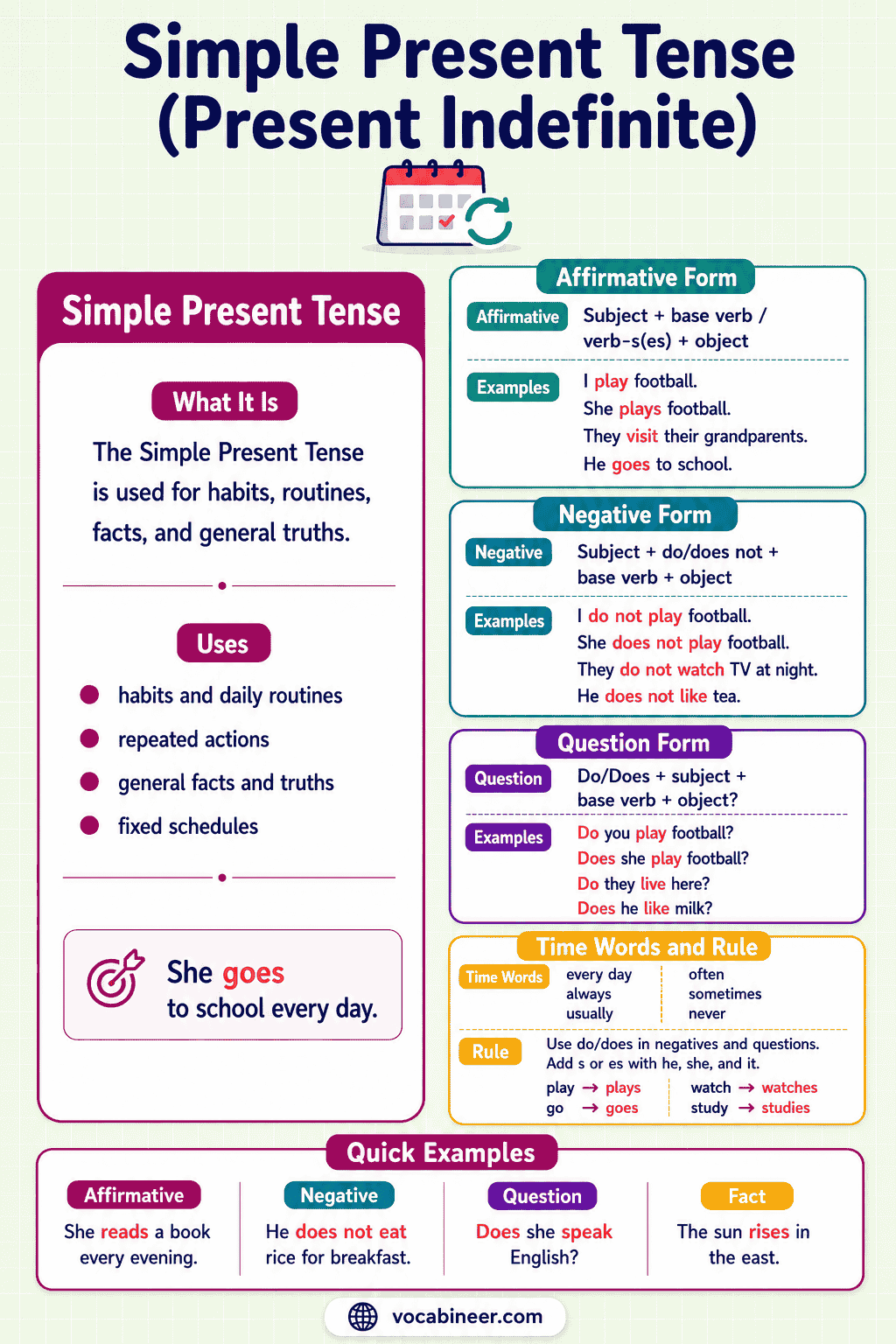
When to Use the Simple Present
Simple Present has several important uses. The tense most commonly marks situations that are regular, general, stative, or fixed by a schedule.
Habits and Routines
Use Simple Present for activities that occur regularly.
- I wake up at six every morning.
- Emma drinks coffee before work.
- We exercise after school.
- He reads before bed.
The repetition can occur daily, weekly, occasionally, or according to another regular pattern.
Repeated Actions
Simple Present also marks actions that happen repeatedly.
- They visit their grandparents every month.
- Ryan calls his sister on Sundays.
- The teacher checks our homework every Friday.
A repeated action does not need to happen every day. The tense marks the repeated pattern.
Facts and General Truths
Use Simple Present for facts and statements treated as generally true.
- Water boils at 100°C at sea level.
- The Earth moves around the Sun.
- Plants need water.
- Birds have feathers.
These statements do not describe temporary activities.
States and Stable Situations
Simple Present commonly occurs with verbs that express states, possession, knowledge, preference, or opinion.
- I know the answer.
- She likes classical music.
- They own a small apartment.
- We believe him.
- Daniel needs more time.
These meanings commonly require Simple Present rather than Present Continuous.
Fixed Schedules and Timetables
Simple Present can mark future events when a fixed schedule, timetable, or programmed sequence determines the event.
- The bus arrives at 8:10 tomorrow.
- The semester starts next Monday.
- Our flight leaves at 6:30 in the morning.
- The movie begins at nine tonight.
The verb form is Simple Present even though the time reference is future.
How to Form the Simple Present
Simple Present formation depends on the subject and the type of sentence.
Affirmative Sentences
The basic structure is:
S + V1 / V1+s
Use the base verb with I, you, we, and they.
- I work here.
- You speak English well.
- We live nearby.
- They play soccer after school.
With he, she, it, and singular noun subjects, the verb usually takes -s or -es.
- He works here.
- She speaks English well.
- My brother lives nearby.
- Emma watches television after dinner.
Negative Sentences
The basic structure is:
S + do/does + not + V1
Use do not with:
- I
- you
- we
- they
Examples:
- I do not eat meat.
- We do not work on Sundays.
- They do not live here.
Use does not with:
- he
- she
- it
- singular noun subjects
Examples:
- She does not drive to work.
- He does not like coffee.
- The store does not open on Sundays.
After does, the main verb remains in V1.
Correct:
She does not work here.
Incorrect:
She does not works here.
Questions
The basic structure is:
Do/Does + S + V1?
Use do with I, you, we, and they.
- Do you live nearby?
- Do they play tennis?
- Do we need more time?
Use does with he, she, it, and singular noun subjects.
- Does she work here?
- Does he know the answer?
- Does the bus stop here?
The main verb remains in V1 after does.
Correct:
Does she study English?
Incorrect:
Does she studies English?
The auxiliary does contains the third-person grammatical marking, so the main verb uses its base form.
Simple Present with Be
The verb be follows a different pattern from ordinary verbs.
Its Simple Present forms are:
- I am
- he/she/it is
- you/we/they are
Affirmative examples:
- I am ready.
- She is tired.
- They are at home.
Negative forms place not after be:
- I am not tired.
- She is not busy.
- They are not late.
Questions place be before the subject:
- Am I late?
- Is she ready?
- Are they at school?
Basic Simple Present negatives and questions with be do not use do or does.
Incorrect:
Does she be tired?
Correct:
Is she tired?
Third-Person Singular Rules
Simple Present affirmative sentences require special verb forms with he, she, it, and singular noun subjects.
Add -s to Most Verbs
- work → works
- read → reads
- play → plays
- help → helps
Examples:
- He works in an office.
- She reads every evening.
Add -es to Certain Endings
Verbs ending in -s, -sh, -ch, -x, or often -o usually take -es.
- pass → passes
- wash → washes
- watch → watches
- fix → fixes
- go → goes
Examples:
- She washes the dishes after dinner.
- The bus passes our house every morning.
Change Consonant + y to -ies
When a verb ends in a consonant + y, change y to ies.
- study → studies
- try → tries
- carry → carries
Example:
Emma studies English every evening.
When a vowel comes before y, simply add -s:
- play → plays
- enjoy → enjoys
Important Irregular Forms
A few high-frequency verbs have special third-person forms:
- have → has
- do → does
- go → goes
Examples:
- She has two brothers.
- He does his homework after dinner.
- Maya goes to work by bus.
Do and Does
Do and does form ordinary Simple Present negatives and questions.
| Subject | Auxiliary |
|---|---|
| I | do |
| you | do |
| we | do |
| they | do |
| he | does |
| she | does |
| it | does |
Compare:
They work here.
They do not work here.
Do they work here?
With a third-person singular subject:
She works here.
She does not work here.
Does she work here?
The affirmative sentence carries the third-person ending on the main verb. In negatives and questions, does carries that marking, so the main verb returns to V1.
Frequency Adverbs with the Simple Present
Frequency adverbs commonly occur with Simple Present because they specify how often a repeated situation occurs.
Common frequency adverbs include:
- always
- usually
- often
- sometimes
- rarely
- never
Position with Ordinary Verbs
Frequency adverbs usually occur before the main verb.
- She usually walks to work.
- I often read after dinner.
- They sometimes visit us on weekends.
- He never drinks coffee.
Position with Be
With be, the frequency adverb usually occurs after am, is, or are.
- She is usually early.
- They are often busy.
- I am never late.
Frequency expressions such as every day, every week, on Mondays, and once a month also commonly occur with Simple Present.
Examples:
- We exercise every morning.
- She calls her mother once a week.
- They play tennis on Saturdays.
These expressions support repeated meaning, but they do not determine the tense automatically. Context and intended meaning remain necessary.
Simple Present vs Present Continuous
Simple Present and Present Continuous can refer to situations around the present, but their grammatical meanings differ.
| Simple Present | Present Continuous |
|---|---|
| general or regular situation | ongoing or temporary activity |
| I work from home. | I am working from home this week. |
| She lives with her parents. | She is living with her parents this month. |
| He drives to work. | He is driving to work today. |
Compare:
I work from home.
This marks a general or regular situation.
I am working from home this week.
This marks a temporary situation around the present.
Stative Verbs
Many stative verbs normally occur in Simple Present when they express states rather than activities.
Common examples include:
- know
- believe
- understand
- own
- need
- prefer
- like
- want
Examples:
I know the answer.
She owns that car.
We need more time.
These forms are normally more appropriate than:
I am knowing the answer.
She is owning that car.
However, some stative verbs can occur progressively when their meaning changes.
Compare:
I have a car.
I am having lunch.
In the first sentence, have marks possession. In the second, having refers to an activity.
Another example:
The soup tastes good.
The chef is tasting the soup.
The verb has a stative meaning in the first sentence and an activity meaning in the second.
Simple Present for Future Schedules
Simple Present can mark future reference when an event belongs to a fixed schedule, timetable, or programmed sequence.
Examples:
- The train leaves at 7 tomorrow morning.
- The meeting starts at nine.
- The semester ends next Friday.
- Our flight arrives at 4:20 tomorrow afternoon.
The tense form remains Simple Present, while the time expression establishes future reference.
This use is most natural with scheduled events rather than personal arrangements.
Compare:
The train leaves at six tomorrow. — fixed schedule
We are leaving at six tomorrow. — personal arrangement
Common Simple Present Mistakes
Simple Present mistakes commonly involve third-person agreement, auxiliary choice, verb form, or confusion with Present Continuous.
Missing -s or -es with he, she, or it
Incorrect:
He work at a hospital.
Correct:
He works at a hospital.
Third-person singular affirmative forms normally require -s/-es.
Keeping -s after does
Incorrect:
Does she works here?
Correct:
Does she work here?
The auxiliary does contains the third-person marking, so the main verb remains in V1.
Using don’t with he, she, or it
Incorrect:
She don’t drive.
Correct:
She doesn’t drive.
Use does not / doesn’t with third-person singular subjects.
Using does with be
Incorrect:
Does he be tired?
Correct:
Is he tired?
The verb be forms its own negatives and questions.
Using Present Continuous for an ordinary stative meaning
Incorrect in the ordinary state meaning:
I am knowing the answer.
Correct:
I know the answer.
Forgetting the base form after does not
Incorrect:
She doesn’t likes coffee.
Correct:
She doesn’t like coffee.
FAQs
Simple Present is an English tense form commonly used for general situations, habits, repeated actions, facts, states, and fixed schedules. Ordinary affirmative verbs use V1 or V1+s according to the subject.
Yes. Present Indefinite is a traditional ESL name for the tense more commonly called Simple Present or Present Simple in modern English-learning materials.
Add -s or -es to ordinary affirmative verbs with he, she, it, and singular noun subjects. For example, work → works, watch → watches, and study → studies. The ending is not kept after does.
Use do with I, you, we, and they. Use does with he, she, it, and singular noun subjects. They form ordinary Simple Present negatives and questions, as in Do you work here? and Does she work here?
Simple Present commonly marks general, regular, or stative situations, while Present Continuous marks activity that is ongoing, temporary, or developing. Compare She works from home with She is working from home this week.
Read More
- 12 English Tenses Chart
- All Tenses Rules and Formula
- English Tenses with Examples
- Indefinite Tense (Simple Tense)