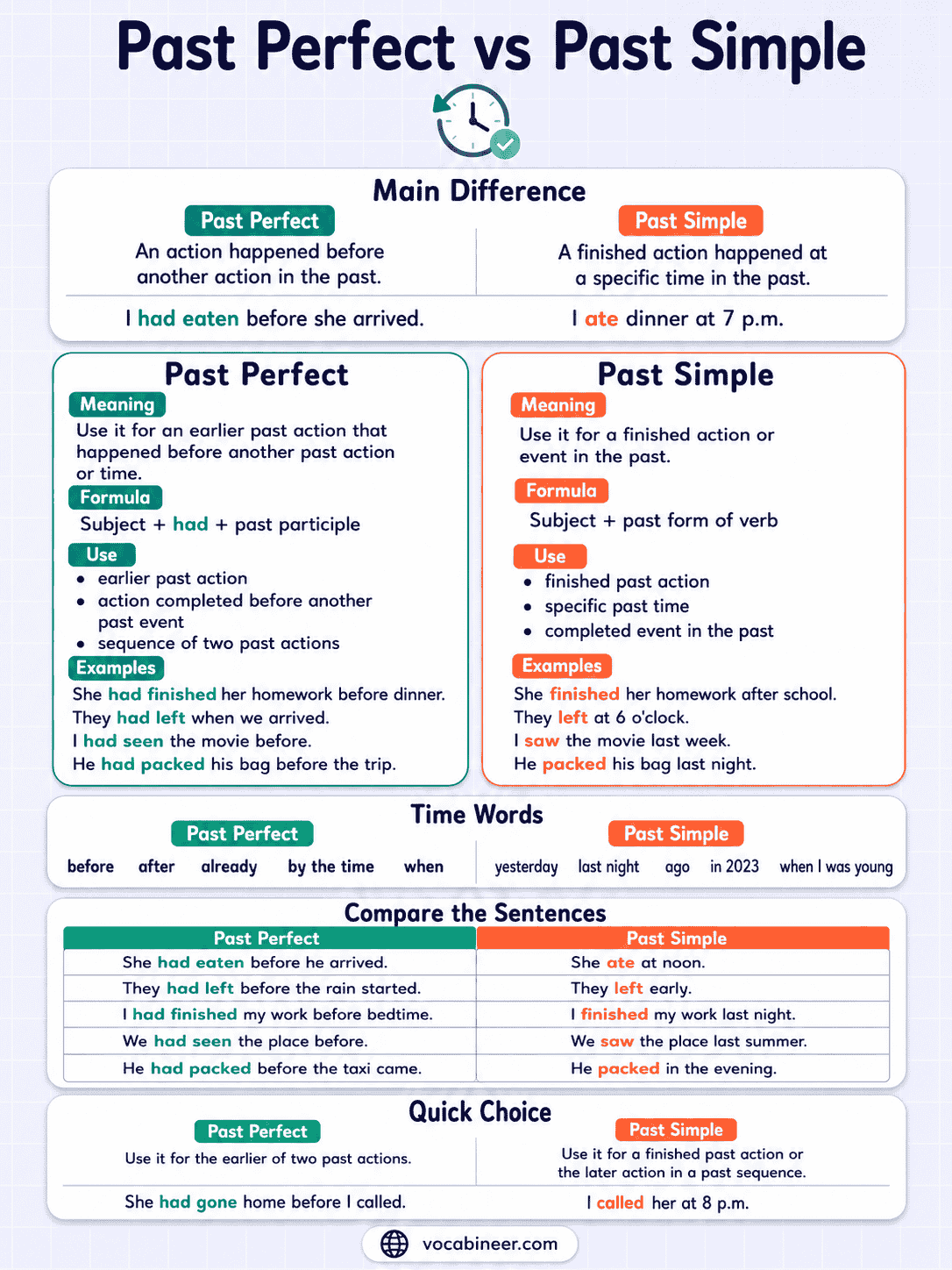
Past Perfect and Past Simple both describe past situations, but they establish different relationships between events. Past Perfect marks an event, experience, or state as already complete or established before a later past reference point, while Past Simple describes ordinary completed past events, states, or the main sequence of a past narrative.
Understanding this difference helps learners place past events in the correct order, explain earlier causes, describe background information, and choose the right tense with when, before, after, and by the time. The comparison also makes the difference between had + V3 and V2 easier to use correctly.
In This Page
Past Perfect vs Past Simple: What Is the Difference?
The main difference concerns the relationship between an earlier past situation and the ordinary past timeline.
| Past Perfect | Past Simple |
|---|---|
| marks an event, state, or experience as earlier than another past reference point | describes a completed event or state in the ordinary past timeline |
| uses had + V3 | uses V2 |
| She had left before I arrived. | I arrived at eight. |
| I had never seen snow before that trip. | I saw snow during the trip. |
| He was tired because he had worked all night. | He worked late yesterday. |
A useful starting rule is:
Past Perfect commonly marks what was already complete before a later past point, while Past Simple describes the later event or an ordinary completed past event.
However, Past Perfect is not required for every event that happened first.
Past Perfect vs Past Simple at a Glance
| Meaning | Past Perfect | Past Simple |
|---|---|---|
| earlier event before another past event | She had left before I arrived. | — |
| later past event | — | I arrived at eight. |
| experience up to a past point | I had never flown before that trip. | — |
| specific past experience | — | I flew to Dubai in 2019. |
| earlier cause | She had not slept well. | — |
| later result | — | She felt exhausted. |
| state continuing up to a past point | They had known each other for years when they married. | — |
| finished past state | — | They knew each other at school. |
| earlier narrative background | Someone had broken a window. | — |
| main narrative event | — | Daniel opened the door. |
The intended time relationship determines the tense.
How Past Perfect and Past Simple Are Formed
The two tenses use different verb forms.
| Feature | Past Perfect | Past Simple |
|---|---|---|
| affirmative | had + V3 | V2 |
| negative | had not + V3 | did not + V1 |
| question | Had + subject + V3? | Did + subject + V1? |
| main verb form | past participle, V3 | past form, V2 |
Examples:
| Past Perfect | Past Simple |
|---|---|
| She had left. | She left. |
| She had not left. | She did not leave. |
| Had she left? | Did she leave? |
Past Perfect always uses had with every subject.
- I had finished
- she had finished
- they had finished
Past Simple uses V2 in affirmative sentences and did + V1 in negatives and questions.
Earlier Past Event vs Later Past Event
This is the central difference between the two tenses.
| Past Perfect | Past Simple |
|---|---|
| earlier event | later event |
| She had left before I arrived. | I arrived later. |
| The film had started when we entered. | We entered later. |
| They had eaten before the guests arrived. | The guests arrived later. |
| Daniel had finished the report before the meeting began. | The meeting began later. |
Past Perfect marks the event that was already complete before another past point.
For example:
- When I arrived, she had left.
The arrival appears first in the sentence, but the leaving happened first in time.
Therefore, sentence order does not always match event order.
Do We Always Need Past Perfect for Two Past Events?
No. Past Perfect is not automatically required whenever a sentence contains two past events.
If the chronology is already clear, Past Simple can often describe both events.
| Past Simple | Past Perfect |
|---|---|
| He finished dinner before he left. | He had finished dinner before he left. |
| After she packed her bag, she called a taxi. | After she had packed her bag, she called a taxi. |
| I checked the door before I went to bed. | I had checked the door before I went to bed. |
Both versions can be grammatical.
Past Perfect becomes especially useful when the speaker needs to:
- clarify which event happened earlier
- emphasize prior completion
- explain an earlier cause
- provide background
- move back from the main narrative timeline
The stronger rule is:
Use Past Perfect when the earlier relationship needs clarification or emphasis; Past Simple can be enough when the chronology is already clear.
Past Simple Sequence vs Earlier Past Perfect Background
Past Simple commonly presents events in straightforward chronological order. Past Perfect can introduce an event that happened before the main sequence.
| Past Simple + Past Simple | Past Perfect + Past Simple |
|---|---|
| presents events in sequence | marks an earlier background event |
| She opened the door and walked inside. | She opened the door after someone had unlocked it. |
| He finished dinner and left. | He left after he had finished dinner. |
| I called Maya and told her the news. | I called Maya after I had heard the news. |
Past Simple commonly moves the timeline forward. Past Perfect can refer to something already complete before that timeline point.
Past Perfect vs Past Simple with When
The conjunction when does not automatically determine which tense to use. The event relationship matters.
| Past Simple + Past Simple | Past Perfect + Past Simple |
|---|---|
| events can happen together or in close sequence | one event clearly happened earlier |
| When she entered, everyone shouted. | When she entered, everyone had already sat down. |
| When the curtains opened, the music started. | When the curtains opened, the music had already started. |
| When I called, Maya answered. | When I called, Maya had already left. |
Compare:
- When I arrived, she left.
- When I arrived, she had left.
The first can mean that her leaving happened at or after my arrival.
The second clearly means that she left before I arrived.
Past Perfect vs Past Simple with Before and After
The words before and after already help establish chronology, so Past Perfect is not always necessary.
Before
| Past Simple | Past Perfect |
|---|---|
| I ate before I left. | I had eaten before I left. |
| chronology is already clear | prior completion receives stronger grammatical marking |
Both forms can be correct.
Another useful pattern is:
- They left before I had spoken to them.
Here, the speaking was not complete before they left.
After
| Past Simple | Past Perfect |
|---|---|
| After she finished, she went home. | After she had finished, she went home. |
| straightforward sequence | prior completion receives stronger emphasis |
The key principle is:
Before and after can establish event order themselves, so they do not automatically require Past Perfect.
Past Perfect with By the Time
By the time establishes a later past reference point. Past Perfect marks what was already complete before or by that point.
Examples:
- By the time I arrived, they had left.
- By the time the class started, Maya had finished the exercise.
- By the time we reached the station, the train had departed.
- By the time Daniel called, I had completed the report.
In each example:
- the by the time clause establishes the later point
- Past Perfect marks the earlier completion
This pattern is especially useful when the earlier event was already finished before the later situation began.
Earlier Cause vs Later Past Result
Past Perfect can establish an earlier cause that explains a later Past Simple result.
| Earlier Cause: Past Perfect | Later Result: Past Simple |
|---|---|
| He had lost his keys. | He couldn’t get into the house. |
| We had booked in advance. | We got a room easily. |
| She had not slept well. | She felt exhausted. |
| They had missed the bus. | They arrived late. |
| Daniel had forgotten the address. | He called Maya for help. |
The earlier event does more than establish chronology. It explains the later past situation.
For example:
- She felt exhausted because she had not slept well.
The tiredness belongs to the later past point. The lack of sleep happened earlier and explains it.
Time Up to a Past Point vs a Finished Past Event
Past Perfect can describe what had already happened, existed, or accumulated up to a particular past point.
| Past Perfect | Past Simple |
|---|---|
| time up to a past reference point | completed event within finished past time |
| By 2010, I had visited five countries. | I visited Spain in 2010. |
| She had lived there for ten years before she moved. | She moved in 2018. |
| He had written three books by age thirty. | He published another book in 2020. |
| We had completed six lessons by Friday. | We completed another lesson on Monday. |
This use shows that Past Perfect is broader than simply marking the first of two actions.
It can describe:
- accumulated experience
- completed amount
- continuing states
- achievements up to a past point
Past Experience Up to a Past Point vs a Specific Past Event
Past Perfect can summarize experience up to a particular point in the past. Past Simple commonly describes a specific past occasion.
| Past Perfect | Past Simple |
|---|---|
| experience up to a past reference point | specific past experience |
| I had never flown before that trip. | I flew to Dubai in 2019. |
| She had visited Rome twice before 2020. | She visited Rome in 2020. |
| It was the best film I had ever seen. | I saw the film last Friday. |
| Daniel had never tried sushi before his trip. | Daniel tried sushi in Tokyo. |
Compare:
- Before that trip, I had never seen snow.
- I saw snow during the trip.
The first describes experience up to a past reference point. The second identifies a specific past event.
Continuing vs Finished Past States
Past Perfect can mark a state that continued up to a later past point. Past Simple presents a state as part of a finished past period.
| Past Perfect | Past Simple |
|---|---|
| state continued up to a later past point | state occupied a finished past period |
| She had lived there for ten years before moving. | She lived there from 2005 to 2015. |
| They had known each other for years when they married. | They knew each other at school. |
| I had worked there for six years before the company closed. | I worked there in 2018. |
| Maya had owned the house for a decade before selling it. | Maya owned a different house in 2010. |
Compare:
- She had lived there for ten years before she moved.
The ten-year period extends up to the later past event of moving.
- She lived there from 2005 to 2015.
The sentence simply presents a completed past period.
Past Perfect vs Past Simple in Stories and Narratives
Past Simple commonly advances the main sequence of a past narrative.
For example:
- Daniel arrived home, opened the door, and walked inside.
Past Perfect can introduce information that happened earlier:
- Daniel arrived home. Someone had broken a window while he was away.
The narrative can then return to Past Simple:
- He called the police and waited outside.
The relationship works like this:
| Narrative Function | Typical Tense | Example |
|---|---|---|
| main past timeline | Past Simple | Daniel arrived home. |
| earlier background | Past Perfect | Someone had broken a window. |
| return to main timeline | Past Simple | Daniel called the police. |
Past Simple therefore commonly advances the main storyline, while Past Perfect supplies earlier background when needed.
Common Words with Past Perfect
Several words frequently occur with Past Perfect because they support earlier-past meaning.
| Expression | Common Function | Example |
|---|---|---|
| already | earlier completion | She had already left when I called. |
| just | completion shortly before another past point | We had just finished when the lights went out. |
| never | no experience up to that past point | I had never seen snow before that trip. |
| ever | experience up to a past point | It was the best meal I had ever eaten. |
| before | earlier experience or event | She had met him before. |
These words do not automatically require Past Perfect. The relationship between events remains the main reason for tense choice.
V2 vs V3 in Past Simple and Past Perfect
Past Simple usually requires V2 in affirmative sentences, while Past Perfect requires had + V3.
| Base Form | V2: Past Simple | V3: Past Perfect |
|---|---|---|
| go | went | gone |
| see | saw | seen |
| write | wrote | written |
| take | took | taken |
| eat | ate | eaten |
| do | did | done |
Examples:
| Past Simple | Past Perfect |
|---|---|
| She went home. | She had gone home before I arrived. |
| He wrote the email. | He had written the email before noon. |
| They saw the film. | They had seen the film before. |
This difference causes many irregular-verb errors.
Correct:
- She went home yesterday.
- She had gone home before I arrived.
Incorrect:
- She had went home.
- She gone home yesterday.
Time Expressions with Past Perfect and Past Simple
Some expressions occur frequently with one tense, but they should not be treated as automatic tense signals.
| Past Perfect Often Occurs With | Past Simple Often Occurs With |
|---|---|
| already | yesterday |
| just | last week |
| never before | in 2020 |
| by the time | two days ago |
| before that | then |
| up to that point | later that day |
Examples:
- She had already left when I called.
- I saw her yesterday.
- By the time we arrived, the train had departed.
- They moved in 2020.
Time expressions support the intended sequence, but the relationship between past events determines the tense.
Common Past Perfect vs Past Simple Mistakes
Learners often make mistakes by treating Past Perfect as an automatic tense for any earlier or older event.
Using Past Simple when earlier order needs clarification
Potentially different meaning:
- When I arrived, she left.
This can mean that she left when or after I arrived.
If she had already gone:
- When I arrived, she had left.
Using Past Perfect for a single past event
Incorrect without another meaningful past reference point:
- The Romans had spoken Latin.
Better:
- The Romans spoke Latin.
Past Perfect is not used simply because an event happened a long time ago.
Using had + V2 instead of V3
Incorrect:
- She had went home.
Correct:
- She had gone home.
Past Perfect requires had + V3.
Using V3 alone as Past Simple
Incorrect:
- She gone home yesterday.
Correct:
- She went home yesterday.
Past Simple requires V2 in an affirmative sentence.
Using did with Past Perfect
Incorrect:
- Did she had finished?
Correct:
- Had she finished?
Past Perfect questions use had before the subject.
Using the wrong verb form after had
Incorrect:
- She had wrote the email.
Correct:
- She had written the email.
Using Past Perfect for every earlier event
Incorrect rule:
The first event must always use Past Perfect.
Better principle:
Past Perfect is especially useful when earlier completion needs clarification, emphasis, or backgrounding; Past Simple can be enough when chronology is already clear.
Assuming sentence order equals event order
Incorrect assumption:
The first event mentioned happened first.
Compare:
- When I arrived, she had left.
The arrival appears first in the sentence, but the leaving happened earlier.
Assuming before always requires Past Perfect
Incorrect rule:
Before = Past Perfect.
Better principle:
Before can already establish event order, so Past Simple or Past Perfect may be possible depending on meaning and emphasis.
FAQs
Past Perfect marks an event, experience, or state as already complete or established before a later past reference point. Past Simple describes an ordinary completed past event, state, or sequence.
Past Perfect commonly marks the earlier action when its relationship to a later past event needs to be clear. For example, She had left before I arrived.
No. Past Simple can describe both events when chronology is already clear. Past Perfect becomes especially useful when the earlier relationship needs clarification, emphasis, or backgrounding.
Yes. Words such as before and after can already establish event order, so Past Simple is often possible. Past Perfect can add stronger emphasis to earlier completion.
Had gone is Past Perfect and marks the leaving as earlier than another past reference point. Went is Past Simple and describes a completed past event. Compare She had gone home before I arrived with She went home yesterday.
Read More
- 12 English Tenses Chart
- All Tenses Rules and Formula
- English Tenses with Examples
- Present Tenses in English
- Past Tenses in English
- Future Tenses in English
- Be Going To in English