

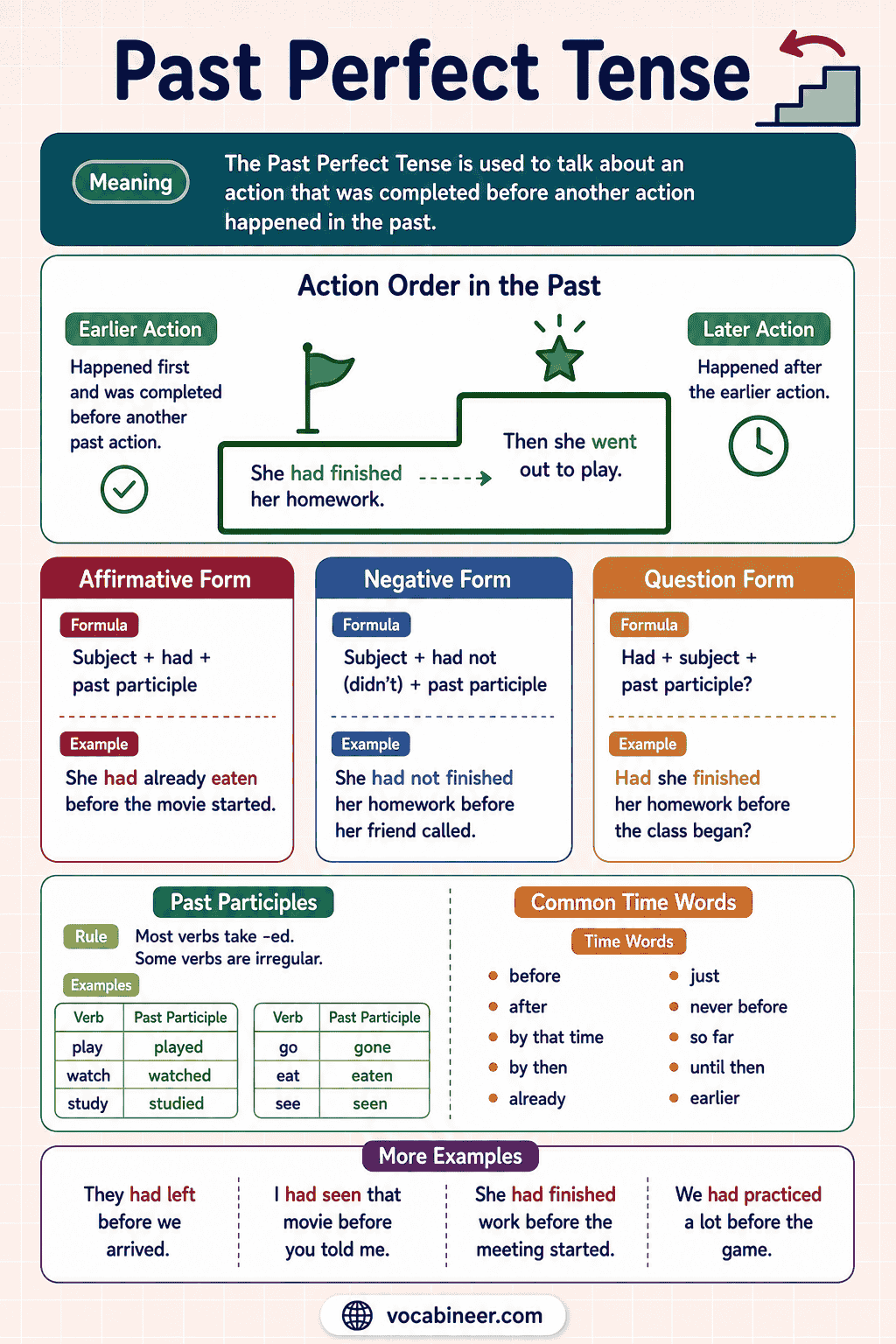
The Past Perfect Tense relates an earlier event or state to a later past reference point. It is used when the relationship between two past situations matters, especially when one event occurred before another past event, something had been completed by a past time, or an earlier state continued up to a later past point.
Past Perfect uses had + V3, where V3 is the past participle of the main verb. Correct use also depends on recognizing when an earlier-past relationship needs grammatical marking, distinguishing V2 from V3, and knowing when Past Perfect is optional rather than necessary.
In This Page
What Is the Past Perfect Tense?
The Past Perfect Tense is formed with had followed by the past participle (V3) of the main verb.
Basic structure:
S + had + V3
Examples:
- I had finished the work.
- Maya had left before noon.
- They had seen the film before.
- Daniel had written the report.
The core meaning is:
Past Perfect relates an earlier event or state to a later past reference point.
For example:
- When I arrived, Maya had left.
The arrival establishes the later past reference point. Had left marks Maya’s departure as earlier than that point.
Past Perfect should not be reduced to a simple rule such as “the first action takes Past Perfect.” The tense is used when the earlier relationship matters grammatically in context.
How Past Perfect Relates an Earlier Event to a Later Past Point
Past Perfect establishes an earlier-past relationship relative to another past event, time, or situation.
Consider these examples:
- The train had left before we reached the station.
- By the time the meeting started, we had finished the report.
- She had known him for years before they worked together.
- Maya could not enter the house because she had lost her keys.
These sentences represent different Past Perfect relationships:
- an earlier completed event
- completion by a later past time
- a state continuing up to a later past point
- an earlier event explaining a later past condition
The tense therefore depends on a past reference relationship rather than simply how long ago an event happened.
How to Form the Past Perfect
Every Past Perfect construction requires:
- had
- the past participle V3
Had with All Subjects
Unlike Present Perfect, which uses have or has, Past Perfect uses had with every subject.
| Subject | Auxiliary |
|---|---|
| I | had |
| you | had |
| he / she / it | had |
| we | had |
| they | had |
Examples:
- I had finished.
- She had finished.
- We had finished.
- They had finished.
Affirmative Sentences
The affirmative structure is:
S + had + V3
Examples:
- I had completed the report.
- Maya had left before noon.
- Daniel had written the email.
- We had taken the earlier train.
- They had seen the film before.
Common contractions include:
- I had → I’d
- you had → you’d
- he had → he’d
- she had → she’d
- we had → we’d
- they had → they’d
Examples:
- I’d finished before the meeting started.
- She’d already left when I called.
The contraction ‘d can also represent would in other constructions, so context determines its meaning.
Negative Sentences
The negative structure is:
S + had + not + V3
Examples:
- I had not finished.
- She had not arrived.
- We had not seen the message.
- They had not completed the work.
The common contraction is:
had not → hadn’t
Examples:
- I hadn’t finished when the meeting began.
- She hadn’t arrived by eight.
Questions and Short Answers
The question structure is:
Had + S + V3?
Examples:
- Had you finished?
- Had she left?
- Had Daniel called?
- Had they seen it before?
Short answers repeat had without repeating the main verb.
- Had you finished?
Yes, I had. / No, I hadn’t. - Had she left?
Yes, she had. / No, she hadn’t.
Wh-Questions
Wh-questions commonly use:
Wh-word + had + S + V3?
Examples:
- What had you done?
- Where had she gone?
- Why had they left?
- How long had he lived there?
- What had Maya written?
The auxiliary had remains necessary in the question structure.
Past Participles
Past Perfect requires V3, not V2.
Regular verbs often have the same V2 and V3 form.
| Base Form | V2 | V3 |
|---|---|---|
| work | worked | worked |
| clean | cleaned | cleaned |
| finish | finished | finished |
Irregular verbs often have different forms.
| Base Form | V2 | V3 |
|---|---|---|
| go | went | gone |
| see | saw | seen |
| write | wrote | written |
| take | took | taken |
| eat | ate | eaten |
| break | broke | broken |
| speak | spoke | spoken |
| do | did | done |
Correct:
- She had gone home.
- He had written the report.
Incorrect:
- She had went home.
- He had wrote the report.
Past Perfect requires had + V3.
When to Use the Past Perfect
Past Perfect commonly marks earlier connected events, completion by a past point, states continuing up to a past point, and earlier events that explain later past conditions.
Earlier of Two Connected Past Events
Use Past Perfect when an earlier event needs to be related clearly to a later past event or reference point.
Examples:
- When the police arrived, the thief had escaped.
- We had finished dinner before the guests arrived.
- Daniel had left by the time I called.
- She had closed the shop before the storm began.
Past Perfect marks the earlier event when its relationship to the later past point needs grammatical marking.
Compare:
- When I arrived, Maya left.
- When I arrived, Maya had left.
The first sentence places the leaving in the main past sequence around the arrival.
The second marks the departure as earlier than the arrival.
Time Up to a Point in the Past
Past Perfect can mark what had already happened by a specified past time.
Examples:
- By noon, she had completed three tasks.
- By the time we arrived, the film had started.
- He had written five chapters by the end of the month.
- They had sold all the tickets by Friday.
This use does not require two full event clauses. A past time expression can establish the later reference point.
States Continuing Up to a Past Point
Past Perfect can mark a state that began earlier and continued until a later past reference point.
Examples:
- She had known him for ten years before they married.
- They had lived there for twenty years when they decided to move.
- I had believed that story for years before I learned the truth.
- We had owned the house for a decade before selling it.
This use is especially natural with stative verbs such as:
- know
- believe
- own
- understand
- want
- need
- like
- love
Ordinary stative meanings commonly use Past Perfect rather than Past Perfect Continuous when they refer to a continuing earlier state.
Earlier Events Explaining a Later Past Situation
Past Perfect can mark an earlier event that explains a later past condition or result.
Examples:
- Daniel was tired because he had slept badly.
- Maya could not enter the house because she had lost her keys.
- The floor was wet because someone had spilled water.
- He was nervous because he had forgotten his notes.
Past Perfect marks the earlier event that explains the later past situation.
Past Perfect with Before, After, and By the Time
Expressions such as before, after, and by the time often occur with Past Perfect because they establish relationships between past events or reference points.
They should not be treated as automatic tense signals.
Before
Example:
- She had left before I arrived.
Past Perfect marks the departure as earlier.
However:
- She left before I arrived.
is also grammatical because before already establishes the order.
After
Example:
- After we had finished dinner, we went home.
But this is also grammatical:
- After we finished dinner, we went home.
The word after already establishes chronology, so Past Perfect is not always necessary.
By the Time
By the time commonly establishes a later past reference point.
Examples:
- By the time we arrived, the train had left.
- By the time the lesson started, the students had taken their seats.
- By the time she called, I had finished the report.
The event in Past Perfect was completed before the later past point.
A useful rule is:
Before, after, and by the time can establish event order, but they do not automatically require Past Perfect.
Already, Just, Ever, Never, and Still with Past Perfect
Several adverbs commonly occur with Past Perfect because they can relate earlier experience, completion, or non-completion to a later past point.
Already
Already marks completion before the later past reference point.
- She had already left when I called.
- They had already finished the work before noon.
Just
Just marks an event completed shortly before another past event.
- We had just arrived when it started raining.
- She had just sat down when the phone rang.
Ever
Ever can refer to experience up to a particular past point.
- It was the best meal I had ever eaten.
- That was the largest building she had ever seen.
Never
Never marks the absence of an experience before a later past point.
- I had never seen snow before that trip.
- He had never flown before he moved abroad.
Still
Still can mark continued non-completion.
- It still hadn’t rained by the beginning of May.
- She still hadn’t replied when I left the office.
These words support the intended time relationship, but they do not determine the tense automatically.
Past Perfect vs Simple Past
Past Perfect and Simple Past both refer to past situations, but they establish different time relationships.
| Simple Past | Past Perfect |
|---|---|
| event located in the past | event earlier than another past point |
| often carries the main chronological sequence | marks an earlier-past relationship |
| She left when I arrived. | She had left when I arrived. |
| I opened the door. | Someone had moved the chair. |
Compare:
- When I arrived, Maya left.
- When I arrived, Maya had left.
In the first sentence, the leaving belongs to the main past sequence.
In the second, Past Perfect marks the departure as earlier than the arrival.
Another example:
- I opened the door and walked inside.
- I noticed that someone had moved the chair.
Simple Past marks the main sequence of completed events. Past Perfect marks the event that occurred before the noticing.
The core distinction is:
Simple Past locates an event in the past; Past Perfect marks that event as earlier than another relevant past reference point.
Past Perfect vs Past Perfect Continuous
Past Perfect and Past Perfect Continuous both relate earlier situations to later past reference points, but their structures and common meanings differ.
| Past Perfect | Past Perfect Continuous |
|---|---|
| had + V3 | had + been + V-ing |
| completed event, amount, result, or state | earlier ongoing activity, process, or duration |
| She had written five pages. | She had been writing for two hours. |
| They had painted three rooms. | They had been painting all morning. |
Compare:
- She had written five pages before lunch.
- She had been writing for two hours before lunch.
The first sentence marks a completed amount.
The second marks the earlier activity and its duration.
Another comparison:
- They had cleaned three rooms.
- They had been cleaning all morning.
Past Perfect marks the completed amount more directly. Past Perfect Continuous marks the activity or duration more directly.
The distinction is not absolute. Some continuing situations allow both forms depending on the intended grammatical meaning.
For example:
- She had worked there for ten years before she moved.
- She had been working there for ten years before she moved.
Both can be natural in suitable contexts, although the continuous form gives more direct grammatical prominence to the ongoing activity or duration.
When Past Perfect Is Not Necessary
Past Perfect is not required simply because one past event happened before another.
Chronology may already be clear from:
- context
- event order
- before
- after
- another time expression
For example:
- After I finished dinner, I went home.
The sequence is already explicit.
Likewise:
- She left before I arrived.
The word before establishes the event order.
Past Perfect becomes useful when the earlier relationship needs clearer grammatical marking.
Examples:
- I realized that I had left my keys at work.
- Maya discovered that someone had opened the window.
- Daniel remembered that he had promised to call.
- We noticed that the train had already departed.
The central principle is:
Use Past Perfect when an earlier event needs to be related explicitly to a later past reference point, not merely because it happened first.
Common Past Perfect Mistakes
Past Perfect mistakes commonly involve had, V3, question formation, unnecessary tense use, or confusion with Past Perfect Continuous.
Using V2 instead of V3
Incorrect:
- She had went home.
Correct:
- She had gone home.
Past Perfect requires V3.
Using V1 after had
Incorrect:
- He had write the report.
Correct:
- He had written the report.
The main verb must use the past participle.
Omitting had
Incorrect:
- She gone before I arrived.
Correct:
- She had gone before I arrived.
Both had and V3 are required.
Using did with Past Perfect
Incorrect:
- Did she had left?
Correct:
- Had she left?
Past Perfect questions use had, not did.
Using incorrect question order
Incorrect:
- She had left before you arrived?
Correct:
- Had she left before you arrived?
Questions place had before the subject.
Using Past Perfect for every earlier action
Incorrect rule:
- first event = always Past Perfect
Better:
- After I finished dinner, I went home.
Past Perfect is unnecessary here because the sequence is already clear.
Confusing Past Perfect with Past Perfect Continuous
Compare:
- She had written five pages. — completed amount
- She had been writing for two hours. — earlier ongoing activity or duration
The intended grammatical meaning determines the preferred form.
FAQs
Past Perfect is an English tense form built with had + V3. It relates an earlier event or state to a later past reference point.
Past Perfect uses had with all subjects, including I, you, he, she, it, we, and they. The auxiliary does not change according to the subject.
Use Past Perfect when an earlier event or state needs to be related explicitly to another past event or reference point. Simple Past is sufficient when the event simply belongs to the past and no earlier-past relationship needs additional marking.
No. Before and after can already establish chronology, so Simple Past can also be grammatical. Past Perfect is used when the earlier-past relationship needs clearer grammatical marking.
Past Perfect commonly marks a completed event, amount, result, or state, while Past Perfect Continuous commonly marks earlier ongoing activity, process, or duration. Some continuing situations allow either form depending on the intended meaning.
Read More
- 12 English Tenses Chart
- All Tenses Rules and Formula
- English Tenses with Examples
- Indefinite Tense (Simple Tense)
- Past Tenses in English
- Simple Past Tense in English
- Past Continuous Tense in English