

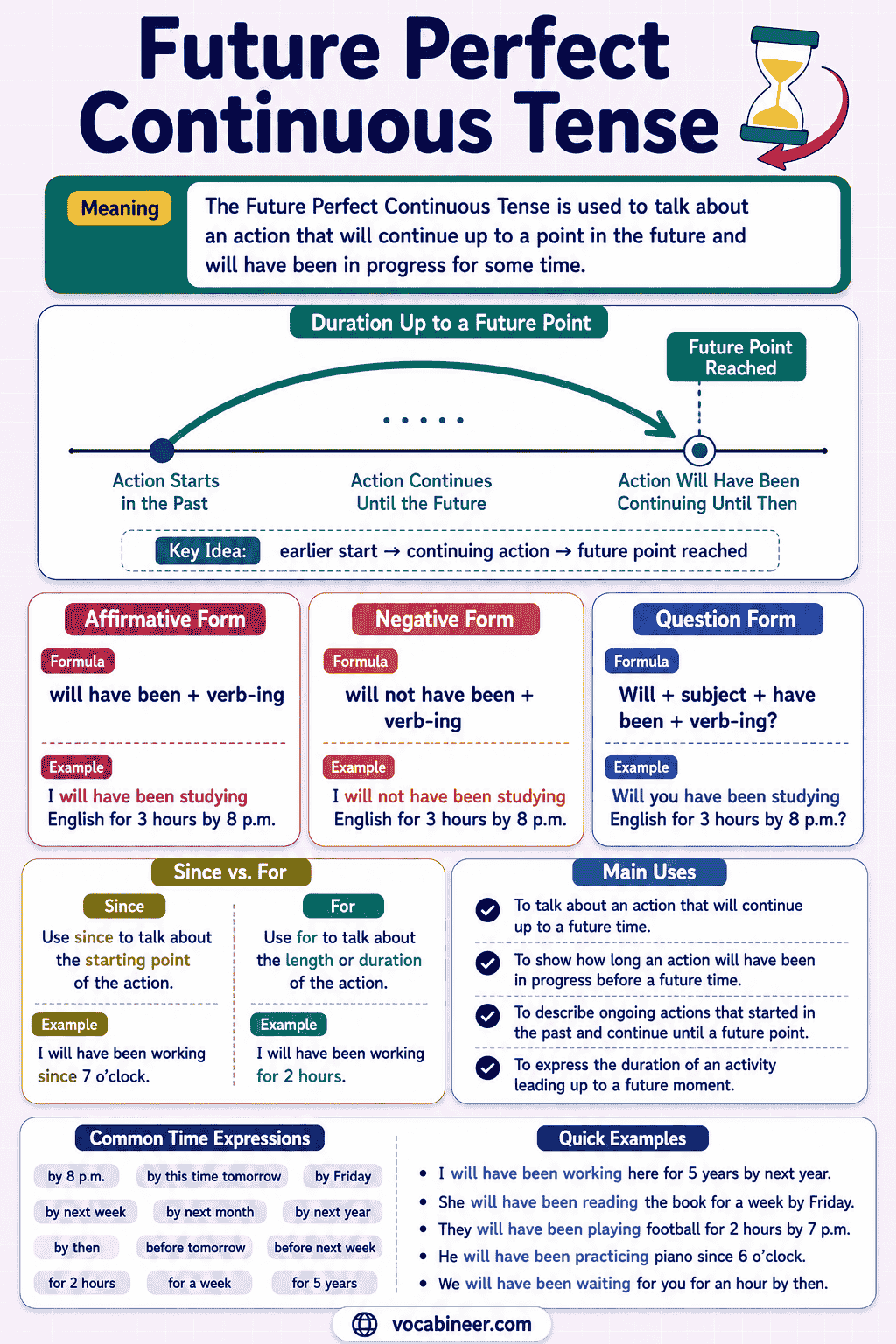
The Future Perfect Continuous Tense marks ongoing activity or duration extending up to a future reference point. It is especially useful when the length of an activity matters, such as how long someone will have been working, studying, waiting, traveling, or living somewhere by a later future time.
Future Perfect Continuous uses will have been + V-ing. Correct use depends on understanding the roles of have and been, using for and since correctly, recognizing the future reference point, and distinguishing this tense from Future Perfect, Future Continuous, and Present Perfect Continuous.
In This Page
What Is the Future Perfect Continuous Tense?
The Future Perfect Continuous Tense is formed with will, followed by have, been, and the -ing form of the main verb.
Basic structure:
S + will + have + been + V-ing
Examples:
- By five, I will have been working for eight hours.
- By next June, she will have been teaching here for ten years.
- When they arrive, we will have been waiting for two hours.
- By Friday, Daniel will have been traveling for a week.
Future Perfect Continuous is also called Future Perfect Progressive. Both names refer to the same grammatical form.
The tense commonly marks activity that begins before a future point and continues toward or up to that point.
How Future Perfect Continuous Relates Duration to a Future Reference Point
Future Perfect Continuous establishes a relationship between ongoing activity and a later future time or event.
Consider:
- By five, I will have been working for eight hours.
- When the course ends, she will have been studying English for three years.
- By next month, they will have been living there for five years.
In each sentence, the future reference point provides the time up to which the activity or duration is measured.
A useful principle is:
Future Perfect Continuous measures how long an ongoing activity will have continued up to a future reference point.
The future point does not necessarily mark the end of the activity.
How to Form the Future Perfect Continuous
Every Future Perfect Continuous form requires four parts:
- will
- have
- been
- the main verb in -ing form
Why Have and Been Are Required
The complete structure is:
will + have + been + V-ing
Correct:
- She will have been working for six hours.
Incorrect:
- She will been working for six hours.
- She will have working for six hours.
Have forms the perfect structure, while been forms part of the continuous structure with the -ing verb.
Use have, not has, after will.
Correct:
- He will have been working all day.
Incorrect:
- He will has been working all day.
The structure remains the same with every subject.
Affirmative Sentences
The affirmative structure is:
S + will + have + been + V-ing
Examples:
- I will have been studying for three hours by noon.
- Maya will have been working here for five years next month.
- Daniel will have been waiting for two hours by then.
- We will have been traveling for a week by Friday.
- They will have been living there for a decade next year.
Common contractions include:
- I will → I’ll
- you will → you’ll
- he will → he’ll
- she will → she’ll
- we will → we’ll
- they will → they’ll
Examples:
- I’ll have been working for eight hours by five.
- She’ll have been studying for three hours by noon.
- They’ll have been traveling for a week by Friday.
Negative Sentences
The negative structure is:
S + will + not + have + been + V-ing
Examples:
- I will not have been working there for long.
- She will not have been studying for three hours by then.
- Daniel will not have been waiting for very long.
- They will not have been traveling for a week by Friday.
The common contraction is:
will not → won’t
Examples:
- I won’t have been living there for a year by June.
- She won’t have been working there for long.
- They won’t have been waiting for two hours by then.
Questions and Short Answers
The question structure is:
Will + S + have + been + V-ing?
Examples:
- Will you have been working here for ten years by June?
- Will she have been studying for three hours by noon?
- Will Daniel have been waiting long when the bus arrives?
- Will they have been traveling for a week by Friday?
Short answers repeat will rather than the full verb phrase.
- Will you have been working here for ten years by June?
Yes, I will. / No, I won’t. - Will she have been studying for three hours by noon?
Yes, she will. / No, she won’t.
Wh-Questions
Wh-questions commonly use:
Wh-word + will + S + have + been + V-ing?
Examples:
- How long will you have been working here by June?
- What will she have been studying?
- Where will they have been living by then?
- Why will he have been waiting so long?
- How long will Maya have been teaching there by next year?
Questions with how long are especially important because duration is central to this tense.
When to Use the Future Perfect Continuous
Future Perfect Continuous commonly marks continuation, duration, repeated activity, and ongoing processes leading up to a future point.
Activity Continuing Up to a Future Point
Use Future Perfect Continuous when an activity begins earlier and continues toward or up to a later future reference point.
Examples:
- By noon, I will have been studying for four hours.
- By next June, she will have been teaching here for ten years.
- When the bus arrives, they will have been waiting for an hour.
- By Friday, we will have been working on the project for two weeks.
- By midnight, Daniel will have been driving for six hours.
The activity starts before the future point and continues toward it.
Duration Before a Future Reference Point
Use Future Perfect Continuous when how long an activity will have continued is important.
Examples:
- By five, I will have been working for eight hours.
- By next month, Maya will have been living here for two years.
- When the course ends, Daniel will have been studying English for three years.
- By noon, they will have been traveling for six hours.
- By next week, we will have been practicing for a month.
The tense is especially suitable when duration forms a central part of the meaning.
Repeated Activity Up to a Future Point
Future Perfect Continuous can mark repeated activity occurring over a period before a later future point.
Examples:
- By next month, she will have been visiting the clinic every week for a year.
- By the end of term, we will have been meeting twice a week for six months.
- By Friday, he will have been working late every evening for two weeks.
- By June, they will have been practicing together every weekend for a year.
The repeated activity continues across a period leading up to the future reference point.
Ongoing Processes Leading Up to a Future Point
The tense can also mark an ongoing process that continues over time before a future reference point.
Examples:
- By June, the team will have been developing the software for a year.
- By next month, they will have been rebuilding the road for six months.
- By the time the project ends, we will have been testing the system for weeks.
These examples still express continuation and duration, so this use should remain connected to the core meaning of the tense.
Does the Activity Have to Stop at the Future Reference Point?
No. Future Perfect Continuous measures activity up to a future reference point without necessarily marking that point as the end of the activity.
For example:
- By five, I will have been working for eight hours.
The sentence gives the duration up to five, but it does not state that the work stops at five.
Another example:
- Next June, she will have been teaching here for ten years.
She may continue teaching after June.
The future reference point establishes the time up to which the duration is measured.
Since and For with Future Perfect Continuous
For and since commonly specify duration and starting points.
For
Use for with a length of time.
Examples:
- for three hours
- for six months
- for ten years
- for several weeks
Sentence examples:
- By noon, I will have been studying for four hours.
- By June, she will have been teaching for ten years.
- By Friday, they will have been traveling for a week.
Since
Use since with a starting point.
Examples:
- since Monday
- since January
- since 2022
- since she joined the company
Sentence examples:
- By next month, she will have been working here since 2022.
- By Friday, we will have been waiting since Monday.
- By June, Daniel will have been studying there since last September.
| Word | Function | Example |
|---|---|---|
| for | duration | for five years |
| since | starting point | since 2022 |
For and since do not automatically determine the tense. The future reference relationship determines whether Future Perfect Continuous fits.
How Long with Future Perfect Continuous
Questions with how long ask about the duration of an activity leading up to a future point.
The structure is:
How long + will + S + have + been + V-ing?
Examples:
- How long will you have been working here by June?
- How long will she have been studying when the exam begins?
- How long will they have been waiting by the time the bus arrives?
- How long will Daniel have been traveling by Friday?
Answers commonly use for or since.
- I will have been working here for ten years.
- She will have been studying since eight.
- They will have been waiting for two hours.
- Daniel will have been traveling since Monday.
Future Time Clauses with Future Perfect Continuous
Future Perfect Continuous can appear in the main clause while the future time clause uses a present form.
Correct:
- By the time we arrive, they will have been waiting for two hours.
- When the course ends, she will have been studying for six months.
- Before the meeting starts, we will have been preparing for several hours.
Incorrect:
- By the time we will arrive, they will have been waiting for two hours.
The main clause can use Future Perfect Continuous, while the future time clause normally uses a present form.
Future Perfect Continuous vs Future Perfect
| Feature | Future Perfect | Future Perfect Continuous |
|---|---|---|
| Structure | will have + V3 | will have been + V-ing |
| Main meaning | completion, result, amount, or state | ongoing activity, process, or duration |
| Reference point | future point | future point |
| Typical emphasis | what will be complete | how long or how continuously something will have continued |
| Example | She will have written ten chapters by June. | She will have been writing for six months by June. |
| Amount example | They will have painted five rooms by Friday. | — |
| Duration example | She will have worked there for ten years by next year. | She will have been working there for ten years by next year. |
Future Perfect commonly marks completion, amount, result, or state more directly. Future Perfect Continuous commonly marks ongoing activity or duration more directly.
When Both Forms Are Possible
| Future Perfect | Future Perfect Continuous | Difference |
|---|---|---|
| She will have worked here for ten years by next year. | She will have been working here for ten years by next year. | The simple form presents the duration more as an established fact; the continuous form gives more prominence to the ongoing activity or duration. |
| We will have lived there for five years by June. | We will have been living there for five years by June. | Both can be natural; verb type and intended meaning influence the choice. |
The distinction is therefore not absolute.
Future Perfect Continuous vs Future Continuous
| Feature | Future Continuous | Future Perfect Continuous |
|---|---|---|
| Structure | will be + V-ing | will have been + V-ing |
| Main meaning | activity in progress around a future point | ongoing activity or duration extending up to a future point |
| Reference relationship | activity at or around the future time | activity measured before and up to the future time |
| Example | At five, I will be working. | By five, I will have been working for eight hours. |
| Another example | She will be studying at noon. | By noon, she will have been studying for four hours. |
The main distinction is that Future Continuous marks activity ongoing around a future point, while Future Perfect Continuous marks duration or continuation extending up to that point.
Words such as at and by can support these meanings, but they do not determine the tense automatically.
Future Perfect Continuous vs Present Perfect Continuous
| Feature | Present Perfect Continuous | Future Perfect Continuous |
|---|---|---|
| Structure | have/has been + V-ing | will have been + V-ing |
| Reference point | present | future |
| Main meaning | ongoing activity or duration up to the present | ongoing activity or duration up to a future point |
| Example | I have been working here for five years. | By next June, I will have been working here for ten years. |
| Another example | She has been studying since eight. | By noon, she will have been studying for four hours. |
The key difference is the reference point: Present Perfect Continuous relates the activity to the present, while Future Perfect Continuous relates it to a future time.
Future Perfect Continuous and Stative Verbs
Many stative verbs normally favor Future Perfect rather than Future Perfect Continuous when they retain an ordinary stative meaning.
Common stative verbs include:
- know
- believe
- understand
- own
- need
- want
- belong
- prefer
- like
- love
Use:
- By next year, I will have known her for ten years.
- By June, they will have owned the house for twenty years.
- By then, she will have believed that for several years.
Not normally:
- I will have been knowing her for ten years.
- They will have been owning the house for twenty years.
- She will have been believing that for several years.
The restriction applies to the ordinary stative meaning rather than every possible use of the verb.
For example:
- By noon, I will have been thinking about the problem for three hours.
Here, thinking marks an ongoing mental activity rather than a stable state.
Verb + -ing Spelling Rules
The main verb takes an -ing form in Future Perfect Continuous.
Add -ing to Most Verbs
- work → working
- read → reading
- play → playing
Drop Final Silent e
- make → making
- write → writing
- come → coming
Double the Final Consonant Where Required
- run → running
- sit → sitting
- swim → swimming
Change -ie to y
- lie → lying
- die → dying
- tie → tying
Keep these rules as spelling support rather than treating them as separate tense meanings.
Common Future Perfect Continuous Mistakes
Future Perfect Continuous mistakes commonly involve have, been, the -ing form, question structure, time clauses, or stative meanings.
Missing have
Incorrect:
- She will been working for six hours.
Correct:
- She will have been working for six hours.
Missing been
Incorrect:
- She will have working for six hours.
Correct:
- She will have been working for six hours.
Using V1 instead of V-ing
Incorrect:
- She will have been work for six hours.
Correct:
- She will have been working for six hours.
Using has after will
Incorrect:
- He will has been working all day.
Correct:
- He will have been working all day.
Using do in questions
Incorrect:
- Do you will have been working here for ten years?
Correct:
- Will you have been working here for ten years?
Using incorrect question order
Incorrect:
- You will have been working here for ten years?
Correct:
- Will you have been working here for ten years?
Confusing since and for
Incorrect:
- She will have been working here since five years.
Correct:
- She will have been working here for five years.
Use for with duration and since with a starting point.
Using will in a future time clause
Incorrect:
- By the time we will arrive, they will have been waiting for two hours.
Correct:
- By the time we arrive, they will have been waiting for two hours.
Confusing Future Perfect and Future Perfect Continuous
| Future Perfect | Future Perfect Continuous |
|---|---|
| She will have written ten pages. | She will have been writing for three hours. |
| completed amount | duration or ongoing activity |
Using an ordinary stative meaning
Incorrect:
- I will have been knowing him for ten years.
Correct:
- I will have known him for ten years.
Ordinary stative meanings normally favor Future Perfect.
FAQs
Future Perfect Continuous is an English tense form built with will have been + V-ing. It marks ongoing activity or duration extending up to a future reference point.
Have forms the perfect structure, while been forms part of the continuous structure with the -ing verb. Both are required in will have been + V-ing.
Use for with a duration, such as for five years, and since with a starting point, such as since 2022. Neither word automatically determines the tense.
Future Perfect commonly marks completion, amount, result, or state more directly, while Future Perfect Continuous commonly marks ongoing activity or duration more directly.
No. Future Perfect Continuous measures activity up to a future reference point, but the activity may continue afterward. For example, By June, she will have been teaching here for ten years does not state that she will stop teaching in June.
Read More
- 12 English Tenses Chart
- All Tenses Rules and Formula
- English Tenses with Examples
- Present Tenses in English
- Past Tenses in English
- Future Tenses in English
- Simple Future Tense in English
- Future Continuous Tense in English
- Future Perfect Tense in English