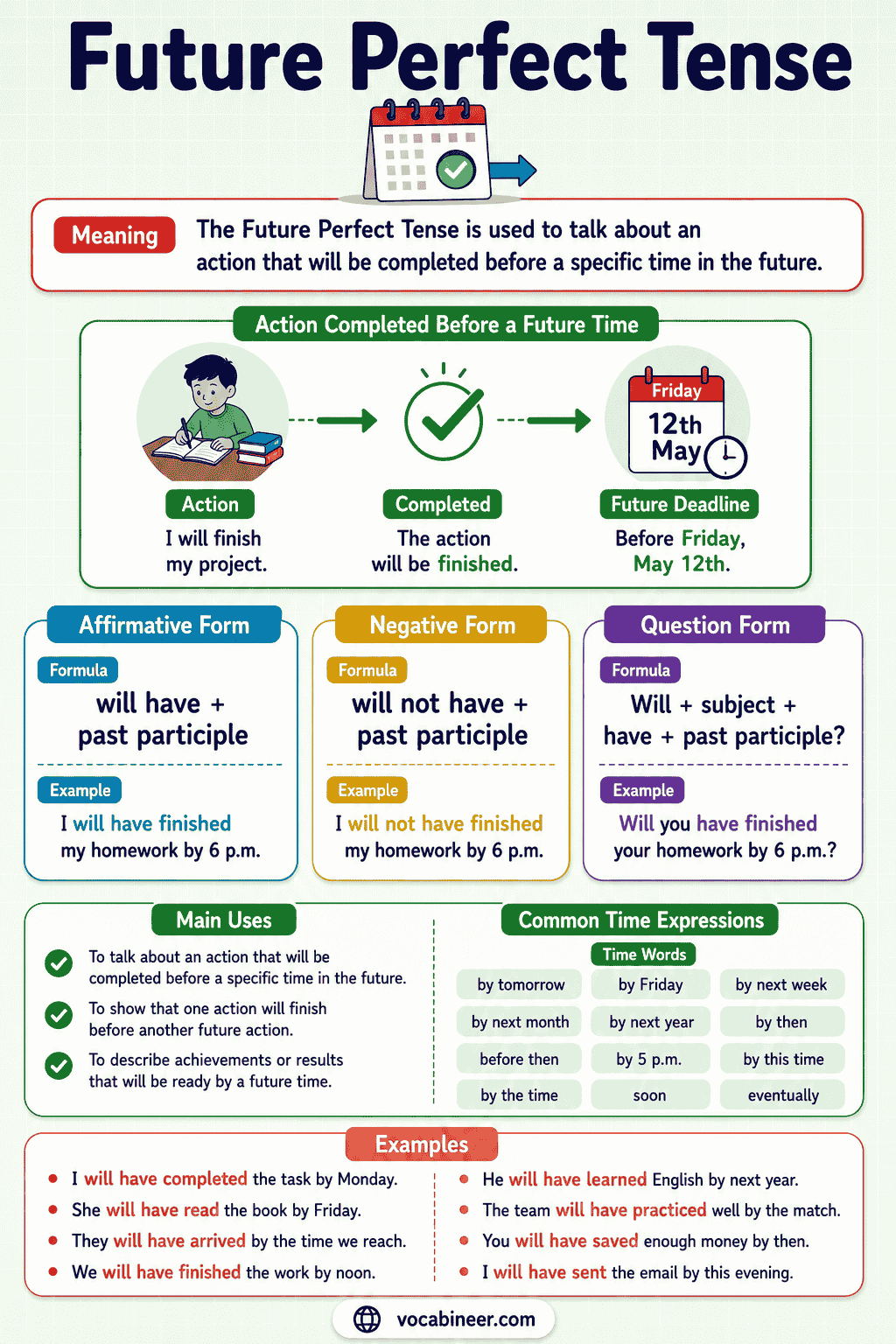
The Future Perfect Tense marks an event, result, amount, or state as complete or established before or by a future reference point. It helps learners express what will already be finished, achieved, known, owned, or otherwise established by a later future time.
Future Perfect uses will have + V3. Correct use depends on understanding the future reference point, using the past participle correctly, distinguishing Future Perfect from nearby future forms, and recognizing that words such as by support the meaning but do not determine the tense automatically.
In This Page
What Is the Future Perfect Tense?
The Future Perfect Tense is formed with will, followed by have and the past participle (V3) of the main verb.
Basic structure:
S + will + have + V3
Examples:
- By six, I will have finished the report.
- By next month, they will have moved.
- By June, she will have written ten chapters.
- By next year, I will have known Maya for ten years.
Future Perfect commonly marks:
- completion before or by a future point
- a completed amount by a future time
- a state continuing up to a future point
- a result established by a later future point
The future reference point is central to the tense.
How Future Perfect Relates Completion to a Future Reference Point
Future Perfect relates completion or an established state to a later future time, event, or situation.
Compare:
- I will finish the report tomorrow.
- By six tomorrow, I will have finished the report.
The first sentence states a future event.
The second establishes six tomorrow as the future reference point and marks the report as complete before or by that point.
Another example:
- By the time we arrive, the guests will have left.
The arrival establishes the later future reference point. The departure is expected to be complete before that point.
How to Form the Future Perfect
Every Future Perfect construction requires three parts:
- will
- have
- the past participle V3
Why Have Is Required
Future Perfect requires:
will + have + V3
Correct:
- She will have finished by six.
Incorrect:
- She will finished by six.
The word have forms part of the perfect structure.
Also use have, not has, after will.
Correct:
- He will have finished.
Incorrect:
- He will has finished.
The structure remains the same with every subject.
Affirmative Sentences
The affirmative structure is:
S + will + have + V3
Examples:
- I will have completed the report by Friday.
- Maya will have left by noon.
- Daniel will have written the email by then.
- We will have finished the project by next week.
- They will have reached the station before sunset.
Common contractions include:
- I will → I’ll
- you will → you’ll
- he will → he’ll
- she will → she’ll
- we will → we’ll
- they will → they’ll
Examples:
- I’ll have finished by six.
- She’ll have arrived by then.
- They’ll have completed the work by Friday.
Negative Sentences
The negative structure is:
S + will + not + have + V3
Examples:
- I will not have finished by six.
- She will not have arrived by then.
- Daniel will not have completed the report.
- They will not have moved by next month.
The common contraction is:
will not → won’t
Examples:
- I won’t have finished by six.
- She won’t have arrived by noon.
- They won’t have completed the project by Friday.
Questions and Short Answers
The question structure is:
Will + S + have + V3?
Examples:
- Will you have finished by six?
- Will she have arrived before noon?
- Will Daniel have completed the report?
- Will they have moved by next month?
Short answers repeat will rather than the full verb phrase.
- Will you have finished by six?
Yes, I will. / No, I won’t. - Will she have arrived by noon?
Yes, she will. / No, she won’t.
Wh-Questions
Wh-questions commonly use:
Wh-word + will + S + have + V3?
Examples:
- What will you have completed by Friday?
- Where will they have moved by then?
- How many chapters will she have written by June?
- How long will you have lived there by next year?
- What will Daniel have achieved by the end of the course?
The main verb remains in V3.
Past Participles
Future Perfect requires V3, not V1 or V2.
Regular verbs often have the same V2 and V3 form.
| Base Form | V2 | V3 |
|---|---|---|
| work | worked | worked |
| finish | finished | finished |
| clean | cleaned | cleaned |
Irregular verbs often have different forms.
| Base Form | V2 | V3 |
|---|---|---|
| go | went | gone |
| see | saw | seen |
| write | wrote | written |
| take | took | taken |
| eat | ate | eaten |
| do | did | done |
| break | broke | broken |
Correct:
- She will have gone home.
- He will have written the report.
Incorrect:
- She will have went home.
- He will have wrote the report.
Future Perfect requires will have + V3.
When to Use the Future Perfect
Future Perfect commonly marks completion, completed amounts, continuing states, and results established by a later future point.
Completion Before or By a Future Point
This is the central use of Future Perfect.
Examples:
- By six, I will have finished the report.
- By next month, they will have moved.
- By Friday, she will have completed the course.
- By the time we arrive, the guests will have left.
- By tomorrow morning, Daniel will have sent the documents.
The tense marks the event as complete before or by the future reference point.
Completed Amount by a Future Time
Future Perfect can mark a quantity or total that will be complete by a future point.
Examples:
- By June, she will have written ten chapters.
- By Friday, we will have completed twenty lessons.
- By the end of the year, they will have built five houses.
- By noon, Daniel will have answered thirty emails.
- By next month, Maya will have read twelve books.
The completed amount is central to the meaning.
States Continuing Up to a Future Point
Future Perfect can also mark a state that begins earlier and continues up to a later future reference point.
Examples:
- By next year, I will have known Maya for ten years.
- In June, they will have lived there for twenty years.
- By December, she will have owned the business for a decade.
- By then, we will have believed that for several years.
This use is especially natural with stative verbs.
Future Perfect can therefore mark how long a state will have continued up to a future point.
Future Results Established by a Later Point
Future Perfect can mark a result that will already exist by a later future point.
Examples:
- By tomorrow, the team will have solved the problem.
- By next month, the company will have completed the move.
- By then, Maya will have made a final decision.
In each sentence, the result is expected to be established before or by the future reference point.
Future Perfect with By, By Then, and By the Time
Expressions with by often establish the future point against which completion is measured.
By
By establishes the latest future point for completion.
Examples:
- I will have finished by six.
- She will have arrived by noon.
- They will have completed the repairs by Friday.
By Then
By then refers to a future point already established in the context.
Example:
- The meeting starts at nine. We will have prepared everything by then.
Another example:
- Maya arrives next Monday. We will have finished the room by then.
By the Time
By the time introduces a later future reference point.
Examples:
- By the time we arrive, they will have eaten.
- By the time the class starts, Maya will have finished the exercise.
- By the time you call, I will have completed the report.
The word by can establish a future deadline or reference point, but it does not automatically require Future Perfect. The tense fits when the intended meaning involves completion or an established state relative to that point.
Future Perfect also works without by.
Examples:
- When you arrive, I will have finished dinner.
- Next month, I will have worked here for six years.
The future reference relationship determines the form.
Future Time Clauses with Future Perfect
Future Perfect often appears in a main clause while the future time clause uses a present form.
Correct:
- By the time we arrive, they will have left.
- When you get home, I will have finished dinner.
- Before the meeting starts, we will have prepared everything.
Incorrect:
- By the time we will arrive, they will have left.
In ordinary future time clauses, expressions such as when, before, after, and by the time commonly take a present form.
The Future Perfect form remains in the main clause when its meaning marks completion relative to that future point.
Future Perfect vs Future Simple
Future Simple and Future Perfect both refer to future situations, but they establish different time relationships.
Compare:
- I will finish the report tomorrow.
- By six tomorrow, I will have finished the report.
The first states a future event.
The second marks completion before or by a later future reference point.
| Future Simple | Future Perfect |
|---|---|
| states a future event or situation | marks completion or an established state by a future point |
| I will finish tomorrow. | I will have finished by six. |
| She will arrive later. | She will have arrived by noon. |
The core distinction is:
Future Simple states what will happen; Future Perfect marks what will already be complete or established by a particular future reference point.
Future Perfect vs Future Continuous
Future Perfect and Future Continuous establish different relationships with a future point.
Future Continuous:
will be + V-ing
Future Perfect:
will have + V3
Compare:
- At eight, I will be writing the report.
- By eight, I will have written the report.
The first marks activity in progress around eight.
The second marks completion before or by eight.
Another pair:
- At noon, she will be preparing lunch.
- By noon, she will have prepared lunch.
Future Continuous marks ongoing activity. Future Perfect marks completion.
The main distinction is:
- Future Continuous → activity ongoing around a future point
- Future Perfect → completion before or by a future point
Words such as at and by often support these meanings, but the intended grammatical relationship determines the form.
Future Perfect vs Future Perfect Continuous
Future Perfect and Future Perfect Continuous both relate earlier activity or states to a future reference point, but they mark different meanings more directly.
| Future Perfect | Future Perfect Continuous |
|---|---|
| will have + V3 | will have been + V-ing |
| completion, amount, result, or state | ongoing activity, process, or duration |
| She will have written ten chapters. | She will have been writing for six months. |
| They will have painted five rooms. | They will have been painting for a week. |
Compare:
- By June, she will have written ten chapters.
- By June, she will have been writing for six months.
The first marks a completed amount.
The second marks duration up to June.
Another pair:
- By Friday, they will have painted five rooms.
- By Friday, they will have been painting for a week.
Future Perfect commonly marks completion, amount, result, or state more directly. Future Perfect Continuous commonly marks ongoing activity or duration more directly.
When Both Forms Are Possible
The distinction is not always absolute.
Compare:
- By next year, she will have worked there for ten years.
- By next year, she will have been working there for ten years.
Both can be natural.
Future Perfect can present the ten-year period as an established fact.
Future Perfect Continuous can give more grammatical prominence to the ongoing activity or duration.
Another pair:
- By June, we will have lived there for five years.
- By June, we will have been living there for five years.
The preferred form depends on the intended meaning and the verb.
Future Perfect and Stative Verbs
Stative meanings often fit Future Perfect naturally when duration continues up to a future point.
Common stative verbs include:
- know
- believe
- own
- understand
- need
- want
- belong
- prefer
Examples:
- By next year, I will have known him for ten years.
- By June, they will have owned the house for two decades.
- By then, she will have believed that for years.
Not normally:
- I will have been knowing him for ten years.
- They will have been owning the house for two decades.
Stative meanings often favor Future Perfect rather than Future Perfect Continuous when duration up to a future point is expressed.
Common Future Perfect Mistakes
Future Perfect mistakes commonly involve have, V3, question structure, future time clauses, or confusion with nearby future forms.
Missing have
Incorrect:
- She will finished by six.
Correct:
- She will have finished by six.
Future Perfect requires will have + V3.
Using V1 instead of V3
Incorrect:
- He will have write the report.
Correct:
- He will have written the report.
The main verb requires V3.
Using V2 instead of V3
Incorrect:
- They will have went home.
Correct:
- They will have gone home.
Past Perfect and Future Perfect both require the past participle rather than V2.
Using has after will
Incorrect:
- She will has finished by six.
Correct:
- She will have finished by six.
Use have after will with every subject.
Using do in questions
Incorrect:
- Do you will have finished by six?
Correct:
- Will you have finished by six?
Questions place will before the subject.
Using incorrect question order
Incorrect:
- You will have finished by six?
Correct:
- Will you have finished by six?
Using will in the future time clause
Incorrect:
- By the time we will arrive, they will have left.
Correct:
- By the time we arrive, they will have left.
The future time clause commonly uses a present form.
Confusing Future Perfect and Future Continuous
- At eight, I will be working. → activity in progress
- By eight, I will have finished. → completion
Confusing Future Perfect and Future Perfect Continuous
- She will have written ten pages. → completed amount
- She will have been writing for three hours. → duration
The intended grammatical meaning determines the form.
FAQs
Future Perfect is an English tense form built with will have + V3. It marks an event, result, amount, or state as complete or established before or by a future reference point.
Have forms part of the perfect structure. Future Perfect therefore requires will + have + V3, as in She will have finished by six.
Use Future Perfect for completion before or by a future point, completed amounts, states continuing up to a future point, and results expected to be established by that point.
Future Continuous marks activity in progress around a future point, while Future Perfect marks completion before or by a future point. Compare I will be working at eight with I will have finished by eight.
Future Perfect commonly marks completion, amount, result, or state more directly, while Future Perfect Continuous commonly marks ongoing activity or duration more directly. Compare She will have written ten pages with She will have been writing for three hours.
Read More
- 12 English Tenses Chart
- All Tenses Rules and Formula
- English Tenses with Examples
- Present Tenses in English
- Past Tenses in English
- Future Tenses in English
- Simple Future Tense in English
- Future Continuous Tense in English