

English tenses help us show when something happens and how an action connects to time. Learning them through clear examples makes it easier to notice the difference between routines, actions happening now, completed events, ongoing activities, and future situations.
English learners commonly study 12 tense forms across the present, past, and future. The examples below show how each tense works in natural sentences, including affirmative, negative, and question forms, followed by the tense differences learners most often confuse.
In This Page
English Tenses Overview
The 12 commonly taught tense forms combine three time groups—present, past, and future—with four recurring patterns: simple, continuous, perfect, and perfect continuous.
| Time | Simple | Continuous | Perfect | Perfect Continuous |
|---|---|---|---|---|
| Present | Present Simple | Present Continuous | Present Perfect | Present Perfect Continuous |
| Past | Past Simple | Past Continuous | Past Perfect | Past Perfect Continuous |
| Future | Future Simple | Future Continuous | Future Perfect | Future Perfect Continuous |
Simple forms often present habits, facts, states, or completed events. Continuous forms focus more on activity in progress, while perfect forms connect one time with an earlier event or situation. Meanwhile, perfect continuous forms usually emphasize ongoing activity or duration.
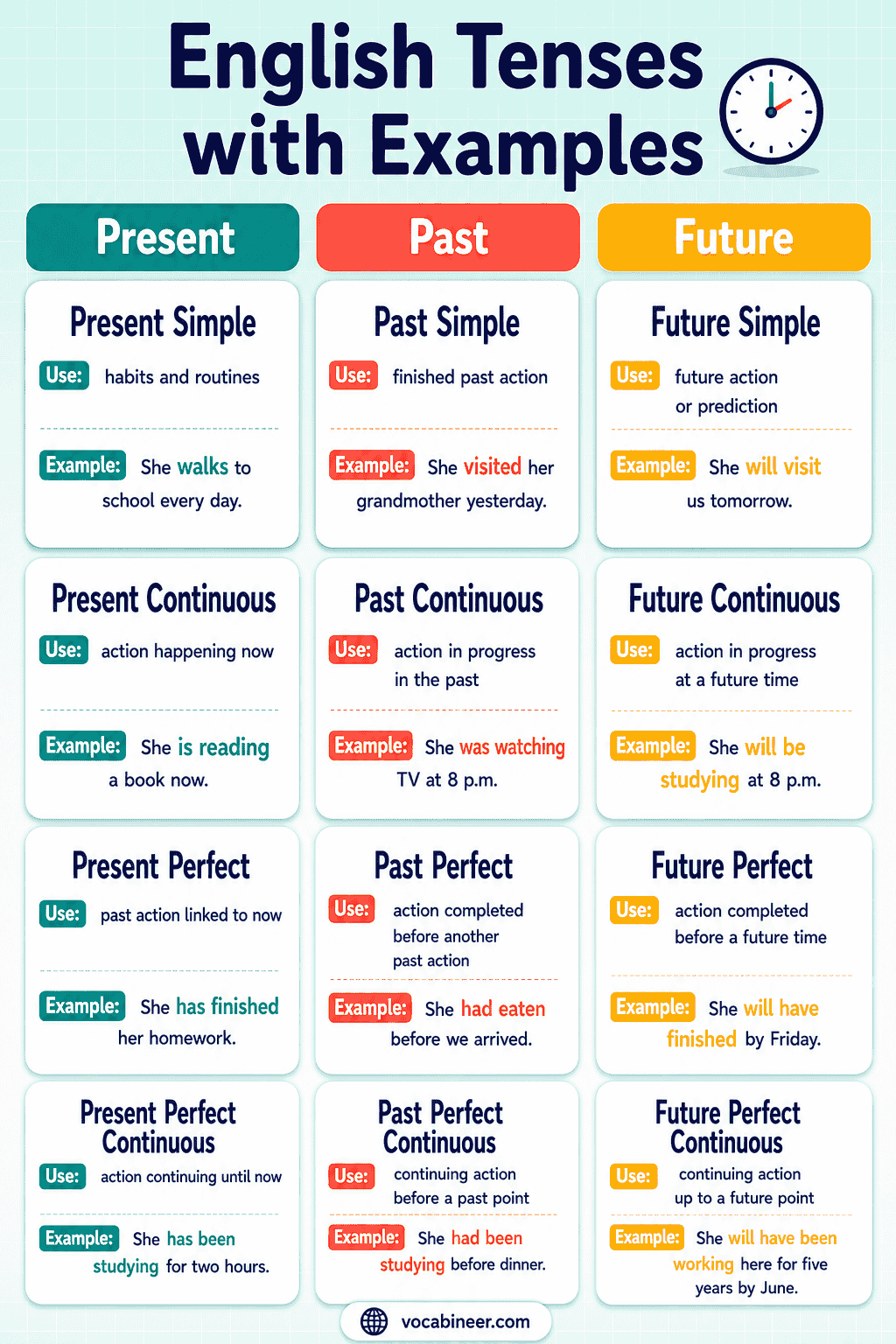
Present Tenses with Examples
Present tenses describe routines, current situations, past actions connected to now, and activities that continue into the present.
Present Simple
The Present Simple commonly describes habits, routines, facts, states, and schedules.
Structure: S + V1 / V1+s
Examples:
- Emma walks to school every morning. — routine
- Water freezes at 32°F. — general fact
- I prefer tea without sugar. — state or preference
- The store doesn’t open on Sundays. — negative fact
- Does the bus leave at 7:30? — schedule question
With he, she, and it, the verb usually takes -s or -es in affirmative sentences. However, after does, the main verb returns to its base form.
She works here.
She doesn’t work here.
Does she work here?
Present Continuous
The Present Continuous describes an activity happening now, taking place around the present, developing, or continuing temporarily.
Structure: S + am/is/are + V-ing
Examples:
- Lucas is talking to his teacher right now. — happening now
- We are staying with friends this week. — temporary situation
- The weather is getting warmer. — changing situation
- Ava isn’t using the laptop at the moment. — negative current action
- Are the children playing outside? — question
The activity does not always need to happen at the exact moment of speaking. For example, I am reading a new book this week describes an activity around the present period.
Many stative verbs do not normally appear in continuous forms in their ordinary meanings. Therefore, I know the answer is usually more natural than I am knowing the answer.
Present Perfect
The Present Perfect connects an earlier action or situation with the present. It commonly describes experience, recent results, unfinished time, or situations that remain relevant now.
Structure: S + have/has + V3
Examples:
- I have visited New York twice. — life experience
- Olivia has lost her keys. — recent action with a present result
- We have completed three lessons today. — unfinished time period
- Daniel hasn’t finished his homework yet. — negative present result
- Have you ever tried Thai food? — experience question
A specific finished past time normally calls for the Past Simple instead.
I saw that movie yesterday.
I have seen that movie before.
The first sentence identifies a finished past time. In contrast, the second focuses on past experience without saying exactly when it happened.
Present Perfect Continuous
The Present Perfect Continuous emphasizes an activity that began earlier and continues to the present, its duration, or a recent activity with present relevance.
Structure: S + have/has + been + V-ing
Examples:
- Noah has been studying for two hours. — duration continuing to now
- It has been raining all morning. — ongoing activity
- My neighbors have been renovating their house lately. — recent ongoing activity
- I haven’t been sleeping well this week. — negative continuing situation
- Have you been waiting long? — question about duration
Present Perfect and Present Perfect Continuous sometimes overlap. However, the first often emphasizes a result or amount, while the second gives more attention to the activity or duration.
Ella has written five pages. — result
Ella has been writing for two hours. — activity and duration
Past Tenses with Examples
Past tenses describe completed events, activities in progress at past times, and relationships between two different points in the past.
Past Simple
The Past Simple describes completed actions, events, and states at finished past times.
Structure: S + V2
Examples:
- We visited the museum last Saturday. — completed past event
- Mason moved to Boston in 2024. — definite past time
- She opened the door, looked outside, and smiled. — sequence of events
- They didn’t attend the meeting yesterday. — negative past action
- Did you call your sister last night? — question
Regular verbs often take -ed, while irregular verbs use different past forms.
- work → worked
- go → went
- write → wrote
- see → saw
After did, the main verb returns to V1.
Did she go?
not Did she went?
Past Continuous
The Past Continuous shows an activity in progress at a particular past time. It also provides background for another event or describes an action interrupted by a shorter event.
Structure: S + was/were + V-ing
Examples:
- At 8 p.m., I was preparing dinner. — activity in progress
- The students were taking notes while the teacher explained the lesson. — background activity
- I was driving home when my phone rang. — interrupted action
- Liam wasn’t sleeping when I checked on him. — negative past activity
- Were you working when the power went out? — question
Past Simple and Past Continuous often appear together:
We were eating dinner when the lights went out.
The longer activity was already happening, while the shorter event occurred during it.
Past Perfect
The Past Perfect shows that one action happened before another past event or past reference point.
Structure: S + had + V3
Examples:
- The train had left before we reached the station. — earlier past action
- Sophia had completed the report when her manager called. — action completed first
- By the time the store opened, several customers had arrived. — earlier event
- We hadn’t met before that evening. — negative earlier experience
- Had they started dinner before you arrived? — question about sequence
This tense becomes especially clear when a sentence contains two past points. Therefore, The train had left before we arrived teaches the relationship more effectively than an isolated sentence such as The train had left.
Past Perfect Continuous
The Past Perfect Continuous emphasizes an activity that continued for some time before another past event or point.
Structure: S + had + been + V-ing
Examples:
- They had been waiting for an hour before the bus arrived. — duration before a past event
- Chloe was tired because she had been working all night. — earlier activity causing a past result
- We had been living there for six months when the landlord sold the house. — continuing past duration
- I hadn’t been feeling well before the appointment. — negative earlier activity
- Had he been practicing before the competition? — question
This tense often explains a past background or cause.
The ground was wet because it had been raining.
Here, the earlier activity explains the later condition.
Future Tenses with Examples
In the traditional 12-form teaching model, the four future patterns use will as the main auxiliary. English can also express future meaning in other ways, but these forms remain useful for understanding future actions from different viewpoints.
Future Simple
The Future Simple commonly expresses predictions, promises, offers, and immediate decisions.
Structure: S + will + V1
Examples:
- I think it will rain tonight. — prediction
- I will call you after work. — promise
- We will carry those bags for you. — offer
- “Someone is at the door.” “I will get it.” — immediate decision
- Jordan won’t forget your birthday. — negative future statement
- Will you join us for dinner? — question
English also uses other structures for future meaning.
- I am going to start a new course next month.
- We are meeting our friends tonight.
- The flight leaves at 6:40 tomorrow morning.
These sentences express the future, although they do not use the traditional Future Simple form.
Future Continuous
The Future Continuous describes an activity that will be in progress at a particular future time.
Structure: S + will + be + V-ing
Examples:
- At this time tomorrow, we will be flying to Denver. — future activity in progress
- Grace will be working at noon. — activity continuing at a future time
- This evening, the team will be practicing at the stadium. — future activity viewed in progress
- I won’t be using the car tonight. — negative future activity
- Will you be staying with us this weekend? — question
Compare:
I will work tomorrow.
At 10 tomorrow, I will be working.
The second sentence places the listener inside an activity already in progress at that future time.
Future Perfect
The Future Perfect describes an action that will be complete before a future time or event.
Structure: S + will + have + V3
Examples:
- We will have finished the project by Friday. — completion before a deadline
- By next year, Elena will have completed her degree. — completed before a future point
- The guests will have arrived before dinner begins. — earlier future completion
- They won’t have finished the repairs by noon. — negative future completion
- Will you have submitted the application by Monday? — question
Expressions with by often make the future reference point clear. However, they serve as useful clues rather than fixed tense rules.
Future Perfect Continuous
The Future Perfect Continuous emphasizes how long an activity will have continued up to a future point.
Structure: S + will + have + been + V-ing
Examples:
- By June, Maya will have been teaching here for ten years. — duration up to a future point
- At noon, I will have been driving for five hours. — future duration
- Next month, they will have been building the house for a year. — continuing future activity
- He won’t have been working there for a full year by then. — negative duration
- Will they have been living abroad for six months by December? — question
Although this tense appears less often in beginner conversation, its meaning becomes clearer when the sentence includes both duration and a future reference point.
How to Identify English Tenses
Verb patterns provide useful clues when you need to recognize a tense in a sentence. Still, always consider the sentence meaning and context as well.
| Pattern | Tense | Example |
|---|---|---|
| V1 / V1+s | Present Simple | She works here. |
| am/is/are + V-ing | Present Continuous | She is working now. |
| have/has + V3 | Present Perfect | She has finished. |
| have/has been + V-ing | Present Perfect Continuous | She has been studying. |
| V2 | Past Simple | She worked yesterday. |
| was/were + V-ing | Past Continuous | She was working at noon. |
| had + V3 | Past Perfect | She had finished before noon. |
| had been + V-ing | Past Perfect Continuous | She had been waiting for an hour. |
| will + V1 | Future Simple | She will call later. |
| will be + V-ing | Future Continuous | She will be working at noon. |
| will have + V3 | Future Perfect | She will have finished by noon. |
| will have been + V-ing | Future Perfect Continuous | She will have been working for five hours. |
For example, have/has + V3 strongly points toward Present Perfect, while had + V3 signals Past Perfect. Similarly, forms of be + V-ing indicate a continuous pattern.
Tenses People Often Confuse
Some English tenses describe closely related situations. Comparing similar sentences side by side makes the difference much easier to understand.
| Tense Pair | Examples | Main Difference |
|---|---|---|
| Present Simple vs Present Continuous | I work from home. / I am working from home this week. | The first describes a usual situation; the second describes a temporary one. |
| Past Simple vs Present Perfect | I saw that movie last Saturday. / I have seen that movie before. | Past Simple uses a finished past context; Present Perfect connects past experience with the present. |
| Present Perfect vs Present Perfect Continuous | She has written five pages. / She has been writing for two hours. | The first emphasizes result or amount; the second emphasizes activity or duration. |
| Past Simple vs Past Continuous | The phone rang while I was cooking. | The continuous action was already in progress when the shorter event happened. |
| Past Simple vs Past Perfect | The train had left before we arrived. | Past Perfect marks the earlier of two past events. |
Some tense pairs can overlap. For instance:
I have lived here for five years.
I have been living here for five years.
Both can be natural. The first can present the situation more as a fact or state, whereas the second places greater emphasis on the ongoing activity or duration.
FAQs
The commonly taught forms are Present Simple, Present Continuous, Present Perfect, Present Perfect Continuous, Past Simple, Past Continuous, Past Perfect, Past Perfect Continuous, Future Simple, Future Continuous, Future Perfect, and Future Perfect Continuous.
Present Simple usually describes routines, facts, or stable situations, while Present Continuous commonly describes current or temporary activity. Compare She works in Chicago with She is working in Chicago this month.
Past Simple normally refers to a completed action in a finished past context, while Present Perfect connects an earlier action with the present. Compare I visited Boston last year with I have visited Boston several times.
Present Perfect often emphasizes a result, amount, or state. In contrast, Present Perfect Continuous often emphasizes the activity or its duration. Compare He has painted three rooms with He has been painting all morning.
Examples show how a tense works in realistic situations. Compare similar sentences, notice the helping verbs and main-verb forms, and then identify how the meaning changes when the speaker shifts the time, duration, or viewpoint.
Read More