

Verb tenses help show when a situation happens and how that situation relates to time. They also help speakers and writers show whether something is habitual, temporary, ongoing, completed, or connected to another event.
English learners commonly study 12 verb-tense forms across the present, past, and future. However, the system becomes much easier to understand when you also recognize the difference between tense, time, and aspect, and when you focus on meaning instead of memorizing isolated rules.
In This Page
What Are Verb Tenses?
A verb tense is part of the verb system that helps express a situation’s relationship to time. The verb may change form, or it may combine with helping verbs such as be, have, do, or will.
For example:
- I work from home.
- I worked from home yesterday.
- I am working from home this week.
- I have worked from home before.
These sentences use related verbs, but each form presents the situation differently.
Verb forms change because speakers need to show more than simply past, present, or future time. They may also need to show whether an action is repeated, temporary, ongoing, completed, or connected to another point in time.
Tense and Time
Time refers to the real-world concepts of past, present, and future. Tense, in contrast, refers to grammar.
The two often match, but they are not always identical.
For example:
I work in Seattle.
The Present Simple form refers to a present situation.
However:
The train leaves tomorrow morning.
The verb leaves is also Present Simple, yet the sentence refers to future time because the context describes a schedule.
As a result, a tense form does not always tell you the complete time meaning by itself. Time expressions, context, and the speaker’s intended meaning also matter.
Tense and Aspect
Tense and aspect work together, but they describe different parts of the verb system.
Tense helps locate a situation relative to time. Aspect shows how the speaker views that situation.
The familiar English tense system uses four recurring patterns:
- Simple
- Continuous
- Perfect
- Perfect Continuous
For instance:
She works here.
presents the situation through a simple form.
Meanwhile:
She is working now.
views the activity as ongoing.
Similarly:
She has finished the report.
looks back from the present toward an earlier completed action.
Understanding these patterns makes the larger tense system much easier to follow.
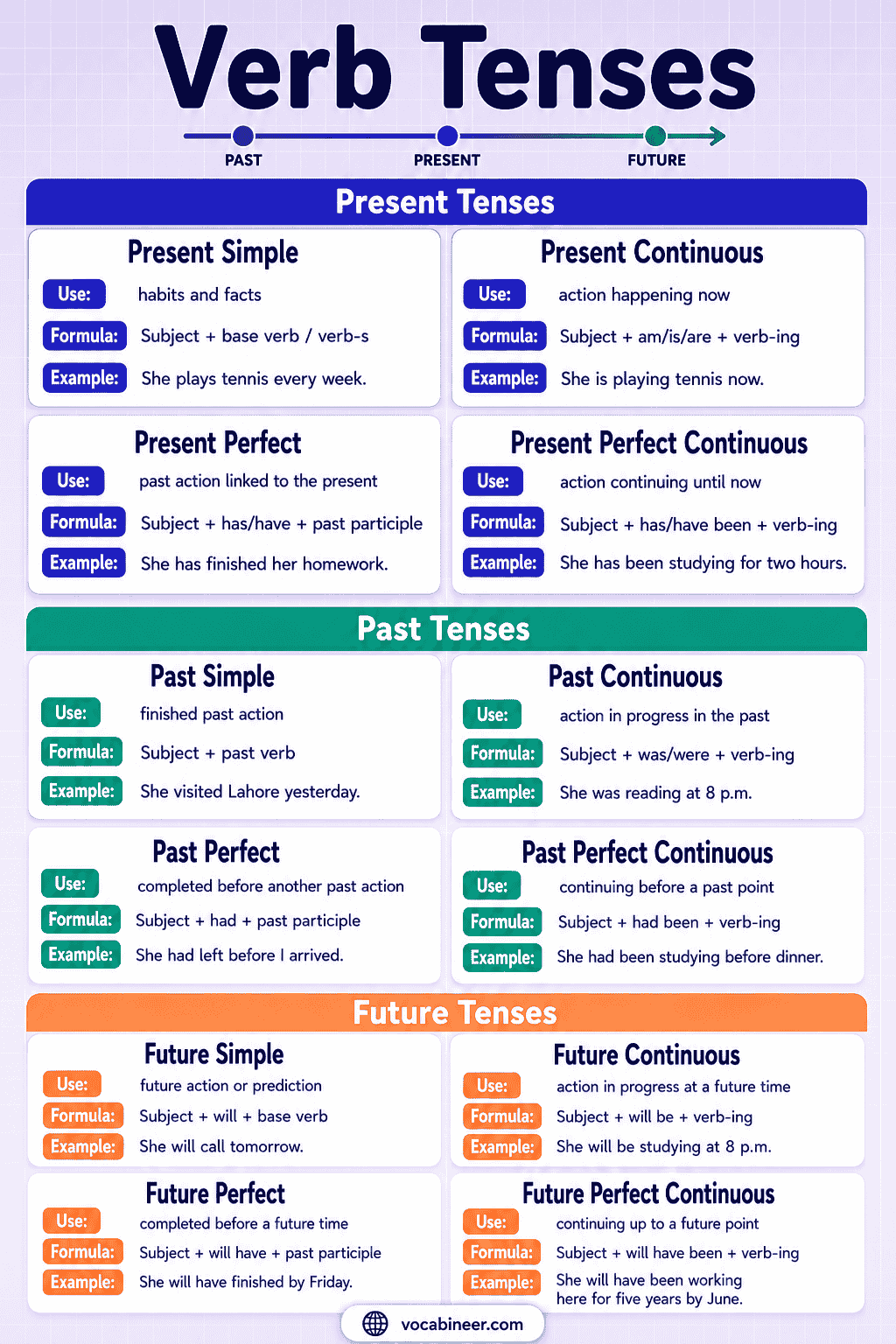
The 12 Common Verb Tense Forms
English learners commonly organize verb tenses into three time groups with four forms in each group.
| Time Group | Simple | Continuous | Perfect | Perfect Continuous |
|---|---|---|---|---|
| Present | Present Simple | Present Continuous | Present Perfect | Present Perfect Continuous |
| Past | Past Simple | Past Continuous | Past Perfect | Past Perfect Continuous |
| Future | Future Simple | Future Continuous | Future Perfect | Future Perfect Continuous |
This 12-form model is widely used because it gives learners a practical way to organize the tense system.
In more technical grammar, however, these labels combine tense, aspect, and future constructions. Therefore, the 12-form system works best as a useful learning model rather than the only possible grammatical analysis.
How the Four Tense Patterns Work
The four recurring patterns help explain how speakers view actions and situations. Their meanings change somewhat across present, past, and future contexts, but the main ideas remain recognizable.
Simple Tenses
Simple forms often describe habits, facts, states, or events viewed as wholes.
Examples:
- I exercise every morning.
- She lived in Boston for five years.
- We will call you tomorrow.
The Simple pattern does not always mean an action is short or completed. For example, I live in New York describes an ongoing state.
Continuous Tenses
Continuous forms view an activity as in progress, temporary, developing, or unfolding around a particular time.
Examples:
- He is studying now.
- They were driving at midnight.
- We will be traveling this time tomorrow.
The core structural pattern is:
be + V-ing
Perfect Tenses
Perfect forms connect a reference time with an earlier event or situation.
Examples:
- She has finished the assignment.
- They had left before we arrived.
- I will have completed the course by June.
The core pattern is:
have + V3
The exact time relationship depends on whether the reference point is present, past, or future.
Perfect Continuous Tenses
Perfect Continuous forms combine an earlier-time relationship with ongoing activity or duration.
Examples:
- I have been studying for two hours.
- She had been working all morning.
- By July, they will have been living here for ten years.
The repeating structure is:
have + been + V-ing
How Verb Tenses Are Formed
English tense forms use a combination of main verbs and helping verbs. The most important helping verbs include do, be, have, and will.
Three patterns are especially useful to recognize:
- Continuous: be + V-ing
- Perfect: have + V3
- Perfect Continuous: have + been + V-ing
The helping verb changes according to the tense.
For example:
- is working → Present Continuous
- was working → Past Continuous
- will be working → Future Continuous
Likewise:
- has finished → Present Perfect
- had finished → Past Perfect
- will have finished → Future Perfect
Regular and Irregular Verbs
Verb forms also depend on whether a verb is regular or irregular.
| Base Form | Past Form | Past Participle |
|---|---|---|
| work | worked | worked |
| play | played | played |
| go | went | gone |
| write | wrote | written |
| see | saw | seen |
Regular verbs usually form the past with -ed. In contrast, irregular verbs may change in different ways.
This difference matters because Past Simple often uses the past form, while perfect forms require the past participle.
The Verb Be
The verb be behaves differently from ordinary verbs.
Present forms include:
- I am
- she is
- they are
Past forms include:
- I was
- they were
It also forms basic questions directly:
Is she ready?
rather than:
Does she be ready?
This makes be one of the most important special verbs in the tense system.
How to Choose the Right Verb Tense
Choosing a tense becomes easier when you focus on meaning first.
Ask yourself several questions:
- When does the situation happen?
- Is it a routine or repeated action?
- Is the activity happening around a particular time?
- Is the action complete?
- Does it connect to another point in time?
- Does duration matter?
For example, compare:
I work from home.
This describes a usual situation.
I am working from home this week.
Here, the situation is temporary.
Similarly:
I saw the movie last night.
refers to a completed action at a finished past time.
By contrast:
I have seen the movie before.
focuses on past experience connected to the present rather than a specific finished time.
Therefore, meaning should guide tense choice more than memorized “signal words.”
Talking About the Future
English can express future time in several ways. The traditional 12-form model uses will in its four future patterns, but everyday English also uses other structures.
Will
Commonly appears with predictions, promises, offers, and immediate decisions.
I will call you tonight.
Be Going To
Often describes intentions or predictions based on present evidence.
We are going to move next month.
Present Continuous
Frequently describes arranged future plans.
I am meeting my dentist tomorrow.
Present Simple
Can describe schedules and timetables.
The train leaves at 8:20 tomorrow morning.
As a result, future meaning cannot be reduced to one single verb tense or one use of will.
Keeping Verb Tenses Consistent
Verb tense should remain logically consistent when the time frame stays the same.
Consider this unnecessary shift:
She opened the door and looks outside.
Both actions belong to the same past sequence, so a consistent version is:
She opened the door and looked outside.
However, changing tense is correct when the time relationship actually changes.
For example:
I worked at that company for five years, but now I run my own business.
The Past Simple fits the earlier job, while the Present Simple correctly describes the current situation.
A sentence can also use more than one tense when different actions have different roles:
I was cooking when the phone rang.
The Past Continuous shows the ongoing background action, whereas the Past Simple shows the shorter event.
So the goal is not to keep every verb in one tense. Instead, keep the tense choices logically connected to the intended time relationships.
Common Mistakes When Choosing Verb Tenses
Some tense errors happen even when the verb forms themselves are correct. The problem comes from choosing a form that does not match the intended meaning.
Using Present Perfect with a finished past time
Incorrect:
I have visited her yesterday.
Better:
I visited her yesterday.
Because yesterday refers to a completed past period, Past Simple fits naturally.
Using Present Continuous for a normal state
Usually incorrect:
I am knowing the answer.
Better:
I know the answer.
Many stative verbs normally use Simple forms in their ordinary meanings.
Using Past Perfect unnecessarily
Awkward:
I had walked to the store yesterday and had bought some milk.
More natural:
I walked to the store yesterday and bought some milk.
Past Perfect becomes useful when an earlier past relationship needs clarification.
Changing tense without a reason
Incorrect:
He walked into the room and sits down.
Better:
He walked into the room and sat down.
Choosing tense only from a time word
Words such as for, since, tomorrow, or already can provide clues, but they do not automatically choose the tense. Context and intended meaning remain more important.
Verb Tenses Learners Often Confuse
Several tense choices cause recurring problems because the meanings are closely related.
| Tense Choice | Main Difference | Example |
|---|---|---|
| Present Simple vs Present Continuous | Usual/stable situation vs current or temporary activity | I work here. / I am working here this week. |
| Past Simple vs Present Perfect | Finished past context vs past connected to the present | I saw it yesterday. / I have seen it before. |
| Present Perfect vs Present Perfect Continuous | Result or amount vs activity or duration | She has written five pages. / She has been writing for two hours. |
| Past Simple vs Past Perfect | Normal past event vs earlier of two past points | We arrived after the train had left. |
| Will vs Other Future Forms | Future form depends on prediction, intention, arrangement, or schedule | I will call. / I am meeting her tomorrow. |
The boundaries are not always absolute. For instance, both I have lived here for five years and I have been living here for five years can be natural, although the second often places stronger emphasis on ongoing activity or duration.
FAQs
Verb tenses are grammatical forms that help express a situation’s relationship to time. They work together with aspect, helping verbs, and context to show whether actions are habitual, ongoing, completed, or connected to another time.
English learners commonly study 12 tense forms arranged into present, past, and future groups with simple, continuous, perfect, and perfect continuous patterns. More technical grammar may analyze tense and aspect differently.
Tense mainly helps locate a situation relative to time, while aspect shows how the speaker views that situation. Continuous aspect emphasizes ongoing activity, whereas perfect aspect connects one reference point with something earlier.
First identify the relevant time. Then decide whether the action is habitual, temporary, ongoing, complete, connected to another time, or important for its duration. Context usually matters more than individual signal words.
Yes. Different clauses may need different tense forms when they refer to different time relationships. For example, I was studying when the phone rang correctly combines Past Continuous with Past Simple.
Read More