English tense formulas become much easier when you understand the patterns behind them. Instead of memorizing dozens of separate structures, learners can focus on a few helping verbs and verb forms that repeat across the present, past, and future.
The 12 commonly taught tense forms follow four main patterns: simple, continuous, perfect, and perfect continuous. The sections below show how to build affirmative, negative, and question forms correctly, while also explaining the verb rules and common construction mistakes learners need to avoid.
In This Page
Understanding Tense Formulas
Tense formulas use short symbols to show how a sentence is constructed. Therefore, learning these symbols first makes every structure easier to read and remember.
- S = Subject
- V1 = Base form of the verb, such as go, eat, write
- V2 = Past form, such as went, ate, wrote
- V3 = Past participle, such as gone, eaten, written
- V-ing = Verb + -ing, such as going, eating, writing
Many grammar charts also use O for object. However, an object is not necessary in every sentence. For example, He sleeps forms a complete sentence without one. For that reason, the formulas here show only the elements required to build the tense correctly.
Helping verbs, also called auxiliary verbs, play an important role in most tense structures. The most common ones include:
- do, does, did
- am, is, are
- was, were
- have, has, had
- will
- be
- been
A formula shows the structure of a sentence. In contrast, a rule explains how the words inside that structure behave.
For example:
Present Perfect formula: S + have/has + V3
An important rule then tells us to use has with he, she, and it, while have works with I, you, we, and they.
Four Main Tense Formula Patterns
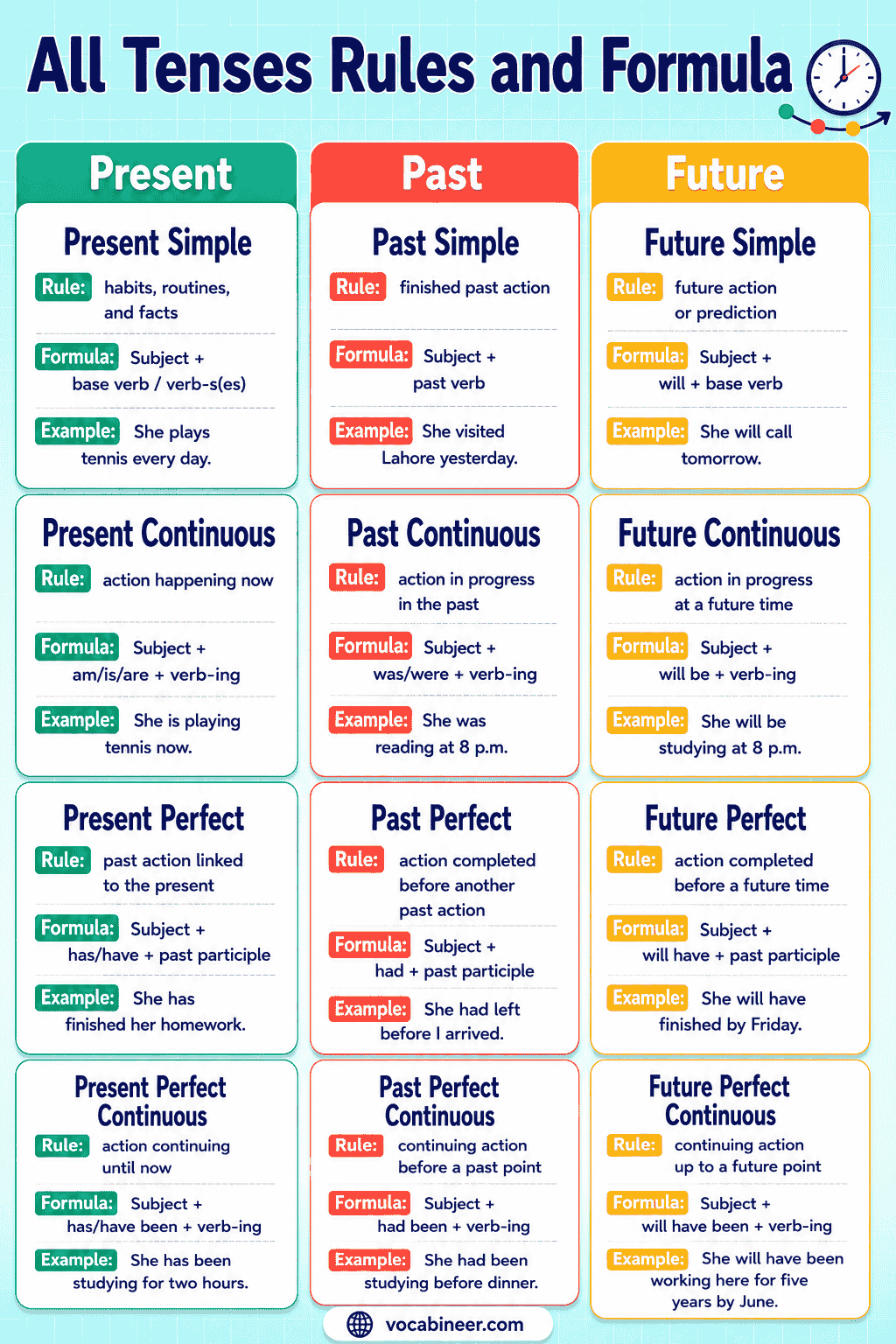
The 12 tense forms become much easier once you notice the patterns that repeat across present, past, and future time. Although the Simple forms need a few special rules, the other three families follow especially clear structures.
| Pattern | Present | Past | Future |
|---|---|---|---|
| Simple | V1 / V1+s | V2 | will + V1 |
| Continuous | am/is/are + V-ing | was/were + V-ing | will be + V-ing |
| Perfect | have/has + V3 | had + V3 | will have + V3 |
| Perfect Continuous | have/has been + V-ing | had been + V-ing | will have been + V-ing |
Continuous Formula
The master pattern is:
BE + V-ing
Only the form of be changes with time:
- Present: am/is/are + V-ing
- Past: was/were + V-ing
- Future: will be + V-ing
For example:
- She is working.
- She was working.
- She will be working.
Perfect Formula
The master pattern is:
HAVE + V3
Again, the helping verb changes according to time:
- Present: have/has + V3
- Past: had + V3
- Future: will have + V3
For example:
- She has finished.
- She had finished.
- She will have finished.
Perfect Continuous Formula
The master structure is:
HAVE + BEEN + V-ing
Its three time forms are:
- Present: have/has been + V-ing
- Past: had been + V-ing
- Future: will have been + V-ing
For example:
- She has been studying.
- She had been studying.
- She will have been studying.
Because these patterns repeat, learners can understand the system instead of memorizing every formula as an unrelated rule.
How Affirmative, Negative, and Question Forms Work
English tense formulas follow a consistent sentence-building system. Once you understand that system, forming negatives and questions becomes much easier.
Affirmative Sentences
An affirmative sentence follows the normal tense structure.
For example:
- She works every day.
- She is working now.
- She has worked here before.
- She will work tomorrow.
The exact verb form changes according to the tense. However, the basic word order usually begins with the subject.
Negative Sentences
When a tense already contains a helping verb, place not after the first helping verb.
For example:
- She is not working.
- She has not finished.
- She had not left.
- She will not come.
Present Simple and Past Simple with ordinary verbs work differently because their affirmative forms normally have no helping verb.
Instead, use:
- do not / does not + V1
- did not + V1
Examples:
- They do not work here.
- She does not work on Sundays.
- He did not go yesterday.
Notice that the main verb returns to V1 after do, does, and did.
Question Forms
If a tense already contains a helping verb, move the first helping verb before the subject.
Affirmative:
She is studying.
Question:
Is she studying?
Likewise:
They have finished.
becomes:
Have they finished?
Similarly:
He will have completed the work.
changes to:
Will he have completed the work?
Present Simple and Past Simple ordinary verbs need do, does, or did:
- Do you work here?
- Does she work here?
- Did they arrive?
A useful method is to choose the time first, then identify the pattern, select the helping verb, choose the correct verb form, and finally adjust the structure for a negative or question.
Present Tense Rules and Formulas
The four present tense forms cover habits, present activities, past events connected to now, and actions that continue into the present. Each form follows its own construction pattern.
Present Simple
Use the Present Simple mainly for habits, routines, repeated actions, facts, and states.
| Form | Formula | Example |
|---|---|---|
| Affirmative | S + V1 / V1+s | She works every day. |
| Negative | S + do/does + not + V1 | She does not work on Sunday. |
| Question | Do/Does + S + V1? | Does she work here? |
With he, she, and it, an affirmative verb usually takes -s or -es.
Examples:
- play → plays
- go → goes
- watch → watches
- study → studies
After does, however, return the main verb to V1:
Does she work?
not:
Does she works?
The verb be follows its own pattern:
- She is happy.
- She is not happy.
- Is she happy?
Therefore, do not use does with be in this structure.
Present Continuous
Use the Present Continuous for an action happening now, a temporary situation, or an activity developing around the present.
| Form | Formula | Example |
|---|---|---|
| Affirmative | S + am/is/are + V-ing | She is reading now. |
| Negative | S + am/is/are + not + V-ing | She is not reading now. |
| Question | Am/Is/Are + S + V-ing? | Is she reading now? |
The key formula is:
BE + V-ing
Choose the correct form of be according to the subject:
- I → am
- he/she/it → is
- you/we/they → are
For instance, I am studying and They are studying follow the same continuous pattern even though the helping verb changes.
Present Perfect
Use the Present Perfect when a past action or situation has a connection with the present.
| Form | Formula | Example |
|---|---|---|
| Affirmative | S + have/has + V3 | She has finished the work. |
| Negative | S + have/has + not + V3 | She has not finished the work. |
| Question | Have/Has + S + V3? | Has she finished the work? |
Subject agreement determines the helping verb:
- has → he, she, it
- have → I, you, we, they
Meanwhile, the main verb must use V3.
Examples:
- go → gone
- eat → eaten
- write → written
- see → seen
Present Perfect Continuous
Use the Present Perfect Continuous when an activity began earlier and continues up to now. It can also describe a recent activity when the action or its duration matters.
| Form | Formula | Example |
|---|---|---|
| Affirmative | S + have/has + been + V-ing | She has been studying for two hours. |
| Negative | S + have/has + not + been + V-ing | She has not been studying for long. |
| Question | Have/Has + S + been + V-ing? | Has she been studying all morning? |
Always remember the full formula:
have/has + been + V-ing
Without been, the perfect continuous structure becomes incomplete.
Past Tense Rules and Formulas
Past tense formulas describe completed events, actions in progress at a past time, and actions that occurred before another past event. As a result, these structures help learners show both sequence and duration clearly.
Past Simple
Use the Past Simple for an action or state that finished in the past.
| Form | Formula | Example |
|---|---|---|
| Affirmative | S + V2 | He visited his uncle. |
| Negative | S + did + not + V1 | He did not visit his uncle. |
| Question | Did + S + V1? | Did he visit his uncle? |
The most important formula rule is:
did + V1
Correct:
Did he go?
Incorrect:
Did he went?
Because did already shows past time, the main verb returns to its base form.
The verb be works differently:
- I/he/she/it → was
- you/we/they → were
Examples:
- She was tired.
- She was not tired.
- Was she tired?
Past Continuous
Use the Past Continuous for an activity that was in progress at a particular past time.
| Form | Formula | Example |
|---|---|---|
| Affirmative | S + was/were + V-ing | They were playing outside. |
| Negative | S + was/were + not + V-ing | They were not playing outside. |
| Question | Was/Were + S + V-ing? | Were they playing outside? |
The continuous rule remains:
BE + V-ing
Only the tense of be changes. Therefore, Present Continuous uses am/is/are, while Past Continuous uses was/were.
Past Perfect
Use the Past Perfect when one action was already complete before another past action or point.
| Form | Formula | Example |
|---|---|---|
| Affirmative | S + had + V3 | She had left before noon. |
| Negative | S + had + not + V3 | She had not left before noon. |
| Question | Had + S + V3? | Had she left before noon? |
One advantage of this formula is that had remains the same with every subject.
For example:
- I had finished.
- She had finished.
- They had finished.
Past Perfect Continuous
Use the Past Perfect Continuous when an activity continued for some time before another past event or point.
| Form | Formula | Example |
|---|---|---|
| Affirmative | S + had + been + V-ing | They had been waiting for an hour. |
| Negative | S + had + not + been + V-ing | They had not been waiting long. |
| Question | Had + S + been + V-ing? | Had they been waiting long? |
Again, the required structure is:
had + been + V-ing
For example, She was tired because she had been working all day shows an ongoing earlier activity that explains a later past condition.
Future Tense Rules and Formulas
In the traditional 12-form teaching model, the four future patterns use will as the main auxiliary. Because will stays the same with every subject, these formulas are often easier to construct than Present Simple forms.
Future Simple
Use the Future Simple for many predictions, promises, offers, and decisions made at the moment of speaking.
| Form | Formula | Example |
|---|---|---|
| Affirmative | S + will + V1 | She will call tomorrow. |
| Negative | S + will + not + V1 | She will not call tomorrow. |
| Question | Will + S + V1? | Will she call tomorrow? |
After will, always use V1.
Correct:
She will go.
Incorrect:
She will goes.
Future Continuous
Use the Future Continuous for an activity that will be in progress at a particular future time.
| Form | Formula | Example |
|---|---|---|
| Affirmative | S + will + be + V-ing | She will be studying at 8. |
| Negative | S + will + not + be + V-ing | She will not be studying at 8. |
| Question | Will + S + be + V-ing? | Will she be studying at 8? |
The continuous pattern still contains:
be + V-ing
Here, will simply places that pattern in the future.
Future Perfect
Use the Future Perfect for an action that will finish before a future point or deadline.
| Form | Formula | Example |
|---|---|---|
| Affirmative | S + will + have + V3 | She will have finished by Friday. |
| Negative | S + will + not + have + V3 | She will not have finished by Friday. |
| Question | Will + S + have + V3? | Will she have finished by Friday? |
Notice that the Perfect formula remains have + V3. The future auxiliary will simply comes before it.
Future Perfect Continuous
Use the Future Perfect Continuous when you want to emphasize how long an activity will have continued up to a future point.
| Form | Formula | Example |
|---|---|---|
| Affirmative | S + will + have + been + V-ing | She will have been working here for ten years. |
| Negative | S + will + not + have + been + V-ing | She will not have been working here for ten years. |
| Question | Will + S + have + been + V-ing? | Will she have been working here for ten years? |
Although this formula is long, it follows a predictable structure:
will + have + been + V-ing
Once you recognize the Perfect Continuous family, the pattern becomes much easier to remember.
Key Verb-Form Rules for Tenses
Correct tense formulas depend on both the helping verb and the form of the main verb. The following rules prevent many of the mistakes learners make when constructing sentences.
Use -s or -es in Third-Person Present Simple
With he, she, and it, ordinary verbs usually change in affirmative Present Simple sentences.
Examples:
- work → works
- read → reads
- go → goes
- wash → washes
- study → studies
In negatives and questions, however, does carries the third-person information:
- She does not study here.
- Does she study here?
Therefore, do not keep the -s on the main verb after does.
Use V1 After Do, Does, Did, and Will
The main verb stays in its base form after these helping verbs.
Correct forms include:
- Do they play?
- Does he play?
- Did she play?
- She will play tomorrow.
This rule explains why forms such as did went and will goes are incorrect.
Use V3 After Have, Has, and Had
Perfect tenses require a past participle.
| V1 | V2 | V3 |
|---|---|---|
| go | went | gone |
| eat | ate | eaten |
| write | wrote | written |
| see | saw | seen |
| take | took | taken |
| work | worked | worked |
Regular verbs often use the same form for V2 and V3. In contrast, irregular verbs may have different past and past-participle forms.
Use V-ing After Forms of Be
Continuous tenses require:
BE + V-ing
Examples include:
- is running
- were talking
- will be working
Consequently, He is work is incorrect because the main verb must take the -ing form.
Include Been in Perfect Continuous Forms
Every Perfect Continuous family includes been:
- has been working
- had been studying
- will have been living
Leaving out been changes the formula and creates an incorrect structure.
Remember the Special Rules for Be
Unlike ordinary verbs, be does not use do, does, or did to form basic Present or Past Simple negatives and questions.
Present:
- She is ready.
- She is not ready.
- Is she ready?
Past:
- They were ready.
- They were not ready.
- Were they ready?
Common Verb Spelling Changes
Spelling may change when adding -s, -ed, or -ing, although the underlying tense formula stays the same.
Adding -ing
- make → making
- write → writing
- run → running
- sit → sitting
- lie → lying
Adding -s or -es
- play → plays
- go → goes
- watch → watches
- study → studies
Regular Past Simple Forms
- work → worked
- live → lived
- stop → stopped
- study → studied
This version removes the repeated sentence opening and reads more naturally.
Common Tense Formula Mistakes
Many tense errors happen because the helping verb is correct but the main verb uses the wrong form. Others occur when learners forget an auxiliary or place words in the wrong order.
Using V1+s after does
❌ Does she works here?
✅ Does she work here?
Because does already carries the third-person marker, the main verb returns to V1.
Using V2 after did
❌ Did he went home?
✅ Did he go home?
Here, did already expresses past time. Therefore, use V1 afterward.
Using V2 instead of V3 after have or has
❌ She has went home.
✅ She has gone home.
Perfect forms require V3 rather than V2.
Forgetting be in a continuous tense
❌ They playing outside.
✅ They are playing outside.
Continuous tenses need a form of be before V-ing.
Using V1 instead of V-ing after be
❌ He is work now.
✅ He is working now.
The helping verb alone is not enough; the main verb must also use the correct form.
Forgetting been in a perfect continuous tense
❌ She has working all morning.
✅ She has been working all morning.
Perfect Continuous forms always contain been + V-ing.
Adding -s after will
❌ He will goes tomorrow.
✅ He will go tomorrow.
Since will takes V1, no third-person ending belongs on the main verb.
Using do with be
❌ Does she be tired?
✅ Is she tired?
The verb be forms these questions without do or does.
Putting not in the wrong position
❌ She has finished not the work.
✅ She has not finished the work.
When a helping verb already exists, place not after the first helping verb.
Keeping the helping verb after the subject in a standard yes/no question
❌ She is working?
✅ Is she working?
In standard yes/no questions, move the first helping verb before the subject.
FAQs
The 12 forms belong to four main families: Simple, Continuous, Perfect, and Perfect Continuous. Continuous forms use be + V-ing, Perfect forms use have + V3, and Perfect Continuous forms use have + been + V-ing. Present, past, and future then change the required helping verbs.
V1 means the base form, V2 means the past form, and V3 means the past participle. For example, with write: V1 = write, V2 = wrote, and V3 = written.
The helping verb already carries the grammatical information for person or past time. As a result, the main verb returns to its base form: Does she work? and Did he go?
Continuous uses be + V-ing, whereas Perfect uses have + V3. Perfect Continuous combines both ideas through have + been + V-ing. The helping verbs then change according to present, past, or future time.
Start with three repeating patterns: BE + V-ing, HAVE + V3, and HAVE + BEEN + V-ing. Next, learn how be and have change across present, past, and future forms. Finally, give extra attention to Simple forms because Present and Past Simple use do, does, and did for many negatives and questions.
Read More