Future tense sentences help learners talk about actions, plans, predictions, promises, arrangements, and events that will happen after the present time. Because English expresses future meaning in several ways, learning the main sentence patterns makes it easier to choose the right form in everyday speaking and writing.
This article includes Future Tense sentences with examples, focusing mainly on will and be going to. It also shows how Present Continuous can describe arranged plans and how Present Simple can refer to fixed schedules.
In This Page
What Do We Mean by Future Tense Sentences?
Future tense sentences describe actions or situations connected to a time after now.
For example:
- I will call you tomorrow.
- She is going to study tonight.
- We are meeting them on Friday.
- The train leaves at six tomorrow.
English does not rely on one single future form. Instead, speakers choose different structures depending on whether they are making a prediction, expressing an intention, making a promise, arranging a meeting, or referring to a timetable.
100 Future Tense Sentences
The following examples show several natural ways to express future meaning.
- I will call you tomorrow.
- She will finish the work later.
- He will help us with the project.
- We will visit our grandparents next week.
- They will arrive soon.
- My brother will buy a new phone.
- The teacher will explain the lesson tomorrow.
- I will send the email tonight.
- She will start work at nine.
- We will see you again soon.
- I won’t go there tomorrow.
- She won’t forget your birthday.
- He won’t come tonight.
- We won’t stay long.
- They won’t finish today.
- My brother won’t drive tomorrow.
- The shop won’t open early.
- I won’t tell anyone.
- She won’t need much time.
- They won’t leave before noon.
- Will you come tomorrow?
- Will she help us?
- Will he call later?
- Will they join the meeting?
- Will we need more time?
- When will you arrive?
- Where will she stay?
- What will he do next?
- Why will they leave early?
- How will we get there?
- I am going to study tonight.
- She is going to buy a new laptop.
- He is going to visit his uncle.
- We are going to travel next month.
- They are going to move soon.
- My sister is going to start a new course.
- I am going to learn Spanish.
- He is going to save more money.
- We are going to paint the house.
- They are going to watch a movie tonight.
- I am not going to stay long.
- She isn’t going to buy it.
- He isn’t going to travel this week.
- We aren’t going to leave early.
- They aren’t going to attend the meeting.
- My brother isn’t going to sell his car.
- I am not going to change my plan.
- She isn’t going to cook tonight.
- We aren’t going to wait much longer.
- They aren’t going to move this year.
- Are you going to study tonight?
- Is she going to come with us?
- Is he going to buy a car?
- Are they going to travel next week?
- What are you going to do tomorrow?
- Where is she going to stay?
- When are they going to leave?
- Why is he going to change jobs?
- Who are you going to invite?
- How are we going to solve this problem?
- I think it will rain tomorrow.
- She will probably pass the exam.
- The team will win the match.
- Prices will rise next year.
- Technology will continue to change.
- Look at those clouds; it is going to rain.
- Be careful! You are going to drop that glass.
- The baby is going to cry.
- That box is going to fall.
- The road is going to get busy soon.
- I will help you with your homework.
- We will be there on time.
- I will never forget your kindness.
- She will carry your bag.
- We will call you when we arrive.
- I will keep your secret.
- He will lend you his book.
- They will support the project.
- I will answer the phone.
- We will take care of everything.
- I am meeting Sarah at six.
- We are flying to Dubai next Friday.
- She is seeing the dentist tomorrow.
- They are having dinner with us tonight.
- My manager is visiting the office on Monday.
- I am meeting my teacher after class.
- We are staying at a hotel this weekend.
- He is starting his new job next week.
- They are coming over tonight.
- She is leaving for Lahore tomorrow morning.
- The train leaves at six tomorrow.
- The class starts at nine.
- The flight lands at noon.
- School opens next Monday.
- The movie begins at eight tonight.
- The bus arrives at seven tomorrow morning.
- The meeting starts at ten.
- The shop closes at nine tonight.
- Our exam begins next Tuesday.
- The match starts at five tomorrow.
Future Sentences with Will
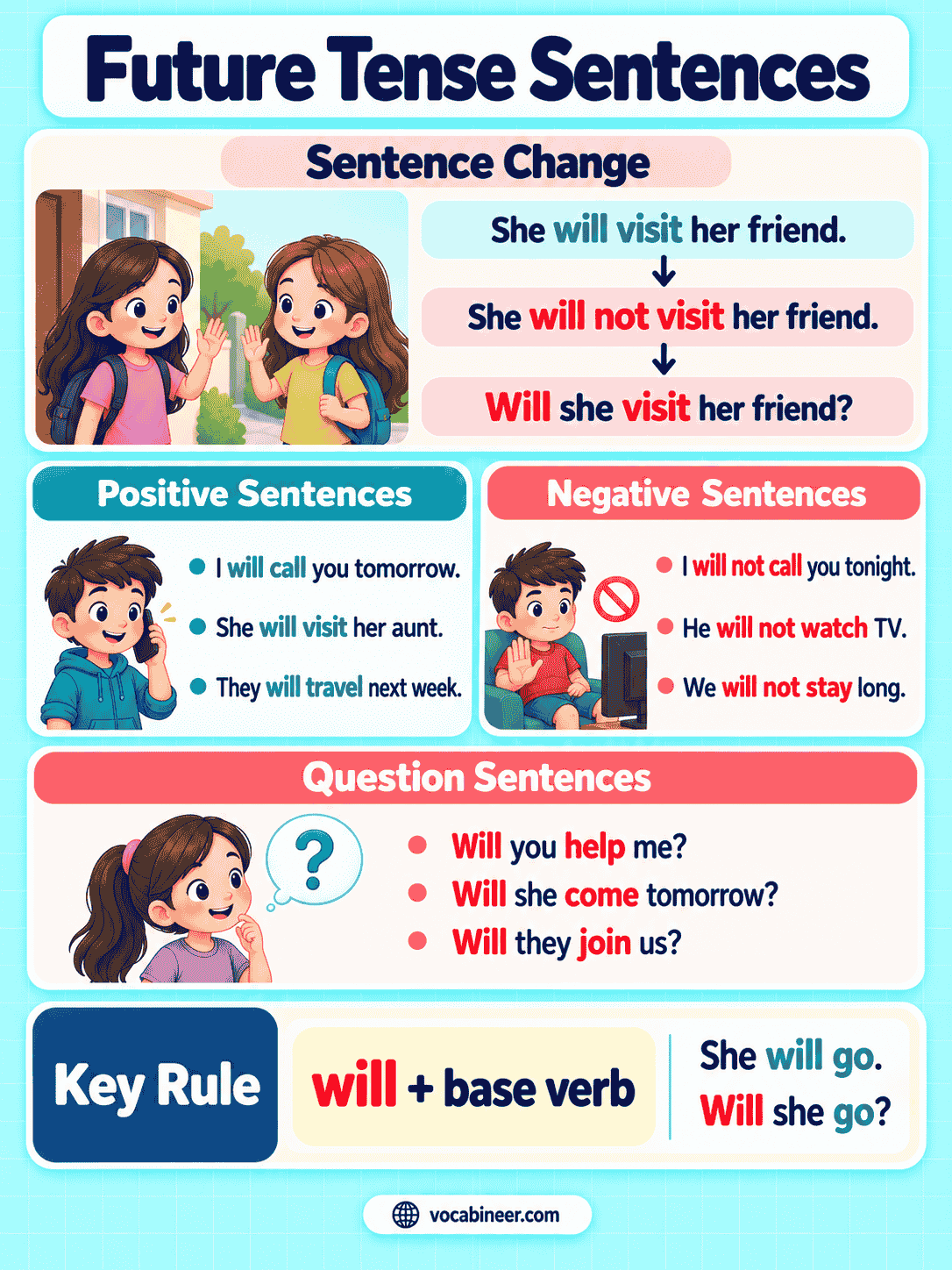
The structure will + base verb is common for predictions, promises, offers, and decisions made at the moment of speaking.
Examples:
- I will help you.
- She will call later.
- We will arrive soon.
- They will finish tomorrow.
- He will probably win.
The form of will does not change with the subject.
| Subject | Example |
|---|---|
| I | I will come. |
| she | She will come. |
| we | We will come. |
| they | They will come. |
Negative Future Sentences with Won’t
Use will not or won’t followed by the base form of the verb.
Examples:
- I won’t go tomorrow.
- She won’t forget.
- He won’t stay long.
- We won’t leave early.
- They won’t need help.
Because will already carries the future meaning, the main verb stays in its base form.
Correct:
- She will go.
Incorrect:
- She will goes.
Future Questions with Will
To make a question, place will before the subject.
Yes/No Questions
- Will you come tomorrow?
- Will she call later?
- Will he help us?
- Will they join the meeting?
WH-Questions
- When will you arrive?
- Where will she stay?
- What will he do?
- How will they travel?
Short answers use will or won’t:
- Will you come? — Yes, I will. / No, I won’t.
- Will she help? — Yes, she will. / No, she won’t.
Future Sentences with Be Going To
Use be going to + base verb for intentions, plans already decided, and predictions based on present evidence.
Examples:
- I am going to study tonight.
- She is going to start a new course.
- He is going to buy a car.
- We are going to travel next month.
- They are going to move soon.
The form of be changes with the subject.
| Subject | Form |
|---|---|
| I | am going to |
| he / she / it | is going to |
| you / we / they | are going to |
Negative and Question Forms with Going To
Negative sentences place not after am, is, or are.
- I am not going to leave.
- She isn’t going to buy it.
- We aren’t going to travel this week.
Questions move am, is, or are before the subject.
- Are you going to study tonight?
- Is she going to come?
- What are they going to do tomorrow?
Will vs Going To
Both forms can refer to the future, but they often express different meanings.
| Will | Be Going To |
|---|---|
| spontaneous decision | prior plan or intention |
| promise or offer | decision already made |
| general prediction | prediction based on present evidence |
| I will help you. | I am going to study tonight. |
| I think it will rain. | Look at the clouds. It is going to rain. |
The distinction is not absolute in every context, but it is a useful guide for learners.
Future Sentences for Spontaneous Decisions
Use will when the decision happens at the moment of speaking.
- The phone is ringing. I will answer it.
- I’m thirsty. I will get some water.
- It’s cold. I will close the window.
- We need another chair. I will bring one.
- Don’t worry. I will help you.
Here, the speaker decides what to do immediately.
Future Sentences for Promises and Offers
Will is also common when making promises or offering help.
- I will help you with your homework.
- We will be there on time.
- I will never forget your kindness.
- She will carry your bag.
- We will call when we arrive.
- I will keep your secret.
Future Sentences for Predictions
Future predictions can use both will and going to.
General Predictions
- I think it will rain tomorrow.
- She will probably pass the exam.
- The team will win the match.
- Prices will rise next year.
Predictions Based on Present Evidence
- Look at those clouds. It is going to rain.
- Be careful! You are going to drop that glass.
- The baby is going to cry.
- That box is going to fall.
The second group relies on evidence that is already visible or noticeable.
Future Plans and Intentions
When someone has already decided on a future action, going to is often natural.
- I am going to learn Spanish.
- She is going to start a new course.
- We are going to renovate the kitchen.
- They are going to visit their grandparents.
- My brother is going to save more money.
- I am going to exercise more regularly.
These sentences express intentions rather than spontaneous decisions.
Arranged Future Plans with Present Continuous
Present Continuous can express a future event when the arrangement is already organized.
- I am meeting Sarah at six.
- We are flying to Dubai next Friday.
- She is seeing the dentist tomorrow.
- They are having dinner with us tonight.
- My manager is visiting the office on Monday.
A specific time, place, or arrangement often supports this use.
Fixed Future Schedules with Present Simple
Present Simple can describe future events that follow a timetable or fixed schedule.
- The train leaves at six tomorrow.
- The class starts at nine.
- The flight lands at noon.
- School opens next Monday.
- The movie begins at eight tonight.
The speaker is not making the plan; the event follows an established schedule.
Future Time Expressions
Several time expressions commonly appear with future meaning:
- tomorrow
- tonight
- later
- soon
- next week
- next month
- next year
- in two days
- this weekend
- in the future
Examples:
- I will call you tomorrow.
- We are going to travel next month.
- She is meeting him tonight.
- They will arrive soon.
- The course starts next week.
These expressions help establish future time, although the sentence form still depends on the intended meaning.
Everyday Future Tense Sentences
Future forms appear constantly in everyday conversations.
- Tomorrow, I will wake up early.
- She is going to cook dinner tonight.
- Later, he will call his friend.
- After work, we are meeting our manager.
- They are going to watch a movie.
- My father will drive us to school.
- Tonight, I will finish the report.
- She is going to clean her room.
- This weekend, we will visit the market.
- Early tomorrow, they are leaving for the airport.
Future Tense Sentences for Kids
Children and beginners can start with short and familiar examples.
- I will play outside tomorrow.
- She will read a story.
- He is going to eat an apple.
- We will visit the zoo.
- They are going to draw pictures.
- My teacher will help us.
- The baby is going to sleep.
- I will bring my book.
- We are meeting our friends tomorrow.
- The bus leaves at eight.
Common Future Sentence Mistakes
Adding -s after Will
Incorrect: She will goes home.
Correct: She will go home.
Using To after Will
Incorrect: I will to call you.
Correct: I will call you.
Forgetting Be before Going To
Incorrect: She going to study.
Correct: She is going to study.
Mixing Will and Going To
Incorrect: He will going to travel tomorrow.
Correct: He will travel tomorrow.
Correct: He is going to travel tomorrow.
Using the Wrong Form of Be
Incorrect: They is going to leave.
Correct: They are going to leave.
Using Present Continuous for an Unarranged Intention
Present Continuous usually works best when the future event is already arranged, while going to commonly expresses an intention or plan.
Future Simple and Other Future Tenses
The term future tense can also refer to more advanced future forms.
| Future Form | Example |
|---|---|
| Future Simple | I will work tomorrow. |
| Future Continuous | I will be working at eight. |
| Future Perfect | I will have finished by six. |
| Future Perfect Continuous | I will have been working for two hours by six. |
This article mainly focuses on practical future-time sentences with will, going to, Present Continuous, and Present Simple. The advanced future forms express different relationships involving duration, completion, and actions in progress.
FAQs
Examples include I will call you tomorrow, She is going to study tonight, We are meeting them on Friday, and The train leaves at six tomorrow. Each sentence refers to future time but uses a form suited to its meaning.
Use will not / won’t + base verb, as in She won’t come tomorrow.
Place will before the subject, as in Will she come? or When will they arrive?
Will commonly expresses spontaneous decisions, promises, offers, and general predictions. Going to commonly expresses prior plans, intentions, and predictions based on present evidence.
Yes. It commonly describes arranged future plans, as in We are meeting at six tomorrow.
Yes. It can describe fixed timetables and schedules, as in The train leaves at seven tomorrow.
Read More
- 12 English Tenses Chart
- All Tenses Rules and Formula
- English Tenses with Examples
- Present Tenses in English
- Past Tenses in English
- Future Tenses in English
- Be Going To in English