

Future tenses help learners describe future events, plans, arrangements, ongoing activities, completed future actions, and duration up to a future point. English commonly uses several forms for future meaning, so choosing the correct structure depends on the intended time relationship rather than on one word such as tomorrow or next week.
In learner grammar, Future Simple, Future Continuous, Future Perfect, and Future Perfect Continuous are commonly taught as the four main future tenses. However, English also uses be going to, Present Continuous, and Present Simple to express important future meanings such as plans, arrangements, schedules, and predictions.
In This Page
What Are the Future Tenses?
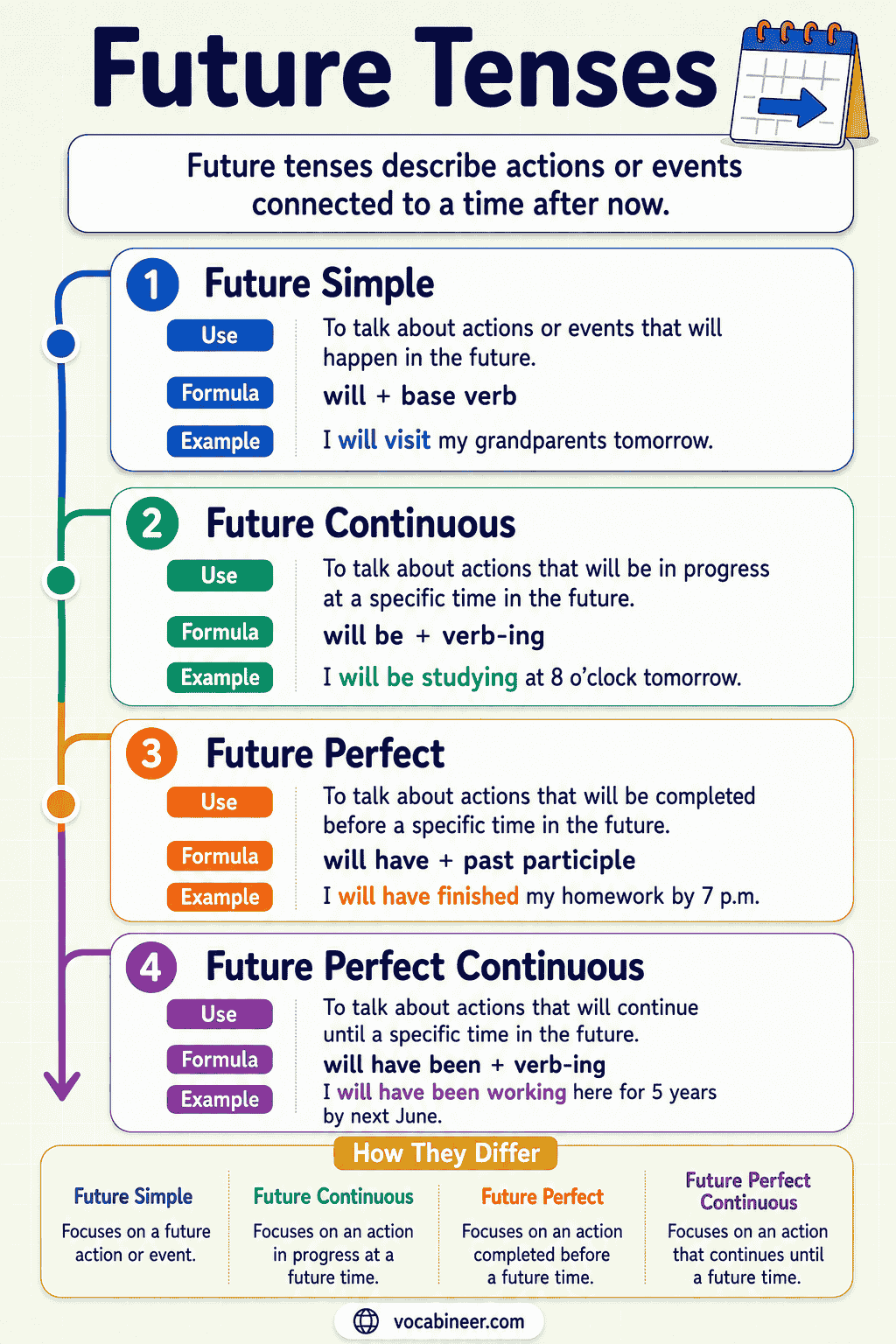
The four commonly taught future tense forms are:
- Future Simple
- Future Continuous
- Future Perfect
- Future Perfect Continuous
Each form marks a different future-time relationship.
Future Simple commonly expresses a future statement, prediction, decision, promise, or offer. Future Continuous marks activity in progress around a future point. Future Perfect marks completion before or by a future point, while Future Perfect Continuous marks ongoing activity or duration extending up to a future point.
Strictly speaking, English uses several grammatical constructions to express future time. However, the four-form framework remains useful for learning and comparing the main future structures.
Four Future Tenses at a Glance
| Future Form | Basic Structure | Core Meaning | Example |
|---|---|---|---|
| Future Simple | will + V1 | future event, prediction, decision, offer, or promise | I will call you tomorrow. |
| Future Continuous | will be + V-ing | activity in progress around a future point | I will be working at eight. |
| Future Perfect | will have + V3 | completion before or by a future point | I will have finished by six. |
| Future Perfect Continuous | will have been + V-ing | activity or duration extending up to a future point | I will have been working for eight hours by five. |
These four forms provide a clear learner framework, but they are not the only ways to express future meaning.
How English Expresses Future Time
English uses several structures for future reference. The correct choice depends on whether the speaker expresses a prediction, decision, plan, arrangement, schedule, ongoing future activity, completion, or duration.
Will
Use will + V1 for several common future meanings.
Spontaneous decisions
- The phone is ringing. I will answer it.
- I forgot the milk. I will buy some on the way home.
Offers
- I will help you with the bags.
- We will carry the boxes for you.
Promises
- I will call you tonight.
- I will not forget your birthday.
General predictions
- I think it will rain tomorrow.
- Prices will probably rise next year.
Future statements
- The meeting will begin soon.
- She will arrive later.
The form will is important, but it should not be treated as the only way to express future time.
Be Going To
Use:
am/is/are + going to + V1
This form commonly expresses prior plans, intentions, and predictions based on present evidence.
Plans and intentions
- I am going to study tonight.
- They are going to move next month.
- Maya is going to start a new course.
Predictions from present evidence
- Look at those clouds. It is going to rain.
- Be careful! You are going to drop that glass.
The plan or evidence normally exists before the statement is made.
Present Continuous for Future Arrangements
Present Continuous can express a future arrangement that has already been organized or agreed.
Examples:
- I am meeting Sarah tomorrow.
- We are flying to Lahore on Friday.
- Daniel is seeing the dentist at three.
- They are having dinner with us tonight.
These sentences usually refer to arrangements with some practical detail already established.
Compare:
- I am going to visit my aunt next week.
- I am visiting my aunt at three on Tuesday.
The first marks a plan or intention. The second more directly marks an arranged event.
Present Simple for Schedules and Timetables
Present Simple can express future events fixed by schedules, timetables, programs, or official arrangements.
Examples:
- The train leaves at 7:30 tomorrow.
- The class starts at nine.
- The flight arrives at noon.
- The shop closes at eight tonight.
The schedule, rather than a personal decision at the moment of speaking, determines the event.
Future Simple
Future Simple commonly uses:
S + will + V1
Examples:
- I will finish the work tomorrow.
- She will probably arrive by six.
- We will help you.
- Daniel will call later.
Future Simple commonly expresses:
- future statements
- predictions
- spontaneous decisions
- offers
- promises
The main verb remains in its base form after will.
Correct:
- She will go tomorrow.
Incorrect:
- She will goes tomorrow.
Future Continuous
Future Continuous uses:
S + will be + V-ing
It marks activity as in progress around a future reference point.
Examples:
- At eight tonight, I will be working.
- This time tomorrow, we will be flying to Dubai.
- She will be studying when you call.
- They will be traveling all afternoon.
Activity in Progress at a Future Time
Use Future Continuous when an activity will already be in progress around a specified future point.
Examples:
- At ten tomorrow, I will be attending a meeting.
- At noon, Maya will be having lunch.
- This evening, they will be watching the match.
The form presents the activity as ongoing around the future time.
Expected Future Activity
Future Continuous can also express activity expected to occur as part of a future situation.
Examples:
- I will be working from home next week.
- Daniel will be staying with us for a few days.
- They will be using the new office next month.
Polite Questions About Future Plans
Future Continuous can make questions about expected plans sound less direct.
Examples:
- Will you be using the car tonight?
- Will you be joining us for dinner?
- Will Maya be attending the meeting?
Future Perfect
Future Perfect uses:
S + will have + V3
It marks completion before or by a future reference point.
Examples:
- By six, I will have finished the report.
- By next month, they will have moved.
- By the time we arrive, the guests will have left.
- She will have completed the course by June.
Completion by a Future Point
Use Future Perfect when an event will be complete before or by a stated future time.
Examples:
- By Friday, we will have completed the project.
- By noon, she will have written the report.
- By next year, they will have built the new school.
The future reference point establishes the deadline for completion.
Completed Amount by a Future Time
Future Perfect can also mark an amount that will be complete by a future point.
Examples:
- By June, she will have written ten chapters.
- By the end of the day, I will have answered fifty emails.
- By next month, they will have completed twenty lessons.
Future Perfect Continuous
Future Perfect Continuous uses:
S + will have been + V-ing
It marks ongoing activity or duration extending up to a future reference point.
Examples:
- By June, I will have been working here for ten years.
- At noon, she will have been studying for four hours.
- By next week, they will have been traveling for a month.
Duration Up to a Future Point
Duration is central to this form.
Examples:
- By five, I will have been working for eight hours.
- By next year, Maya will have been teaching for a decade.
- By midnight, they will have been driving for six hours.
The form marks how long the activity will have continued up to the future reference point.
How to Choose the Right Future Form
Choose the form from the intended meaning rather than from a memorized signal word.
| Intended Meaning | Common Future Form |
|---|---|
| spontaneous decision | will |
| offer or promise | will |
| general prediction | will |
| prior plan or intention | be going to |
| prediction from present evidence | be going to |
| arranged future event | Present Continuous |
| fixed schedule or timetable | Present Simple |
| activity in progress around a future point | Future Continuous |
| completion before or by a future point | Future Perfect |
| duration extending up to a future point | Future Perfect Continuous |
Consider these examples:
- I will answer the phone. → decision made now
- I am going to study tonight. → prior plan
- I am meeting Daniel at three. → arrangement
- The train leaves at seven. → timetable
- At nine, I will be working. → ongoing activity
- By five, I will have finished. → completion
- By five, I will have been working for eight hours. → duration
How Future Forms Work Together
Different future forms can occur in the same situation because each one marks a different future relationship.
Consider:
- The train leaves at seven.
- I am meeting Daniel at the station at six-thirty.
- We are going to travel together.
- At nine, we will be traveling through the countryside.
- By noon, we will have reached Lahore.
Each form has a different grammatical function:
- leaves → fixed timetable
- am meeting → arranged event
- are going to travel → plan
- will be traveling → activity in progress around a future point
- will have reached → completion by a future point
This example shows why future meaning should be learned as a system rather than through will alone.
Future Forms Learners Often Confuse
Will vs Be Going To
Both forms can refer to the future, but their common meanings differ.
Will commonly marks:
- spontaneous decisions
- offers
- promises
- general predictions
Be going to commonly marks:
- prior plans
- intentions
- predictions based on present evidence
Compare:
- The phone is ringing. I will answer it.
- I am going to call Maya tonight.
The first decision occurs at the moment of speaking. The second plan already exists.
For predictions:
- I think it will rain tomorrow.
- Look at those clouds. It is going to rain.
The distinction is useful but not absolute. Context can allow both forms.
Be Going To vs Present Continuous
Compare:
- I am going to visit my aunt next week.
- I am visiting my aunt at three on Tuesday.
The first sentence presents a plan or intention.
The second presents a future arrangement with a more definite time.
However, the forms can overlap in some contexts, so meaning and level of arrangement matter more than a rigid rule.
Future Continuous vs Future Perfect
Compare:
- At eight, I will be writing the report.
- By eight, I will have written the report.
Future Continuous marks activity in progress around a future point.
Future Perfect marks completion before or by a future point.
Another pair:
- At noon, she will be preparing lunch.
- By noon, she will have prepared lunch.
The first sentence marks an ongoing activity. The second marks completion.
The words at and by often support these meanings, but they do not automatically determine the tense.
Future Perfect vs Future Perfect Continuous
Compare:
- By June, she will have written ten chapters.
- By June, she will have been writing for six months.
The first sentence marks a completed amount.
The second marks duration.
Another pair:
- By Friday, they will have painted five rooms.
- By Friday, they will have been painting for a week.
Future Perfect commonly marks completion, amount, result, or state more directly. Future Perfect Continuous commonly marks ongoing activity, process, or duration more directly.
The distinction should not be treated as absolute because some contexts allow overlap.
Future Time Clauses with When, Before, After, and Until
English commonly uses a present form in future time clauses after expressions such as:
- when
- before
- after
- until
- as soon as
Correct:
- I will call you when I arrive.
- We will leave after she finishes.
- I will wait until he comes.
- She will message me as soon as she gets home.
- We will eat before the film starts.
Avoid:
- I will call you when I will arrive.
The main clause can contain will, but the future time clause commonly uses a present form.
Present Perfect can also occur when completion before the main future event matters.
Example:
- We will leave after she has finished.
- I will call you when I have completed the work.
The present form still refers to future time because the clause establishes a future time relationship.
Common Future-Tense Mistakes
Future-tense mistakes commonly involve will, future time clauses, missing auxiliaries, or confusion between future forms.
Using will in a future time clause
Incorrect:
- I will call you when I will arrive.
Correct:
- I will call you when I arrive.
Future time clauses after when, before, after, until, and similar expressions commonly use a present form.
Using will for every future meaning
Future time does not always require will.
Compare:
- I will help you. → offer
- I am going to study tonight. → prior plan
- I am meeting Maya tomorrow. → arrangement
- The train leaves at seven. → schedule
The intended meaning determines the form.
Confusing will and going to
- I will answer the phone. → decision made now
- I am going to call her tonight. → prior plan
Keep the distinction flexible because both forms can overlap in some contexts.
Missing be in Future Continuous
Incorrect:
- I will working at eight.
Correct:
- I will be working at eight.
Future Continuous requires will be + V-ing.
Missing have in Future Perfect
Incorrect:
- I will finished by six.
Correct:
- I will have finished by six.
Future Perfect requires will have + V3.
Missing been in Future Perfect Continuous
Incorrect:
- I will have working here for ten years.
Correct:
- I will have been working here for ten years.
Future Perfect Continuous requires will have been + V-ing.
Confusing Future Continuous and Future Perfect
Compare:
- At eight, I will be working.
- By eight, I will have finished.
The first marks ongoing future activity. The second marks future completion.
Confusing a plan with an arrangement
Compare:
- I am going to visit her next week.
- I am visiting her at three on Tuesday.
The first commonly marks intention. The second more directly marks an arranged event.
FAQs
The four commonly taught future forms are Future Simple, Future Continuous, Future Perfect, and Future Perfect Continuous. They commonly use will + V1, will be + V-ing, will have + V3, and will have been + V-ing.
In learner grammar, four future forms are commonly taught as future tenses. More precisely, English uses several grammatical structures, including will, be going to, Present Continuous, and Present Simple, to express future time.
Will commonly expresses spontaneous decisions, offers, promises, and general predictions. Be going to commonly expresses prior plans, intentions, and predictions based on present evidence. The distinction can overlap in some contexts.
Future Continuous marks activity in progress around a future point, while Future Perfect marks completion before or by a future point. Compare I will be working at eight with I will have finished by eight.
Choose the form according to meaning: use will for spontaneous decisions or general predictions, be going to for plans, Present Continuous for arrangements, Present Simple for schedules, Future Continuous for ongoing future activity, Future Perfect for completion, and Future Perfect Continuous for duration up to a future point.
Read More
- 12 English Tenses Chart
- All Tenses Rules and Formula
- English Tenses with Examples
- Indefinite Tense (Simple Tense)
- Past Tenses in English