

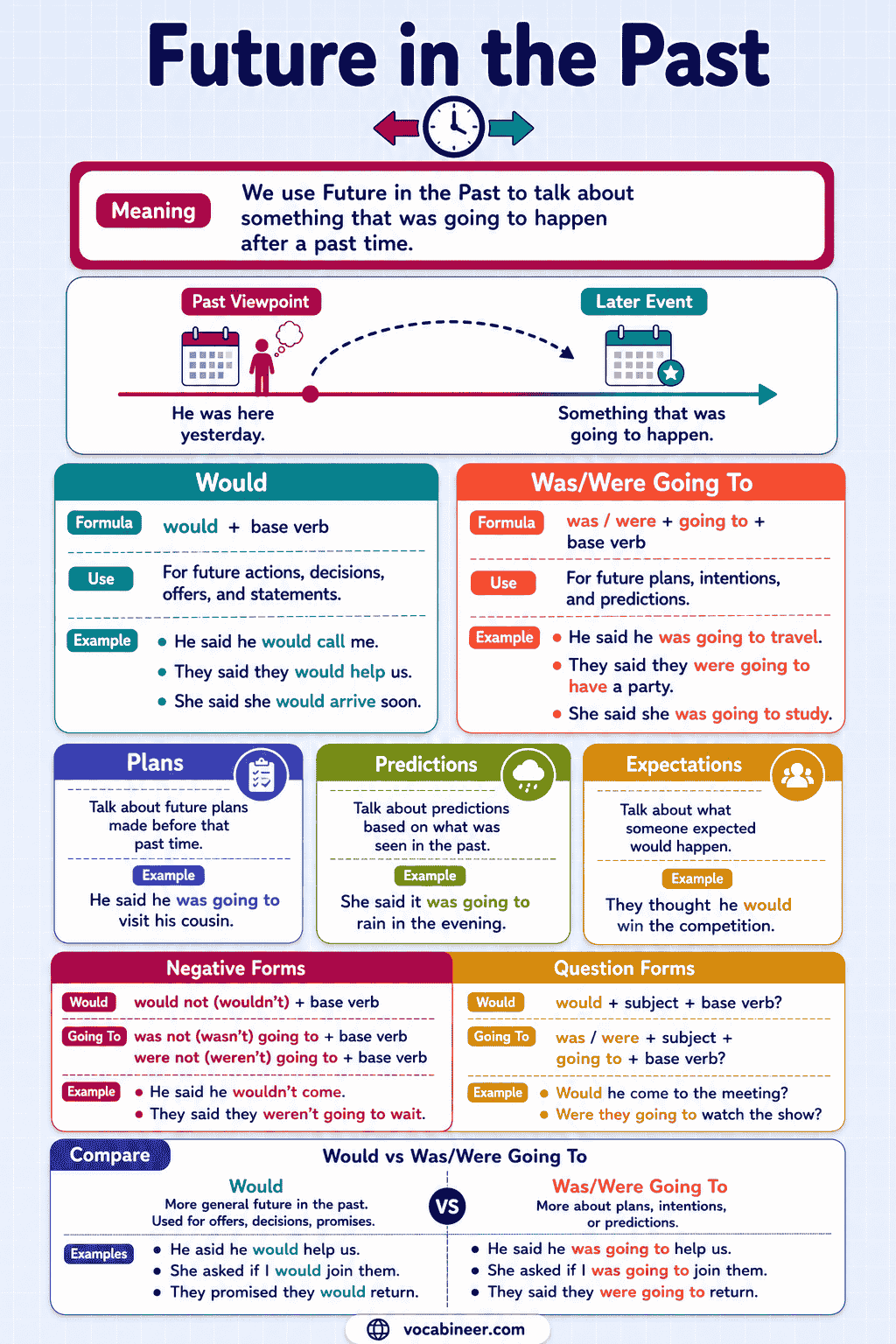
Future in the Past helps learners describe an event or situation that was still future from an earlier point in the past. It is useful in reported speech, past plans, arrangements, expectations, biographies, and narratives because English often needs to show that one event came later than another past reference point.
Future in the Past does not use one fixed tense formula. English commonly expresses it with would + V1, was/were going to + V1, Past Continuous, and was/were to + V1, depending on whether the meaning involves an expectation, intention, arrangement, or later development.
In This Page
What Is Future in the Past?
Future in the Past expresses an event or situation that was still future from a particular point in the past.
Examples:
- In 2015, Maya believed she would become a doctor.
- He said he was going to start a new job the following week.
- I knew I was meeting Daniel the next day.
- The delegation was to arrive the following morning.
In each sentence, the first viewpoint belongs to the past, while another event lies later than that past point.
Future in the Past is therefore better understood as a time relationship rather than one single tense.
How Future in the Past Works
The key idea is the relationship between:
- an earlier past reference point
- an event or situation that was still later from that viewpoint
| Present or Future Viewpoint | Past Viewpoint |
|---|---|
| Maya thinks she will move abroad. | Maya thought she would move abroad. |
| I am going to start a course next month. | I was going to start a course the following month. |
| We are meeting Maya tomorrow. | We were meeting Maya the next day. |
Future in the Past keeps the later event ahead of the past reference point, even when both events are now past from the speaker’s present viewpoint.
For example:
- In 2018, Daniel believed he would move to London in 2020.
The belief belongs to 2018. The move lies later than that past point.
Main Forms of Future in the Past
English uses several grammatical forms for Future in the Past.
| Form | Core Function | Example |
|---|---|---|
| would + V1 | prediction, expectation, or future statement from a past viewpoint | She thought she would pass. |
| was/were going to + V1 | past plan or intention | They were going to move. |
| Past Continuous | arranged future event viewed from the past | I was meeting Maya the next day. |
| was/were to + V1 | formal arrangement, scheduled development, or narrative future | He was to become a famous writer. |
Each form expresses a different relationship to the later event.
Would + V1
Use:
S + would + V1
Examples:
- She thought she would pass the exam.
- I knew they would arrive late.
- He said he would call the next day.
- Everyone believed the event would be successful.
- Maya expected the journey would take several hours.
Would commonly expresses:
- a prediction from a past viewpoint
- an expectation from a past viewpoint
- a reported future statement
- a later event in a narrative
The main verb remains in V1 after would.
Correct:
- She thought he would come later.
- They believed the plan would work.
Incorrect:
- She thought he would came later.
- They believed the plan would worked.
Use:
would + V1
Was/Were Going To + V1
Use:
S + was/were + going to + V1
Examples:
- I was going to call you.
- She was going to travel the following weekend.
- They were going to move, but they changed their plans.
- We were going to leave, but the weather got worse.
- Daniel was going to study abroad the following year.
Use:
- was going to with I, he, she, and it
- were going to with you, we, and they
This form expresses a plan or intention that was future from a past viewpoint.
The planned event may or may not have happened.
For example:
- I was going to call Maya.
This sentence establishes the intention, but it does not confirm whether the call happened.
Past Continuous for Future Arrangements
Past Continuous can express an arranged event that was still future from an earlier past point.
Examples:
- It was September. Mary was starting school the next week.
- Our guests were arriving soon.
- I knew I was meeting Daniel the following day.
- She said she was flying to Karachi on Friday.
- We knew we were leaving early the next morning.
This use usually presents the later event as an arrangement rather than only an intention.
It is the past-viewpoint counterpart of Present Continuous used for future arrangements.
Was/Were To + V1
Use:
S + was/were + to + V1
Examples:
- He was to become a famous writer.
- I saw the house where I was to live for the next six months.
- The delegation was to arrive the following morning.
- The ceremony was to begin at noon.
This form can express:
- formal arrangements
- scheduled future events
- later narrative developments
- events presented as destined or expected
It is more formal and less common in everyday conversation than would or was/were going to.
Would in Reported Speech
Future in the Past commonly appears when a future statement is reported from a past reporting point.
In many such cases, will changes to would.
| Direct Speech | Reported Speech |
|---|---|
| “I will call you.” | He said he would call me. |
| “We will arrive at six.” | They said they would arrive at six. |
| “It will be difficult.” | She said it would be difficult. |
| “I will finish tomorrow.” | Daniel said he would finish the next day. |
The future event remains later than the reporting point, but the viewpoint has shifted into the past.
For example:
- Maya said, “I will travel next month.”
- Maya said she would travel the following month.
This section concerns future reference in reported speech rather than every rule of reported speech.
Future in the Past in Narratives and Biographies
Future in the Past also appears in storytelling, biographies, historical writing, and retrospective narration.
Examples:
- As a child, no one knew that she would become a famous scientist.
- In 1995, the company opened its first store. It would eventually expand across the country.
- He moved to London in 2001, where he would later build his career.
- The young athlete did not know that she would win an international title years later.
In these sentences, the writer starts from an earlier point in the story and refers to a later development.
This use is not ordinary reported speech. It expresses a later event relative to the narrative reference point.
Did the Future Event Actually Happen?
Future in the Past does not automatically state whether the later event actually happened.
Consider:
- He said he would call later.
The sentence reports his future intention or statement from a past viewpoint. It does not confirm the later call.
Another example:
- They were going to move, but they changed their plans.
The second clause confirms that the move did not happen.
Another:
- She was starting school the next week.
This presents the event as arranged, but additional context determines whether it actually occurred.
The central principle is:
Future in the Past describes how a later event was viewed from a past point; it does not automatically state the final outcome.
Would vs Was/Were Going To
| Feature | Would | Was/Were Going To |
|---|---|---|
| Structure | would + V1 | was/were + going to + V1 |
| Main meaning | expectation, prediction, or reported future statement | past plan or intention |
| Prior intention | not the main function | central |
| Reported speech | very common | useful for reporting plans |
| Event may fail to happen | yes | yes |
| Example | She thought she would pass. | She was going to study that night. |
| Another example | He said he would call. | He was going to call, but forgot. |
Would commonly expresses what someone expected, predicted, or said would happen later.
Was/were going to commonly expresses a plan or intention that already existed at the past reference point.
The distinction is useful but not absolute because context can allow some overlap.
Was/Were Going To vs Past Continuous
| Feature | Was/Were Going To | Past Continuous |
|---|---|---|
| Main meaning | plan or intention | arranged future event |
| Degree of organization | intention may exist without full details | usually more definite or arranged |
| Example | I was going to visit Maya the next week. | I was meeting Maya at three the next day. |
| Another example | We were going to travel soon. | We were flying on Friday morning. |
| Event may fail to happen | yes | yes |
| Core distinction | intention | arrangement |
A plan can later become an arrangement, so the forms can overlap in some contexts.
Future in the Past vs Ordinary Past
| Ordinary Past | Future in the Past |
|---|---|
| describes something already past at the reference point | describes something still later than the past reference point |
| She left the next day. | She said she would leave the next day. |
| He started work in June. | He knew he was going to start work in June. |
| Maya met Daniel on Friday. | Maya said she was meeting Daniel on Friday. |
The main difference is the time relationship.
Ordinary Past presents an event as past.
Future in the Past presents an event as still later than another past point.
Future-in-the-Past Would vs Habitual Would
The word would can express both future-in-the-past meaning and repeated past behavior. Context determines which meaning applies.
| Future in the Past | Habitual Would |
|---|---|
| refers to a later event from a past viewpoint | refers to repeated past action |
| He thought he would become a doctor. | Every summer, he would visit his grandparents. |
| She knew they would arrive later. | Every evening, they would walk together. |
| future relative to past | repeated past behavior |
| often expresses expectation or prediction | expresses habit or repeated action |
Do not treat these two uses as the same grammatical meaning.
Time Expressions with Future in the Past
Future in the Past often uses expressions that establish a time later than the past reference point.
Common expressions include:
- the next day
- the following day
- the following week
- the following month
- the following year
- later
- soon
- in a few days
- that evening
Examples:
- He said he would call the next day.
- She was going to leave later.
- They were arriving the following week.
- Daniel believed he would finish in a few days.
These expressions help establish the later time but do not automatically determine the grammatical form.
Common Time-Expression Changes
Reported contexts can shift some future expressions when the viewpoint moves into the past.
| Original Expression | Past-Viewpoint Expression |
|---|---|
| tomorrow | the next day / the following day |
| next week | the following week |
| next month | the following month |
| next year | the following year |
| later today | later that day |
Example:
- “I will call you tomorrow.”
- He said he would call me the next day.
These changes depend on context, so they should not be treated as mechanical rules in every sentence.
Common Future in the Past Mistakes
Future in the Past mistakes commonly involve incorrect backshift, the wrong future form, verb form errors after would, or misunderstanding whether the later event happened.
Using will instead of would after a past reporting point
Incorrect:
- He said he will call the next day.
Correct:
- He said he would call the next day.
A past reporting viewpoint commonly changes will to would.
Using present going to instead of past going to
Incorrect:
- She said she is going to move the following month.
Correct:
- She said she was going to move the following month.
The viewpoint is past, so the form of be normally shifts to the past.
Using Present Continuous instead of Past Continuous for a past-viewpoint arrangement
Incorrect:
- He said he is meeting Maya the next day.
Correct:
- He said he was meeting Maya the next day.
Past Continuous marks the arrangement from the earlier past viewpoint.
Using the wrong verb form after would
Incorrect:
- She thought he would came later.
Correct:
- She thought he would come later.
Use V1 after would.
Assuming was going to means the event happened
Incorrect assumption:
- She was going to travel, so she definitely traveled.
Correct interpretation:
- Was going to expresses the earlier plan. Additional context determines whether the action occurred.
Confusing Future-in-the-Past Would and Habitual Would
| Meaning | Example |
|---|---|
| Future in the Past | He believed he would succeed. |
| Past habit | Every evening, he would read for an hour. |
The first refers to a later event from a past viewpoint. The second describes repeated past behavior.
Confusing a plan with an arrangement
| Plan or Intention | Arrangement |
|---|---|
| She was going to visit Maya. | She was meeting Maya at three. |
The first marks an intention. The second more directly marks an arranged event.
FAQs
Future in the Past expresses an event or situation that was still future from an earlier past reference point. English uses forms such as would, was/were going to, Past Continuous, and was/were to to express this relationship.
Would + V1 commonly expresses a prediction, expectation, or future statement from a past viewpoint. It also commonly represents will when future meaning is reported from a past reporting point.
Would commonly expresses expectation, prediction, or a reported future statement, while was/were going to commonly expresses a plan or intention that already existed at the past reference point.
Yes. Past Continuous can express an arranged future event viewed from a past point, as in I knew I was meeting Daniel the next day.
No. Future in the Past establishes how the event was viewed from the earlier past point. The later event may have happened, may not have happened, or may require additional context to determine the outcome.
Read More
- 12 English Tenses Chart
- All Tenses Rules and Formula
- English Tenses with Examples
- Present Tenses in English
- Past Tenses in English
- Future Tenses in English
- Be Going To in English