

The structure be going to helps learners express future plans, intentions, and predictions based on present evidence. It is especially useful when a decision already exists before speaking or when the current situation provides evidence about what is likely to happen next.
Learners need to understand the pattern am/is/are + going to + V1, choose the correct form of be, form negatives and questions correctly, and distinguish be going to from will, Present Continuous arrangements, and Present Simple schedules.
In This Page
What Does Be Going To Mean?
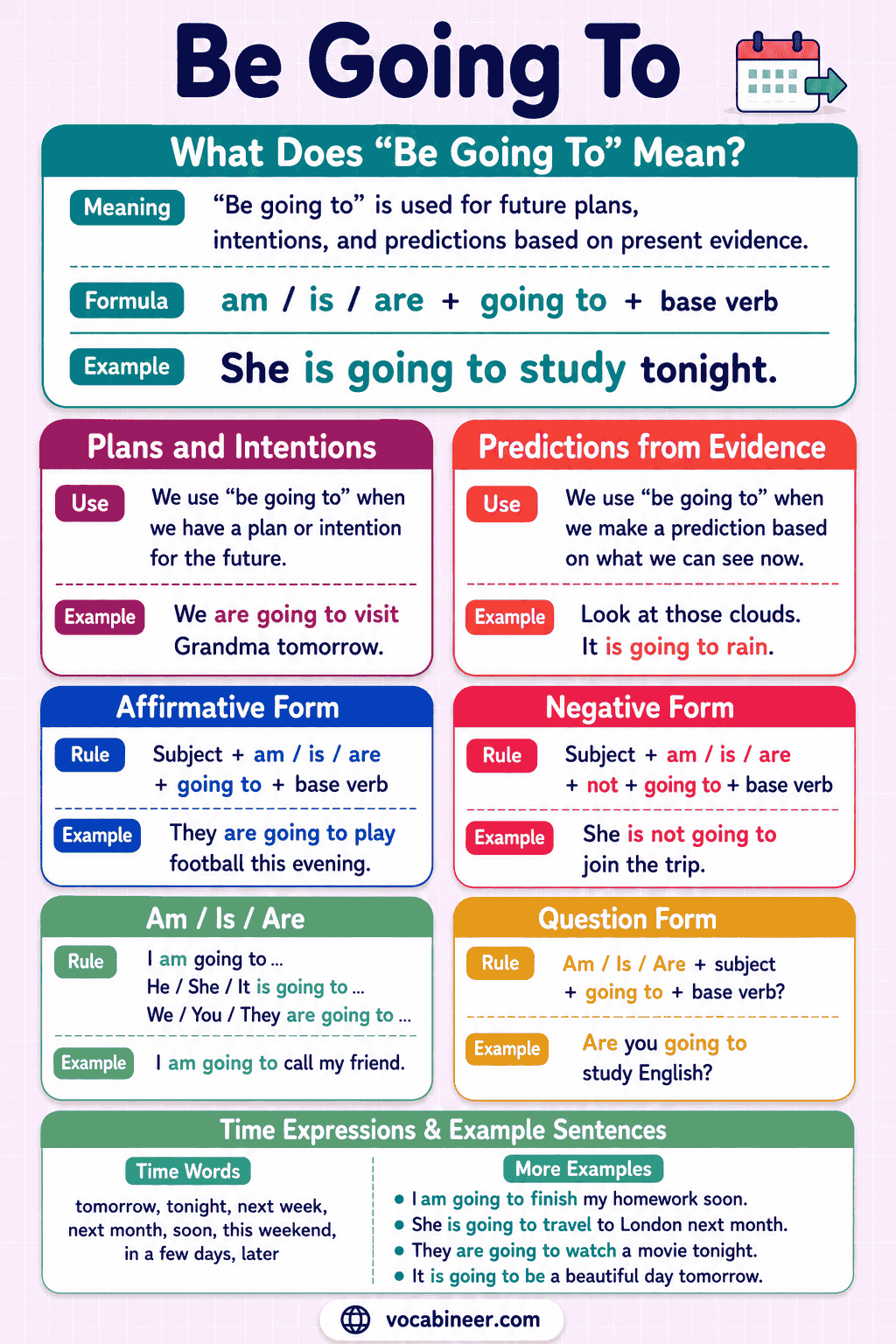
Be going to is a common English structure used to express future meaning.
Its basic structure is:
S + am/is/are + going to + V1
Examples:
- I am going to study tonight.
- She is going to travel next week.
- We are going to start early.
- They are going to move next month.
Be going to commonly expresses:
- a plan or intention already formed
- a prediction based on present evidence
It can also express a strong instruction in some contexts.
Be going to is an important future structure, but it is not normally listed as one of the four traditional future tense forms.
How to Form Be Going To
The structure requires three main parts:
- the correct form of be
- going to
- the main verb in V1
Am, Is, and Are with Different Subjects
The form of be changes according to the subject.
| Subject | Form of Be | Example |
|---|---|---|
| I | am | I am going to study. |
| he / she / it | is | She is going to travel. |
| you / we / they | are | They are going to move. |
The form of be agrees with the subject. The pattern going to + V1 remains unchanged.
Why V1 Follows Going To
The main verb uses its base form after going to.
Correct:
- She is going to travel.
- They are going to move.
- I am going to study.
Incorrect:
- She is going to travels.
- They are going to moved.
- I am going to studied.
Use this pattern:
am/is/are + going to + V1
Affirmative Sentences
The affirmative structure is:
S + am/is/are + going to + V1
Examples:
- I am going to study tonight.
- Maya is going to visit her aunt.
- Daniel is going to start a new course.
- We are going to leave early.
- They are going to move next month.
Common contractions include:
- I am → I’m
- he is → he’s
- she is → she’s
- we are → we’re
- they are → they’re
Examples:
- I’m going to call her.
- She’s going to travel next week.
- We’re going to start early.
- They’re going to move soon.
Negative Sentences
The negative structure is:
S + am/is/are + not + going to + V1
Examples:
- I am not going to stay.
- She is not going to travel.
- Daniel is not going to join us.
- They are not going to move this year.
Common contractions include:
- is not → isn’t
- are not → aren’t
Examples:
- She isn’t going to come.
- We aren’t going to wait much longer.
- They aren’t going to leave early.
Questions and Short Answers
The question structure is:
Am/Is/Are + S + going to + V1?
Examples:
- Are you going to study tonight?
- Is she going to travel next week?
- Is Daniel going to call?
- Are they going to move?
Short answers use the correct form of be.
- Are you going to study tonight?
Yes, I am. / No, I’m not. - Is she going to travel?
Yes, she is. / No, she isn’t. - Are they going to move?
Yes, they are. / No, they aren’t.
Wh-Questions
Wh-questions commonly use:
Wh-word + am/is/are + S + going to + V1?
Examples:
- What are you going to do?
- Where is she going to stay?
- When are they going to leave?
- Why is he going to change jobs?
- Who are you going to invite?
The main verb remains in V1.
Be Going To with Be
The main verb itself can also be be.
Structure:
S + am/is/are + going to + be + complement
Examples:
- It is going to be difficult.
- She is going to be busy tomorrow.
- They are going to be late.
- I am going to be ready by six.
The first form of be changes according to the subject. The second be remains in the base form after going to.
When to Use Be Going To
The two main uses are plans or intentions and predictions based on present evidence.
Plans and Intentions
Use be going to when a plan or intention already exists before the moment of speaking.
Examples:
- I am going to study tonight.
- We are going to visit our relatives this weekend.
- Maya is going to look for a new apartment.
- They are going to start a business next year.
- Daniel is going to learn Spanish.
The plan does not need to include every practical detail. The important point is that the intention already exists.
Predictions Based on Present Evidence
Use be going to when present evidence supports the expected future result.
Examples:
- Look at those clouds. It is going to rain.
- Be careful! You are going to fall.
- That glass is shaking. It is going to break.
- The team is playing very well. They are going to win.
The prediction relates directly to evidence available in the current situation.
Strong Commands and Instructions
In some contexts, be going to can express a strong instruction.
Examples:
- You are going to clean your room now.
- You are going to finish this work before dinner.
This use is secondary to plans, intentions, and evidence-based predictions.
Be Going To vs Will
| Feature | Be Going To | Will |
|---|---|---|
| Structure | am/is/are + going to + V1 | will + V1 |
| Prior plan | commonly used | less typical for a pre-decided plan |
| Decision made now | less typical | commonly used |
| Prediction | often based on present evidence | often expresses a general prediction or belief |
| Offer or promise | not the usual default | commonly used |
| Plan example | I am going to call Maya tonight. | I will call her now. |
| Prediction example | Look at those clouds. It is going to rain. | I think it will rain tomorrow. |
Be going to commonly marks a prior intention, while will commonly marks a decision made at the moment of speaking.
For predictions, be going to often relates the prediction to present evidence, while will commonly expresses a general belief or prediction.
These distinctions are useful but not absolute. Some contexts allow either form.
Be Going To vs Present Continuous
| Feature | Be Going To | Present Continuous |
|---|---|---|
| Main meaning | plan or intention | arranged future event |
| Degree of organization | plan may exist without full details | often organized or agreed |
| Time or place details | not always required | often more definite |
| Example | I am going to visit my aunt next week. | I am visiting my aunt at three on Tuesday. |
| Another example | We are going to travel soon. | We are flying on Friday morning. |
Be going to commonly expresses an intention or plan. Present Continuous commonly expresses an arranged future event.
The distinction is not absolute because a future event can be both planned and arranged.
Be Going To vs Present Simple for Schedules
| Feature | Be Going To | Present Simple |
|---|---|---|
| Main meaning | personal plan or intention | fixed schedule or timetable |
| Control | usually connected to a person’s plan | usually externally fixed |
| Example | We are going to leave early. | The train leaves at seven. |
| Another example | She is going to attend the event. | The event starts at six. |
Present Simple commonly suits fixed timetables and schedules. Be going to commonly suits personal plans or intentions.
Was and Were Going To
The structure was/were going to expresses a plan or intention viewed from a past reference point.
Basic structure:
S + was/were + going to + V1
Examples:
- I was going to call you.
- She was going to travel last weekend.
- They were going to move, but they changed their plans.
- We were going to leave, but it started raining.
Use:
- was going to with I, he, she, and it
- were going to with you, we, and they
The intended action may or may not have happened.
A useful rule is:
Was/were going to expresses a future intention viewed from a past reference point.
Gonna in Informal English
Gonna is an informal spoken form of going to.
| Informal Speech | Standard Writing |
|---|---|
| I’m gonna call her. | I’m going to call her. |
| They’re gonna leave soon. | They’re going to leave soon. |
| She’s gonna study tonight. | She’s going to study tonight. |
Use going to in standard and formal writing. Gonna mainly occurs in informal speech and informal representations of speech.
Going To Go
The structure going to go is grammatical.
Example:
- I am going to go to the cinema tonight.
Present Continuous may sound more natural when the movement itself forms part of an arrangement.
| Be Going To | Present Continuous |
|---|---|
| I am going to go to the cinema tonight. | I am going to the cinema tonight. |
| presents an intention | can present an arranged movement |
Do not treat going to go as incorrect.
Future-Time Expressions with Be Going To
Expressions such as tonight, tomorrow, next week, next month, soon, later, and this weekend can provide future context.
Examples:
- I am going to study tonight.
- They are going to move next month.
- She is going to call later.
These expressions do not automatically require be going to. The intended meaning determines the future form.
Common Be Going To Mistakes
Be going to mistakes commonly involve the form of be, the main verb, question structure, negatives, or confusion with other future forms.
Omitting be
Incorrect:
- I going to study tonight.
Correct:
- I am going to study tonight.
The structure requires am, is, or are.
Using the wrong form of be
Incorrect:
- She are going to travel.
Correct:
- She is going to travel.
The form of be must agree with the subject.
Adding -s to the main verb
Incorrect:
- She is going to travels.
Correct:
- She is going to travel.
The main verb remains in V1.
Using V2 after going to
Incorrect:
- They are going to moved.
Correct:
- They are going to move.
Using to twice
Incorrect:
- I am going to to study.
Correct:
- I am going to study.
Using do in questions
Incorrect:
- Do you going to study tonight?
Correct:
- Are you going to study tonight?
Questions use the correct form of be before the subject.
Using the wrong negative structure
Incorrect:
- She doesn’t going to come.
Correct:
- She isn’t going to come.
The negative uses be + not.
Confusing Be Going To and Will
| Intended Meaning | Less Suitable Choice | Better Choice |
|---|---|---|
| spontaneous decision | The phone is ringing. I am going to answer it. | I will answer it. |
| prior plan | I decided yesterday. I will study tonight. | I am going to study tonight. |
Confusing Be Going To and Present Continuous
| Meaning | Example |
|---|---|
| plan or intention | I am going to visit Maya next week. |
| arranged event | I am meeting Maya at three on Tuesday. |
The distinction is useful but not absolute.
FAQs
Be going to commonly expresses a future plan or intention that already exists before the moment of speaking, or a prediction based on present evidence.
The basic structure is S + am/is/are + going to + V1. The form of be changes according to the subject.
Be going to commonly expresses prior plans or predictions based on present evidence, while will commonly expresses spontaneous decisions, offers, promises, and general predictions.
Be going to commonly expresses a plan or intention, while Present Continuous commonly expresses an arranged future event with more definite practical details.
Was/were going to + V1 expresses a plan or intention viewed from a past reference point. The intended action may or may not have happened.
Read More
- 12 English Tenses Chart
- All Tenses Rules and Formula
- English Tenses with Examples
- Present Tenses in English
- Past Tenses in English
- Future Tenses in English