

Present Perfect Tense sentences help learners connect past actions, experiences, and situations with the present. Because this tense often appears in everyday English, understanding its sentence patterns makes it easier to talk about recent events, life experiences, unfinished time, present results, and situations that continue until now.
This article includes 120 Present Perfect Tense sentences with examples, followed by clear explanations of have/has + past participle, life experiences, ever/never, just/already/yet, since/for, unfinished time, been/gone, and the difference between Present Perfect and Past Simple.
In This Page
What Are Present Perfect Tense Sentences?
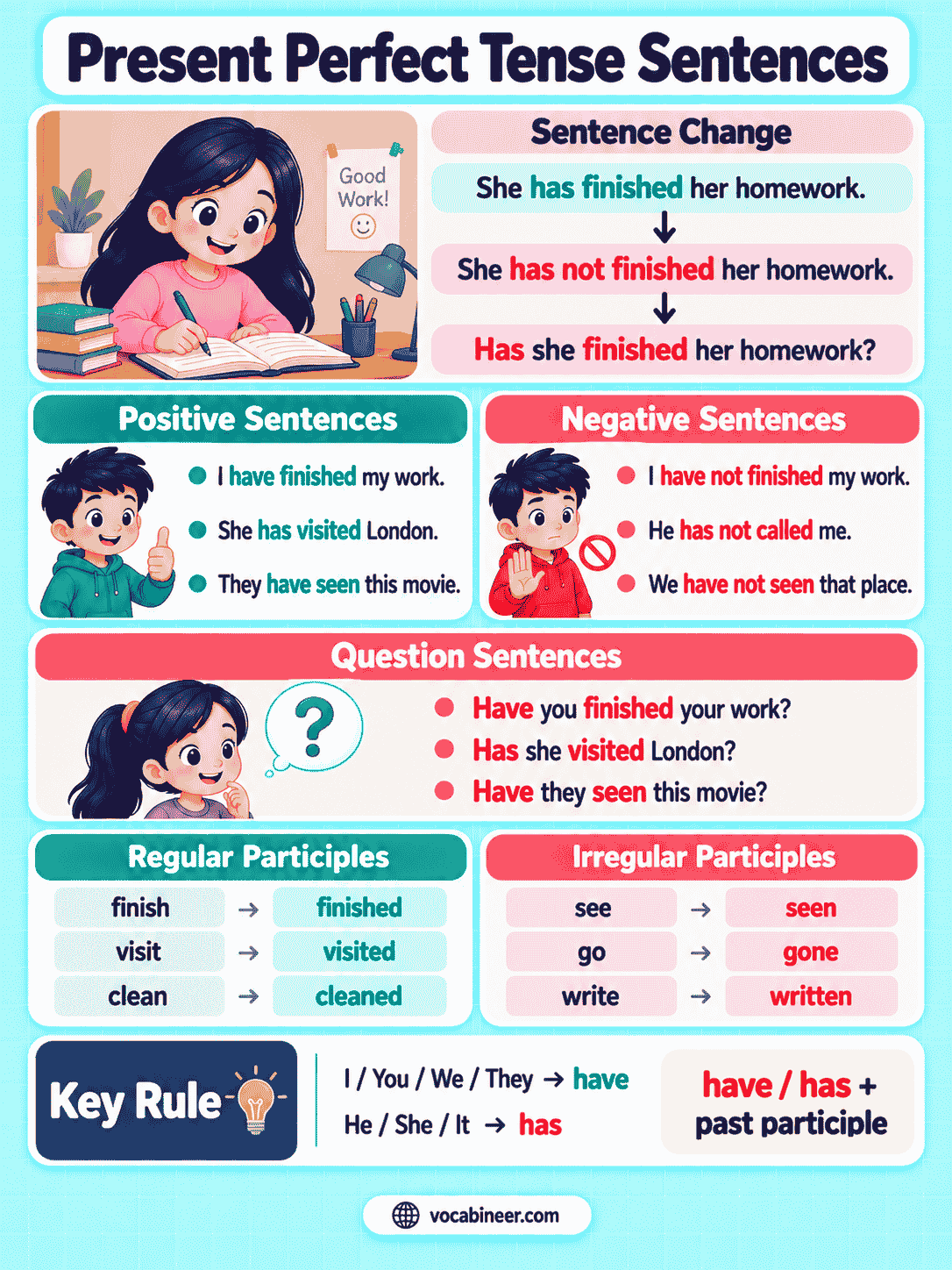
Present Perfect Tense sentences use have or has + past participle to connect an earlier action, event, or state with the present.
For example:
- I have finished my homework.
- She has visited London.
- We have lived here for five years.
- He has just arrived.
Depending on the context, Present Perfect can describe an experience, a recent action, a current result, an unfinished period, or a state that continues until now. Therefore, meaning matters just as much as structure.
120 Present Perfect Tense Sentences
The following 120 examples are grouped by function so learners can see how the tense changes across affirmative sentences, negatives, questions, experiences, recent actions, present results, and continuing situations.
Affirmative Present Perfect Sentences
- I have finished my homework.
- She has cleaned her room.
- He has bought a new phone.
- We have visited that museum.
- They have completed the project.
- My brother has gone to work.
- Recently, I have seen that film again.
- She has written three emails.
- Meanwhile, we have made dinner.
- The children have finished their work.
Negative Present Perfect Sentences
- I haven’t eaten breakfast yet.
- However, she hasn’t called me.
- He hasn’t arrived yet.
- We haven’t seen that movie.
- They haven’t completed the task.
- So far, my brother hasn’t returned home.
- I haven’t read that book.
- Likewise, she hasn’t answered my message.
- We haven’t decided yet.
- Unfortunately, the bus hasn’t arrived yet.
Present Perfect Questions
- Have you finished your work?
- Has she called you?
- Has he arrived yet?
- Have they seen this film?
- Have we met before?
- Where have you been?
- What has she done?
- Why has he left early?
- How long have they lived here?
- Finally, how many books have you read?
Present Perfect Sentences for Life Experiences
- I have visited Italy twice.
- She has ridden a horse.
- He has climbed a mountain.
- Over the years, we have travelled abroad many times.
- They have tried sushi.
- My sister has flown in a helicopter.
- Once, I have stayed in a tent.
- She has met a famous actor.
- We have seen the ocean at sunrise.
- In addition, he has travelled by ship.
Present Perfect with Ever and Never
- Have you ever visited Paris?
- Has she ever flown alone?
- Have they ever eaten sushi?
- I have never seen snow.
- She has never driven a car.
- He has never met my brother.
- We have never stayed there.
- Similarly, they have never tried this food.
- My mother has never travelled abroad.
- Even now, I have never forgotten that day.
Present Perfect with Just
- I have just finished lunch.
- She has just arrived.
- He has just called me.
- We have just eaten.
- They have just left.
- My brother has just returned home.
- Meanwhile, the train has just departed.
- Our teacher has just entered the classroom.
- I have just received your message.
- Finally, she has just started her new job.
Present Perfect with Already
- I have already finished the work.
- She has already eaten dinner.
- We have already booked the tickets.
- He has already seen that film.
- They have already completed the first stage.
- My father has already paid the bill.
- In fact, I have already sent the email.
- She has already read the report.
- We have already made a decision.
- By now, the children have already gone to bed.
Present Perfect with Yet
- Have you finished yet?
- Has she arrived yet?
- I haven’t eaten yet.
- He hasn’t called yet.
- They haven’t decided yet.
- We haven’t started yet.
- Unfortunately, she hasn’t replied yet.
- The teacher hasn’t arrived yet.
- I haven’t received the email yet.
- So far, my parents haven’t returned yet.
Present Perfect for Present Results
- I have lost my keys.
- She has broken her arm.
- He has forgotten his password.
- They have missed the bus.
- The battery has run out.
- We have finished the report.
- Unfortunately, my phone has stopped working.
- Someone has opened the window.
- The children have made a mess.
- Meanwhile, she has changed her hairstyle.
Present Perfect with Since and For
- I have lived here since 2020.
- She has worked there for six years.
- We have known each other since school.
- He has owned this car for a decade.
- They have been married for twenty years.
- Since 2018, my uncle has lived abroad.
- I have had this phone for two years.
- She has known him since childhood.
- We have stayed here for a week.
- Since morning, the shop has been open.
Present Perfect for Unfinished Time
- I have had two meetings today.
- She has called three times this week.
- We have visited them twice this year.
- He has read four books this month.
- So far, they have made good progress.
- Today, I have completed five tasks.
- Until now, she hasn’t had any problems.
- This year, we have learned a lot.
- He has written six pages so far.
- Up to now, they have achieved excellent results.
Present Perfect with Been, Gone, and Continuing States
- I have been to Japan twice.
- She has been to London several times.
- Tom has gone to the bank.
- My parents have gone to the market.
- We have been to that restaurant before.
- Meanwhile, Sarah has gone to the doctor.
- I have known her for ten years.
- Since January, he has had that car.
- We have been friends since childhood.
- For eight years, she has owned this house.
How Present Perfect Sentences Are Formed
The Present Perfect combines have or has with the past participle of the main verb. Although the structure is simple, the auxiliary changes according to the subject.
| Form | Structure | Example |
|---|---|---|
| affirmative | subject + have/has + past participle | She has finished. |
| negative | subject + haven’t/hasn’t + past participle | She hasn’t finished. |
| question | Have/Has + subject + past participle? | Has she finished? |
Use have with I, you, we, and they. By contrast, has goes with he, she, it, and singular subjects.
Present Perfect Sentences with Have and Has
The subject determines which auxiliary is correct.
Using Have
- I have completed my homework.
- You have improved a lot.
- We have visited that museum.
- They have finished the project.
- The students have passed the test.
Using Has
- She has written an email.
- He has bought a new phone.
- The baby has fallen asleep.
- My brother has gone to work.
- The teacher has checked our work.
Therefore, once the subject is clear, choosing between have and has becomes straightforward.
Negative Present Perfect Sentences
Negative sentences use have not / haven’t or has not / hasn’t followed by the past participle.
Examples:
- I haven’t finished yet.
- She hasn’t called me.
- He hasn’t arrived.
- We haven’t seen that film.
- They haven’t completed the work.
- My brother hasn’t eaten breakfast.
In many cases, the negative means that something has not happened up to the present time. For example, He hasn’t arrived yet suggests that his arrival is still expected.
Present Perfect Questions
Questions place have or has before the subject.
Yes/No Questions
- Have you finished?
- Has she called?
- Has he arrived?
- Have they seen the film?
- Have we met before?
WH-Questions
- Where have you been?
- What has she done?
- Why has he left?
- How long have they lived here?
- How many books have you read?
Short answers repeat the auxiliary. For example:
- Have you finished? — Yes, I have. / No, I haven’t.
- Has she arrived? — Yes, she has. / No, she hasn’t.
- Have they called? — Yes, they have. / No, they haven’t.
Present Perfect for Life Experiences
One of the main uses of Present Perfect is to describe experiences at any time before now when the exact past date is not important.
Examples:
- I have visited Italy.
- She has ridden a horse.
- He has climbed a mountain.
- We have travelled abroad.
- They have tried sushi.
- My sister has flown in a helicopter.
The focus is on whether the experience has happened. Therefore, a finished-time expression such as in 2022 is usually unnecessary in this use.
Ever and Never in Present Perfect Sentences
Ever and never are especially useful when discussing experience.
Using Ever
Use ever when asking whether something has happened at any time up to now.
- Have you ever visited London?
- Has she ever ridden a horse?
- Have they ever tried sushi?
- Have you ever slept outdoors?
Using Never
Use never when an experience has not happened at any point up to now.
- I have never seen snow.
- She has never driven a car.
- He has never travelled abroad.
- We have never stayed there.
In short, ever asks about experience, whereas never shows that the experience has not occurred.
Just, Already, and Yet
These three words commonly appear with recent or expected actions, but each one expresses a different relationship to the present.
Just
Just describes something that happened very recently.
- I have just finished lunch.
- She has just arrived.
- He has just called.
- They have just left.
Because the action is very recent, its connection with the present is usually obvious.
Already
Already indicates that something has happened before now, sometimes sooner than expected.
- I have already finished.
- She has already eaten.
- We have already booked the tickets.
- He has already seen the film.
Usually, already appears between have/has and the past participle.
Yet
By contrast, yet commonly appears at the end of questions and negative sentences.
- Have you finished yet?
- Has she arrived yet?
- I haven’t eaten yet.
- They haven’t decided yet.
Together, these three words make recent-action sentences more precise.
Recent Actions and Present Results
Present Perfect often describes a past action when its result still matters now.
Examples:
- I have lost my keys.
- She has broken her arm.
- He has forgotten his password.
- They have missed the bus.
- The battery has run out.
- My phone has stopped working.
For instance, I have lost my keys normally means that I still cannot find them. Therefore, the present result matters more than the exact time when the loss happened.
Present Perfect for Unfinished Time
Present Perfect also works naturally when the time period is still continuing.
Examples:
- I have had two meetings today.
- She has called three times this week.
- We have visited them twice this year.
- He has read four books this month.
- They have made good progress today.
Expressions such as today, this week, this month, and this year can describe periods that have not finished yet.
Finished and Unfinished Time
The difference between finished and unfinished time explains many Present Perfect choices.
| Unfinished Time | Finished Time |
|---|---|
| today | yesterday |
| this week | last week |
| this month | last month |
| this year | last year |
| so far | in 2020 |
Compare:
- I have seen her twice this week.
- I saw her twice last week.
Because this week may still be continuing, Present Perfect is natural. In contrast, last week is finished, so Past Simple fits better.
Since and For with Present Perfect
Present Perfect frequently appears with since and for when a situation began in the past and continues now.
Since for a Starting Point
Use since with the point when something began.
- I have lived here since 2020.
- She has worked there since Monday.
- We have known each other since school.
- He has owned the shop since January.
For for a Duration
Use for with the length of time.
- I have lived here for five years.
- She has worked there for six months.
- He has owned the shop for a decade.
- They have been married for twenty years.
Therefore, since identifies the starting point, while for identifies the duration.
Present Perfect with How Long
Questions with how long often ask about situations that started in the past and remain true now.
Examples:
- How long have you lived here?
- How long has she worked there?
- How long have they known each other?
- How long has he had that car?
Answers commonly use since or for. For example:
- I have lived here for five years.
- She has worked there since 2021.
States That Continue Until Now
Present Perfect is especially common with stative verbs when a situation began earlier and still remains true.
Examples:
- I have known her for ten years.
- She has owned the house since 2018.
- We have lived here for five years.
- He has had that car since January.
- They have been friends since childhood.
Unlike a completed event, these situations continue into the present. As a result, the Present Perfect creates a clear link between past and present.
So Far, Until Now, and Up to Now
These expressions emphasize progress from an earlier point to the present.
Examples:
- We have completed five tasks so far.
- She hasn’t had any problems until now.
- They have made good progress up to now.
- I have read three chapters so far.
- He has answered every question so far.
Because the period remains open, Present Perfect fits naturally.
Been vs Gone in Present Perfect
Been and gone can communicate different meanings.
| Form | Meaning |
|---|---|
| have/has been to | visited and returned |
| have/has gone to | went there and has not returned yet |
Examples:
- I have been to Japan twice.
- She has been to London several times.
- Tom has gone to the bank.
- My parents have gone to the market.
So, She has been to London means she visited and returned. In contrast, She has gone to London means she is there or is still on the way.
Regular and Irregular Past Participles
Present Perfect requires a past participle, not simply a Past Simple verb.
| Base Verb | Past Participle |
|---|---|
| work | worked |
| finish | finished |
| go | gone |
| see | seen |
| write | written |
| eat | eaten |
| take | taken |
| break | broken |
| buy | bought |
| speak | spoken |
Regular verbs often use the same form for Past Simple and the past participle. Irregular verbs, however, may change differently and usually need to be learned individually.
Present Perfect vs Past Simple
Present Perfect connects an earlier event or state with the present, whereas Past Simple normally places an event in a finished past time.
| Present Perfect | Past Simple |
|---|---|
| exact past time often unstated | finished past time stated or understood |
| connected with the present | treated as a finished past event |
| I have seen that film. | I saw that film yesterday. |
| She has visited Paris. | She visited Paris in 2022. |
| We have spoken this week. | We spoke last week. |
Present Perfect normally avoids finished-time expressions such as:
- yesterday
- last night
- last week
- last year
- in 2020
- two days ago
Incorrect:
- I have seen him yesterday.
Correct:
- I saw him yesterday.
Therefore, always consider whether the past time is finished before choosing between these two tenses.
Everyday Present Perfect Sentences
Present Perfect appears frequently in everyday conversation because many recent actions have a clear connection with now.
- I have finished my homework.
- She has made dinner.
- He has gone to work.
- We have cleaned the house.
- They have arrived home.
- My brother has bought a new phone.
- Recently, I have lost my keys.
- She has just called me.
- We have already eaten.
- However, they haven’t arrived yet.
These examples show how naturally the tense appears outside formal grammar exercises.
Present Perfect Tense Sentences for Kids
Children and beginners can begin with short, familiar examples:
- I have finished my homework.
- She has eaten an apple.
- He has lost his pencil.
- We have seen that movie.
- They have visited the zoo.
- My teacher has given us homework.
- I have never ridden a horse.
- Recently, she has just arrived.
- We have already eaten.
- However, he hasn’t finished yet.
These examples combine familiar vocabulary with the most useful Present Perfect patterns.
Common Present Perfect Sentence Mistakes
A few errors cause most beginner problems. Therefore, correcting these patterns can improve accuracy quickly.
Using the wrong past participle
Incorrect: I have went home.
Correct: I have gone home.
Because Present Perfect requires the past participle, went cannot follow have.
Using Has with I, You, We, or They
Incorrect: They has finished.
Correct: They have finished.
By contrast, has belongs with he, she, it, and singular subjects.
Using Have with He, She, or It
Incorrect: She have arrived.
Correct: She has arrived.
Therefore, subject–auxiliary agreement must stay consistent.
Using Present Perfect with a finished past time
Incorrect: I have seen him yesterday.
Correct: I saw him yesterday.
Since yesterday is finished, Past Simple is the appropriate choice.
Confusing Since and For
Incorrect: I have lived here since five years.
Correct: I have lived here for five years.
Remember that since gives a starting point, whereas for gives a duration.
Using the Past Simple form instead of the past participle
Incorrect: She has wrote a letter.
Correct: She has written a letter.
Again, the verb after have/has must be the past participle.
Present Perfect vs Present Perfect Continuous
Both forms connect the past with the present, but their focus often differs.
| Present Perfect | Present Perfect Continuous |
|---|---|
| often emphasizes result, completion, or quantity | often emphasizes activity or duration |
| I have written three emails. | I have been writing emails all morning. |
| She has read five chapters. | She has been reading for two hours. |
| We have painted three rooms. | We have been painting all day. |
Present Perfect often suits completed results or quantities. By contrast, Present Perfect Continuous usually emphasizes the activity itself or how long it has continued.
FAQs
Examples include I have finished my homework, She has visited London, We have lived here for five years, and He has just arrived. In each case, the earlier action or state has a connection with the present.
Use haven’t or hasn’t + past participle. For example, I haven’t finished yet and She hasn’t called me are both correct.
Place have or has before the subject. For instance, you can ask Have you finished?, Has she arrived?, or Where have they been?
Since identifies a starting point, such as since 2020. By contrast, for identifies a duration, such as for five years.
Present Perfect connects an earlier action or state with now and usually avoids finished past-time expressions. Past Simple, however, refers to an event in a completed past period such as yesterday, last year, or in 2020.
Been to usually means someone visited a place and returned. Gone to, on the other hand, normally means the person went there and has not returned yet.
Read More
- 12 English Tenses Chart
- All Tenses Rules and Formula
- English Tenses with Examples
- Present Tenses in English
- Past Tenses in English
- Future Tenses in English
- Be Going To in English