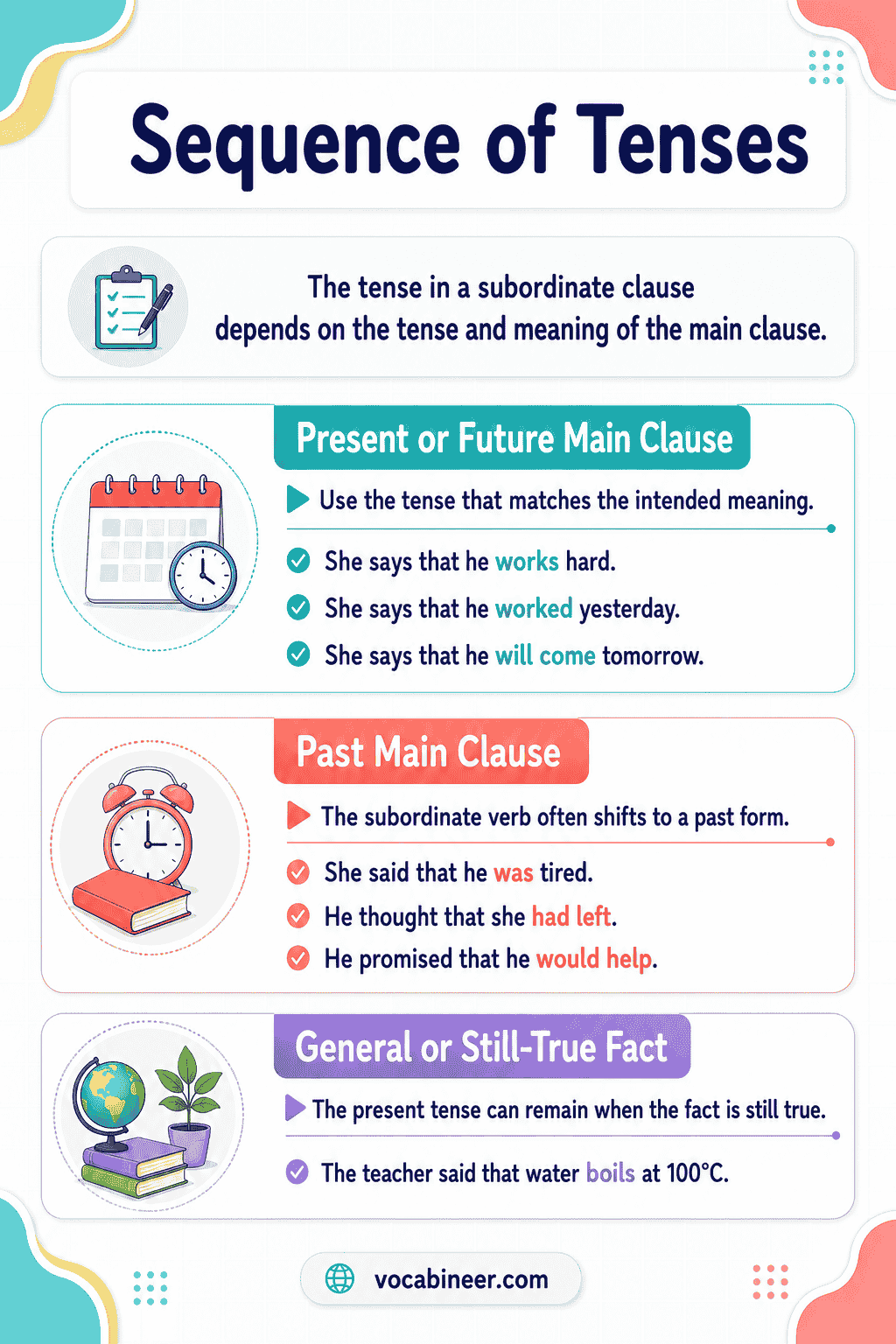
Sequence of tenses explains how verb tenses relate across connected clauses. It helps learners understand why one tense may stay the same, shift backward, or change according to whether an action happens at the same time as, before, or after another reference point.
Learning sequence of tenses makes reported speech, subordinate clauses, future-in-the-past forms, and time clauses easier to use accurately. The key is to follow the time relationship between events rather than applying a mechanical rule that every subordinate verb must match the tense of the main clause.
In This Page
What Is the Sequence of Tenses?
Sequence of tenses is the relationship between verb tenses in connected clauses.
It commonly involves:
- a main clause
- a subordinate clause
- a reporting verb
- an earlier, simultaneous, or later action
- a future event viewed from a past point
A useful principle is:
Sequence of tenses follows the time relationship between ideas, not a fixed tense-matching rule.
For example:
- She says she is tired.
- She said she was tired.
- She said she had finished.
- She said she would call.
Each subordinate tense reflects a different relationship to the main clause.
Sequence of Tenses at a Glance
| Main or Reporting Clause | Related Clause | Typical Pattern |
|---|---|---|
| present reporting verb | original tense often remains | She says she is tired. |
| past reporting verb | backshift often occurs | She said she was tired. |
| past reporting verb + earlier action | Past Perfect commonly appears | She said she had finished. |
| past reporting verb + later action | would commonly expresses future in the past | She said she would call. |
| past reporting verb + Past Perfect | usually no further change | She said she had left. |
| universal or still-true fact | present may remain | He said the Earth moves around the Sun. |
The tense of the subordinate clause depends on relative time, reporting perspective, and whether the information remains true.
Main Clause and Subordinate Clause Tense Relationship
The action in a subordinate clause can be simultaneous with, earlier than, or later than the action or reference point in the main clause.
| Time Relationship | Example |
|---|---|
| simultaneous | She said she was tired. |
| earlier | She said she had finished. |
| later | She said she would call. |
Simultaneous Action
- She said she was tired.
Her tiredness existed at the same general time as the reported statement.
Earlier Action
- She said she had finished.
The finishing happened before the time of the statement.
Later Action
- She said she would call.
The call was still in the future from the earlier reporting point.
A strong rule is:
The subordinate tense should reflect whether its action is simultaneous with, earlier than, or later than the main reference point.
Present Reporting Verb vs Past Reporting Verb
The tense of the reporting verb strongly influences whether backshift occurs.
| Present Reporting Verb | Past Reporting Verb |
|---|---|
| original tense often remains | backshift commonly occurs |
| She says she likes coffee. | She said she liked coffee. |
| He says he is working. | He said he was working. |
| Maya says she has finished. | Maya said she had finished. |
With a present reporting verb, the original tense perspective usually remains current.
With a past reporting verb, English often shifts the subordinate tense backward.
Use this principle:
A present reporting verb usually keeps the original tense perspective, while a past reporting verb commonly causes backshift.
Backshift Rules in Reported Speech
Backshift means changing a tense to an earlier form when reporting something from a past viewpoint.
| Original Tense | Common Backshift |
|---|---|
| Present Simple | Past Simple |
| Present Continuous | Past Continuous |
| Present Perfect | Past Perfect |
| Past Simple | Past Perfect |
| Past Continuous | Past Perfect Continuous |
| Past Perfect | usually unchanged |
| will | would |
Examples:
- “I work here.” → She said she worked there.
- “I am working.” → She said she was working.
- “I have finished.” → She said she had finished.
- “I saw him.” → She said she had seen him.
- “I was waiting.” → She said she had been waiting.
- “I will call.” → She said she would call.
Backshift presents the reported information from an earlier time perspective.
Will to Would in Backshift
When a future event is reported from a past viewpoint, will commonly changes to would.
| Present or Direct Future | Future Viewed from the Past |
|---|---|
| He says he will call. | He said he would call. |
| She says she will return. | She said she would return. |
| I think they will arrive soon. | I thought they would arrive soon. |
For example:
- “I will call tomorrow.”
- He said he would call the next day.
The call remained future relative to the earlier reporting point.
Use this principle:
Would commonly expresses a future event viewed from an earlier past perspective.
Why Past Perfect Usually Does Not Change
Past Perfect already expresses an action that occurred before another past reference point, so it normally does not shift further.
Direct statement:
- “I had already finished.”
Reported statement:
- She said she had already finished.
Do not create another past form beyond Past Perfect.
Incorrect:
- She said she had had finished.
Correct:
- She said she had finished.
A useful rule is:
Past Perfect normally remains Past Perfect because it already marks earlier past time.
When Backshift Is Optional
Backshift is common after a past reporting verb, but it is not always required.
If information remains true, relevant, or current, the present tense can sometimes remain.
| Backshifted | Present Retained |
|---|---|
| She said she loved music. | She said she loves music. |
| He said he worked in London. | He said he works in London. |
| Maya said she was tired. | Maya said she is tired. |
The two choices can differ in emphasis.
- She said she lived in Paris.
This reports her situation from the earlier viewpoint without confirming whether it remains true. - She said she lives in Paris.
This explicitly presents the information as still true now.
Use this principle:
Backshift is common after a past reporting verb, but present tense can remain when the information is still true or currently relevant.
Still-True Facts vs Past-Only Facts
This distinction is especially important.
| Still True Now | Past-Only or Uncertain Now |
|---|---|
| She said she lives in Paris. | She said she lived in Paris. |
| He said he works for a bank. | He said he worked for a bank. |
| Maya said she likes classical music. | Maya said she liked classical music. |
| present form confirms current truth | past form reports the earlier situation without confirming the present |
A backshifted past form does not necessarily mean the information is false now.
For example:
- He said he worked for a bank.
This sentence does not automatically mean that he no longer works there. It simply reports the fact from the earlier perspective.
Universal Truths and Permanent Facts
Universal truths and generally accepted facts commonly remain in the present tense after a past reporting verb.
Examples:
- The teacher said that water boils at 100°C.
- He explained that the Earth moves around the Sun.
- She said that gravity pulls objects toward the Earth.
- The teacher explained that plants need water to grow.
The truth of these statements is not limited to the original speaking time.
Use this principle:
Universal truths normally remain in the present because their truth continues beyond the reporting time.
Sequence of Tenses in Reported Questions
Reported questions follow the same general backshift principles as reported statements.
| Direct Question | Reported Question |
|---|---|
| “Where do you live?” | She asked where I lived. |
| “Are you working?” | She asked whether I was working. |
| “Have you finished?” | She asked whether I had finished. |
| “Will you come?” | She asked whether I would come. |
Reported questions also use statement word order.
Correct:
- She asked where I lived.
Incorrect:
- She asked where did I live.
The tense relationship follows the reporting perspective, while the clause structure follows normal reported-question order.
Sequence of Tenses in Future Time Clauses
Future meaning does not require will in every clause.
After time expressions such as:
- when
- before
- after
- until
- as soon as
- once
English commonly uses a present form in the time clause.
| Main Clause | Future Time Clause |
|---|---|
| I will call you | when I arrive. |
| We will leave | after she finishes. |
| I will wait | until he comes. |
| She will rest | as soon as she finishes. |
Incorrect:
- I’ll call you when I will arrive.
Correct:
- I’ll call you when I arrive.
Use this teaching point:
Future meaning can use will in the main clause and a present form in the future time clause.
Present Perfect in Future Time Clauses
Present Perfect can appear in a future time clause when completion before another future event is important.
Examples:
- I’ll call you after I have finished.
- We’ll leave when she has completed the report.
- He’ll rest once he has finished the work.
- They’ll start dinner after everyone has arrived.
Compare:
| Present Simple in Time Clause | Present Perfect in Time Clause |
|---|---|
| I’ll call when I finish. | I’ll call when I have finished. |
| focuses on the future event | emphasizes completion before the next event |
Use this principle:
Present Perfect can mark completed action before another future event inside a time clause.
Future in the Past
Future in the past describes an event that was future from an earlier past viewpoint.
| Present Viewpoint | Past Viewpoint |
|---|---|
| She says she will call. | She said she would call. |
| I think they will arrive soon. | I thought they would arrive soon. |
| We know he will return. | We knew he would return. |
For example:
- At noon, she said she would return in the evening.
The return was still future at the time of the statement.
This is why would plays an important role in sequence of tenses.
Simultaneous, Earlier, and Later Actions
The entire system becomes clearer when tense sequence is organized by relative time.
| Relationship to Past Main Clause | Typical Form | Example |
|---|---|---|
| same time | Past Simple / Past Continuous | She said she was tired. |
| earlier | Past Perfect | She said she had finished. |
| later | would + V1 | She said she would call. |
Same Time
- He said he was working.
The work was happening around the reporting time.
Earlier Time
- He said he had completed the project.
The completion happened before the statement.
Later Time
- He said he would send the report later.
The sending was still future from the reporting point.
Use this principle:
Sequence of tenses expresses relative time: same time, earlier time, or later time.
Does a Past Main Verb Always Require a Past Subordinate Verb?
No. A past main verb does not automatically force every subordinate verb into the past.
| Situation | Example |
|---|---|
| universal truth | He said the Earth is round. |
| still-true present fact | She told me she works there now. |
| simultaneous past situation | He said he was tired. |
| earlier past action | She said she had left. |
| later action from past viewpoint | He said he would return. |
The correct tense depends on:
- the time relationship
- whether the fact is still true
- whether the information is universal
- the reporting viewpoint
- the intended emphasis
A better rule is:
A past main verb influences subordinate tense choice, but it does not mechanically determine it.
When Past Perfect Is Necessary and When It Is Not
Past Perfect commonly marks an action that occurred before another past reference point.
However, learners should not use it automatically after every past reporting verb.
| Past Perfect Useful | Past Perfect Often Unnecessary |
|---|---|
| earlier-past relationship needs emphasis | sequence is already clear |
| She said she had left before noon. | She said she worked there in 2019. |
| He realized he had forgotten the key. | She said she left at noon. |
Compare:
- She told me that she had burnt herself while she was cooking.
- She told me that she burnt herself while she was cooking.
The first emphasizes the earlier-past relationship more strongly. The second can be natural when the sequence is already clear from context.
Use this principle:
Past Perfect clarifies or emphasizes earlier past time; it is not required mechanically in every past subordinate clause.
Sequence of Tenses with Time Relationships
The main patterns can be summarized clearly.
| Main Reference | Subordinate Relationship | Example |
|---|---|---|
| present | current/simultaneous | She says she is tired. |
| past | simultaneous | She said she was tired. |
| past | earlier | She said she had eaten. |
| past | later | She said she would eat later. |
| future main clause | future time clause | I’ll call when I arrive. |
| future main clause | completed future time clause | I’ll call after I have finished. |
This table shows that sequence of tenses is fundamentally about time relationships between connected ideas.
Common Sequence of Tenses Mistakes
Learners often make mistakes when they treat tense sequence as a fixed substitution system rather than a relationship between events.
Backshifting every statement automatically
Incorrect rule:
A past reporting verb always requires backshift.
Better principle:
Backshift is common, but still-true facts and universal truths can remain in the present.
Assuming backshift means the information is no longer true
Incorrect assumption:
She said she lived in London means she definitely does not live there now.
Better principle:
The past form reports her situation from the earlier viewpoint without necessarily confirming or denying the present situation.
Keeping present tense for a clearly past-only situation
Incorrect:
- He said he is tired yesterday.
Correct:
- He said he was tired.
Using will instead of would in normal backshift
Incorrect:
- He said he will call the next day.
Standard:
- He said he would call the next day.
Shifting Past Perfect again
Incorrect:
- She said she had had finished.
Correct:
- She said she had finished.
Using will in a future time clause
Incorrect:
- I’ll call you when I will arrive.
Correct:
- I’ll call you when I arrive.
Using Past Perfect everywhere after a past reporting verb
Incorrect rule:
Every past subordinate action must use Past Perfect.
Better principle:
Past Perfect is useful when earlier-past meaning needs to be shown or emphasized.
Backshifting universal truths unnecessarily
Less natural:
- The teacher said that the Earth was round.
More natural:
- The teacher said that the Earth is round.
Ignoring the time relationship between actions
Incorrect approach:
Choose the subordinate tense only from the tense of the reporting verb.
Better principle:
First determine whether the subordinate action is simultaneous, earlier, or later, and then choose the tense that expresses that relationship.
FAQs
Sequence of tenses is the relationship between verb forms in connected clauses. It reflects whether one action happens at the same time as, before, or after another reference point.
No. Backshift is common, but present tense can remain when information is still true, currently relevant, or universally true.
The present can remain when the speaker wants to confirm that the information is still true or when the subordinate clause expresses a universal or permanent fact.
Would commonly represents future meaning viewed from an earlier past reporting point. For example, She said she would call means the call was still future when she spoke.
Usually not. Past Perfect normally remains unchanged because it already expresses an action earlier than another past reference point.
Read More
- 12 English Tenses Chart
- All Tenses Rules and Formula
- English Tenses with Examples
- Present Tenses in English
- Past Tenses in English
- Future Tenses in English
- Be Going To in English