

Present Continuous Tense sentences help learners describe actions happening now, activities continuing around the present time, temporary situations, changing conditions, and arranged future plans. Learning these sentence patterns makes it easier to explain what people are doing and how situations are developing.
This article includes 100 Present Continuous Tense sentences with examples, followed by clear sections on affirmative, negative, and question forms, actions happening now, temporary situations, changing situations, future arrangements, stative verbs, spelling patterns, and common mistakes.
In This Page
What Are Present Continuous Tense Sentences?
Present Continuous Tense sentences describe actions or situations happening now, continuing around the present time, developing temporarily, or occurring in certain future arrangements.
Examples:
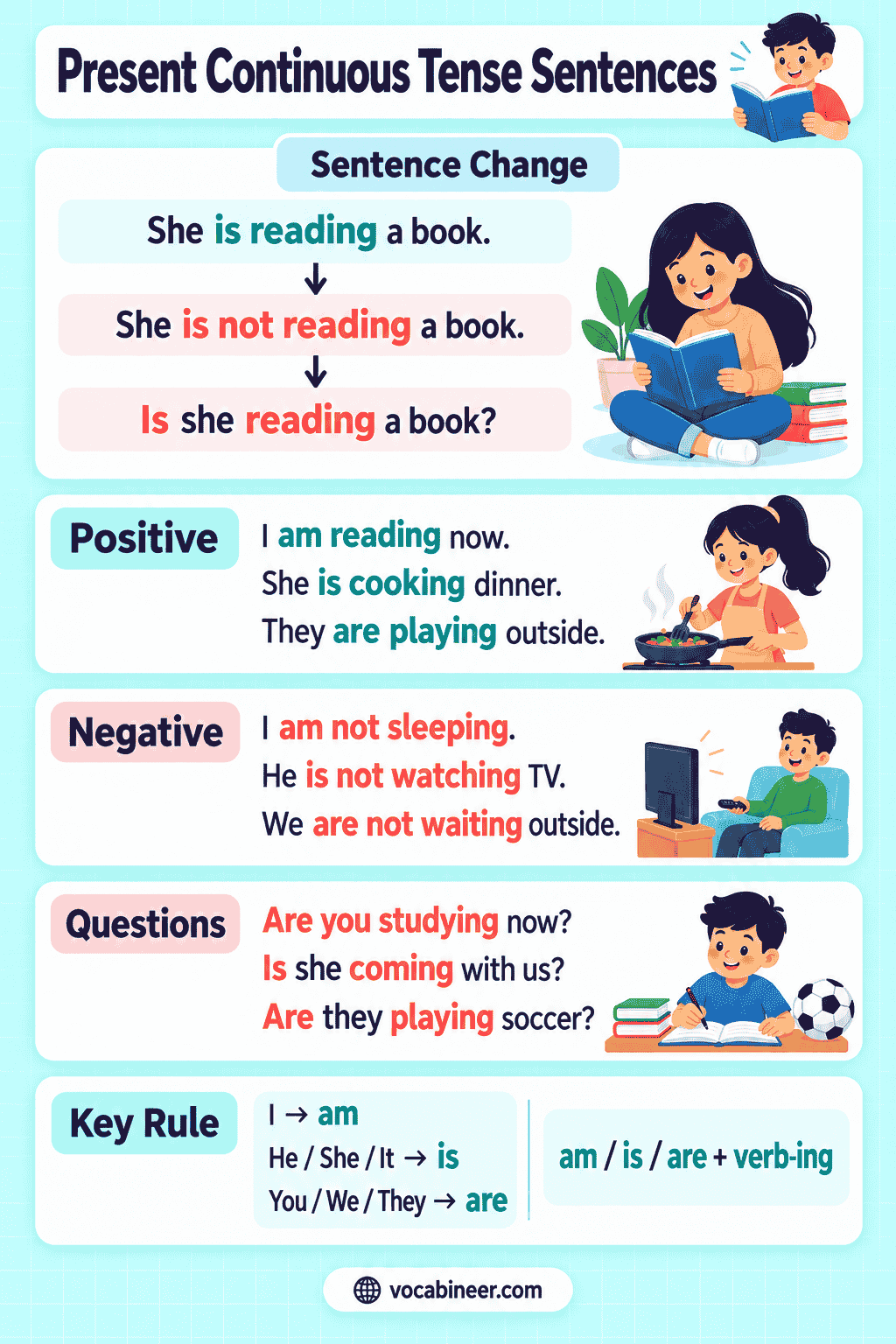
- I am reading a book.
- She is cooking dinner.
- They are playing outside.
- The weather is getting colder.
The basic form uses am, is, or are followed by a verb ending in -ing.
Present Continuous Tense Sentences at a Glance
| Sentence Type | Example |
|---|---|
| affirmative | She is reading a book. |
| negative | She isn’t reading now. |
| yes/no question | Is she reading? |
| WH-question | What is she reading? |
| action happening now | They are eating dinner. |
| temporary situation | I am staying with my aunt this week. |
| changing situation | The weather is getting warmer. |
| future arrangement | We are meeting tomorrow. |
Present Continuous Sentence Structure
| Form | Structure | Example |
|---|---|---|
| affirmative | subject + am/is/are + verb-ing | She is working. |
| negative | subject + am/is/are + not + verb-ing | She isn’t working. |
| question | Am/Is/Are + subject + verb-ing? | Is she working? |
The subject determines whether the sentence uses am, is, or are.
100 Present Continuous Tense Sentences
The following sentences cover actions happening now, temporary situations, changing conditions, repeated temporary actions, future arrangements, negatives, and questions.
- I am reading a book right now.
- She is cooking dinner in the kitchen.
- He is playing football outside.
- We are waiting for the bus.
- They are studying English together.
- The baby is sleeping peacefully.
- My mother is making tea.
- My father is washing the car.
- The children are playing in the garden.
- It is raining heavily outside.
- I am writing an email.
- She is talking on the phone.
- He is watching television.
- We are eating lunch now.
- They are listening to music.
- My sister is cleaning her room.
- The dog is barking at the gate.
- The birds are flying over the trees.
- Our teacher is explaining the lesson.
- The students are taking notes.
- I am learning a new language.
- She is preparing for her exam.
- He is looking for his keys.
- We are working on a new project.
- They are building a new house.
- My brother is searching for a job.
- The company is developing a new product.
- I am taking an online course this month.
- She is reading a new novel these days.
- We are practising our English this week.
- I am staying with my aunt this week.
- She is working in another office this month.
- He is living with his parents for now.
- We are using a smaller classroom today.
- They are travelling around Europe this summer.
- My friend is taking evening classes this term.
- I am working from home this week.
- She is sharing an apartment with a friend.
- He is driving a rented car this week.
- We are staying at a hotel for a few days.
- The weather is getting warmer.
- Your English is improving quickly.
- The children are growing fast.
- Prices are rising again.
- The city is becoming more crowded.
- Technology is changing rapidly.
- The days are getting longer.
- The company is expanding its business.
- More people are working from home.
- Online shopping is becoming more popular.
- I am drinking less coffee these days.
- She is working late a lot this month.
- We are eating out more often this week.
- He is travelling frequently at the moment.
- They are meeting more often this term.
- I am exercising more regularly this month.
- She is spending more time with her family.
- He is studying harder these days.
- We are using public transport more often.
- They are practising together every evening this week.
- He is always losing his keys.
- She is always interrupting me.
- They are constantly arguing about small things.
- You are always helping other people.
- My neighbor is always playing loud music.
- He is constantly changing his plans.
- She is always forgetting her phone.
- The children are always asking questions.
- You are always making me laugh.
- My brother is constantly borrowing my books.
- We are meeting our friends tomorrow.
- She is seeing the dentist on Friday.
- I am flying to Rome next week.
- They are having dinner with us tonight.
- He is starting a new job on Monday.
- We are leaving early tomorrow morning.
- My parents are visiting us this weekend.
- She is attending a conference next month.
- I am meeting my manager at ten tomorrow.
- They are moving to a new house next week.
- I am not watching television now.
- She isn’t sleeping at the moment.
- He isn’t working today.
- We aren’t waiting outside.
- They aren’t playing football now.
- My brother isn’t using the computer.
- The children aren’t studying right now.
- It isn’t raining anymore.
- She isn’t coming with us tonight.
- We aren’t travelling this weekend.
- Are you listening to me?
- Is she working today?
- Is he coming with us?
- Are they playing outside?
- Are we leaving now?
- What are you doing?
- Where is she going?
- Why is he laughing?
- Who are they waiting for?
- When are you coming home?
Affirmative Present Continuous Tense Sentences
Affirmative sentences use am, is, or are + verb-ing.
With I Am
- I am reading a book.
- I am doing my homework.
- I am waiting for the bus.
- I am learning English.
With He, She, It Is
- He is playing football.
- She is cooking dinner.
- The baby is sleeping.
- It is raining outside.
With You, We, They Are
- You are speaking quietly.
- We are eating lunch.
- They are watching a movie.
- The children are playing outside.
Negative Present Continuous Tense Sentences
Negative sentences place not after am, is, or are.
Examples:
- I am not sleeping.
- He isn’t working today.
- She isn’t listening to music.
- We aren’t waiting outside.
- They aren’t playing football.
- It isn’t raining now.
The basic pattern is:
subject + am/is/are + not + verb-ing
Interrogative Present Continuous Tense Sentences
Questions place am, is, or are before the subject.
Yes/No Questions
- Are you listening?
- Is he working today?
- Is she coming with us?
- Are they playing outside?
- Are we leaving now?
WH-Questions
- What are you doing?
- Where is she going?
- Why is he laughing?
- Who are they waiting for?
- When is she leaving?
Short Answers in the Present Continuous
Yes/no questions often use short answers with am, is, or are.
- Are you working? — Yes, I am. / No, I’m not.
- Is she sleeping? — Yes, she is. / No, she isn’t.
- Is he coming? — Yes, he is. / No, he isn’t.
- Are they studying? — Yes, they are. / No, they aren’t.
Short answers repeat the correct form of be rather than the full verb phrase.
Present Continuous Sentences for Actions Happening Now
Present Continuous commonly describes actions in progress at the moment of speaking.
- I am reading right now.
- She is talking on the phone.
- He is eating breakfast.
- We are waiting for the teacher.
- They are playing outside.
- The baby is crying.
- My mother is cooking dinner.
- It is raining heavily.
Present Continuous Sentences for Actions Around Now
An activity can belong to the current period even when it is not happening at the exact second of speaking.
Examples:
- I am reading a new book these days.
- She is studying for her final exams.
- We are working on a new project.
- He is learning Spanish.
- They are preparing for a competition.
- My brother is looking for a new job.
Present Continuous Sentences for Temporary Situations
Present Continuous often describes situations expected to last for a limited period.
- I am staying with my aunt this week.
- She is working in London for two months.
- He is living with his parents at the moment.
- We are using another office this month.
- They are travelling around Europe this summer.
- My friend is taking evening classes this term.
Present Continuous Sentences for Changes and Developing Situations
Present Continuous can describe situations that are gradually changing or developing.
- The weather is getting warmer.
- Your English is improving.
- The children are growing quickly.
- Prices are rising.
- The city is becoming more crowded.
- Technology is changing rapidly.
- More people are working from home.
- Online shopping is becoming more popular.
Present Continuous Sentences for Repeated Temporary Actions
Repeated actions can use Present Continuous when the repetition belongs to a temporary period.
- I am drinking less coffee these days.
- She is working late a lot this month.
- We are eating out more often this week.
- He is travelling frequently at the moment.
- They are meeting more often this term.
The repetition is temporary rather than a permanent habit.
Present Continuous Sentences with Always
Present Continuous with always, constantly, or similar adverbs can emphasize repeated behavior.
Examples:
- He is always losing his keys.
- She is always interrupting me.
- They are constantly arguing.
- You are always helping people.
- My neighbor is always playing loud music.
Depending on context, these sentences can express irritation, criticism, surprise, or praise.
Present Continuous Sentences for Future Arrangements
Present Continuous can describe future arrangements that are already planned.
Examples:
- We are meeting tomorrow.
- She is seeing the dentist on Friday.
- I am flying to Rome next week.
- They are having dinner with us tonight.
- He is starting a new job on Monday.
Present Continuous Sentences with Time Expressions
Common time expressions include:
- now
- right now
- at the moment
- currently
- today
- this week
- these days
- this month
- tonight
Examples:
- She is studying right now.
- We are working from home this week.
- He is staying with friends at the moment.
- They are travelling this month.
- The team is practising tonight.
These expressions often support Present Continuous meaning, but the situation determines the tense.
Present Continuous with Temporary Behavior Using Be
The form be being can describe temporary or current behavior.
Compare:
- He is rude.
This describes a characteristic. - He is being rude.
This describes his behavior now.
Examples:
- You are being very helpful.
- He is being difficult today.
- She is being unusually quiet.
- The children are being very noisy.
Stative Verbs in Present Continuous Sentences
Many stative verbs do not normally use continuous forms because they describe states rather than ongoing actions.
Common examples include:
- know
- understand
- believe
- want
- need
- prefer
- belong
- own
- remember
Incorrect:
- I am knowing the answer.
- She is wanting a new phone.
- He is understanding the lesson.
Correct:
- I know the answer.
- She wants a new phone.
- He understands the lesson.
Common -ing Spelling Patterns
Some verbs change slightly when -ing is added.
| Base Verb | -ing Form |
|---|---|
| work | working |
| make | making |
| write | writing |
| run | running |
| sit | sitting |
| lie | lying |
Examples:
- She is writing an email.
- He is running in the park.
- The baby is lying on the bed.
- We are making dinner.
- They are sitting outside.
I Am vs He/She Is vs You/We/They Are
The subject determines the correct form of be.
| Subject | Present Continuous |
|---|---|
| I | I am working. |
| he / she / it | She is working. |
| you / we / they | They are working. |
Affirmative vs Negative vs Question Sentences
| Affirmative | Negative | Question |
|---|---|---|
| She is working. | She isn’t working. | Is she working? |
| They are playing. | They aren’t playing. | Are they playing? |
| I am reading. | I am not reading. | Am I reading? |
| He is sleeping. | He isn’t sleeping. | Is he sleeping? |
Present Continuous Tense Sentences for Kids
These short examples are useful for children and beginners.
- I am eating an apple.
- She is reading a book.
- He is playing football.
- We are drawing pictures.
- They are running in the park.
- The dog is sleeping.
- The bird is flying.
- My teacher is writing on the board.
Common Present Continuous Tense Sentence Mistakes
Learners often make mistakes with am, is, are, verb-ing forms, questions, negatives, and stative verbs.
Forgetting Am, Is, or Are
Incorrect: She reading a book.
Correct: She is reading a book.
Using the Base Verb Instead of Verb-ing
Incorrect: They are play football.
Correct: They are playing football.
Using the Wrong Form of Be
Incorrect: He are working.
Correct: He is working.
Using Do or Does in Questions
Incorrect: Does she is working?
Correct: Is she working?
Using Do or Does in Negatives
Incorrect: He doesn’t working.
Correct: He isn’t working.
Using Present Continuous for a Regular Habit
Less suitable: I am going to school every day.
Better: I go to school every day.
Using a Stative Verb Incorrectly
Incorrect: I am knowing the answer.
Correct: I know the answer.
Forgetting -ing Spelling Changes
Incorrect: She is writeing an email.
Correct: She is writing an email.
Using the Wrong Subject-Be Match
Incorrect: They is playing outside.
Correct: They are playing outside.
FAQs
Examples include I am reading a book, She is cooking dinner, They are playing outside, and The weather is getting warmer. These sentences describe actions or situations connected to the present time.
Examples include I am doing my homework, She is studying for her exam, He is washing the car, and They are watching a movie.
Place not after am, is, or are, followed by the -ing form of the verb. For example, I am not sleeping, She isn’t working, and They aren’t playing.
Move am, is, or are before the subject. For example, Are you listening?, Is she coming?, and What are they doing?
Use am with I, is with he, she, it, and singular subjects, and are with you, we, they, and plural subjects.
Yes. It can describe arranged future plans, as in We are meeting tomorrow or She is flying to Rome next week.
Read More
- 12 English Tenses Chart
- All Tenses Rules and Formula
- English Tenses with Examples
- Present Tenses in English
- Past Tenses in English
- Future Tenses in English
- Be Going To in English