

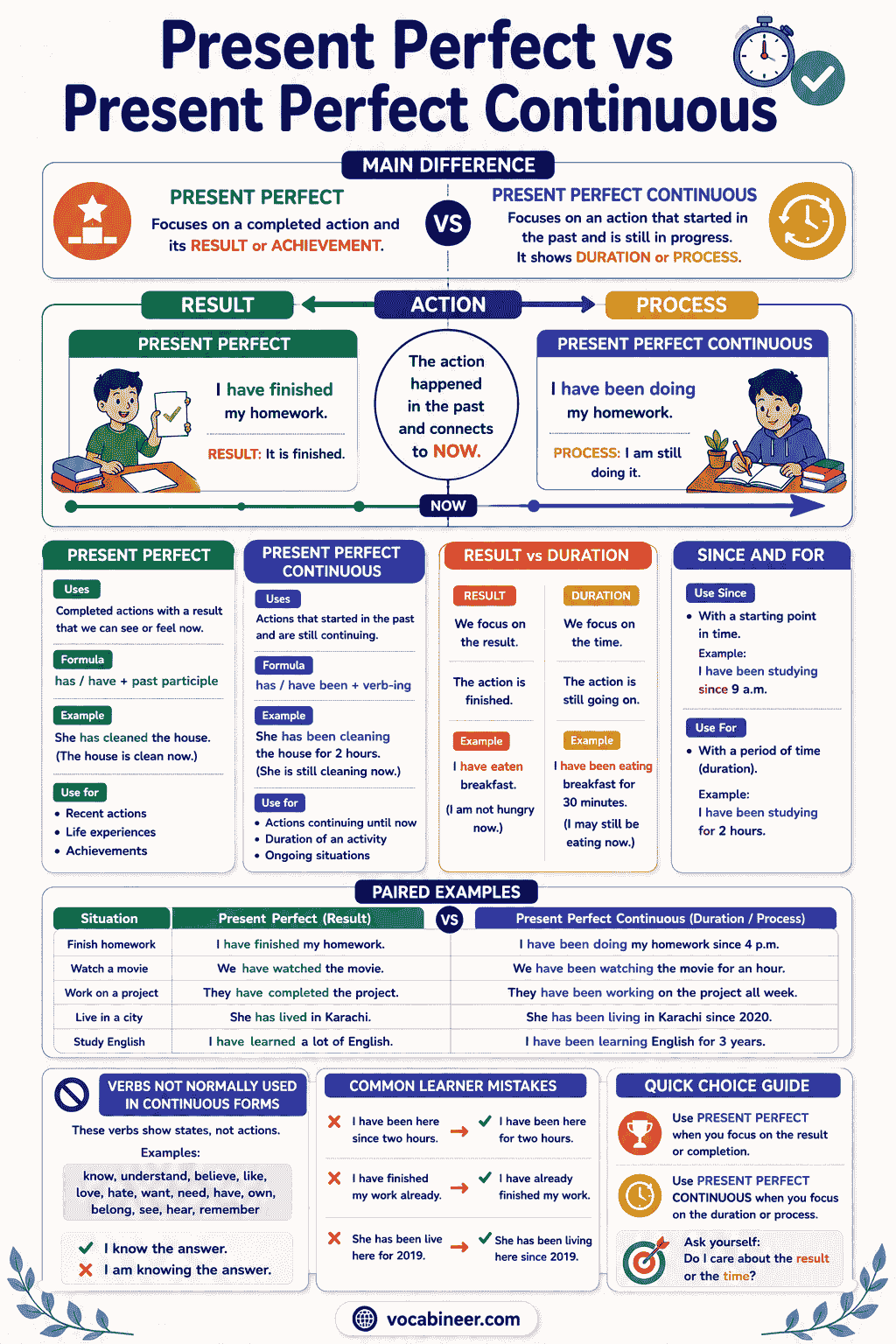
Present Perfect and Present Perfect Continuous both connect past situations with the present, but they emphasize different things. Present Perfect commonly emphasizes result, completion, quantity, experience, or state, while Present Perfect Continuous commonly emphasizes activity, duration, repetition, continuation, or recent evidence.
Understanding this contrast helps learners choose the correct form for completed results, ongoing activities, duration, repeated actions, stative verbs, and expressions such as since, for, how long, recently, and lately.
In This Page
Present Perfect vs Present Perfect Continuous: What Is the Difference?
The main difference is usually one of emphasis.
| Present Perfect | Present Perfect Continuous |
|---|---|
| emphasizes result, completion, quantity, experience, or state | emphasizes activity, duration, repetition, continuation, or process |
| have/has + V3 | have/has + been + V-ing |
| I have written the report. | I have been writing the report. |
| She has read five books. | She has been reading all afternoon. |
| I have known Maya for ten years. | I have been working here for ten years. |
A useful core rule is:
Present Perfect commonly emphasizes what has been completed, achieved, experienced, counted, or established, while Present Perfect Continuous commonly emphasizes the activity itself, its duration, repetition, or continuation up to now.
The difference should not be reduced to:
- Present Perfect = finished
- Present Perfect Continuous = unfinished
Both forms can describe situations connected to the present, and both can sometimes describe situations that continue up to now.
Present Perfect vs Present Perfect Continuous at a Glance
| Meaning | Present Perfect | Present Perfect Continuous |
|---|---|---|
| completed result | I have cleaned the kitchen. | — |
| ongoing activity | — | I have been cleaning the kitchen. |
| completed quantity | She has written ten emails. | — |
| duration | — | She has been writing for three hours. |
| ongoing state | I have known Maya for years. | — |
| ongoing action | — | I have been working here for years. |
| completed repetitions | They have called three times. | — |
| repeated activity over a period | — | They have been calling all morning. |
| present result | He has repaired the bike. | — |
| evidence of recent activity | — | He has been repairing the bike. |
This table gives the main semantic pattern, but context still determines the most natural form.
How Present Perfect and Present Perfect Continuous Are Formed
The two tenses use different structures.
| Feature | Present Perfect | Present Perfect Continuous |
|---|---|---|
| affirmative | have/has + V3 | have/has + been + V-ing |
| negative | have/has not + V3 | have/has not + been + V-ing |
| question | Have/Has + subject + V3? | Have/Has + subject + been + V-ing? |
| main verb form | V3 | V-ing |
Examples:
| Present Perfect | Present Perfect Continuous |
|---|---|
| She has worked. | She has been working. |
| She has not worked. | She has not been working. |
| Has she worked? | Has she been working? |
The key structural difference is:
- Present Perfect → have/has + V3
- Present Perfect Continuous → have/has + been + V-ing
Result vs Activity
This is the central comparison between the two tenses.
| Present Perfect | Present Perfect Continuous |
|---|---|
| result is central | activity is central |
| I have cleaned the kitchen. | I have been cleaning the kitchen. |
| She has written the report. | She has been writing the report. |
| They have painted the room. | They have been painting the room. |
| Daniel has fixed the computer. | Daniel has been fixing the computer. |
Compare:
- I have cleaned the kitchen.
- I have been cleaning the kitchen.
The first sentence emphasizes the result: the kitchen is clean or the task is complete.
The second emphasizes the activity. The cleaning may still be continuing, may have just stopped, or may simply be the most important part of the message.
Completed Action vs Ongoing or Recently Ongoing Activity
Present Perfect can present an action as complete, while Present Perfect Continuous can present an activity as ongoing or recently ongoing.
| Present Perfect | Present Perfect Continuous |
|---|---|
| action presented as complete | activity presented as ongoing or recently ongoing |
| I have written the essay. | I have been writing the essay. |
| She has repaired the bike. | She has been repairing the bike. |
| We have cleaned the house. | We have been cleaning the house. |
| They have prepared dinner. | They have been preparing dinner. |
For example:
- She has repaired the bike.
The repair is presented as complete. - She has been repairing the bike.
The focus is on the repair activity rather than on completed result.
Present Perfect Continuous does not always mean that the activity is still happening. It can also describe an activity that stopped recently when its present effect remains relevant.
How Many vs How Long
This is one of the clearest practical differences.
| Present Perfect | Present Perfect Continuous |
|---|---|
| emphasizes quantity or completed amount | emphasizes duration |
| She has read five books this month. | She has been reading for three hours. |
| I have written ten emails. | I have been writing emails all morning. |
| They have painted three rooms. | They have been painting since eight. |
| We have completed six lessons. | We have been studying for two hours. |
A useful rule is:
Present Perfect commonly answers “how many?” or “how much?”, while Present Perfect Continuous commonly answers “how long?”
Examples:
- How many emails have you written?
- How long have you been writing?
This is a strong tendency rather than an absolute rule.
Ongoing States vs Ongoing Activities
Present Perfect commonly suits ongoing states, while Present Perfect Continuous commonly suits ongoing activities.
| Present Perfect | Present Perfect Continuous |
|---|---|
| ongoing state | ongoing activity |
| I have known Maya for ten years. | I have been working here for ten years. |
| She has owned the house since 2018. | She has been living there since 2018. |
| We have believed that for years. | We have been discussing it for hours. |
| Daniel has had this car since 2020. | Daniel has been driving it for years. |
State verbs such as know, own, believe, and have in a possessive sense usually favor Present Perfect.
Action verbs such as work, live, study, wait, and discuss often allow Present Perfect Continuous when ongoing activity is central.
Present Result vs Evidence of Recent Activity
Both forms can connect past activity with the present, but the type of connection can differ.
| Present Perfect | Present Perfect Continuous |
|---|---|
| present result is central | present evidence of recent activity is central |
| She has cleaned the kitchen. | She has been cleaning the kitchen. |
| He has repaired the bike. | He has been repairing the bike. |
| We have painted the room. | We have been painting the room. |
Examples of recent evidence:
- The grass is wet. It has been raining.
- You look tired. Have you been running?
- Her hands are covered in paint. She has been painting.
- The floor is wet because they have been cleaning it.
Present Perfect Continuous is especially useful when recent activity explains something visible or noticeable now.
The activity may already have stopped.
Since and For with Both Tenses
Both forms can occur with since and for.
Since identifies a starting point, while for identifies a duration.
| Present Perfect | Present Perfect Continuous |
|---|---|
| I have known her for ten years. | I have been working here for ten years. |
| She has owned the house since 2020. | She has been living there since 2020. |
| We have had this problem for weeks. | We have been discussing the problem for weeks. |
Examples of starting points:
- since 2020
- since Monday
- since January
- since I started school
Examples of durations:
- for five years
- for two hours
- for several months
- for a long time
The key principle is:
Since and for can occur with both forms; verb meaning and intended emphasis determine the better choice.
Do not use the rule:
since / for = Present Perfect Continuous
because many ongoing states naturally use Present Perfect.
How Long with Present Perfect and Present Perfect Continuous
The expression how long can appear with either form.
| Present Perfect | Present Perfect Continuous |
|---|---|
| ongoing state | ongoing activity |
| How long have you known Maya? | How long have you been waiting? |
| How long have you owned this house? | How long have you been studying English? |
The difference depends largely on verb meaning.
Use Present Perfect with states:
- How long have you known him?
- How long have you had this car?
Use Present Perfect Continuous with activities:
- How long have you been working here?
- How long have you been learning English?
Therefore:
How long does not automatically require Present Perfect Continuous.
Stative Verbs with Present Perfect and Present Perfect Continuous
Many stative verbs normally use Present Perfect rather than Present Perfect Continuous when they retain their ordinary stative meaning.
Common stative verbs include:
- know
- believe
- understand
- like
- love
- hate
- want
- need
- own
- belong
- seem
Examples:
- I have known Maya for years.
- She has liked that band since school.
- They have owned the house since 2019.
- We have believed that for a long time.
- He has needed help for several days.
Not normally:
- I have been knowing Maya.
- They have been owning the house.
- We have been believing that.
A useful principle is:
Many stative verbs normally use Present Perfect when they retain an ordinary stative meaning.
This should not be treated as an absolute ban on continuous forms because some verbs can change meaning in different contexts.
Verbs That Can Use Both Forms
Some verbs can naturally use either Present Perfect or Present Perfect Continuous.
Live
| Present Perfect | Present Perfect Continuous |
|---|---|
| I have lived here for ten years. | I have been living here for ten years. |
| presents the situation more as an established fact | gives more emphasis to ongoing duration or activity |
Both sentences can be natural.
Work
| Present Perfect | Present Perfect Continuous |
|---|---|
| She has worked here since 2020. | She has been working here since 2020. |
| can present employment as an established fact | emphasizes continuing work or duration |
Study
| Present Perfect | Present Perfect Continuous |
|---|---|
| He has studied English for five years. | He has been studying English for five years. |
| can present the period as a fact | emphasizes ongoing study |
With verbs such as live, work, and study, the meaning difference may be small.
The continuous form often gives more emphasis to duration or ongoing activity, but both forms can be correct.
Repeated Activity vs Completed Number
Present Perfect commonly counts completed repetitions, while Present Perfect Continuous emphasizes repeated activity over a period.
| Present Perfect | Present Perfect Continuous |
|---|---|
| completed number | repeated activity over a period |
| She has called three times today. | She has been calling all morning. |
| I have written six emails. | I have been writing emails since nine. |
| They have visited us twice this month. | They have been visiting regularly this month. |
| Daniel has asked four questions. | Daniel has been asking questions all lesson. |
The first form answers questions about completed quantity.
The continuous form presents the repetition as an ongoing pattern or activity.
Single-Point Completion Verbs
Some verbs naturally describe completion at a single point. When that completed point is the intended meaning, Present Perfect usually fits better.
Common examples include:
- start
- stop
- finish
- begin
- arrive
- leave
Examples:
- The concert has started.
- She has finished the report.
- The rain has stopped.
- Daniel has arrived.
- Maya has left the office.
Not normally for the same completion meaning:
- The concert has been starting.
- She has been finishing the report.
- Daniel has been arriving.
Use this principle:
Verbs that naturally mark a single completed point usually favor Present Perfect when completion is central.
Temporary vs More Established Meaning
In some contexts, the continuous form can make a situation sound more temporary or current, while the simple form can present it as more established.
| Present Perfect | Present Perfect Continuous |
|---|---|
| more established meaning | more temporary or current emphasis |
| She has lived with her parents for years. | She has been living with her parents recently. |
| He has worked there for a decade. | He has been working there temporarily. |
This is a tendency, not an absolute rule.
Context, verb meaning, and speaker emphasis remain important.
Recently and Lately with Both Tenses
Both forms can occur with recent-time expressions.
| Present Perfect | Present Perfect Continuous |
|---|---|
| result, change, or completed event | ongoing or repeated recent activity |
| She has recently changed jobs. | She has been working late lately. |
| We have recently completed the project. | We have been meeting more often lately. |
| Daniel has recently moved house. | Daniel has been travelling a lot lately. |
The expressions recently and lately do not automatically determine the tense.
The intended emphasis still matters.
Time Expressions with Both Tenses
Many time expressions overlap between the two forms.
| Present Perfect Often Occurs With | Present Perfect Continuous Often Occurs With |
|---|---|
| already | all day |
| yet | all morning |
| ever | for hours |
| never | since Monday |
| so far | lately |
| recently | recently |
Examples:
- She has already finished.
- We have completed five lessons so far.
- I have been working all morning.
- They have been waiting for hours.
Time expressions support the meaning, but they do not determine the tense automatically.
Common Present Perfect vs Present Perfect Continuous Mistakes
Learners often make mistakes by relying on the simple rule that Present Perfect means finished and Present Perfect Continuous means unfinished.
Using Present Perfect Continuous with a stative verb
Incorrect:
- I have been knowing Maya for years.
Correct:
- I have known Maya for years.
Using the simple form when activity duration is the main emphasis
Less natural for strong activity emphasis:
- I have worked all morning.
Often more natural:
- I have been working all morning.
The simple form is not universally incorrect; context can affect the choice.
Using Present Perfect Continuous for single-point completion
Incorrect for intended completion:
- She has been finishing the report.
Correct:
- She has finished the report.
Confusing quantity and duration
| Quantity | Duration |
|---|---|
| I have written ten emails. | I have been writing emails for three hours. |
| She has read four chapters. | She has been reading all evening. |
Omitting been
Incorrect:
- She has working all morning.
Correct:
- She has been working all morning.
Present Perfect Continuous requires have/has + been + V-ing.
Using V3 after been
Incorrect:
- She has been worked all morning.
Correct:
- She has been working all morning.
Use V-ing after been.
Assuming Present Perfect Continuous always means unfinished
Incorrect rule:
- Present Perfect Continuous = still happening now.
Better principle:
Present Perfect Continuous can describe activity still continuing or activity that has recently stopped when its present evidence or effect remains.
Assuming Present Perfect always means finished
Incorrect rule:
- Present Perfect = completed action only.
Better principle:
Present Perfect can also describe states or situations that continue up to now, especially with stative verbs and some verbs such as live and work.
Assuming since and for require Present Perfect Continuous
Incorrect rule:
- since / for = Present Perfect Continuous.
Better principle:
Both forms can occur with since and for; verb meaning and intended emphasis determine the form.
Assuming how long requires Present Perfect Continuous
Incorrect rule:
- how long = Present Perfect Continuous.
Better principle:
How long can use Present Perfect with states and Present Perfect Continuous with activities.
FAQs
Present Perfect commonly emphasizes result, completion, quantity, experience, or state, while Present Perfect Continuous commonly emphasizes activity, duration, repetition, continuation, or recent evidence.
Use Present Perfect when result, completion, quantity, experience, or a state is central. Present Perfect Continuous is often more suitable when activity, duration, repetition, or ongoing process is central.
Yes. Both forms can occur with since and for. Present Perfect commonly appears with states, while Present Perfect Continuous commonly appears with ongoing activities.
Many stative verbs normally use Present Perfect when they retain an ordinary stative meaning. For example, use I have known her for years, not I have been knowing her for years.
Present Perfect commonly emphasizes quantity, as in I have written ten emails, while Present Perfect Continuous commonly emphasizes duration, as in I have been writing for three hours. However, how long can also use Present Perfect with ongoing states.
Read More
- 12 English Tenses Chart
- All Tenses Rules and Formula
- English Tenses with Examples
- Present Tenses in English
- Past Tenses in English
- Future Tenses in English
- Be Going To in English