

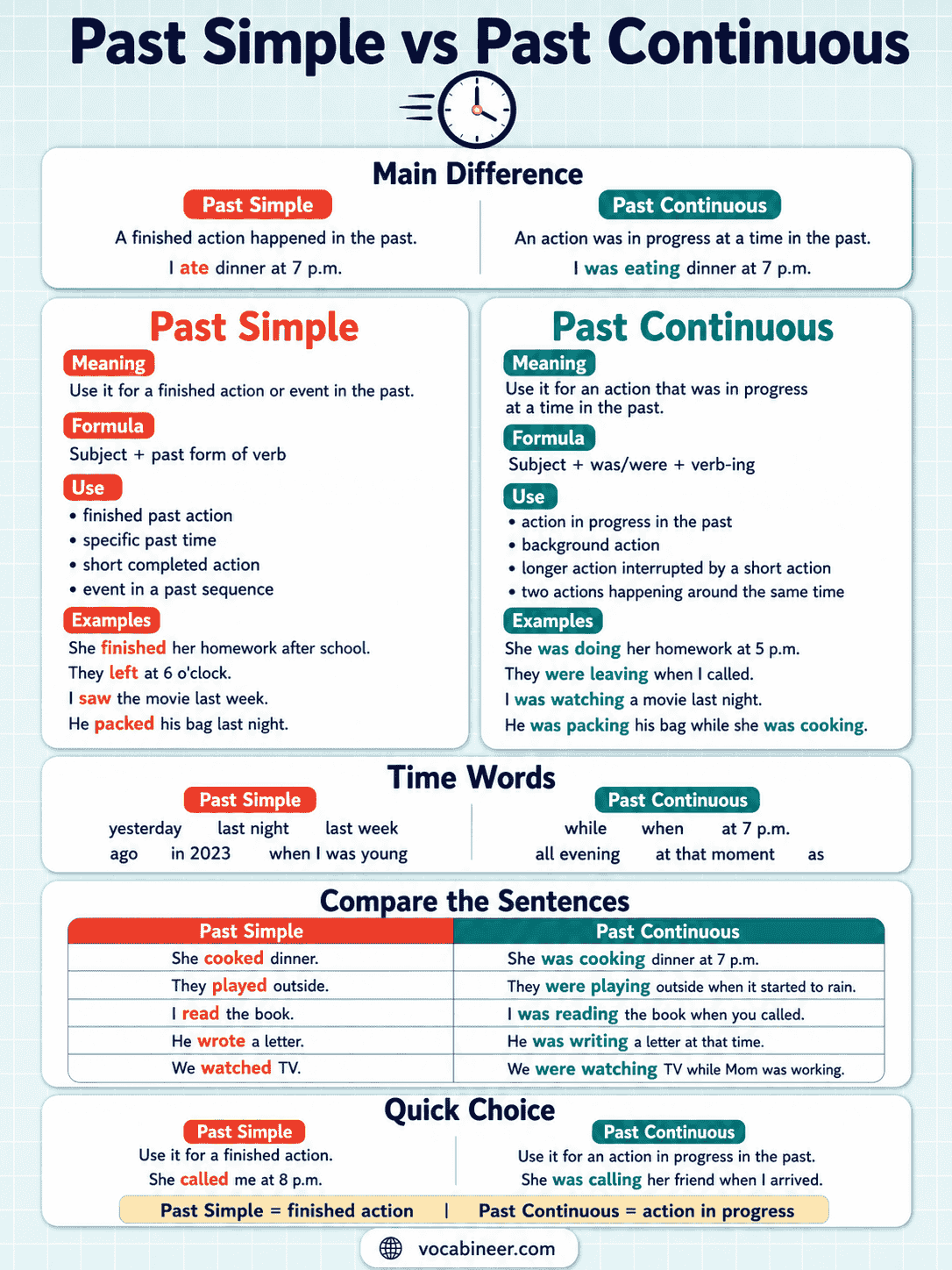
Past Simple and Past Continuous both describe past situations, but they present those situations differently. Past Simple usually marks a completed event or state, while Past Continuous presents an activity as ongoing, temporary, overlapping, or background around a past reference point.
Understanding this contrast helps learners describe interruptions, simultaneous activities, background events, specific past times, and story sequences more accurately. It also helps prevent common mistakes with when, while, was/were + V-ing, and the unreliable “short action vs long action” rule.
In This Page
Past Simple vs Past Continuous: What Is the Difference?
The main difference concerns whether the speaker presents the past situation as complete or in progress.
| Past Simple | Past Continuous |
|---|---|
| presents an event or state as completed | presents an activity as in progress |
| commonly marks a main event | commonly establishes background activity |
| can describe completed events in sequence | can describe overlapping activities |
| can describe a finished past situation | can present a temporary past situation |
| uses V2 | uses was/were + V-ing |
| I worked yesterday. | I was working at eight. |
| The phone rang. | I was cooking when the phone rang. |
A useful core rule is:
Past Simple presents a past event as a completed whole, while Past Continuous presents activity as ongoing around a past reference point.
The difference does not depend simply on whether an action was long or short.
Past Simple vs Past Continuous at a Glance
| Meaning | Past Simple | Past Continuous |
|---|---|---|
| completed past event | She finished the report. | — |
| activity in progress | — | She was writing the report at eight. |
| main event | The phone rang. | — |
| background activity | — | I was cooking when it rang. |
| completed sequence | He opened the door and entered. | — |
| overlapping activities | — | Maya was cooking while Daniel was cleaning. |
| finished past situation | She lived there for five years. | — |
| temporary past situation | — | She was living with her aunt that summer. |
| completed event at a specific time | At five, I finished work. | — |
| activity in progress at a specific time | — | At five, I was working. |
These distinctions provide a useful overview, but the intended meaning determines the tense.
How Past Simple and Past Continuous Are Formed
The two tenses use different structures.
| Feature | Past Simple | Past Continuous |
|---|---|---|
| affirmative | V2 | was/were + V-ing |
| negative | did not + V1 | was/were not + V-ing |
| question | Did + subject + V1? | Was/Were + subject + V-ing? |
| main verb form | V2 | V-ing |
Examples:
| Past Simple | Past Continuous |
|---|---|
| She worked yesterday. | She was working at eight. |
| She did not work yesterday. | She was not working at eight. |
| Did she work yesterday? | Was she working at eight? |
Past Simple uses V2 in affirmative sentences, while negatives and questions use did + V1.
Past Continuous always requires the correct form of be:
- I/he/she/it was working
- you/we/they were working
Completed Past Event vs Action in Progress
This is the central contrast between the two tenses.
| Past Simple | Past Continuous |
|---|---|
| completed event | activity in progress |
| I finished work at five. | I was working at five. |
| She read the email. | She was reading the email when I called. |
| They played football yesterday. | They were playing football at four. |
| Daniel wrote the report. | Daniel was writing the report at noon. |
Past Simple presents the event as complete.
Past Continuous presents the activity as already in progress at a past time.
Compare:
- At eight, I watched the film.
- At eight, I was watching the film.
The first presents watching as a past event. The second specifically places the activity in progress around eight.
Main Event vs Background Activity
Past Continuous often establishes the background situation, while Past Simple marks the main completed event.
| Past Simple | Past Continuous |
|---|---|
| main completed event | background activity |
| The phone rang. | I was cooking when the phone rang. |
| I saw Maya. | I was walking through the park when I saw Maya. |
| The lights went out. | We were having dinner when the lights went out. |
| Daniel arrived. | It was raining when Daniel arrived. |
For example:
- I was walking home when I saw Daniel.
The walking was already in progress. Seeing Daniel was the completed event that occurred during it.
Past Continuous therefore often provides the surrounding situation, while Past Simple marks what happened within that situation.
Interrupted Actions with Past Simple and Past Continuous
A common use of the two tenses is to describe an activity in progress when another event occurs.
| Ongoing Activity | Completed Event |
|---|---|
| I was sleeping | when you called. |
| She was driving | when the accident happened. |
| We were eating dinner | when the lights went out. |
| Daniel was studying | when Maya arrived. |
The common pattern is:
Past Continuous + when + Past Simple
Example:
- I was sleeping when you called.
The clause order can also change:
- When you called, I was sleeping.
The tense relationship remains the same. Past Continuous marks the activity already in progress, while Past Simple marks the completed event occurring during it.
Not every combination represents a literal interruption. The later event may simply happen during the ongoing activity.
Simultaneous Past Actions
Past Continuous can describe two activities that were happening at the same time.
| Activity 1 | Activity 2 |
|---|---|
| I was cooking | while Maya was setting the table. |
| Daniel was reading | while his sister was studying. |
| The children were playing | while their parents were talking. |
| We were driving | while it was raining. |
Both activities overlap in time.
For example:
- Maya was preparing dinner while Daniel was washing the dishes.
Neither activity is presented as a completed event occurring after the other. Both were in progress during the same past period.
Sequential Events vs Overlapping Actions
Past Simple commonly describes completed events in sequence. Past Continuous commonly describes activities that overlap.
| Past Simple | Past Continuous |
|---|---|
| completed events occur one after another | ongoing activities occur at the same time |
| Maya cooked dinner and Daniel washed the dishes. | Maya was cooking while Daniel was washing the dishes. |
| He opened the door, entered, and sat down. | He was talking while I was taking notes. |
| She picked up the bag and left. | She was packing while I was checking the tickets. |
Compare:
- Daniel finished dinner and washed the dishes.
- Daniel was eating while Maya was washing the dishes.
The first sentence gives a completed sequence. The second describes overlapping activity.
Past Simple vs Past Continuous with When
The word when can appear with several tense combinations. It does not determine the tense by itself.
| Pattern | Meaning | Example |
|---|---|---|
| Past Continuous + when + Past Simple | completed event occurs during ongoing activity | I was sleeping when the phone rang. |
| Past Simple + when + Past Continuous | main event occurs during background activity | I called when she was driving. |
| Past Simple + when + Past Simple | completed events or close sequence | When I arrived, she opened the door. |
Compare:
- When I arrived, Maya was cooking.
- When I arrived, Maya opened the door.
In the first sentence, cooking was already in progress.
In the second, opening the door occurred after or around the time of my arrival.
The relationship between the events determines the tense choice.
Past Simple vs Past Continuous with While
While commonly connects activities that overlap in time.
| Pattern | Example |
|---|---|
| Past Continuous + Past Continuous | While I was cooking, Maya was setting the table. |
| Past Continuous + Past Simple | While I was walking, I saw an old friend. |
Examples:
- While they were studying, the lights went out.
- While I was working, Daniel was preparing dinner.
- I found my keys while I was cleaning the room.
While often introduces an ongoing activity, but it does not automatically require Past Continuous in every possible context.
A stronger rule is:
While commonly connects overlapping past situations, while tense choice still depends on whether each event is presented as ongoing or completed.
Past Simple vs Past Continuous at a Specific Past Time
A specific past time can occur with either tense.
| Past Simple | Past Continuous |
|---|---|
| completed event at that time | activity in progress around that time |
| At five, I finished work. | At five, I was working. |
| At eight, she left the office. | At eight, she was talking to a client. |
| At noon, Daniel called me. | At noon, Daniel was driving home. |
| At ten, the meeting ended. | At ten, we were discussing the budget. |
A time expression such as at eight does not automatically require Past Continuous or Past Simple.
The tense depends on whether the event is presented as completed or ongoing at that past point.
Temporary vs Finished Past Situations
Past Continuous can present a situation as temporary or limited to a certain past period. Past Simple presents a situation as a completed past fact or period.
| Past Simple | Past Continuous |
|---|---|
| finished past situation | temporary situation during a past period |
| She lived in Lahore for ten years. | She was living with her aunt that summer. |
| I worked at the company for five years. | I was working from home that month. |
| They stayed in Dubai for three years. | They were staying with friends for a few weeks. |
Compare:
- I worked in Islamabad for six years.
- I was working in Islamabad that summer.
The first presents the work period as a completed past fact. The second presents it as the situation in progress during a particular past period.
Temporary and permanent should not be treated as absolute categories. The speaker’s intended viewpoint matters.
Same Past Event, Different Viewpoint
Sometimes a similar real-world situation can use either tense depending on how the speaker presents it.
| Past Simple | Past Continuous |
|---|---|
| presents the situation as a completed whole | presents it as activity in progress |
| Doctors treated patients in temporary beds. | Doctors were treating patients in temporary beds. |
| Workers repaired the road. | Workers were repairing the road. |
| She wrote reports all morning. | She was writing reports when I arrived. |
Consider:
- The workers repaired the road.
- The workers were repairing the road when I passed.
The first presents the repair work as a completed event.
The second presents the work as ongoing at the moment when another past event occurred.
Tense choice therefore depends partly on grammatical viewpoint, not only on what happened in the real world.
Why Long Action vs Short Action Is Not a Reliable Rule
A common beginner rule says:
long action = Past Continuous
short action = Past Simple
This is not reliable.
| Example | Explanation |
|---|---|
| I lived there for twenty years. | The action lasted a long time, but Past Simple presents the period as complete. |
| The light was flashing for a few seconds. | The activity lasted only briefly, but Past Continuous presents it as ongoing. |
| She worked there all her life. | Long duration can still use Past Simple. |
| He was coughing when I entered. | A relatively short activity can use Past Continuous. |
The stronger principle is:
Duration alone does not determine tense choice. Completion, progress, background, overlap, and viewpoint matter more.
Past Simple and Past Continuous in Stories
Past Simple and Past Continuous often work together in storytelling.
Past Continuous can establish the background:
- It was raining.
- People were rushing home.
- Cars were moving slowly.
Past Simple can advance the main event sequence:
- Daniel opened the door.
- He walked inside.
- The lights went out.
The two forms can then combine:
- It was raining when Daniel opened the door.
- People were rushing home as he walked down the street.
- He was taking off his coat when the lights went out.
| Narrative Function | Typical Form | Example |
|---|---|---|
| background activity | Past Continuous | It was raining. |
| main completed event | Past Simple | Daniel opened the door. |
| continuing background | Past Continuous | People were rushing home. |
| next main event | Past Simple | The lights went out. |
Past Continuous commonly establishes what was already happening, while Past Simple advances the main sequence of completed events.
Stative Verbs with Past Simple and Past Continuous
Many stative verbs normally use Past Simple when they retain an ordinary stative meaning.
Common examples include:
- know
- believe
- understand
- want
- need
- own
- belong
- like
- love
- prefer
Examples:
- I knew the answer.
- She wanted some help.
- They owned the house.
- He believed the story.
- Maya preferred tea.
Not normally:
- I was knowing the answer.
- They were owning the house.
A useful principle is:
Many stative verbs normally use Past Simple when they retain an ordinary stative meaning.
However, some verbs can use a continuous form when their meaning changes.
Verbs That Change Meaning
Some verbs can use either tense because the intended meaning changes.
Think
| Past Simple | Past Continuous |
|---|---|
| opinion or completed thought | active mental process |
| I thought the plan was good. | I was thinking about the problem. |
| She thought he was right. | She was thinking about changing jobs. |
Have
| Past Simple | Past Continuous |
|---|---|
| possession, state, or completed event | ongoing activity or experience |
| She had a car. | She was having lunch. |
| They had a large house. | They were having dinner when I called. |
The intended meaning determines whether a continuous form is suitable.
Past Simple vs Past Continuous with As
As can connect overlapping or closely related past events.
Examples:
- As I was leaving, the phone rang.
- She smiled as she walked into the room.
- As we were driving home, it started to rain.
The conjunction does not automatically require Past Continuous.
Compare:
- As I was walking home, I saw Daniel.
- She smiled as she entered the room.
The first combines ongoing background activity with a completed event. The second presents two closely related completed actions.
Time Expressions with Past Simple and Past Continuous
Certain expressions commonly occur with these tenses, but they are not automatic tense signals.
| Past Simple Often Occurs With | Past Continuous Often Occurs With |
|---|---|
| yesterday | at eight last night |
| last week | at that moment |
| in 2020 | while |
| two days ago | when another event occurred |
| then | all morning |
| later | at the time |
Examples:
- We visited Maya yesterday.
- She moved there in 2020.
- At eight last night, I was studying.
- They were working at that moment.
Time expressions support the intended meaning, but the event relationship determines the tense.
Common Past Simple vs Past Continuous Mistakes
Past Simple vs Past Continuous mistakes often involve tense choice, missing auxiliary verbs, incorrect verb forms, or overly rigid rules about action length and time expressions.
Using Past Simple for intended activity in progress
If the intended meaning is an activity already in progress:
Incorrect:
- At eight, I studied.
Better:
- At eight, I was studying.
Using Past Continuous for a completed event
If the intended meaning is one completed event:
Incorrect:
- The phone was ringing once.
Better:
- The phone rang once.
Omitting was or were
Incorrect:
- She working when I called.
Correct:
- She was working when I called.
Past Continuous requires was/were + V-ing.
Using did with Past Continuous
Incorrect:
- Did she working?
Correct:
- Was she working?
Past Continuous questions use was or were before the subject.
Using V2 after was or were
Incorrect:
- She was worked.
Correct:
- She was working.
The main verb requires the -ing form.
Using V-ing without was or were
Incorrect:
- They playing football.
Correct:
- They were playing football.
Treating long vs short as the main rule
Incorrect rule:
- Long action = Past Continuous.
- Short action = Past Simple.
Better principle:
Tense choice depends on completion, progress, background, overlap, and viewpoint rather than duration alone.
Assuming when always takes Past Simple and while always takes Past Continuous
Incorrect rule:
- when = Past Simple
- while = Past Continuous
Better principle:
When and while connect past events, but tense choice depends on how those events relate to each other.
Using Past Continuous with an ordinary stative meaning
Incorrect:
- I was knowing the answer.
Correct:
- I knew the answer.
FAQs
Past Simple presents a past event or state as completed, while Past Continuous presents an activity as ongoing, temporary, overlapping, or background around a past reference point.
Past Continuous commonly describes background activity that was already in progress, while Past Simple commonly marks the main completed event. For example, I was cooking when the phone rang.
Past Continuous commonly marks the activity already in progress, while Past Simple marks the event occurring during it. For example, I was sleeping when you called.
Yes. Past Continuous can describe two overlapping activities, as in I was cooking while Maya was setting the table.
When can connect completed and ongoing events in several patterns, while while commonly connects overlapping activity. Neither word automatically determines the tense; the relationship between the events does.
Read More
- 12 English Tenses Chart
- All Tenses Rules and Formula
- English Tenses with Examples
- Present Tenses in English
- Past Tenses in English
- Future Tenses in English
- Be Going To in English