

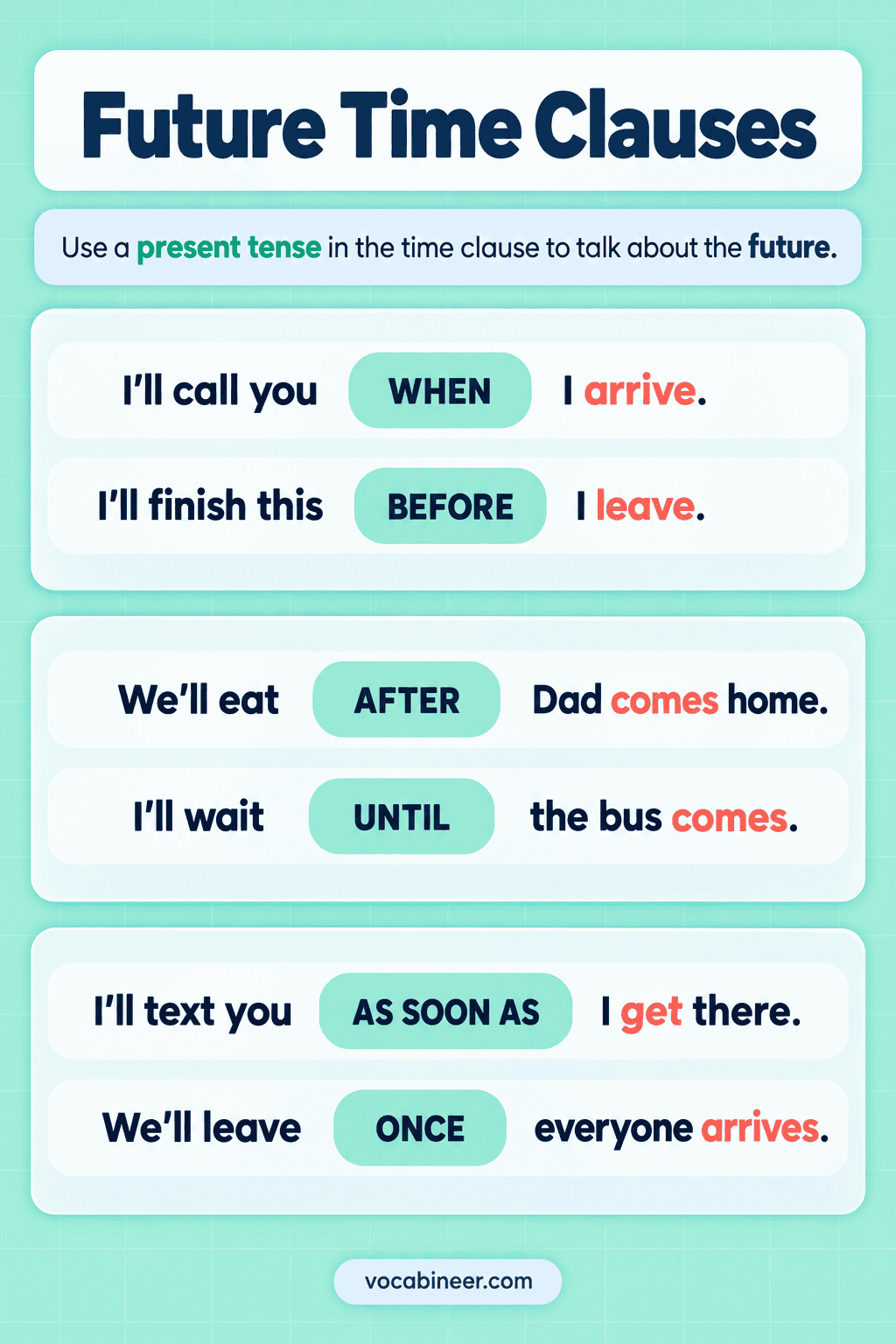
Future time clauses help learners connect two future events and show when one action will happen in relation to another. They are common with words such as when, before, after, until, as soon as, once, while, and by the time.
The main rule is simple: a future time clause normally uses a present form, even though its meaning is future. The main clause gives the main action, while the time clause tells when that action will happen.
In This Page
What Are Future Time Clauses?
A future time clause is a subordinate clause that refers to future time and begins with a time conjunction such as when, before, after, until, as soon as, once, or while.
For example:
- I’ll call you when I arrive.
The sentence contains two clauses:
| Clause | Example | Function |
|---|---|---|
| Main clause | I’ll call you | gives the main future action |
| Future time clause | when I arrive | tells when the action will happen |
Although both actions refer to the future, the time clause uses Present Simple rather than will.
Future meaning comes from the complete sentence, not from using will in every clause.
Future Time Clauses at a Glance
| Time Conjunction | Example |
|---|---|
| when | I’ll call you when I arrive. |
| before | Finish your work before you leave. |
| after | We’ll eat after she comes home. |
| until | I’ll wait until he gets here. |
| as soon as | I’ll text you as soon as I know. |
| once | We’ll leave once everyone is ready. |
| while | I’ll cook while you set the table. |
| by the time | By the time she arrives, we’ll be ready. |
These conjunctions establish the time relationship between future events.
Main Clause vs Future Time Clause
The two clauses perform different jobs.
| Main Clause | Future Time Clause |
|---|---|
| gives the main action | establishes when the action happens |
| may use will, going to, a modal, an imperative, or another suitable form | normally uses a present form |
| I will call you | when I arrive. |
| We are going to leave | after she finishes. |
| You must wait | until your father comes. |
The main clause does not always need will.
Examples:
- Call me when you arrive.
- We can start once everyone is ready.
- You must leave before the office closes.
The main clause gives the action or instruction; the future time clause gives its time reference.
Why Will Is Normally Avoided in Future Time Clauses
Learners often try to use will in both clauses because both events refer to the future.
Incorrect:
- I’ll call you when I will arrive.
- We’ll leave after she will finish.
- Stay here until he will come.
- I’ll tell you as soon as I will know.
Correct:
- I’ll call you when I arrive.
- We’ll leave after she finishes.
- Stay here until he comes.
- I’ll tell you as soon as I know.
The present form in the time clause already carries future meaning through the sentence context.
Use a present form after a future time conjunction when will would only express ordinary future time.
Present Simple in Future Time Clauses
Present Simple is the most common tense in future time clauses.
Examples:
- I’ll call you when I get home.
- We’ll leave after she finishes.
- Wait here until your father comes.
- I’ll tell you as soon as I know.
- Once everyone arrives, we’ll begin.
- I’ll check the door before I leave.
The verbs get, finishes, comes, know, arrives, and leave are grammatically present forms, but they refer to future events.
Present Simple commonly marks the future event that establishes the time for another action.
Present Perfect in Future Time Clauses
Present Perfect can appear when completion before another future event is important.
Examples:
- I’ll call you after I have finished.
- We’ll leave when she has completed the report.
- I’ll rest once I have done the shopping.
- We’ll wait until Donna has finished.
- After you have read the document, send me your comments.
The Present Perfect does not move the action into the past here. It marks a future action as complete before the next event.
Present Perfect emphasizes completed action before another future reference point.
Present Simple vs Present Perfect in Future Time Clauses
Both forms can often be correct.
| Present Simple | Present Perfect |
|---|---|
| expresses the basic time relationship | emphasizes completion |
| I’ll call when I finish. | I’ll call when I have finished. |
| We’ll leave after she eats. | We’ll leave after she has eaten. |
| Once he checks it, we’ll continue. | Once he has checked it, we’ll continue. |
Present Perfect is not automatically required just because one future action happens first.
Use Present Perfect when completion deserves emphasis; otherwise Present Simple is often enough.
Present Continuous in Future Time Clauses
Present Continuous can appear when the action is expected to be in progress at the future time.
Examples:
- Don’t call me while I am driving.
- She’ll explain everything while we are travelling.
- I’ll message you when I am waiting at the station.
This shows that future time clauses are not limited to Present Simple.
Choose the present form that matches the aspect of the future event.
Common Future Time Conjunctions
The most common expressions include:
- when
- before
- after
- until
- as soon as
- once
- while
- by the time
- the moment
- the minute
- the second
For example:
- I’ll call you the moment I arrive.
- We’ll start the minute everyone is ready.
- She’ll tell us the second she knows.
These expressions link future actions through time.
Future Time Clauses with When
When connects the main action to an expected future event or time.
Examples:
- I’ll call you when I arrive.
- She’ll tell us when she knows.
- We’ll celebrate when the project is complete.
- When he gets home, we’ll have dinner.
The speaker normally expects the event in the when-clause to happen.
When identifies the future event that sets the time for another action.
Future Time Clauses with Before and After
Before and after show the order of future events.
Examples with before:
- Finish your work before you go home.
- I’ll check the door before I leave.
- Call me before you start the meeting.
Examples with after:
- We’ll eat after she arrives.
- I’ll call you after I speak to Maya.
- We’ll leave after everyone has finished.
Before marks an earlier point in the sequence, while after connects an action to a later stage in that sequence.
Future Time Clauses with Until
Until shows that an action or situation continues up to a future endpoint.
Examples:
- I’ll wait until he comes.
- Stay here until I return.
- We’ll remain inside until the rain stops.
- I won’t leave until everyone is ready.
Until marks the endpoint of a continuing action or situation.
Until vs By
These expressions both refer to time limits, but their meanings differ.
| Until | By |
|---|---|
| action continues up to a point | action must be completed no later than a point |
| I’ll wait until six. | I’ll finish by six. |
| stay until Friday | submit it by Friday |
| continuation | deadline |
Incorrect:
- I must finish the report until Friday.
Correct:
- I must finish the report by Friday.
Use until for continuation and by for a deadline.
Future Time Clauses with As Soon As and Once
These expressions connect one future event closely to another.
As Soon As
As soon as emphasizes that the second action follows immediately.
Examples:
- I’ll call you as soon as I arrive.
- We’ll start as soon as everyone is ready.
- She’ll message me as soon as she knows the result.
Once
Once marks the point after which another action can happen.
Examples:
- Once she finishes, we’ll leave.
- Once everyone arrives, we can begin.
- Once I have checked the figures, I’ll send the report.
As soon as emphasizes immediate sequence, while once marks the point after which the next action becomes possible.
Future Time Clauses with While
While connects actions that overlap in time.
Examples:
- I’ll cook while you set the table.
- Don’t call me while I am driving.
- She’ll read while we are waiting.
- I’ll prepare the documents while you speak to the client.
A useful structural distinction is:
- while + clause
- during + noun phrase
Examples:
- while I am working
- during the meeting
Incorrect:
- I’ll listen to music during I work.
Correct:
- I’ll listen to music while I work.
Future Time Clauses with By the Time
By the time creates a future reference point before which another action may already happen or be complete.
Examples:
- By the time she arrives, we’ll be ready.
- By the time you get home, I’ll have finished dinner.
- By the time they have completed the project, several months will have passed.
This expression often works naturally with Future Perfect in the main clause.
By the time establishes a future point against which another event is measured.
Clause Order and Punctuation
A future time clause can come before or after the main clause.
Compare:
- I’ll call you when I arrive.
- When I arrive, I’ll call you.
- We’ll leave after she finishes.
- After she finishes, we’ll leave.
When the time clause comes first, use a comma before the main clause.
When it comes second, a comma is usually unnecessary.
Changing the clause order does not change the tense rule.
Both of these are correct:
- I’ll call you when I arrive.
- When I arrive, I’ll call you.
When vs If for Future Meaning
When and if can both refer to future situations, but they express different relationships.
| When | If |
|---|---|
| event is expected | event is uncertain or conditional |
| I’ll call you when I arrive. | I’ll call you if I arrive early. |
| expected future event | possible condition |
Compare:
- When she comes, we’ll start.
Her arrival is expected. - If she comes, we’ll start.
Her arrival is uncertain.
When introduces the time of an expected event, while if introduces a condition.
Is Will Ever Possible in a Future Time Clause?
Normally, will is avoided when it simply marks future time.
However, will can sometimes appear when it expresses a separate modal meaning such as willingness.
The main learner rule remains:
Do not use will in a future time clause when it only means future time.
This exception should not replace the normal rule.
Time Conjunctions vs Sequence Expressions
Not every word that shows sequence introduces a future time clause.
Time conjunctions include:
- when
- before
- after
- until
- once
- as soon as
These introduce subordinate clauses.
Sequence expressions include:
- then
- next
- after that
- following that
- subsequently
Compare:
- I’ll go home after I finish my work.
- I’ll finish my work, and then I will go home.
The first sentence contains a future time clause.
The second uses two coordinated clauses connected by then, so the same present-form rule does not apply.
The future time-clause rule applies to subordinate clauses, not to every expression that shows sequence.
Future Time Clauses with Imperatives and Modals
The main clause can use more than will.
Imperatives
- Call me when you arrive.
- Wait here until I return.
- Check the door before you leave.
Modals
- You must wait until your father comes.
- We can start once everyone is ready.
- You should rest after you finish the work.
The time clause still uses a present form.
Future Time Clauses in Questions
Questions follow the same grammar.
Examples:
- What will you do when you finish school?
- Where will you stay when you arrive?
- Will you call me after you speak to her?
- What will happen once everyone is ready?
- When will you leave after the meeting ends?
The clause type changes, but the tense rule remains the same.
Negative Future Time Clauses
Negative meaning does not change the basic structure.
Examples:
- I won’t leave until everyone is ready.
- Don’t start before the manager arrives.
- We won’t make a decision until we have received all the information.
- I won’t call while she is sleeping.
The time clause still uses a present form.
Common Future Time Clause Mistakes
Learners often make errors by using will in both clauses or by treating the present tense as present-time only.
Using will after when
Incorrect:
- I’ll call you when I will arrive.
Correct:
- I’ll call you when I arrive.
Using will after before
Incorrect:
- Finish this before you will leave.
Correct:
- Finish this before you leave.
Using will after until
Incorrect:
- I’ll wait until he will come.
Correct:
- I’ll wait until he comes.
Using will after as soon as
Incorrect:
- I’ll tell you as soon as I will know.
Correct:
- I’ll tell you as soon as I know.
Using will in both clauses
Incorrect:
- We will leave when she will arrive.
Correct:
- We will leave when she arrives.
Thinking Present Simple means present time only
Incorrect assumption:
arrives can only refer to the present.
Better principle:
Present Simple can express future meaning inside a future time clause.
Overusing Present Perfect
Incorrect rule:
Use Present Perfect whenever one future event happens first.
Better:
- I’ll call when I finish.
- I’ll call when I have finished.
Both can be correct.
Confusing until and by
Incorrect:
- I must finish the report until Friday.
Correct:
- I must finish the report by Friday.
Confusing while and during
Incorrect:
- I’ll listen to music during I work.
Correct:
- I’ll listen to music while I work.
Applying the rule after then
Incorrect assumption:
Every sequence expression requires Present Simple.
Compare:
- I’ll go home after I finish my work.
- I’ll finish my work and then I will go home.
Only the first contains a future time clause.
Assuming the main clause must use will
Incorrect rule:
Future time clauses always follow will + Present Simple.
Correct patterns include:
- Call me when you arrive.
- You must wait until he comes.
- We can start once she gets here.
FAQs
A future time clause is a subordinate clause that refers to future time and begins with a time conjunction such as when, before, after, until, as soon as, once, or while. It normally uses a present form even though its meaning is future.
When when introduces a future time clause, Present Simple normally expresses the future event. For example, I’ll call you when I arrive is correct because the main clause already establishes the future context.
Yes. Present Perfect can emphasize that one future action will be completed before another. For example, I’ll call you after I have finished places extra emphasis on completion.
Yes. Present Continuous can appear when an action is expected to be in progress at the future reference time, as in Don’t call me while I am driving.
Until shows continuation up to a point, while by gives a deadline. I’ll wait until six means the waiting continues to six, while I’ll finish by six means the task will be complete no later than six.
Read More
- 12 English Tenses Chart
- All Tenses Rules and Formula
- English Tenses with Examples
- Present Tenses in English
- Past Tenses in English
- Future Tenses in English
- Be Going To in English