

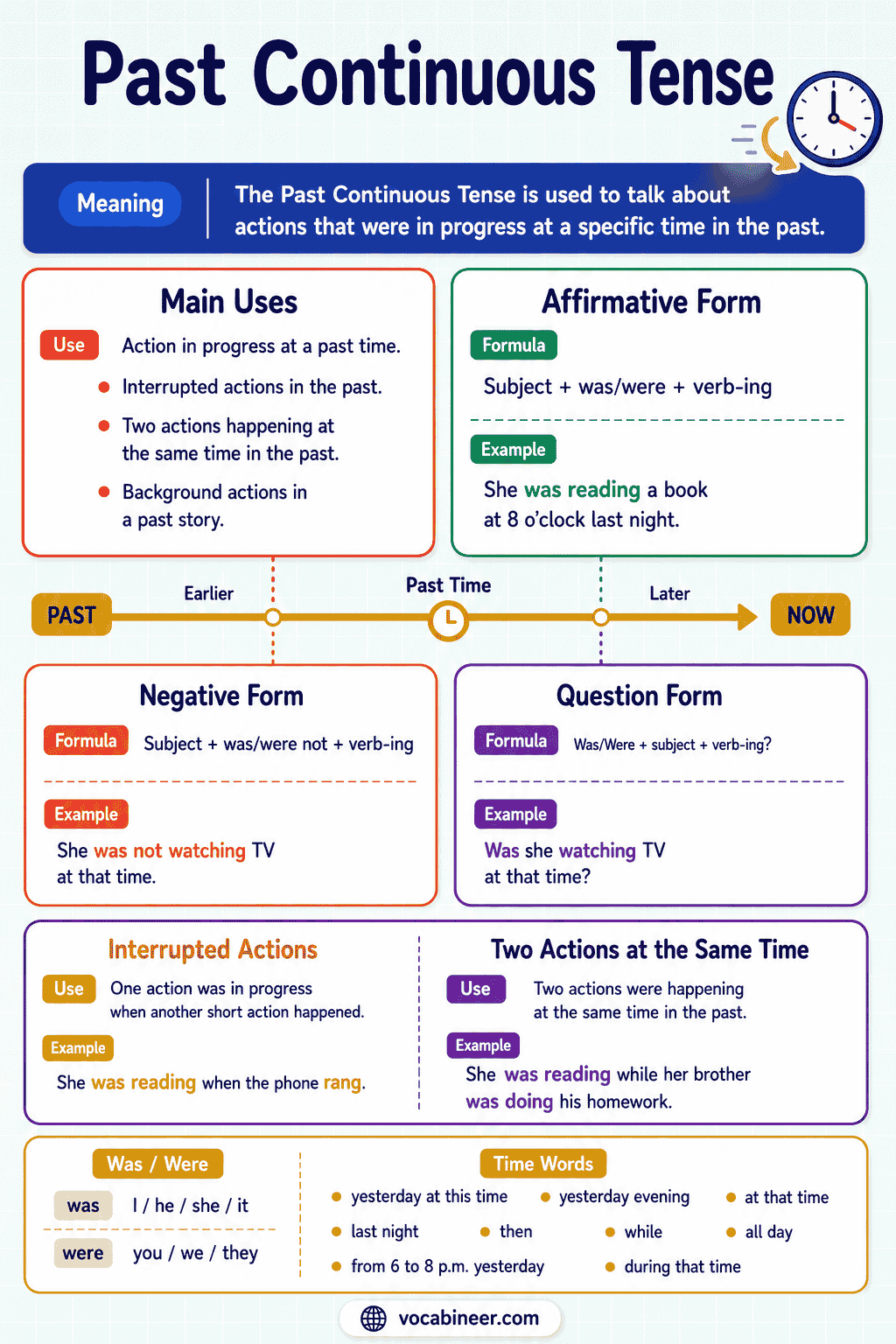
The Past Continuous Tense marks activity in progress around a past reference point. It can describe ongoing activity at a specific past time, background activity, two activities continuing at the same time, repeated activity during a past period, and situations that were developing over time.
Past Continuous uses was/were + V-ing. Correct use also depends on subject agreement, question order, the -ing form, stative-verb restrictions, and the distinction between Past Continuous and nearby forms such as Simple Past and Past Perfect Continuous.
In This Page
What Is the Past Continuous Tense?
The Past Continuous Tense is formed with was or were followed by the -ing form of the main verb.
Basic structure:
S + was/were + V-ing
Examples:
- I was reading.
- She was working.
- We were waiting.
- They were playing outside.
Past Continuous is also called Past Progressive. Both names refer to the same grammatical form.
The tense does not present the activity as a completed whole. Instead, it marks the activity as ongoing around a past reference point.
For example:
- I was studying at 8 p.m.
The studying was in progress around eight.
- She was cooking when the phone rang.
The cooking was already in progress when the completed event occurred.
How Past Continuous Relates Activity to a Past Reference Point
Past Continuous establishes a grammatical relationship between an ongoing activity and a point or period in the past.
Consider these examples:
- I was studying at 8 p.m.
- She was cooking when the phone rang.
- The wind was blowing while people were hurrying home.
The first sentence marks activity in progress around a specific past time. The second combines ongoing activity with a completed event. The third marks two ongoing activities in the same past context.
The central meaning remains the same: Past Continuous presents the activity as ongoing rather than completed around the relevant past point or period.
When to Use the Past Continuous
Past Continuous commonly marks ongoing past activity, background circumstances, simultaneous actions, repeated activity within a limited past period, and developing situations.
Activity in Progress at a Past Time
Use Past Continuous when an activity was already in progress around a specified past time.
Examples:
- I was studying at 8 p.m.
- Maya was driving home at six.
- They were eating dinner at seven.
- Daniel was sleeping at midnight.
- We were working in the office that afternoon.
The tense marks the activity as ongoing around the stated past reference point.
Compare:
- At eight, I watched a film.
- At eight, I was watching a film.
The first sentence can present the film-watching as a completed past event in context. The second specifically marks the activity as in progress around eight.
Background Activity
Past Continuous commonly marks ongoing circumstances around a main past event.
Examples:
- The wind was blowing.
- People were hurrying home.
- Children were playing outside.
- Rain was falling heavily.
- Cars were moving slowly through the traffic.
A completed event can then occur within that background:
- The wind was blowing when the lights went out.
- People were leaving the station when the announcement started.
- The children were playing outside when it began to rain.
Past Continuous marks the ongoing background activity, while Simple Past commonly marks the completed event.
Ongoing Activity During Another Past Event
Past Continuous often occurs when a completed event happens during an activity already in progress.
Examples:
- I was walking home when I saw Sarah.
- She was sleeping when the alarm rang.
- We were eating dinner when the power went out.
- Daniel was driving when he received the call.
- They were discussing the problem when the manager entered.
Past Continuous marks the ongoing activity. Simple Past commonly marks the completed event that occurs during it.
The interruption itself does not define Past Continuous. The grammatical distinction comes from the contrast between ongoing activity and completed event.
Two Simultaneous Ongoing Activities
Past Continuous can mark two activities that were in progress during the same past period.
Examples:
- While I was reading, she was cooking.
- The children were playing while their parents were talking.
- He was studying while I was working.
- Maya was preparing dinner while Daniel was setting the table.
- We were walking while the rain was falling.
Both activities are presented as ongoing during the same past context.
Repeated Activity During a Past Period
Past Continuous can also mark repeated activity within a limited past period.
Examples:
- She was practicing every day that summer.
- They were meeting after school that month.
- We were working late during the final week.
- Daniel was calling me every evening.
- I was taking the bus to work while my car was being repaired.
The repeated activity belongs to a temporary or limited past period rather than an established general habit.
Past Continuous can also occur with always, constantly, continually, and similar expressions when repeated behavior carries evaluation.
Examples:
- He was always complaining.
- She was constantly losing her keys.
- They were always changing their plans.
This construction can combine repeated past behavior with irritation, criticism, surprise, or another evaluation.
Changing or Developing Situations
Past Continuous can mark changes or developments that were in progress during a past period.
Examples:
- The city was growing quickly.
- Her English was improving.
- Prices were rising.
- The weather was getting colder.
- The company was expanding rapidly.
These forms mark situations that were developing rather than remaining stable.
How to Form the Past Continuous
Every Past Continuous construction requires:
- was or were
- a main verb in -ing form
Was and Were
The subject determines whether the tense uses was or were.
| Subject | Form of Be |
|---|---|
| I | was |
| he / she / it | was |
| you | were |
| we | were |
| they | were |
Examples:
- I was reading.
- She was working.
- Daniel was sleeping.
- We were waiting.
- They were playing.
Past Continuous requires both parts of the structure.
Incorrect:
- She working at eight.
Correct:
- She was working at eight.
Affirmative Sentences
The affirmative structure is:
S + was/were + V-ing
Examples:
- I was studying at eight.
- Maya was preparing dinner.
- Daniel was writing an email.
- We were waiting outside.
- They were playing soccer.
Negative Sentences
The negative structure is:
S + was/were + not + V-ing
Examples:
- I was not sleeping.
- She was not working.
- Daniel was not listening.
- We were not waiting outside.
- They were not playing.
Common contractions are:
- was not → wasn’t
- were not → weren’t
Examples:
- I wasn’t sleeping.
- They weren’t waiting outside.
Questions and Short Answers
The question structure is:
Was/Were + S + V-ing?
Examples:
- Were you working?
- Was she sleeping?
- Was Daniel driving?
- Were they waiting?
- Were we speaking too loudly?
Short answers repeat was or were without repeating the main verb.
- Were you working?
Yes, I was. / No, I wasn’t. - Was she sleeping?
Yes, she was. / No, she wasn’t. - Were they waiting?
Yes, they were. / No, they weren’t.
Wh-Questions
Wh-questions commonly use:
Wh-word + was/were + S + V-ing?
Examples:
- What were you doing?
- Where was she going?
- Why were they laughing?
- Who was he talking to?
- What was Maya reading?
The auxiliary remains necessary in Wh-questions.
Verb + -ing Spelling Rules
The main verb takes an -ing form, and some verbs require spelling changes before -ing is added.
Add -ing to Most Verbs
Most verbs take -ing directly.
- work → working
- read → reading
- play → playing
- speak → speaking
- clean → cleaning
Examples:
- She was working.
- They were playing.
Drop Final Silent e
Many verbs ending in silent e drop the e before -ing.
- make → making
- write → writing
- come → coming
- take → taking
- drive → driving
Examples:
- She was making dinner.
- Daniel was writing an email.
Double the Final Consonant Where Required
Some short stressed verbs double the final consonant before -ing.
- run → running
- sit → sitting
- swim → swimming
- stop → stopping
- begin → beginning
Examples:
- He was running in the park.
- We were sitting near the window.
Consonant doubling depends on spelling and stress patterns, so it does not apply to every verb ending in a consonant.
Change -ie to y
Verbs ending in -ie normally change ie to y before -ing.
- lie → lying
- die → dying
- tie → tying
Examples:
- The cat was lying on the sofa.
- She was tying her shoes.
Past Continuous vs Simple Past
Past Continuous and Simple Past can refer to the same past period, but they mark different types of past situations.
| Simple Past | Past Continuous |
|---|---|
| completed past event | activity in progress around a past point |
| I walked home. | I was walking home at eight. |
| She cooked dinner. | She was cooking at six. |
| The phone rang. | I was studying when the phone rang. |
Compare:
- Maya cleaned the kitchen.
- Maya was cleaning the kitchen when I arrived.
The first sentence presents the cleaning as a completed event.
The second presents the cleaning as ongoing when another event occurred.
Another contrast:
- Daniel read the report last night.
- Daniel was reading the report at ten.
Simple Past locates the reading as a completed past event in the first sentence. Past Continuous marks it as ongoing around ten in the second.
The distinction comes from grammatical meaning rather than individual time expressions.
When and While with Past Continuous
When and while often establish relationships between past activities and events, but neither word automatically determines the tense.
When
Examples:
- I was reading when she called.
- She was driving when the rain started.
- When I arrived, they were eating dinner.
When can introduce either the ongoing situation or the completed event depending on sentence structure and meaning.
While
Examples:
- While I was reading, she was cooking.
- He was driving while we were talking.
- While the children were sleeping, their parents were watching television.
While commonly relates activities that continue during the same period, but the intended grammatical meaning determines the actual tense form.
Therefore:
When and while establish temporal relationships; they do not function as automatic tense signals.
Past Continuous and Stative Verbs
Many stative verbs normally occur in Simple Past rather than Past Continuous when they retain an ordinary stative meaning.
Common examples include:
- know
- believe
- understand
- own
- need
- want
- prefer
- belong
- like
- love
Use:
- I knew the answer.
- She wanted more time.
- We owned that house.
- They believed him.
Not normally:
- I was knowing the answer.
- She was wanting more time.
- We were owning that house.
The restriction applies to the stative meaning rather than every possible use of a verb. Some verbs can occur in continuous constructions when their meaning changes.
For example:
- I thought he was right.
- I was thinking about the problem.
The first expresses an opinion. The second marks an ongoing mental activity.
Past Continuous vs Past Perfect Continuous
Past Continuous and Past Perfect Continuous both contain an -ing form, but they establish different past-time relationships.
Past Continuous:
was/were + V-ing
Past Perfect Continuous:
had + been + V-ing
Compare:
- I was working at eight.
- I had been working for three hours when Maya arrived.
Past Continuous marks activity in progress around a past reference point.
Past Perfect Continuous marks earlier ongoing activity or duration related to a later past reference point.
Another pair:
- She was studying when I called.
- She had been studying for two hours when I called.
The first marks the activity as ongoing at the time of the call. The second also establishes that the activity began earlier and had continued for two hours before the call.
Common Past Continuous Mistakes
Past Continuous mistakes commonly involve was/were, the -ing form, auxiliary choice, question order, spelling, or stative meanings.
Missing was or were
Incorrect:
- She working when I called.
Correct:
- She was working when I called.
Past Continuous requires was/were + V-ing.
Using the wrong form of be
Incorrect:
- They was playing outside.
Correct:
- They were playing outside.
Use were with you, we, and they.
Using V1 instead of V-ing
Incorrect:
- He was work at eight.
Correct:
- He was working at eight.
The main verb requires the -ing form.
Using did with Past Continuous
Incorrect:
- Did she was working?
Correct:
- Was she working?
Past Continuous questions use was/were, not did.
Using incorrect question order
Incorrect:
- She was sleeping?
Correct:
- Was she sleeping?
Questions place was or were before the subject.
Using incorrect -ing spelling
Incorrect:
- She was makeing dinner.
Correct:
- She was making dinner.
Many verbs ending in silent e drop the e before -ing.
Using an ordinary stative meaning
Incorrect:
- I was knowing the answer.
Correct:
- I knew the answer.
The ordinary stative meaning of know normally occurs in Simple Past rather than Past Continuous.
FAQs
Past Continuous is an English tense form built with was/were + V-ing. It marks activity as in progress around a past reference point and can also mark background, simultaneous, repeated, or developing past activity.
Yes. Past Progressive and Past Continuous are two names for the same grammatical form.
Use was with I, he, she, and it. Use were with you, we, and they. Both forms combine with the main verb in -ing form.
Simple Past commonly marks completed past events, while Past Continuous marks activity in progress around a past point. For example, I walked home presents a completed event, while I was walking home at eight marks ongoing activity.
Ordinary stative meanings normally use Simple Past rather than Past Continuous. For example, I knew the answer is normally used instead of I was knowing the answer. Some verbs can use continuous forms when their meaning changes.
Read More
- 12 English Tenses Chart
- All Tenses Rules and Formula
- English Tenses with Examples
- Indefinite Tense (Simple Tense)