

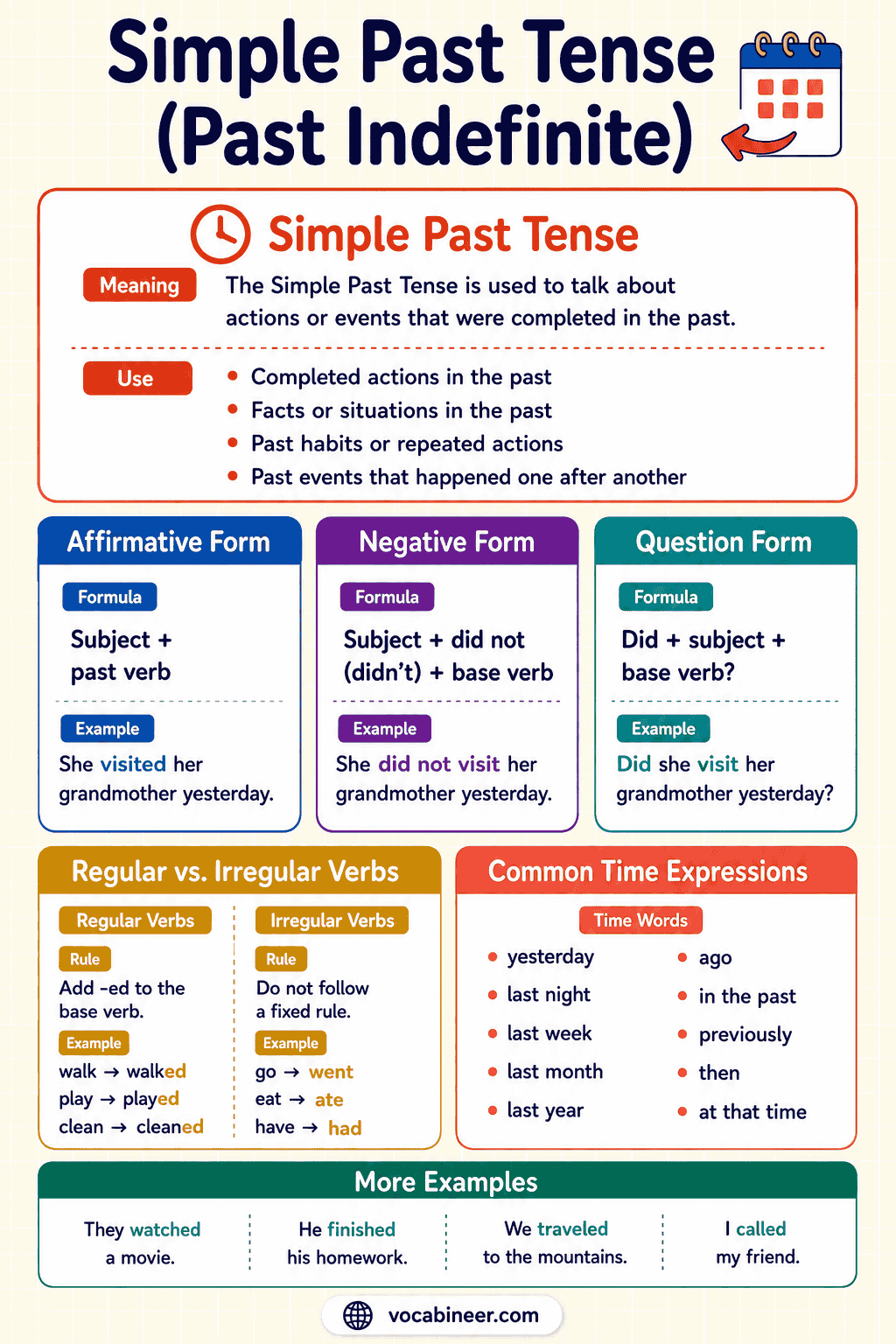
The Simple Past Tense marks events, states, and repeated situations located in a completed past context. It is commonly used for finished actions, past conditions, repeated past habits, and sequences of events that belong to an earlier time.
Simple Past is also called Past Simple, while Past Indefinite is a traditional ESL name for the same basic tense form. Correct use depends on the V2 form of the verb, did + V1 in negatives and questions, the special forms was/were, and the distinction between Simple Past and nearby tense forms such as Present Perfect and Past Continuous.
In This Page
What Is the Simple Past Tense?
The Simple Past Tense marks an event, state, or repeated situation located in a completed past context.
Examples:
- Maya visited her aunt yesterday.
- We lived there for ten years.
- Daniel played soccer every Saturday as a child.
- She opened the door and walked inside.
The first sentence marks a completed past event. The second marks a past state, the third marks a repeated past situation, and the fourth gives a sequence of completed events.
Simple Past commonly uses the V2 form of ordinary verbs in affirmative sentences.
Basic affirmative structure:
S + V2
Examples:
- I worked yesterday.
- She went home.
- They saw the film.
Simple Past and Past Indefinite
Simple Past, Past Simple, and Past Indefinite generally refer to the same tense form in English learner grammar.
| Term | Meaning |
|---|---|
| Simple Past | Common name for the tense |
| Past Simple | Common alternative word order |
| Past Indefinite | Traditional ESL term |
Modern English-learning materials commonly use Simple Past or Past Simple. The term Past Indefinite remains common in some school systems and traditional grammar materials.
The word indefinite is a traditional grammatical label. It does not mean that the past event is uncertain.
When to Use the Simple Past
Simple Past commonly marks completed events, past states, repeated past situations, and sequences of completed events.
Completed Past Actions
Use Simple Past for events that occurred and ended in a completed past context.
Examples:
- I finished the report last night.
- She arrived at noon.
- They visited us yesterday.
- Daniel called me after dinner.
- We watched a movie on Saturday.
The event belongs to an earlier period rather than the present.
Past States
Simple Past also marks states that existed during an earlier period.
Examples:
- I knew the answer.
- She liked that school.
- We owned a small house.
- Daniel wanted a new bicycle.
- They believed the story.
Simple Past is therefore not limited to action verbs.
Repeated Past Actions and Habits
Use Simple Past for actions or situations that occurred repeatedly during a completed past period.
Examples:
- We visited our grandparents every summer.
- He played cricket every weekend.
- She walked to school when she was young.
- I read before bed every night as a child.
- They traveled frequently during college.
Simple Past can express past habits directly without requiring another habitual construction.
For example:
- I walked to school every day.
- I used to walk to school every day.
Both can refer to a repeated past habit, although used to has its own grammatical pattern and emphasis.
Sequences of Completed Events
Simple Past commonly marks the main sequence of completed events in a narrative.
Examples:
- Maya opened the envelope, read the letter, and called her brother.
- Daniel got out of the car, locked the door, and walked into the building.
- We finished dinner, paid the bill, and left the restaurant.
Each verb moves the completed past sequence forward in chronological order.
How to Form the Simple Past
Ordinary verbs use different structures in affirmative sentences, negatives, and questions.
Affirmative Sentences
The basic affirmative structure is:
S + V2
Examples:
- I worked yesterday.
- She visited her aunt.
- Daniel wrote the email.
- We took the bus.
- They went home.
In affirmative sentences, the main verb itself carries the past form.
Regular Verbs
Regular verbs normally form V2 by adding -ed or following a related spelling pattern.
Add -ed to Most Verbs
- work → worked
- clean → cleaned
- help → helped
- visit → visited
Examples:
- She worked late.
- We visited them yesterday.
Add -d to Verbs Ending in e
- live → lived
- move → moved
- use → used
- arrive → arrived
Example:
- They moved last year.
Change Consonant + y to -ied
When a verb ends in a consonant + y, change y to ied.
- study → studied
- carry → carried
- try → tried
Example:
- Maya studied all evening.
When a vowel comes before y, normally add -ed.
- play → played
- enjoy → enjoyed
Double the Final Consonant Where Required
Some short stressed verbs double the final consonant before -ed.
- stop → stopped
- plan → planned
- drop → dropped
Example:
- The bus stopped near the station.
Consonant doubling depends on spelling and stress patterns, so it does not apply to every verb ending in a consonant.
Irregular Verbs
Irregular verbs do not form V2 with a regular -ed pattern.
| Base Form | V2 |
|---|---|
| go | went |
| see | saw |
| write | wrote |
| take | took |
| eat | ate |
| come | came |
| have | had |
| do | did |
| make | made |
| give | gave |
Examples:
- She went home early.
- I saw Daniel yesterday.
- He wrote three emails.
- We took the train.
- They had lunch at noon.
Because irregular forms vary, they must be learned individually.
Negative Sentences
The negative structure is:
S + did not + V1
Examples:
- I did not work yesterday.
- She did not go home.
- They did not see him.
- Daniel did not write the email.
The common contraction is:
did not → didn’t
Examples:
- I didn’t work yesterday.
- She didn’t go home.
- We didn’t stay long.
The main verb remains in V1 after did.
Correct:
- She did not go home.
Incorrect:
- She did not went home.
Did carries the past grammatical marking, so the main verb remains in its base form.
Questions and Short Answers
The basic question structure is:
Did + S + V1?
Examples:
- Did you work yesterday?
- Did she go home?
- Did Daniel write the email?
- Did they see the film?
V1 follows did.
Correct:
- Did he take the bus?
Incorrect:
- Did he took the bus?
Short answers repeat did rather than the main verb.
- Did you call her?
Yes, I did. / No, I didn’t. - Did she arrive?
Yes, she did. / No, she didn’t.
Wh-Questions
Wh-questions commonly use:
Wh-word + did + S + V1?
Examples:
- Where did you go?
- What did she say?
- Why did they leave?
- When did Daniel arrive?
- How did you find the address?
The same did + V1 rule applies.
Simple Past with Be
The verb be follows a different Simple Past pattern from ordinary verbs.
Its past forms are:
| Subject | Past Form of Be |
|---|---|
| I | was |
| he / she / it | was |
| you / we / they | were |
Examples:
- I was tired.
- She was at home.
- Daniel was busy.
- We were ready.
- They were late.
Negative Forms with Be
Place not after was or were.
Examples:
- I was not tired.
- She was not at home.
- We were not ready.
- They were not late.
Common contractions are:
- was not → wasn’t
- were not → weren’t
Examples:
- She wasn’t at school.
- They weren’t late.
Questions with Be
Place was or were before the subject.
Examples:
- Was she tired?
- Was Daniel at home?
- Were they late?
- Were you busy?
Ordinary Simple Past forms of be do not use did.
Incorrect:
- Did she be tired?
Correct:
- Was she tired?
Finished Past Time with the Simple Past
Simple Past commonly occurs when the situation is located in a completed past period.
Common expressions include:
- yesterday
- last night
- last week
- last year
- two days ago
- three months ago
- in 2022
- when I was a child
Examples:
- We visited them yesterday.
- She moved here in 2022.
- Daniel called me last night.
- I played outside every day when I was a child.
- They left two hours ago.
These expressions commonly occur with Simple Past because they place the situation in a completed past context. However, they should not be treated as automatic signal words. The intended time relationship determines the tense.
Simple Past vs Present Perfect
Simple Past and Present Perfect both refer to earlier situations, but they establish different time relationships.
| Simple Past | Present Perfect |
|---|---|
| situation located in a finished past context | earlier situation related to the present |
| specific finished past time can be stated | finished past time is not normally specified |
| I saw the film last night. | I have seen the film. |
| She visited Paris in 2023. | She has visited Paris. |
Compare:
- I visited London in 2023.
- I have visited London.
The first sentence places the visit in the finished period 2023.
The second marks an experience before the present without specifying a finished past time.
Another example:
- We lived there from 2018 to 2021.
- We have lived here since 2021.
The first situation belongs to a completed past period. The second begins earlier and continues to the present.
Simple Past vs Past Continuous
Simple Past commonly marks a completed event, while Past Continuous marks activity in progress around a past reference point.
Compare:
- I walked home.
- I was walking home at eight.
The first sentence represents the walk as a completed past event. The second marks the activity as in progress at eight.
These forms often occur together:
- I was walking home when I saw Sarah.
- She was cooking when the phone rang.
- They were sleeping when the storm started.
In each pair, Past Continuous marks the ongoing activity while Simple Past marks the completed event that occurred during it.
The distinction comes from grammatical meaning rather than the presence of when alone.
Common Simple Past Mistakes
Simple Past mistakes commonly involve irregular forms, did + V1, the verb be, spelling, or confusion between V2 and V3.
Using the wrong irregular V2
Incorrect:
- She goed home.
Correct:
- She went home.
Irregular verbs do not follow the regular -ed pattern.
Using V2 after did or didn’t
Incorrect:
- Did she went home?
Correct:
- Did she go home?
Incorrect:
- She didn’t went home.
Correct:
- She didn’t go home.
Did and didn’t carry the past grammatical marking, so the main verb remains in V1.
Using did with be
Incorrect:
- Did she be tired?
Correct:
- Was she tired?
The Simple Past forms of be use was/were directly.
Using the wrong form of be
Incorrect:
- They was late.
Correct:
- They were late.
Use were with you, we, and they.
Using the wrong regular spelling
Incorrect:
- The car stoped.
Correct:
- The car stopped.
Some short stressed verbs require final-consonant doubling before -ed.
Confusing V2 with V3
Incorrect:
- She gone home yesterday.
Correct:
- She went home yesterday.
Went is V2 and forms Simple Past. Gone is V3 and normally requires an auxiliary in perfect constructions.
FAsQs
Simple Past is an English tense form that marks events, states, and repeated situations located in a completed past context. Ordinary affirmative verbs use V2.
Yes. Past Indefinite is a traditional ESL name for the tense more commonly called Simple Past or Past Simple in modern learner materials.
Did carries the past grammatical marking in ordinary Simple Past negatives and questions. Therefore, the main verb remains in V1, as in Did she go? rather than Did she went?
Use was with I, he, she, and it. Use were with you, we, and they. These are the Simple Past forms of be.
Simple Past places a situation in a completed past context, while Present Perfect relates an earlier event, experience, result, or state to the present reference point. Compare I visited Paris in 2023 with I have visited Paris.
Read More
- 12 English Tenses Chart
- All Tenses Rules and Formula
- English Tenses with Examples
- Indefinite Tense (Simple Tense)