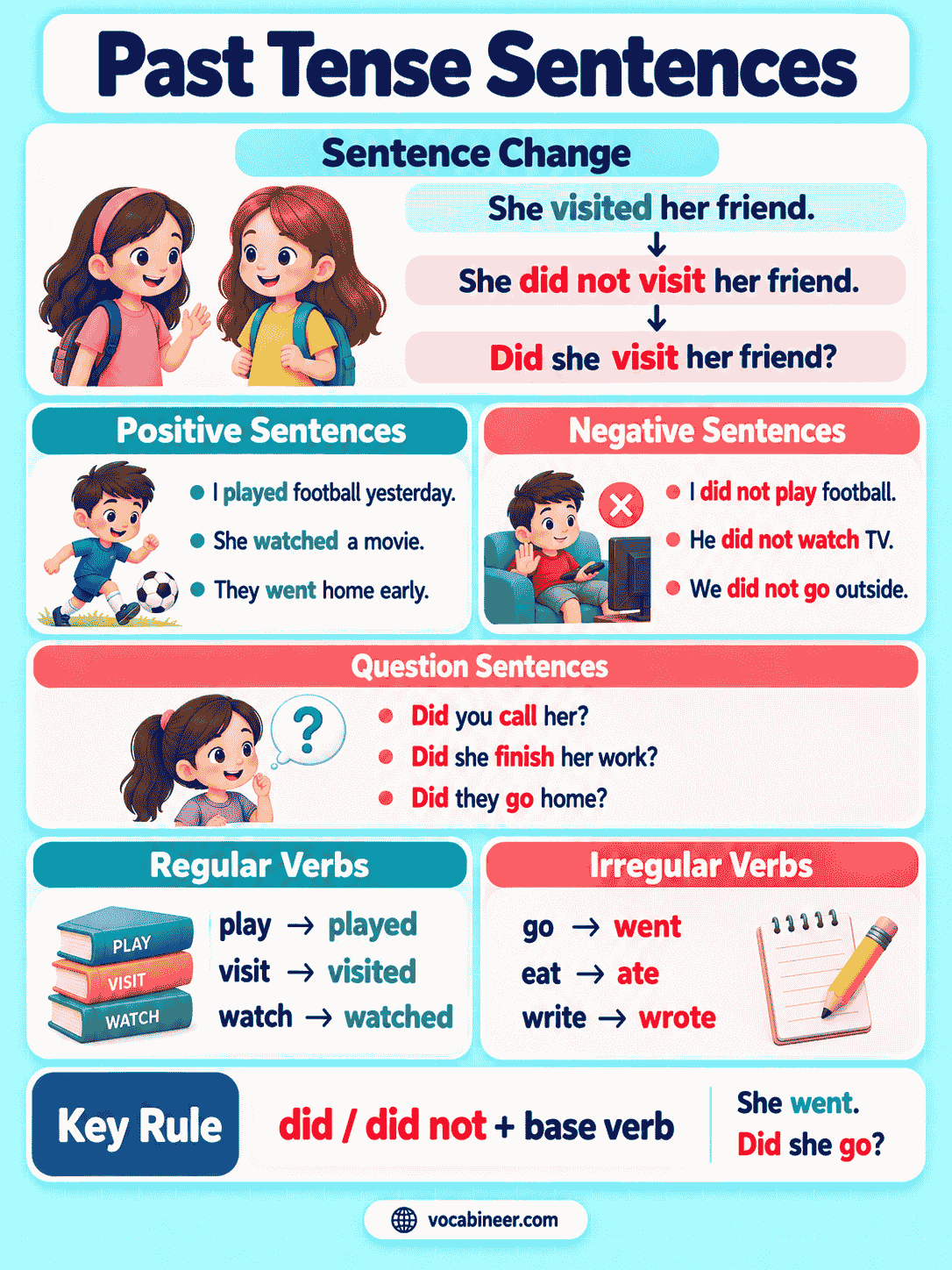
Past tense sentences help learners describe actions, events, habits, experiences, and situations that happened before the present. Because the Past Simple appears constantly in everyday English, learning its sentence patterns makes it easier to talk about yesterday, previous experiences, finished activities, and earlier stages of life.
This article focuses mainly on the Past Simple, which is usually what learners mean when searching for past tense sentences. First, you’ll explore 100 Past Tense sentences; then, you’ll learn how regular and irregular verbs, negatives, questions, was/were, past habits, past states, and common time expressions work in real sentences.
In This Page
What Do We Mean by Past Tense Sentences?
Past tense sentences describe actions, events, habits, or states connected to an earlier time.
For example:
- I visited my grandmother yesterday.
- She went to school early.
- They played football after class.
- He was tired last night.
English has several past forms. However, this article concentrates on the Past Simple because it is the main form used for completed past actions, repeated past events, and past states.
100 Past Tense Sentences
The following examples cover everyday actions, regular and irregular verbs, negatives, questions, was/were, habits, states, and common past-time expressions.
- I woke up early yesterday.
- Afterward, she made breakfast for everyone.
- He walked to school in the morning.
- Later, we played football after class.
- They watched a movie last night.
- Meanwhile, my mother cooked dinner at home.
- My father washed the car.
- Then Sara cleaned her room.
- Ali went to the market.
- Finally, the baby slept for two hours.
- I finished my homework before dinner.
- Later, she called her friend.
- He studied for the test.
- During the weekend, we visited our grandparents.
- They travelled by train.
- After lunch, my brother opened the window.
- The teacher explained the lesson clearly.
- Then I helped my mother in the kitchen.
- She worked late yesterday.
- In the evening, he played chess with his friend.
- I went home early.
- After lunch, she ate an apple.
- He wrote a letter.
- Suddenly, we saw a rainbow.
- They bought new shoes.
- Later, my sister took the bus.
- He came home at six.
- Before work, I had breakfast at seven.
- She gave me a book.
- Eventually, we found the missing keys.
- I read a story last night.
- Then he drank a glass of water.
- They ran around the park.
- After class, she spoke to the teacher.
- We drove to the city.
- Later, my uncle sold his old car.
- I met an old friend.
- Afterward, he sent an email.
- She lost her phone.
- In the end, they won the match.
- I didn’t go to school yesterday.
- However, she didn’t eat breakfast.
- He didn’t call me.
- Likewise, we didn’t watch television.
- They didn’t finish the work.
- Because of the rain, my father didn’t drive to work.
- I didn’t understand the question.
- Therefore, she didn’t buy anything.
- He didn’t bring his bag.
- Fortunately, we didn’t arrive late.
- Did you finish your homework?
- Afterward, did she call you?
- Did he go to work?
- Later, did they watch the match?
- Did we leave early?
- Where did you go yesterday?
- Then what did she buy?
- Why did he leave early?
- Finally, when did they arrive?
- How did you learn that?
- I was tired after work.
- Yesterday, she was at home.
- He was very busy.
- Meanwhile, the room was quiet.
- We were happy with the result.
- Unfortunately, they were late for class.
- The children were excited.
- At that time, my parents were at the market.
- She wasn’t at school.
- As a result, we weren’t ready.
- Was he tired?
- Earlier, was she at home?
- Were they late?
- Yesterday, were you busy?
- Was the shop open?
- When I was young, I walked to school every day.
- After class, she played outside.
- Every summer, we visited our grandparents.
- Before bed, he read each night.
- On weekends, they swam together.
- I lived in London for five years.
- At school, she liked that teacher.
- He knew the answer.
- After the journey, we felt tired.
- They had a small house.
- Years ago, my grandfather owned a shop.
- I remembered his name.
- At the time, she wanted a new bicycle.
- He believed the story.
- Therefore, we needed more time.
- I called her yesterday.
- Last year, we travelled abroad.
- She arrived two hours ago.
- Back in 2020, he worked there.
- They left earlier.
- Last week, I visited the museum.
- She finished the book last night.
- Three months ago, he started his new job.
- We moved here last year.
- Finally, they met us yesterday evening.
How Past Simple Sentences Are Formed
Past Simple sentences follow different patterns depending on whether they are affirmative, negative, interrogative, or built with be. Fortunately, the main patterns are quite consistent.
| Form | Structure | Example |
|---|---|---|
| affirmative | subject + past verb | She worked yesterday. |
| negative | subject + did not + base verb | She didn’t work yesterday. |
| question | Did + subject + base verb? | Did she work yesterday? |
| be | subject + was/were | They were tired. |
In affirmative sentences, the main verb carries the past form. By contrast, negatives and ordinary questions use did, so the main verb returns to its base form.
Regular Verb Past Tense Sentences
Regular verbs usually form the Past Simple by adding -ed or -d. Therefore, once learners recognize the base verb, these forms are generally easier to predict.
Examples:
- I walked home.
- Afterward, she cleaned her room.
- We watched a movie.
- Later, they played football.
- He visited his uncle.
- Meanwhile, the teacher explained the lesson.
- My mother cooked dinner.
- Finally, Sara finished her homework.
Although the ending is predictable, spelling can change slightly in verbs such as study → studied and stop → stopped.
Irregular Verb Past Tense Sentences
Irregular verbs do not form the past simply by adding -ed. Instead, each verb has its own past form, so learners usually need to remember these individually.
Examples:
- I went home early.
- After breakfast, she ate an apple.
- He wrote a letter.
- Suddenly, we saw a rainbow.
- They bought new shoes.
- Later, my brother took the bus.
- She came home late.
- At noon, he had lunch.
Some common irregular forms are:
| Base Verb | Past Form |
|---|---|
| go | went |
| eat | ate |
| write | wrote |
| see | saw |
| buy | bought |
| take | took |
| come | came |
| have | had |
Because irregular forms vary, frequent exposure through sentences helps learners remember them more naturally.
Negative Past Tense Sentences
Past Simple negatives use did not or didn’t followed by the base form of the verb.
Examples:
- I didn’t go to school.
- However, she didn’t eat breakfast.
- He didn’t call me.
- Likewise, we didn’t watch television.
- They didn’t finish the work.
- Because of the weather, my father didn’t drive yesterday.
The main point is simple: after didn’t, do not use the past form again.
Correct:
- She didn’t go.
Incorrect:
- She didn’t went.
Because did already marks the sentence as past, the main verb remains in its base form.
Past Tense Questions
Past Simple questions usually place did before the subject. Again, the main verb stays in its base form.
Yes/No Questions
- Did you finish your homework?
- Later, did she call you?
- Did he go to work?
- Afterward, did they watch the match?
- Did we leave early?
WH-Questions
- Where did you go?
- Then what did she buy?
- Why did he leave?
- Finally, when did they arrive?
- How did you learn that?
Therefore, forms such as Did she went? are incorrect because did already carries the past-time marking.
Subject Questions Without Did
Not every Past Simple question needs did. In particular, when who or what is the subject of the sentence, English normally uses the past verb directly.
Examples:
- Who called you?
- Who broke the window?
- What happened yesterday?
- Who opened the door?
Compare:
- Who called you?
- Who did you call?
In the first question, who is the subject. In the second, however, you is the subject and who is the object, so did is required.
Past Tense Sentences with Was and Were
The verb be follows its own Past Simple pattern. Instead of using did, it changes directly to was or were.
Use was with I, he, she, it, and singular subjects:
- I was tired.
- Yesterday, she was at home.
- He was busy.
- At noon, the shop was closed.
Use were with you, we, they, and plural subjects:
- We were happy.
- Unfortunately, they were late.
- You were right.
- Meanwhile, the children were excited.
Negative forms include:
- She wasn’t at school.
- Therefore, they weren’t ready.
Questions include:
- Was he at home?
- Were they late?
Unlike ordinary verbs, be does not use did in Past Simple negatives or questions.
Past Tense Sentences for Completed Actions
One of the main uses of the Past Simple is to describe an action that started and finished before now.
Examples:
- I finished my homework last night.
- Yesterday, she visited the doctor.
- We watched a movie after dinner.
- Later, he lost his keys.
- They arrived at noon.
- After work, my brother bought a new phone.
- The train left at nine.
- Finally, I sent the message.
In each case, the action belongs to a finished past time.
Past Tense Sentences for Past Habits
Past Simple also describes actions that happened repeatedly in an earlier period.
Examples:
- When I was young, I walked to school every day.
- After class, she played outside.
- Every summer, we visited our grandparents.
- Before bed, he read each night.
- On weekends, they swam together.
- Years ago, my father rode his bicycle to work.
- Every Sunday, we ate together.
These sentences describe repeated past behavior rather than one isolated event. Therefore, expressions such as every day, every summer, and on weekends often help establish the habitual meaning.
Past Tense Sentences for Past States
Past Simple is not limited to physical actions. It can also describe feelings, knowledge, possession, preferences, and situations that were true at an earlier time.
Examples:
- I lived in London for five years.
- At school, she liked that teacher.
- He knew the answer.
- After the journey, we felt tired.
- They had a small house.
- Years ago, my grandfather owned a shop.
- I remembered his name.
- At the time, she wanted a new bicycle.
These examples describe past conditions or states rather than completed physical actions.
Everyday Past Tense Sentences
Past Simple appears constantly in conversations about daily life. For that reason, routine activities provide some of the easiest examples to remember.
- I woke up late.
- Then she made breakfast.
- He missed the bus.
- Afterward, we went shopping.
- They came home early.
- Meanwhile, my mother cooked dinner.
- I washed the dishes.
- Later, she called her friend.
- He studied for the test.
- In the evening, we watched television.
- My sister cleaned the kitchen.
- Finally, I went to bed at ten.
Because these examples follow a natural daily sequence, they also work well for speaking and storytelling practice.
Past Tense Sentences with Time Expressions
Past Simple frequently appears with expressions that identify an earlier time.
Common examples include:
- yesterday
- last night
- last week
- last month
- last year
- two days ago
- an hour ago
- in 2020
- when I was young
- earlier
Sentence examples:
- I called her yesterday.
- Last year, we travelled abroad.
- She arrived two hours ago.
- Back in 2020, he worked there.
- They left earlier.
- Last week, we met our old teacher.
These expressions often support past-time meaning. However, they are not rigid rules; the wider context still determines which tense is appropriate.
Regular vs Irregular Past Tense Verbs
Regular and irregular verbs differ mainly in how they form the affirmative Past Simple.
| Regular Verbs | Irregular Verbs |
|---|---|
| work → worked | go → went |
| play → played | eat → ate |
| clean → cleaned | write → wrote |
| watch → watched | take → took |
| visit → visited | see → saw |
Regular verbs usually follow predictable spelling patterns. Irregular verbs, by contrast, may change completely, so learners generally need to learn their individual past forms.
Short Answers in the Past Tense
Past questions can often be answered briefly with did, was, or were.
- Did you call him? — Yes, I did. / No, I didn’t.
- Did she go home? — Yes, she did. / No, she didn’t.
- Was he tired? — Yes, he was. / No, he wasn’t.
- Were they ready? — Yes, they were. / No, they weren’t.
Notice that short answers normally repeat the auxiliary or the form of be, rather than the main action verb.
Past Tense Sentences for Kids
Children and beginners benefit most from short, concrete examples.
- I played with my toys.
- Then she ate an apple.
- He ran to school.
- Afterward, we saw a bird.
- They jumped on the grass.
- Meanwhile, my dog slept on the floor.
- The teacher read a story.
- Finally, I drew a picture.
- She opened the box.
- Later, we made a cake.
These sentences combine familiar actions with common regular and irregular verbs.
Common Past Tense Sentence Mistakes
A few patterns cause most beginner errors. Therefore, learning these corrections can prevent many common Past Simple mistakes.
Using the past form after Did
Incorrect: Did she went home?
Correct: Did she go home?
Because did already marks past time, the main verb stays in its base form.
Using the past form after Didn’t
Incorrect: He didn’t ate breakfast.
Correct: He didn’t eat breakfast.
Again, didn’t carries the past meaning, so eat remains in the base form.
Forgetting the regular past ending
Incorrect: We walk home yesterday.
Correct: We walked home yesterday.
When no auxiliary is present, the affirmative verb itself must show the past form.
Using an incorrect irregular form
Incorrect: She buyed a dress.
Correct: She bought a dress.
Unlike regular verbs, irregular forms do not simply take -ed.
Using Was and Were incorrectly
Incorrect: They was tired.
Correct: They were tired.
Use were with you, we, they, and plural subjects.
Changing tense without a reason
Incorrect: He went home and eats dinner.
Correct: He went home and ate dinner.
When both actions belong to the same finished past sequence, consistent Past Simple usually gives the clearest meaning.
Past Simple and Other Past Tenses
The phrase past tense can refer broadly to several English tense forms. This article focuses on Past Simple; however, the other past tenses express different time relationships.
| Past Form | Example |
|---|---|
| Past Simple | I worked yesterday. |
| Past Continuous | I was working at eight. |
| Past Perfect | I had worked before he arrived. |
| Past Perfect Continuous | I had been working for two hours. |
Past Simple usually presents a completed past event or state. By contrast, the other forms can highlight an action in progress, an earlier past event, or duration before another past point.
FAQs
Common examples include I visited my grandmother yesterday, She went to school early, They played football after class, and He was tired last night. In each case, the action or state belongs to an earlier time.
With ordinary verbs, use did not / didn’t + base verb, as in She didn’t go home. With be, however, use wasn’t or weren’t.
Usually, place did before the subject and use the base verb, as in Did she call you? or Where did they go? Questions with was/were, by contrast, place was or were before the subject.
Regular verbs usually add -ed or -d, such as work → worked. Irregular verbs change differently; for example, go → went and eat → ate.
Use was with I, he, she, it, and singular subjects. Meanwhile, were goes with you, we, they, and plural subjects.
Read More
- 12 English Tenses Chart
- All Tenses Rules and Formula
- English Tenses with Examples
- Present Tenses in English
- Past Tenses in English
- Future Tenses in English
- Be Going To in English