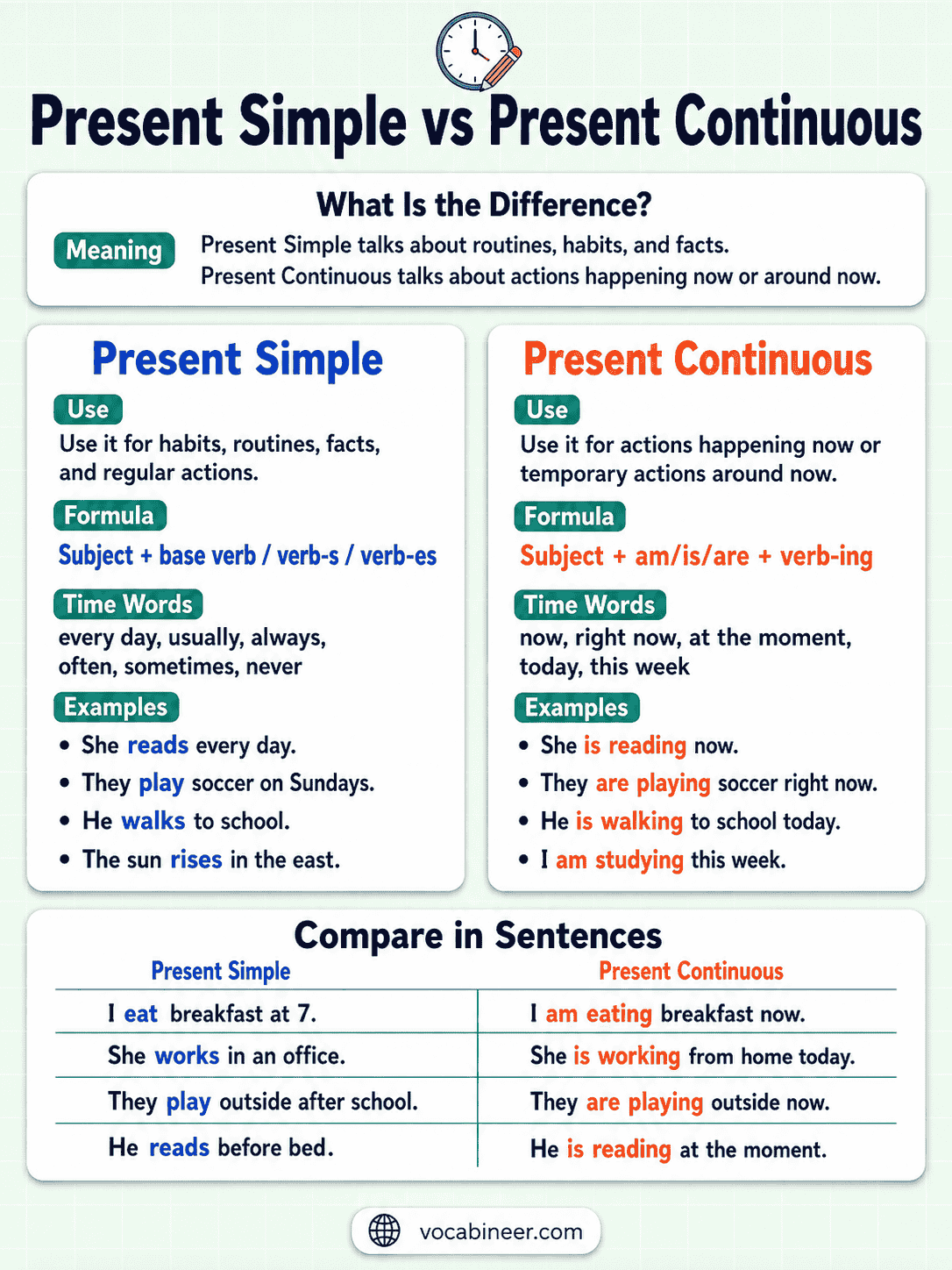
Present Simple and Present Continuous both describe present-time situations, but they do not express the same meaning. Present Simple commonly presents actions, facts, habits, and states as general, regular, stable, or normal, while Present Continuous presents actions and situations as current, temporary, changing, developing, or arranged.
Learning the difference helps students choose the correct tense for everyday routines, actions happening now, temporary situations, changing habits, stative verbs, future timetables, and personal arrangements.
In This Page
Present Simple vs Present Continuous: What Is the Difference?
The main difference is the way the speaker presents the situation.
| Present Simple | Present Continuous |
|---|---|
| general or regular meaning | current or temporary meaning |
| stable situation | changing or developing situation |
| established habit | temporary or new habit |
| stative meaning | active or ongoing meaning |
| timetable or schedule | personal arrangement |
Examples:
- I work in Lahore.
- I am working in Karachi this month.
The first sentence presents the job location as a normal or stable situation. The second presents the work in Karachi as temporary.
Another example:
- She drinks coffee every morning.
- She is drinking coffee now.
The first describes a regular habit. The second describes an action in progress.
Present Simple vs Present Continuous at a Glance
| Meaning | Present Simple | Present Continuous |
|---|---|---|
| regular habit | I walk to work every day. | — |
| action happening now | — | I am walking to work now. |
| stable situation | She lives in Lahore. | — |
| temporary situation | — | She is living with her aunt this month. |
| general fact | Water boils at 100°C. | — |
| changing situation | — | The weather is getting warmer. |
| state | I know the answer. | — |
| temporary behavior | — | He is being rude today. |
| timetable | The train leaves at seven. | — |
| arrangement | — | I am meeting Maya at seven. |
This table gives the basic contrast, but context still determines the correct form.
How Present Simple and Present Continuous Are Formed
The two tenses use different structures.
| Feature | Present Simple | Present Continuous |
|---|---|---|
| affirmative | I/you/we/they work; he/she/it works | am/is/are + V-ing |
| negative | do/does not + V1 | am/is/are not + V-ing |
| question | Do/Does + subject + V1? | Am/Is/Are + subject + V-ing? |
| main verb form | V1 or V1 + s/es | V-ing |
| auxiliary in negatives/questions | do/does | am/is/are |
Examples:
| Present Simple | Present Continuous |
|---|---|
| She works every day. | She is working now. |
| She does not work on Sundays. | She is not working today. |
| Does she work here? | Is she working now? |
The comparison article only needs this compact formation overview. Detailed spelling rules belong in the individual tense lessons.
Regular Habits vs Actions Happening Now
Present Simple commonly expresses regular or repeated actions, while Present Continuous expresses activity happening now or around the current period.
| Present Simple | Present Continuous |
|---|---|
| regular or repeated action | action happening now or around now |
| I drink coffee every morning. | I am drinking coffee now. |
| She walks to school every day. | She is walking to school now. |
| They play football on Fridays. | They are playing football now. |
| Daniel reads before bed. | Daniel is reading at the moment. |
Present Continuous does not always refer to the exact second of speaking.
For example:
- I am reading a very interesting book this week.
The speaker may not be holding the book at that exact moment. The activity belongs to the current period.
Stable vs Temporary Situations
Present Simple commonly presents a situation as stable or normal, while Present Continuous presents it as limited to the current period.
| Present Simple | Present Continuous |
|---|---|
| stable or normal situation | temporary situation |
| She lives with her parents. | She is living with her parents for a few weeks. |
| I work in Lahore. | I am working in Karachi this month. |
| They study at the university. | They are studying abroad this semester. |
| Daniel drives to work. | Daniel is taking the bus this week. |
The word permanent should not be treated as an absolute rule. A situation can last a long time and still be presented as temporary if the speaker views it that way.
Compare:
- She lives in Dubai.
- She is living in Dubai for a year.
The second sentence presents the stay as limited.
Regular Habits vs Temporary or New Habits
Present Simple commonly describes established routines. Present Continuous can describe habits that are temporary, recent, or changing.
| Present Simple | Present Continuous |
|---|---|
| regular or established habit | temporary, new, or changing habit |
| I drink two cups of coffee every day. | I am drinking more coffee these days. |
| She works late on Mondays. | She is working late a lot this month. |
| He takes the bus to work. | He is taking the train this week. |
| We eat at home most evenings. | We are eating out more often this month. |
The contrast is not simply routine vs now. It can also be established routine vs temporary routine.
Stable Situations vs Changing or Developing Situations
Present Continuous commonly expresses change or development, while Present Simple presents the situation as more stable.
| Present Simple | Present Continuous |
|---|---|
| stable fact or situation | changing or developing situation |
| The climate is warm. | The climate is getting warmer. |
| She speaks English well. | Her English is improving quickly. |
| The company employs 200 people. | The company is growing rapidly. |
| Prices remain high. | Prices are rising again. |
Other common changing situations include:
- Technology is changing quickly.
- More people are working from home.
- The city is becoming more crowded.
General Characteristics vs Temporary Behavior
The verb be usually describes a state in Present Simple, but being can describe temporary behavior.
| Present Simple | Present Continuous |
|---|---|
| general characteristic | temporary or current behavior |
| He is rude. | He is being rude today. |
| She is helpful. | She is being especially helpful this morning. |
| Daniel is difficult. | Daniel is being difficult today. |
Compare:
- He is selfish.
This presents selfishness as a general characteristic. - He is being selfish.
This describes his behavior in the current situation.
Therefore, be can appear in a continuous form when the meaning changes from general characteristic to temporary behavior.
Stative Verbs with Present Simple and Present Continuous
Many stative verbs normally use Present Simple because they describe states rather than ongoing actions.
Common stative verbs include:
- know
- believe
- understand
- like
- love
- hate
- prefer
- want
- need
- own
- belong
- seem
Examples:
- I know the answer.
- She likes coffee.
- They own the house.
- He needs more time.
- This bag belongs to Maya.
Not normally:
- I am knowing the answer.
- She is liking coffee.
- They are owning the house.
A useful rule is:
Many stative verbs normally use Present Simple when they retain an ordinary stative meaning.
This is not an absolute ban on continuous forms because some verbs can change meaning.
Verbs That Change Meaning
Some verbs can use either tense because their meaning changes.
Have
| Present Simple | Present Continuous |
|---|---|
| possession or state | activity or experience |
| I have a new car. | I am having lunch. |
| She has two brothers. | She is having a shower. |
Use Present Simple for possession and Present Continuous for an activity.
Think
| Present Simple | Present Continuous |
|---|---|
| opinion or belief | active mental process |
| I think this is correct. | I am thinking about the problem. |
| She thinks the plan will work. | She is thinking about changing jobs. |
Taste
| Present Simple | Present Continuous |
|---|---|
| describes flavor | active tasting |
| The soup tastes good. | The chef is tasting the soup. |
| The sauce tastes salty. | She is tasting the sauce. |
See
| Present Simple | Present Continuous |
|---|---|
| perception or understanding | meeting or visiting |
| I see what you mean. | I am seeing the doctor tomorrow. |
| She sees the mountains from her window. | She is seeing a client this afternoon. |
Feel
| Present Simple | Present Continuous |
|---|---|
| state or general perception | temporary current condition |
| I feel tired. | I am feeling better today. |
The intended meaning determines the tense.
Present Simple vs Present Continuous with Always
The word always can appear with both tenses, but the meaning can differ.
| Present Simple | Present Continuous |
|---|---|
| neutral regular habit | repeated behavior presented with speaker attitude |
| He always forgets his keys. | He is always forgetting his keys. |
| She always arrives early. | She is constantly arriving late. |
| Daniel always asks questions. | Daniel is always interrupting people. |
Present Simple normally presents the behavior neutrally as a regular pattern.
Present Continuous with always, constantly, or similar expressions can present repeated behavior as noticeable, excessive, irritating, surprising, or otherwise marked by the speaker.
Therefore, always is not an automatic Present Simple signal word.
Present Simple vs Present Continuous for Future Meaning
Both tenses can refer to future events, but they commonly express different relationships.
| Present Simple | Present Continuous |
|---|---|
| fixed timetable, schedule, or program | personal arrangement already organized |
| The train leaves at seven. | I am meeting Maya at seven. |
| The class starts at nine. | We are having dinner at nine. |
| The flight arrives tomorrow morning. | They are flying tomorrow morning. |
| The conference begins on Monday. | I am attending the conference on Monday. |
Present Simple commonly expresses events controlled by timetables, programs, or schedules.
Present Continuous commonly expresses arrangements involving people and organized plans.
Compare:
- The film starts at eight.
This is a schedule. - We are watching the film at eight.
This is an arrangement.
Present Simple in Future Time Clauses
Present Simple commonly appears in future time clauses after expressions such as:
- when
- before
- after
- until
- as soon as
Examples:
- I will call you when I get home.
- We will leave after she finishes.
- I will wait until he arrives.
- She will message me as soon as she gets home.
The future meaning does not automatically require Present Continuous.
Correct:
- I will call you when I arrive.
Not normally:
- I will call you when I am arriving.
The intended clause meaning determines the form.
Time Expressions with Present Simple and Present Continuous
Some time expressions commonly occur with one form more than the other.
| Present Simple Often Occurs With | Present Continuous Often Occurs With |
|---|---|
| always | now |
| usually | right now |
| often | at the moment |
| sometimes | currently |
| every day | these days |
| on Mondays | this week |
| once a week | this month |
Examples:
- She usually walks to work.
- They play football every Friday.
- She is working right now.
- We are staying with friends this week.
These expressions support the meaning, but they do not determine the tense automatically.
For example, always can appear with both tenses.
Common Present Simple vs Present Continuous Mistakes
Learners often choose the wrong tense because they rely only on time words instead of meaning.
Using Present Simple for an action happening now
Incorrect:
- Look! She runs.
Correct:
- Look! She is running.
Using Present Continuous for a general fact
Incorrect:
- Water is boiling at 100°C.
Correct:
- Water boils at 100°C.
However:
- The water is boiling.
is correct when the water is actually boiling now.
Using Present Continuous for a stable situation without temporary meaning
For a normal stable situation:
- She lives in Lahore.
For a temporary situation:
- She is living in Lahore this year.
The continuous form is not inherently wrong; the intended meaning determines whether it fits.
Using Present Continuous with an ordinary stative meaning
Incorrect:
- I am knowing the answer.
Correct:
- I know the answer.
Forgetting third-person -s
Incorrect:
- She work every day.
Correct:
- She works every day.
Using do or does with Present Continuous
Incorrect:
- Does she working now?
Correct:
- Is she working now?
Present Continuous questions use am, is, or are.
Omitting be in Present Continuous
Incorrect:
- She working now.
Correct:
- She is working now.
Present Continuous requires the correct form of be + V-ing.
Confusing stable and temporary situations
| Stable or Regular | Temporary |
|---|---|
| I work in Lahore. | I am working in Karachi this month. |
Confusing timetables and arrangements
| Timetable | Arrangement |
|---|---|
| The train leaves at seven. | I am meeting Maya at seven. |
FAQs
Present Simple commonly presents actions and situations as general, regular, stable, or stative, while Present Continuous commonly presents them as current, temporary, changing, developing, or arranged.
Use Present Simple for regular habits, general facts, stable situations, stative meanings, and fixed schedules. Use Present Continuous when the meaning is current, temporary, changing, developing, or arranged.
Many stative verbs normally use Present Simple when they retain a stative meaning. However, some verbs can use Present Continuous when their meaning changes, such as I think this is correct versus I am thinking about the problem.
Present Simple commonly describes an established routine, while Present Continuous can describe a habit that is temporary, recent, or changing. Compare I take the bus every day with I am taking the train this week.
Present Simple commonly expresses fixed timetables and schedules, while Present Continuous commonly expresses personal arrangements. Compare The train leaves at seven with I am meeting Maya at seven.
Read More
- 12 English Tenses Chart
- All Tenses Rules and Formula
- English Tenses with Examples
- Present Tenses in English
- Past Tenses in English
- Future Tenses in English
- Be Going To in English