

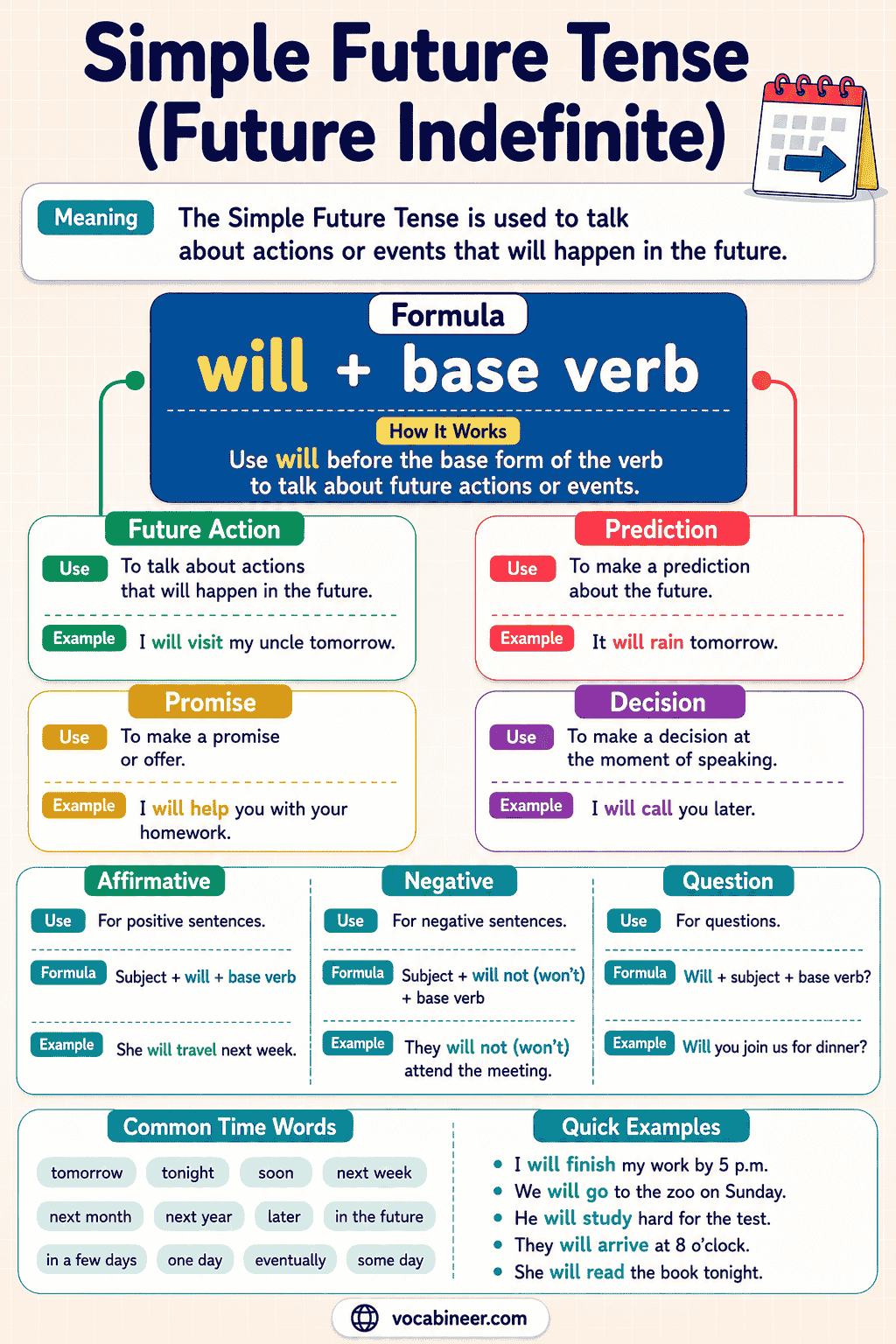
The Future Indefinite Tense uses will + V1 to express predictions, spontaneous decisions, offers, promises, and other future statements. It is also commonly called the Future Simple Tense or Simple Future in modern learner grammar.
Correct use depends on understanding will as a modal auxiliary, keeping the main verb in its base form, forming negatives and questions correctly, and distinguishing will from other future structures such as be going to, Present Continuous arrangements, and Present Simple schedules.
In This Page
What Is the Future Indefinite Tense?
The Future Indefinite Tense is a traditional learner term for the form built with will + V1.
Basic structure:
S + will + V1
Examples:
- I will call you tomorrow.
- She will arrive later.
- We will help you.
- They will visit us next week.
Future Indefinite commonly expresses:
- predictions
- spontaneous decisions
- offers
- promises
- neutral future statements and expectations
The main verb remains in its base form after will.
Future Indefinite and Future Simple
Future Indefinite, Future Simple, and Simple Future commonly refer to the same basic will + V1 form in learner grammar.
| Term | Meaning |
|---|---|
| Future Indefinite | Traditional ESL term |
| Future Simple | Common modern learner term |
| Simple Future | Common alternative term |
The terminology differs, but the core structure remains the same.
How to Form the Future Indefinite
Future Indefinite uses will as the auxiliary and the main verb in V1.
Will with All Subjects
Will remains the same with every subject.
| Subject | Auxiliary |
|---|---|
| I | will |
| you | will |
| he / she / it | will |
| we | will |
| they | will |
Examples:
- I will work.
- She will work.
- We will work.
- They will work.
Unlike some present-tense forms, will does not change according to the subject.
Why V1 Follows Will
Will is a modal auxiliary, so the main verb remains in its base form.
Correct:
- She will go tomorrow.
- Daniel will write the report.
- They will come later.
Incorrect:
- She will goes tomorrow.
- She will went tomorrow.
- Daniel will wrote the report.
A useful rule is:
will + V1
The main verb does not take -s, a past form, or to after will.
Affirmative Sentences
The affirmative structure is:
S + will + V1
Examples:
- I will study tonight.
- Maya will arrive tomorrow.
- Daniel will call later.
- We will finish the work soon.
- They will visit us next week.
Common contractions include:
- I will → I’ll
- you will → you’ll
- he will → he’ll
- she will → she’ll
- we will → we’ll
- they will → they’ll
Examples:
- I’ll call you tonight.
- She’ll arrive tomorrow.
- They’ll help us.
Negative Sentences
The negative structure is:
S + will + not + V1
Examples:
- I will not go.
- She will not arrive early.
- Daniel will not stay long.
- They will not forget.
The common contraction is:
will not → won’t
Examples:
- I won’t forget.
- She won’t come tomorrow.
- We won’t be late.
The main verb remains in V1 after will not or won’t.
Questions and Short Answers
The question structure is:
Will + S + V1?
Examples:
- Will you come tomorrow?
- Will she call us?
- Will Daniel join the meeting?
- Will they help?
Short answers repeat will rather than the main verb.
- Will you come tomorrow?
Yes, I will. / No, I won’t. - Will she call us?
Yes, she will. / No, she won’t.
Wh-Questions
Wh-questions commonly use:
Wh-word + will + S + V1?
Examples:
- What will you do?
- Where will she stay?
- When will they arrive?
- Why will he leave early?
- How will we solve the problem?
The main verb remains in V1 after will.
Future Indefinite with Be
The verb be also remains in its base form after will.
Structure:
S + will + be + complement
Examples:
- She will be busy tomorrow.
- They will be at home.
- I will be ready at six.
- Daniel will be twenty next year.
Negative:
- She will not be late.
- They won’t be at home.
Questions:
- Will she be ready?
- Will they be there?
The same modal rule applies: will + be.
When to Use the Future Indefinite
Future Indefinite commonly expresses predictions, spontaneous decisions, offers, promises, and future statements or expectations.
Predictions
Use will for general predictions or beliefs about future situations.
Examples:
- I think it will rain tomorrow.
- She will probably pass the exam.
- The weather will improve later.
- Prices will rise next year.
- They will probably arrive by evening.
Expressions such as I think, probably, maybe, and perhaps can support prediction meaning, but they do not automatically determine the form.
Spontaneous Decisions
Use will for decisions made at the moment of speaking.
Examples:
- The phone is ringing. I will answer it.
- There is no milk. I will buy some.
- I forgot to call Maya. I will do it now.
- This bag is heavy. I will carry it for you.
The decision is formed at the current moment rather than planned earlier.
Offers
Use will to offer help or action.
Examples:
- I will help you with the bags.
- We will carry the boxes.
- I will open the door.
- I will get you some water.
The future form expresses the action the speaker offers to perform.
Promises
Use will for promises and commitments.
Examples:
- I will call you tonight.
- I will not tell anyone.
- We will help you finish the work.
- I will remember your birthday.
- I will return the book tomorrow.
The statement expresses a commitment about future action.
Future Facts and Expectations
Future Indefinite can also express neutral future statements, expected events, or likely future facts.
Examples:
- She will be twenty next year.
- The new office will open next month.
- The event will begin at six.
- They will arrive later.
This use is broader than a spontaneous decision or promise and simply places the statement in a future context.
Future Indefinite vs Be Going To
Will and be going to can both refer to future time, but their common meanings differ.
| Will | Be Going To |
|---|---|
| spontaneous decision | prior plan or intention |
| offer or promise | intended future action |
| general prediction | prediction based on present evidence |
Compare:
- The phone is ringing. I will answer it.
- I am going to call Maya tonight.
The first decision is made at the moment of speaking. The second plan already exists.
For predictions:
- I think it will rain tomorrow.
- Look at those clouds. It is going to rain.
The first is a general prediction. The second is based on present evidence.
The distinction is useful, but it should not be treated as absolute because context can allow overlap.
Future Indefinite vs Present Continuous for Future Arrangements
Present Continuous can express an organized future arrangement.
Compare:
- I will meet Daniel tomorrow.
- I am meeting Daniel at three tomorrow.
The first is a general future statement.
The second more directly marks a future arrangement with definite details.
Another example:
- We will travel on Friday.
- We are flying to Lahore at eight on Friday.
The Present Continuous form presents the event as more clearly arranged.
Future Indefinite vs Present Simple for Schedules
Present Simple commonly expresses fixed schedules and timetables.
Compare:
- I will leave at seven.
- The train leaves at seven.
The first can express a future statement or decision depending on context.
The second marks a fixed timetable.
Another pair:
- The meeting will begin soon.
- The class starts at nine tomorrow.
The intended meaning determines the preferred form.
Shall with I and We
Shall can occur with I and we, especially in more formal future statements.
Examples:
- I shall contact you soon.
- We shall return tomorrow.
However, will is much more common in ordinary modern English for neutral future reference.
Future Time Clauses with When, Before, After, and Until
English commonly uses a present form in future time clauses after words such as:
- when
- before
- after
- until
- as soon as
Correct:
- I will call you when I arrive.
- We will leave after she finishes.
- I will wait until he comes.
- She will message me as soon as she gets home.
- We will eat before the film starts.
Incorrect:
- I will call you when I will arrive.
In ordinary future time clauses, will commonly appears in the main clause, while the time clause uses a present form.
Future-time expressions such as tomorrow, next week, later, and soon can establish future context, but they do not automatically require will.
Common Future Indefinite Mistakes
Future Indefinite mistakes commonly involve the verb form after will, question structure, negative formation, or overuse of will.
Adding -s after will
Incorrect:
- She will goes tomorrow.
Correct:
- She will go tomorrow.
The main verb remains in V1.
Using V2 after will
Incorrect:
- They will went tomorrow.
Correct:
- They will go tomorrow.
Past forms do not follow will.
Using to after will
Incorrect:
- I will to call you.
Correct:
- I will call you.
Use will + V1, not will + to + V1.
Using do with will
Incorrect:
- Do you will come?
Correct:
- Will you come?
Questions use inversion with will rather than do.
Using the wrong negative structure
Incorrect:
- She doesn’t will come.
Correct:
- She will not come.
The negative uses will not or won’t.
Confusing will and going to
Compare:
- I will answer the phone. → spontaneous decision
- I am going to call her tonight. → prior plan
The distinction depends on the intended meaning and context.
Using will in a future time clause
Incorrect:
- I will call you when I will arrive.
Correct:
- I will call you when I arrive.
The future time clause commonly uses a present form.
FAQs
Future Indefinite is a traditional learner term for the will + V1 form. It commonly expresses predictions, spontaneous decisions, offers, promises, and other future statements.
Yes. Future Indefinite is a traditional ESL name for the form more commonly called Future Simple or Simple Future.
Will is a modal auxiliary, so the following main verb remains in its base form. Use will go, will write, and will come, not will goes, will went, or will came.
Will commonly marks spontaneous decisions, offers, promises, and general predictions. Be going to commonly marks prior plans or intentions and predictions based on present evidence. Context can allow overlap.
Shall can occur with I and we, especially in formal English, but will is much more common for neutral future reference in ordinary modern usage.
Read More
- 12 English Tenses Chart
- All Tenses Rules and Formula
- English Tenses with Examples
- Indefinite Tense (Simple Tense)
- Past Tenses in English