The Future Continuous Tense marks activity in progress around a future reference point. It is useful for describing actions that will already be happening at a particular future time, expected future activity, temporary future situations, and actions that will continue when another future event occurs.
Future Continuous uses will be + V-ing. Correct use depends on including be, forming the main verb with -ing, recognizing the future reference point, and distinguishing Future Continuous from forms such as Future Simple, Future Perfect, Present Continuous for arrangements, and Future Perfect Continuous.
In This Page
What Is the Future Continuous Tense?
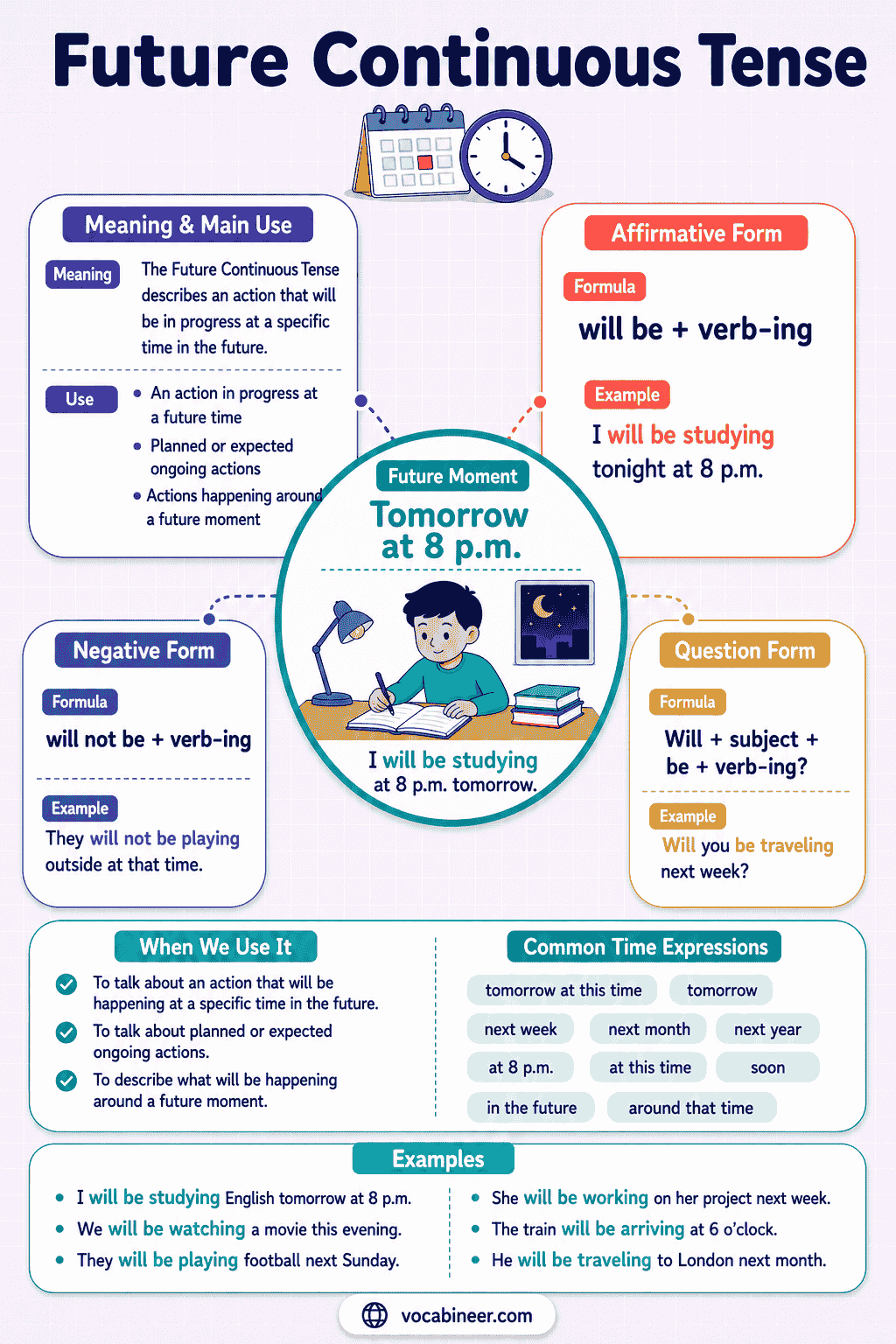
The Future Continuous Tense is formed with will, followed by be and the -ing form of the main verb.
Basic structure:
S + will + be + V-ing
Examples:
- I will be working at eight.
- She will be studying tomorrow morning.
- We will be traveling next week.
- They will be waiting outside.
Future Continuous is also called Future Progressive. Both names refer to the same grammatical form.
The tense marks an activity as ongoing around a future time rather than as a completed whole.
For example:
- At ten tomorrow, I will be working.
The work will already be in progress around ten.
- She will be driving when the meeting starts.
The driving will be in progress when the later future event occurs.
How Future Continuous Relates Activity to a Future Reference Point
Future Continuous establishes a relationship between an ongoing activity and a future time, event, or period.
Consider these examples:
- At ten tomorrow, I will be working.
- She will be driving when the meeting starts.
- This time next week, they will be staying in Lahore.
The first sentence relates the activity to a specific future time. The second relates an ongoing activity to another future event. The third marks a temporary or expected situation during a future period.
The central meaning remains the same: Future Continuous marks activity as ongoing around a future reference point.
How to Form the Future Continuous
Every Future Continuous construction requires three grammatical parts:
- will
- be
- the main verb in -ing form
Why Be Is Required
Future Continuous requires:
will + be + V-ing
Correct:
- She will be working at eight.
Incorrect:
- She will working at eight.
The word be forms part of the continuous structure. Without it, the Future Continuous form is incomplete.
Another example:
- They will be traveling tomorrow.
not:
- They will traveling tomorrow.
Affirmative Sentences
The affirmative structure is:
S + will + be + V-ing
Examples:
- I will be studying at eight.
- Maya will be working tomorrow morning.
- Daniel will be traveling next week.
- We will be waiting outside.
- They will be staying with us.
Common contractions include:
- I will → I’ll
- you will → you’ll
- he will → he’ll
- she will → she’ll
- we will → we’ll
- they will → they’ll
Examples:
- I’ll be working at eight.
- She’ll be traveling tomorrow.
- They’ll be waiting for us.
Negative Sentences
The negative structure is:
S + will + not + be + V-ing
Examples:
- I will not be working tomorrow.
- She will not be studying at eight.
- Daniel will not be traveling next week.
- They will not be staying long.
The common contraction is:
will not → won’t
Examples:
- I won’t be working tomorrow.
- She won’t be attending the meeting.
- They won’t be staying with us.
Questions and Short Answers
The question structure is:
Will + S + be + V-ing?
Examples:
- Will you be working tomorrow?
- Will she be traveling next week?
- Will Daniel be staying with us?
- Will they be waiting outside?
Short answers repeat will without repeating the full verb phrase.
- Will you be working tomorrow?
Yes, I will. / No, I won’t. - Will she be traveling next week?
Yes, she will. / No, she won’t.
Wh-Questions
Wh-questions commonly use:
Wh-word + will + S + be + V-ing?
Examples:
- What will you be doing tomorrow?
- Where will she be staying?
- When will they be leaving?
- Who will you be meeting?
- Why will Daniel be working late?
The main verb remains in the -ing form.
When to Use the Future Continuous
Future Continuous commonly marks activity in progress at a future time, expected future activity, temporary future situations, activity during another future event, and polite questions about future plans.
Activity in Progress at a Future Time
Use Future Continuous when an activity will already be in progress around a specified future reference point.
Examples:
- At eight tonight, I will be working.
- This time tomorrow, she will be flying to London.
- At noon, they will be having lunch.
- At six, Daniel will be driving home.
- Tomorrow afternoon, we will be attending a workshop.
The tense presents the activity as ongoing around the stated future time.
Compare:
- I will work tomorrow.
- At ten tomorrow, I will be working.
The first states a future action. The second specifically marks that action as in progress around ten.
Expected Future Activity
Future Continuous can mark activity expected to occur as part of a future situation.
Examples:
- I will be working from home next week.
- Daniel will be attending several meetings tomorrow.
- Maya will be using the new office next month.
- We will be traveling during the holidays.
These activities are presented as expected parts of the future situation rather than as decisions made at the moment of speaking.
Temporary Future Situations
Future Continuous can also mark a situation that will last for a limited future period.
Examples:
- I will be living with my brother for a few weeks.
- She will be working in another office next month.
- They will be staying in Karachi during the project.
- Daniel will be using my desk while his office is repaired.
The temporary situation is limited to a future period rather than presented as permanent.
Activity During Another Future Event
Future Continuous can mark an activity that will be in progress when another future event occurs.
Examples:
- I will be sleeping when you arrive.
- She will be working when the meeting begins.
- They will be traveling when we call them.
- We will be eating when the film starts.
- Maya will be studying when Daniel gets home.
The Future Continuous form marks the ongoing activity.
The future time clause commonly uses a present form:
- when you arrive
- when the meeting begins
- when we call
- when the film starts
Use:
- I will be working when you arrive.
rather than normally:
- I will be working when you will arrive.
Polite Questions About Future Plans
Future Continuous can make questions about expected plans or routine sound less direct.
Examples:
- Will you be using the car tonight?
- Will you be joining us for dinner?
- Will Maya be attending the meeting?
- Will you be staying long?
- Will Daniel be working tomorrow?
These questions ask about expected future activity without directly requesting or demanding a decision.
Verb + -ing Spelling Rules
Future Continuous requires the main verb in an -ing form.
Add -ing to Most Verbs
Most verbs take -ing directly.
- work → working
- read → reading
- play → playing
- speak → speaking
Examples:
- She will be working.
- They will be playing.
Drop Final Silent e
Many verbs ending in silent e drop the e before -ing.
- make → making
- write → writing
- come → coming
- drive → driving
Examples:
- She will be making dinner.
- Daniel will be driving home.
Double the Final Consonant Where Required
Some short stressed verbs double the final consonant before -ing.
- run → running
- sit → sitting
- swim → swimming
- stop → stopping
Examples:
- He will be running in the park.
- We will be sitting near the window.
Consonant doubling depends on spelling and stress patterns, so it does not apply to every verb ending in a consonant.
Change -ie to y
Verbs ending in -ie normally change ie to y before -ing.
- lie → lying
- die → dying
- tie → tying
Example:
- The dog will be lying near the door.
Future Continuous vs Future Simple
Future Continuous and Future Simple can both refer to future situations, but they mark different meanings.
| Future Simple | Future Continuous |
|---|---|
| future event or statement | activity in progress around a future point |
| I will work tomorrow. | At ten tomorrow, I will be working. |
| She will travel next week. | This time next week, she will be traveling. |
Compare:
- I will work tomorrow.
- At ten tomorrow, I will be working.
The first sentence states a future action.
The second marks the activity as ongoing around ten.
Another pair:
- She will study tomorrow evening.
- At eight tomorrow evening, she will be studying.
The intended grammatical meaning determines the form rather than the presence of a particular time expression.
Future Continuous vs Future Perfect
Future Continuous and Future Perfect establish different relationships with a future reference point.
Future Continuous:
will be + V-ing
Future Perfect:
will have + V3
Compare:
- At eight, I will be writing the report.
- By eight, I will have written the report.
Future Continuous marks activity in progress around eight.
Future Perfect marks completion before or by eight.
Another pair:
- At noon, she will be preparing lunch.
- By noon, she will have prepared lunch.
The first sentence marks ongoing activity. The second marks completion.
The core distinction is:
Future Continuous marks activity in progress around a future point, while Future Perfect marks completion before or by a future point.
Words such as at and by often support these meanings, but they do not automatically determine the tense.
Future Continuous vs Present Continuous for Future Arrangements
Present Continuous can express a future arrangement, while Future Continuous presents activity as expected or ongoing around a future point.
Compare:
- I am meeting Daniel at three tomorrow.
- At three tomorrow, I will be meeting Daniel.
The first sentence more directly marks an organized future arrangement.
The second presents the meeting as expected activity around the stated future time.
Another pair:
- We are flying to Lahore tomorrow morning.
- This time tomorrow, we will be flying to Lahore.
The Present Continuous form marks the arrangement. The Future Continuous form marks the activity in progress around the future reference point.
Future Continuous vs Future Perfect Continuous
Future Continuous and Future Perfect Continuous both use an -ing form, but they establish different future-time relationships.
Future Continuous:
will be + V-ing
Future Perfect Continuous:
will have been + V-ing
Compare:
- At five, I will be working.
- By five, I will have been working for eight hours.
The first marks activity in progress at five.
The second marks duration extending up to five.
Another comparison:
- She will be studying at noon.
- By noon, she will have been studying for four hours.
The distinction is:
- Future Continuous → activity ongoing around a future point
- Future Perfect Continuous → ongoing activity or duration extending up to a future point
Future Continuous and Stative Verbs
Many stative verbs normally use a simple future form rather than Future Continuous when they retain an ordinary stative meaning.
Common stative verbs include:
- know
- believe
- understand
- own
- need
- want
- belong
- prefer
Use:
- I will know the answer tomorrow.
- She will understand the problem soon.
- They will own the house by then.
- We will need more time.
Not normally:
- I will be knowing the answer.
- She will be understanding the problem.
- They will be owning the house.
The restriction applies to the ordinary stative meaning rather than every possible use of a verb. Some verbs can occur in continuous constructions when their meaning changes.
For example:
- I will think about your suggestion.
- At that time, I will be thinking about the next stage of the project.
The second sentence marks an ongoing mental activity rather than a stable state.
Common Future Continuous Mistakes
Future Continuous mistakes commonly involve be, the -ing form, question structure, negative formation, tense comparison, or stative meanings.
Missing be
Incorrect:
- I will working at eight.
Correct:
- I will be working at eight.
Future Continuous requires will be + V-ing.
Using V1 instead of V-ing
Incorrect:
- She will be work tomorrow.
Correct:
- She will be working tomorrow.
The main verb requires the -ing form.
Adding -s after will
Incorrect:
- He will be works tomorrow.
Correct:
- He will be working tomorrow.
The main verb does not take -s after the auxiliary structure.
Using do in questions
Incorrect:
- Do you will be working tomorrow?
Correct:
- Will you be working tomorrow?
Future Continuous questions use will directly.
Using incorrect question order
Incorrect:
- You will be working tomorrow?
Correct:
- Will you be working tomorrow?
Questions place will before the subject.
Using the wrong negative structure
Incorrect:
- She doesn’t will be working.
Correct:
- She will not be working.
Use will not or won’t for the negative.
Confusing Future Continuous and Future Perfect
Compare:
- At eight, I will be working. → activity in progress
- By eight, I will have finished. → completion
The intended future-time relationship determines the form.
Using an ordinary stative meaning
Incorrect:
- I will be knowing the answer.
Correct:
- I will know the answer.
Ordinary stative meanings normally use a simple future form rather than Future Continuous.
FAQs
Future Continuous is an English tense form built with will be + V-ing. It marks activity as in progress around a future reference point and can also describe expected or temporary future activity.
Be forms part of the continuous structure. Future Continuous therefore requires will + be + V-ing, as in She will be working at eight.
Use Future Continuous for activity in progress around a future time, expected or temporary future activity, activity continuing when another future event occurs, and some polite questions about future plans.
Future Simple states a future event or situation, while Future Continuous marks activity as ongoing around a future reference point. Compare I will work tomorrow with At ten tomorrow, I will be working.
Future Continuous marks activity in progress around a future point, while Future Perfect marks completion before or by a future point. Compare I will be working at eight with I will have finished by eight.
Read More
- 12 English Tenses Chart
- All Tenses Rules and Formula
- English Tenses with Examples
- Present Tenses in English
- Past Tenses in English
- Future Tenses in English
- Simple Future Tense in English