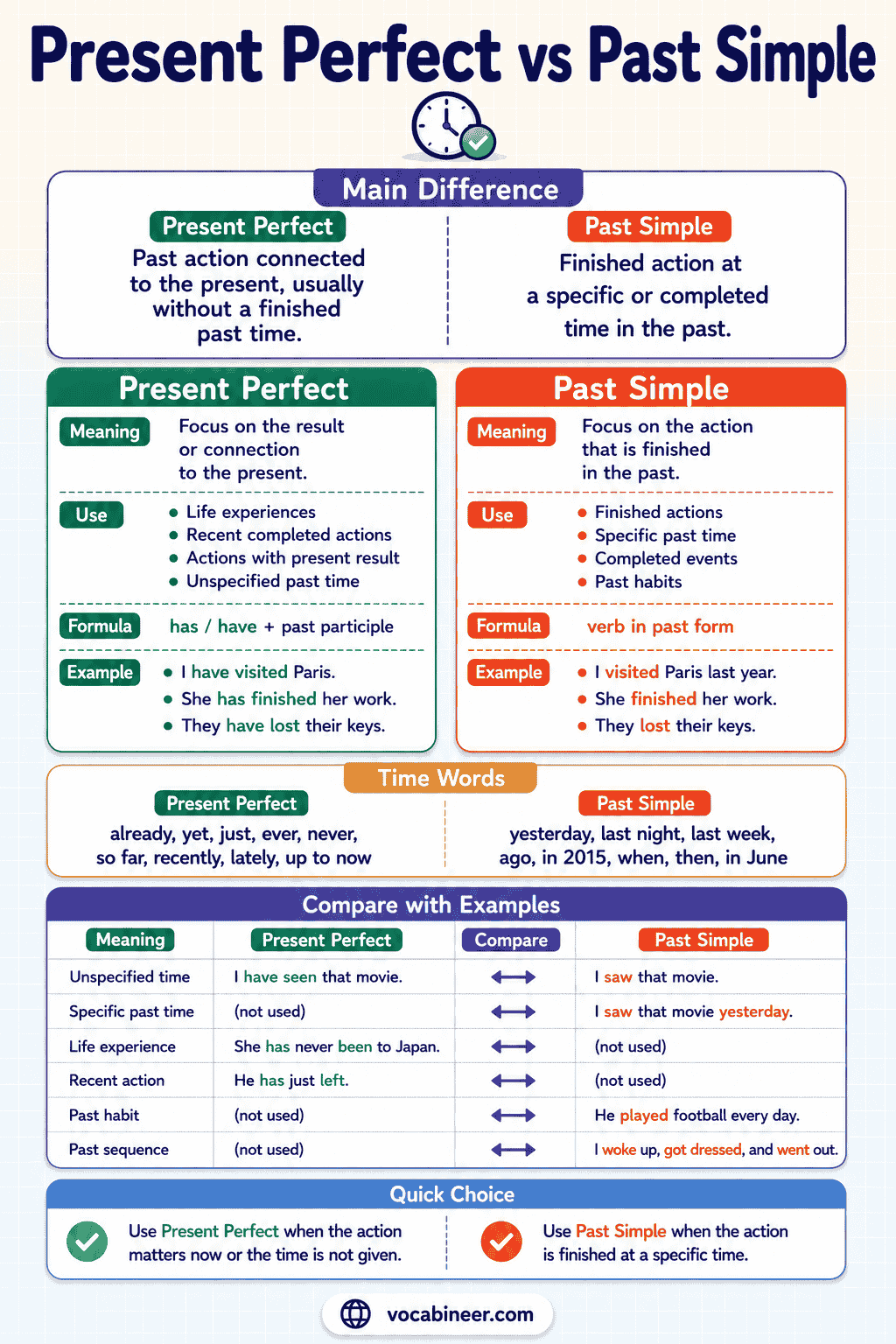
Present Perfect and Past Simple both describe past events and states, but they establish different time relationships. Present Perfect commonly relates a past event, experience, or state to the present or to time up to now, while Past Simple places the event or state in a finished past period.
Understanding this difference helps learners choose the correct tense for life experiences, specific past events, unfinished and finished time periods, present results, continuing states, and time expressions such as since, for, already, yet, just, ever, never, and yesterday.
In This Page
Present Perfect vs Past Simple: What Is the Difference?
The main difference is the time relationship created by the speaker.
| Present Perfect | Past Simple |
|---|---|
| connects past activity, experience, or state to the present | places the event or state in a finished past time |
| time is unfinished, unspecified, or viewed up to now | time is definite, finished, or completed |
| I have seen that film. | I saw that film last week. |
| She has lived here for ten years. | She lived there for ten years before moving. |
| I have lost my keys. | I lost my keys yesterday. |
Present Perfect commonly relates past meaning to the present, while Past Simple locates the event in a completed past period.
The difference is broader than:
- Present Perfect = no time
- Past Simple = time given
That shortcut misses several important uses.
Present Perfect vs Past Simple at a Glance
| Meaning | Present Perfect | Past Simple |
|---|---|---|
| life experience up to now | I have visited Turkey three times. | — |
| specific past experience | — | I visited Turkey in 2019. |
| unfinished time period | She has called twice this week. | — |
| finished time period | — | She called twice last week. |
| present result | I have lost my keys. | — |
| finished past event | — | I lost my keys yesterday. |
| continuing state | I have known Maya for ten years. | — |
| finished state | — | I knew Maya for ten years before she moved away. |
| unspecified past time | We have completed the task. | — |
| specific finished past time | — | We completed the task yesterday. |
The table provides a quick overview, but the intended time relationship still determines the tense.
How Present Perfect and Past Simple Are Formed
The two tenses use different structures.
| Feature | Present Perfect | Past Simple |
|---|---|---|
| affirmative | have/has + V3 | V2 |
| negative | have/has not + V3 | did not + V1 |
| question | Have/Has + subject + V3? | Did + subject + V1? |
| main verb form | past participle V3 | past form V2 |
Examples:
| Present Perfect | Past Simple |
|---|---|
| She has finished. | She finished yesterday. |
| She has not finished. | She did not finish yesterday. |
| Has she finished? | Did she finish yesterday? |
The main distinction is:
- Present Perfect → have/has + V3
- Past Simple → V2, or did + V1 in negatives and questions
Unspecified Time Up to Now vs Specific Finished Past Time
Present Perfect commonly leaves the exact past time unstated because the present connection or experience matters. Past Simple places the event in a specific or understood finished past time.
| Present Perfect | Past Simple |
|---|---|
| exact past time is not stated or not central | specific finished past time is stated or understood |
| I have seen that film. | I saw that film last Friday. |
| She has visited Paris twice. | She visited Paris in 2022. |
| We have completed the task. | We completed the task yesterday. |
| He has spoken to Maya. | He spoke to Maya this morning. |
Compare:
- I have read that book.
- I read that book last year.
The first sentence presents the reading as an experience up to now. The second locates it in a finished past period.
Unfinished vs Finished Time Periods
Present Perfect commonly fits a period that still includes the present. Past Simple commonly fits a completed period.
| Present Perfect | Past Simple |
|---|---|
| unfinished time period | finished time period |
| I have had three coffees today. | I had three coffees yesterday. |
| She has called twice this week. | She called twice last week. |
| We have made good progress this year. | We made good progress last year. |
| I have read four books this month. | I read four books last month. |
The important distinction is not the time expression alone.
For example:
- this week often supports Present Perfect because the week is still open
- last week naturally supports Past Simple because the period is finished
However, the speaker’s viewpoint can affect tense choice in some current-period expressions.
Life Experience vs Specific Past Experience
Present Perfect commonly introduces life experience without identifying a finished occasion. Past Simple commonly gives the specific details.
| Present Perfect | Past Simple |
|---|---|
| life experience at an unspecified time up to now | specific occasion or past detail |
| I have been to Japan. | I went to Japan in 2023. |
| She has seen that play twice. | She saw it last Saturday. |
| Have you ever visited Rome? | When did you visit Rome? |
| Daniel has tried sushi. | Daniel tried it during his trip to Tokyo. |
A common pattern is:
- I have been to Istanbul.
- I went there in 2022.
- I stayed for five days.
- I visited several museums.
Present Perfect introduces the experience. Past Simple gives the finished-time details.
Finished and Unfinished Life Periods
Present Perfect commonly suits experience within an unfinished life period, while Past Simple suits a completed life period.
| Unfinished Life Period | Finished Life Period |
|---|---|
| My brother has visited Mexico three times. | My great-grandmother visited Mexico three times. |
| experience up to now | experience within a completed life period |
The difference depends on whether the person’s life period continues into the present.
Present Result vs Finished Past Event
Present Perfect can present a past event through its current result or present relevance. Past Simple places the event in finished past time.
| Present Perfect | Past Simple |
|---|---|
| present result or current relevance is central | event is placed in finished past time |
| I have lost my keys. | I lost my keys yesterday. |
| He has broken his leg. | He broke his leg last week. |
| They have missed the train. | They missed the train this morning. |
| She has finished the report. | She finished the report at six. |
Compare:
- I have lost my keys.
The missing keys matter now.
- I lost my keys yesterday.
The sentence places the event in yesterday.
Past Simple does not mean that the event has no effect now. A finished past event can still have a present consequence. The tense difference concerns grammatical viewpoint, not whether a real-world result exists.
Continuing States vs Finished States
Present Perfect can mark a state that began in the past and continues now. Past Simple marks a state that belonged to a finished past period.
| Present Perfect | Past Simple |
|---|---|
| state began earlier and continues now | state belongs to a finished past period |
| I have known Maya for ten years. | I knew Maya for ten years before she moved away. |
| She has lived here since 2020. | She lived there from 2010 to 2020. |
| We have had this car for five years. | We had that car for five years, then sold it. |
| Daniel has worked here since January. | Daniel worked there for three years before changing jobs. |
The central distinction is continuation versus completion.
- She has lived here since 2020.
She still lives here. - She lived there from 2010 to 2020.
That period is finished.
Since and For with Present Perfect and Past Simple
Since identifies a starting point, while for identifies a duration. Tense choice depends on whether the state or activity continues to the present or belongs to a finished past period.
Since
Use since with a starting point:
- since 2020
- since Monday
- since January
- since I started school
Examples:
- She has worked here since 2021.
- I have known him since childhood.
For
Use for with a duration:
- for five years
- for two hours
- for a long time
- for several months
Examples:
- I have lived here for five years.
- They have owned the house for a decade.
Compare the two tenses:
| Present Perfect | Past Simple |
|---|---|
| I have lived here for five years. | I lived there for five years before moving. |
| She has worked here since 2021. | She worked there from 2018 to 2021. |
| continuing now | finished duration |
The tense depends on whether the state or activity continues to the present or belongs to a completed past period.
A common error is:
Incorrect:
- I have lived here since five years.
Correct:
- I have lived here for five years.
Already, Yet, Just, Ever, Never, and Recently
Several expressions commonly occur with Present Perfect because they relate events or experiences to time up to now.
| Expression | Common Function | Example |
|---|---|---|
| already | completion earlier than expected | She has already left. |
| yet | expected completion or question | Have you finished yet? |
| just | very recent completion | I have just arrived. |
| ever | life experience question | Have you ever visited Rome? |
| never | no experience up to now | I have never flown. |
| recently | recent event with present relevance | She has recently changed jobs. |
| so far | time up to now | We have completed five lessons so far. |
These expressions do not automatically determine the tense.
For example, dialect and context can influence whether Present Perfect or Past Simple is preferred with already, yet, and just.
Present Perfect vs Past Simple with Today, This Week, and This Year
Expressions such as today, this week, this month, and this year can occur with either tense depending on how the speaker views the period.
| Present Perfect | Past Simple |
|---|---|
| speaker treats the period as still open | speaker treats the relevant period as finished |
| I have had two meetings today. | I had two meetings today. |
| We have spoken three times this week. | We spoke three times this week. |
For example:
- I have had two meetings today.
The speaker treats today as part of an open period connected to now.
- I had two meetings today.
The speaker may be referring to a completed part of the day or otherwise framing the events as finished.
The grammatical viewpoint matters more than the time expression alone.
British English vs American English
American and British English both use Present Perfect and Past Simple, but their preferred distribution can differ in some contexts.
| British English | Common American English Alternative |
|---|---|
| Have you eaten yet? | Did you eat yet? |
| Have you finished already? | Did you finish already? |
| I’ve just arrived. | I just arrived. |
British English often prefers Present Perfect with already, yet, and just when the event relates closely to the present.
American English commonly permits Past Simple in some of these contexts.
These differences do not change the main distinction between time up to now and finished past time.
Time Expressions with Present Perfect and Past Simple
Some expressions often occur with one tense more than the other.
| Present Perfect Often Occurs With | Past Simple Often Occurs With |
|---|---|
| ever | yesterday |
| never | last week |
| already | last year |
| yet | two days ago |
| just | in 2020 |
| recently | when I was a child |
| so far | on Monday |
| since / for | from 2010 to 2015 |
Examples:
- I have never visited Canada.
- We have made good progress so far.
- I saw Maya yesterday.
- They moved here in 2020.
These expressions support the intended time relationship, but they should not be treated as mechanical tense signals.
Common Present Perfect vs Past Simple Mistakes
Learners often choose the wrong tense because they rely on individual time words instead of the relationship between past and present.
Using Present Perfect with a finished past-time expression
Incorrect:
- I have seen him yesterday.
Correct:
- I saw him yesterday.
Using Present Perfect with a specific finished past date
Incorrect:
- She has visited Paris in 2022.
Correct:
- She visited Paris in 2022.
Using Past Simple for a state continuing now
Incorrect:
- I lived here since 2020.
Correct:
- I have lived here since 2020.
The state continues into the present.
Using since with a duration
Incorrect:
- I have lived here since five years.
Correct:
- I have lived here for five years.
Use since with a starting point and for with a duration.
Confusing V2 and V3
| Present Perfect | Past Simple |
|---|---|
| She has gone home. | She went home yesterday. |
| He has written the email. | He wrote the email this morning. |
| They have seen the film. | They saw the film last week. |
Incorrect:
- She has went home.
Correct:
- She has gone home.
Present Perfect requires V3.
Using did with Present Perfect
Incorrect:
- Did you have finished?
Correct:
- Have you finished?
Present Perfect questions use have or has.
Using have or has with Past Simple
Incorrect:
- She has went yesterday.
Correct:
- She went yesterday.
Past Simple does not use have/has + V2.
Assuming Present Perfect always means recent
Incorrect rule:
Present Perfect = recent past.
Better principle:
Present Perfect relates a past event or state to the present or to time up to now.
Example:
- I have known her for twenty years.
The state began long ago but continues now.
Assuming Past Simple means no present effect
Incorrect rule:
Past Simple means the event has no effect now.
Better principle:
Past Simple locates the event in finished past time; a present consequence can still exist.
For example:
- I broke my leg last week.
The leg may still be broken now, but the sentence places the accident in a finished past time.
Using Past Simple for general life experience without a specific past context
For standard learner comparison:
- Have you ever visited Japan?
Past Simple normally needs a finished past context:
- Did you visit Japan when you traveled through Asia?
Some dialects permit wider Past Simple use in certain contexts, but the general experience distinction remains useful.
FAQs
Present Perfect commonly relates past events, experiences, or states to the present or to time up to now, while Past Simple places them in a finished past period.
Present Perfect does not normally occur with a finished past-time expression such as yesterday. Use Past Simple: I saw her yesterday, not I have seen her yesterday.
Use Present Perfect when talking about experience at an unspecified time up to now, as in I have visited Rome twice. Use Past Simple when giving a specific occasion or detail, as in I visited Rome in 2022.
Have been can express life experience up to now without specifying a finished past occasion, while went places the trip in a finished past event. Compare I have been to Japan with I went to Japan in 2023.
Yes. Past Simple can describe an event that still has a consequence now. It simply places the event in finished past time rather than grammatically presenting it through its current connection.
Read More
- 12 English Tenses Chart
- All Tenses Rules and Formula
- English Tenses with Examples
- Present Tenses in English
- Past Tenses in English
- Future Tenses in English
- Be Going To in English