

A tall drafting chair with a footring looks very different from a padded executive chair or a compact task chair. Office chairs vary in shape, height, support, material, and purpose, so knowing the main types makes them easier to recognize and compare.
Some chair names describe how people use the chair, while others refer to its material, backrest height, body size, durability, or sitting style. Therefore, understanding these categories helps you make sense of similar terms without treating every chair name as a completely separate type.
In This Page
How Office Chairs Are Grouped
Office chairs do not follow one single classification system. Instead, different names describe different features, which means one chair can fit several categories at once.
For example, a manufacturer may describe one model as a high-back ergonomic mesh task chair:
- Task describes its workplace use.
- Ergonomic describes its supportive design.
- Mesh describes its material or construction.
- High-back describes the height of its backrest.
As a result, office chairs can fall into groups based on purpose, material, backrest height, body size, sitting position, or level of use.
Common Types of Office Chairs
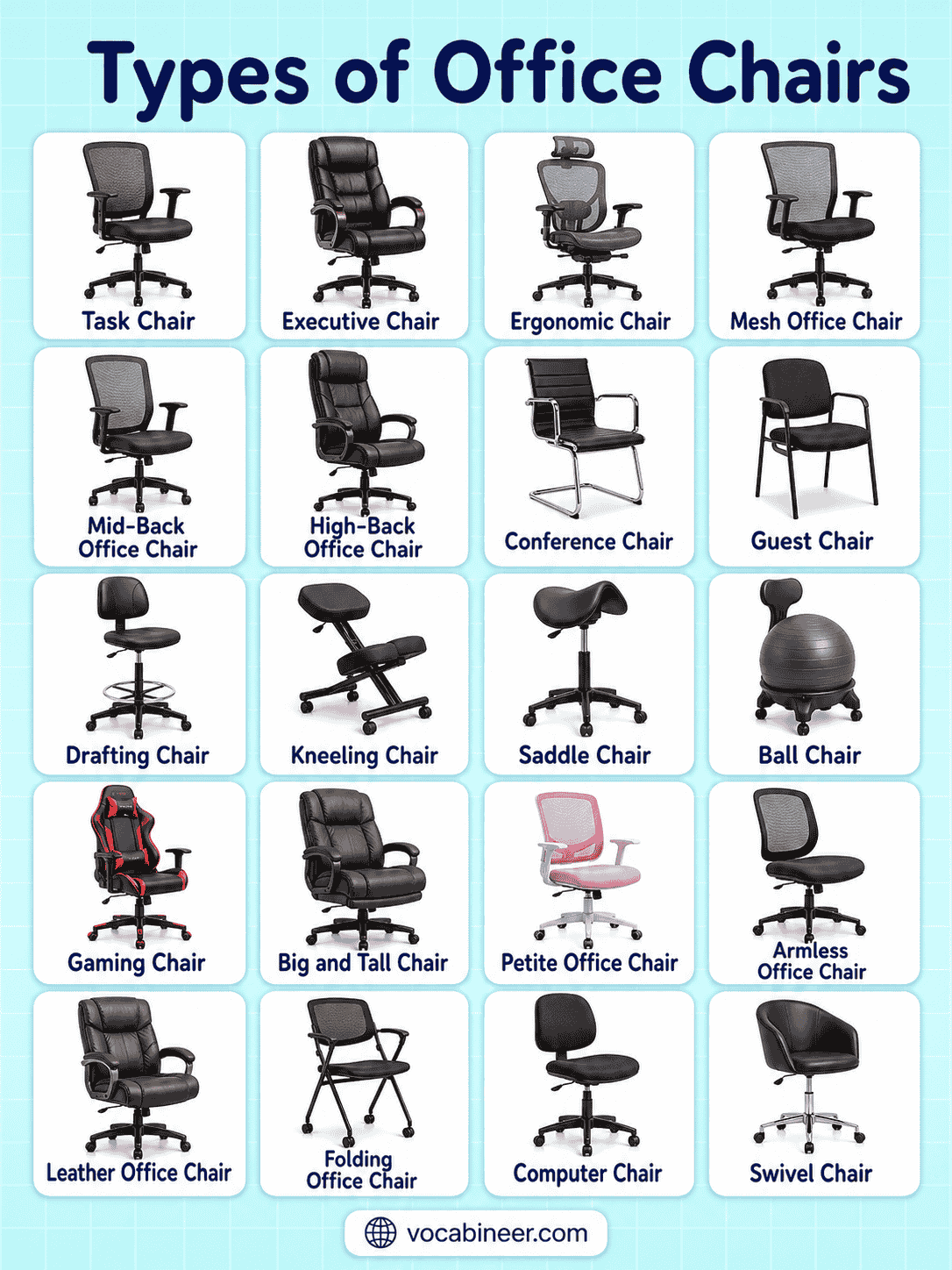
These are the chair types people most often see in workplaces, home offices, meeting rooms, reception areas, studios, and other work settings. Although their designs vary, each type usually serves a recognizable purpose.
Task Chair
A task chair is a compact desk chair for everyday work such as typing, writing, and computer use. Most models include casters, a swivel base, and adjustable seat height.
Ergonomic Chair
An ergonomic chair focuses on support, fit, and adjustability. For example, it may include lumbar support, adjustable armrests, seat-depth controls, and recline settings.
Executive Chair
An executive chair usually has a larger frame, high back, generous padding, and a formal appearance. Therefore, people commonly use it in private offices and managerial workspaces.
Drafting Chair
A drafting chair has a taller seat and usually includes a footring. Because of its height, it works well with drafting tables, counters, raised desks, and laboratory benches.
Conference Chair
A conference chair suits meeting rooms and boardrooms. Its streamlined shape allows several chairs to fit comfortably around a conference table without making the area feel crowded.
Visitor Chair
A visitor chair provides temporary seating for guests beside a desk or workstation. Since visitors usually sit for shorter periods, these chairs often include fewer adjustments than regular desk chairs.
Reception Chair
A reception chair suits waiting rooms, lobbies, and reception areas. In addition, many models use fixed frames and durable upholstery so several chairs can sit together neatly.
24-Hour Chair
A 24-hour or 24/7 chair suits workplaces where different people use the same seat across long or continuous shifts. For example, control rooms, dispatch centers, and security stations often use this type.
Heavy-Duty Chair
A heavy-duty chair uses stronger components for frequent or demanding use. As a result, many models include reinforced frames, durable bases, and higher weight ratings.
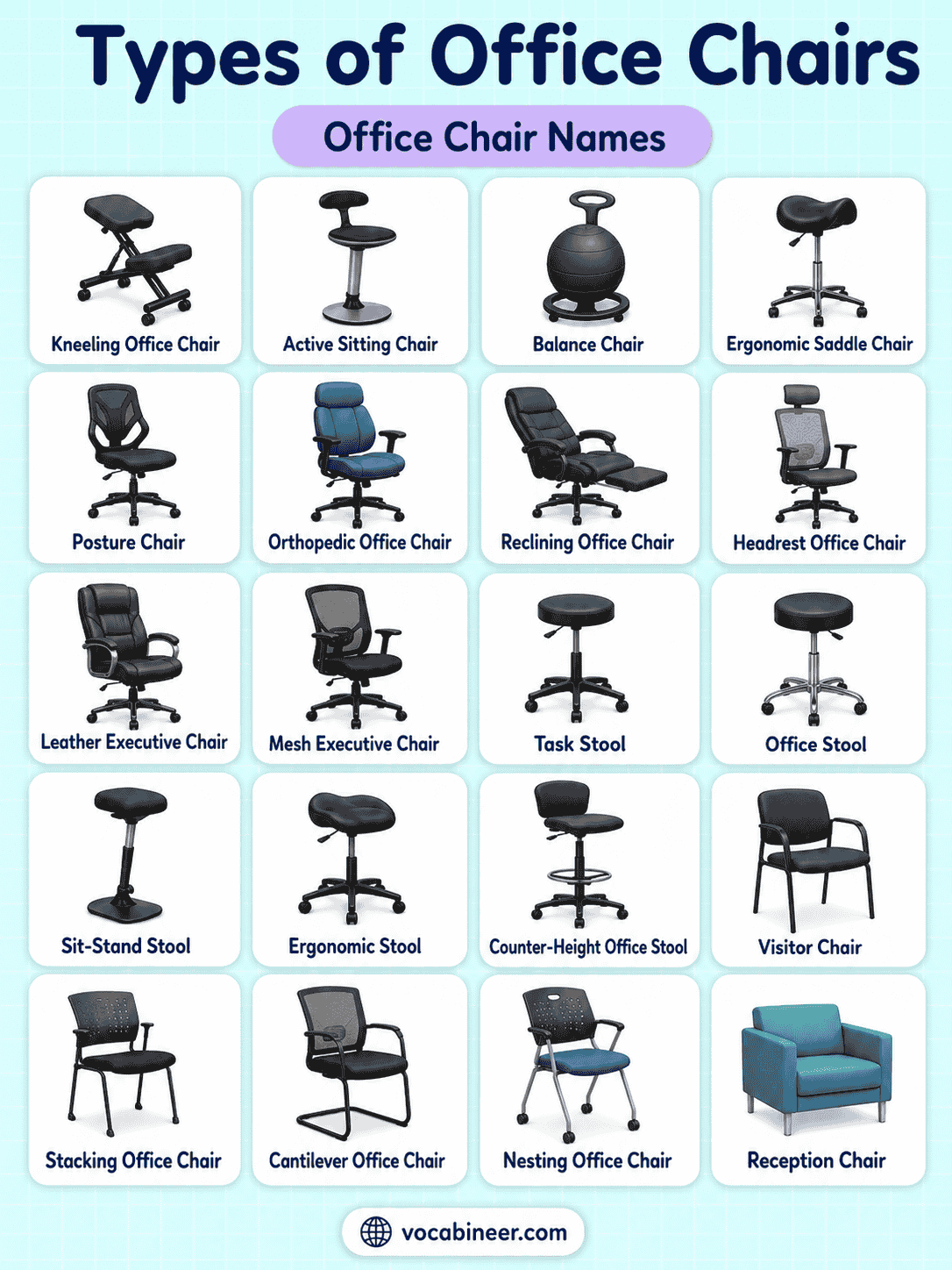
Kneeling Chair
A kneeling chair has an angled seat with padded supports for the knees or shins. Unlike a standard office chair, it places the sitter in a different position and spreads support across more than one contact point.
Saddle Chair
A saddle chair has a narrow, contoured seat shaped like a riding saddle. Because the seat encourages a straddled position, people often choose it for tasks that require easy movement.
Perching Chair
A perching chair supports a position between sitting and standing. Therefore, it works well with raised desks and sit-stand workstations where users change posture frequently.
Chairs by Material
Material changes a chair’s appearance, texture, and airflow, but it does not always define its main purpose. For instance, a mesh chair can also function as an ergonomic task chair, while a leather chair can have an executive or conference design.
Mesh Chair
A mesh chair uses open woven material across the backrest and sometimes the seat. Because air can move through the material, mesh designs often feel more ventilated than fully padded chairs.
Leather Chair
A leather office chair uses leather or leather-like upholstery over padded areas. Consequently, this finish often appears on executive and conference chairs that aim for a more formal look.
Fabric Chair
A fabric chair uses textile upholstery over a padded seat or backrest. However, fabric does not describe one specific chair function because manufacturers use it on task, visitor, conference, and ergonomic designs.
Chairs by Backrest Height
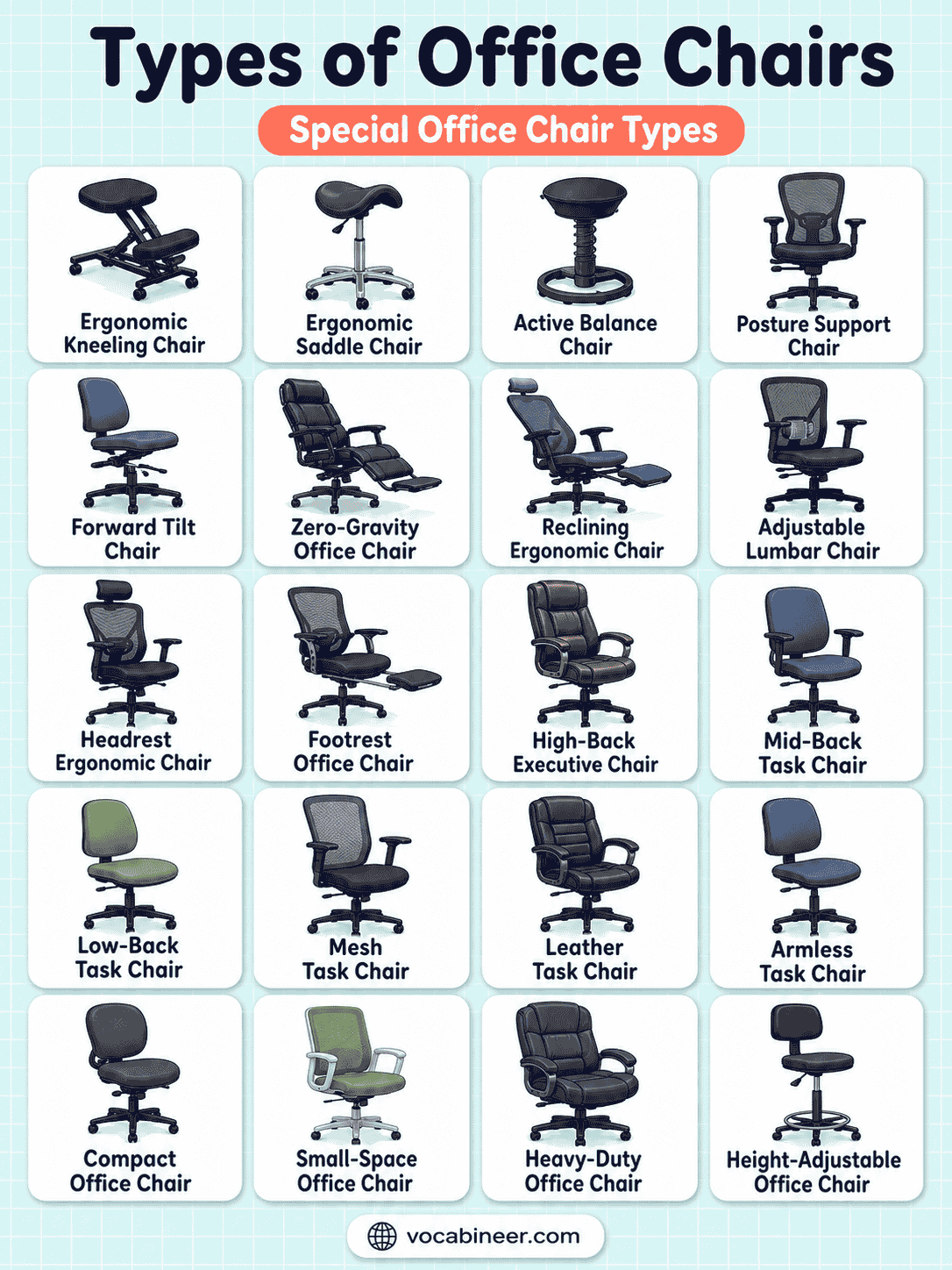
Backrest height changes a chair’s overall shape and affects which areas of the back the chair aims to support. Therefore, people commonly describe office chairs as high-back, mid-back, or low-back.
High-Back Chair
A high-back chair extends into the upper-back or shoulder area and may also include a headrest. As a result, this style appears frequently in executive and ergonomic seating.
Mid-Back Chair
A mid-back chair supports the lower and middle back without reaching the head or shoulders. Because of its balanced size, it works well in task chairs and standard desk seating.
Low-Back Chair
A low-back chair has a shorter backrest that mainly supports the lower back. Meanwhile, its compact shape can suit shorter sitting periods or work that requires more upper-body freedom.
Chairs for Different Body Sizes
Chair fit depends on more than style. In fact, seat width, depth, height range, and backrest size can all affect how well a chair suits someone’s body.
Big and Tall Chair
A big and tall chair has larger proportions for taller or larger users. For example, it may include a wider seat, deeper seat depth, larger frame, and higher weight rating.
Petite Chair
A petite chair uses smaller dimensions for shorter or smaller users. Therefore, it may include a shallower seat, lower height range, narrower width, and more compact proportions.
Office Chairs People Often Confuse
Some office chair names overlap because they describe different things, such as purpose, body fit, construction, or sitting style. The table below shows the clearest differences between commonly confused chair types.
| Chair Types | Main Difference | Key Features |
|---|---|---|
| Task Chair vs Ergonomic Chair | A task chair describes workplace use, while an ergonomic chair focuses on support and adjustability. | Task chairs suit desk work; ergonomic chairs may include lumbar support, adjustable arms, seat-depth controls, and recline. |
| Big and Tall vs Heavy-Duty Chair | Big-and-tall chairs focus on body size and fit, while heavy-duty chairs focus on strength and durability. | Big-and-tall chairs are often wider and deeper; heavy-duty chairs commonly use reinforced frames, bases, and mechanisms. |
| Kneeling Chair vs Saddle Chair | A kneeling chair uses knee or shin supports, while a saddle chair uses a narrow, contoured seat. | Kneeling chairs have an angled seat and knee pads; saddle chairs have a saddle-shaped seat without separate knee supports. |
Desk Chair, Task Chair, and Office Chair
These three terms often appear interchangeably in furniture stores and product listings. However, they do not mean exactly the same thing.
- Office chair is the broadest term and can describe almost any chair used in an office.
- Desk chair is an everyday term for a chair used at a desk.
- Task chair usually refers to a practical workstation chair for typing, computer work, writing, and similar activities.
Because these terms overlap, the same chair may reasonably carry all three names.
FAQs
A task chair is one of the most common office chair types because it suits everyday desk, typing, writing, and computer work.
Yes. “Task” describes the chair’s use, while “ergonomic” describes its support and adjustability. Therefore, one chair can fit both categories.
Mesh mainly describes material or construction. For example, a mesh chair can also function as a task, ergonomic, conference, or executive chair.
A drafting chair commonly works with raised desks, counters, and drafting tables because it has a taller seat and usually includes a footring.
Office chair is the broader term, while desk chair usually refers to a chair used specifically at a desk. However, people often use the two terms interchangeably.
Read More
- Different Types of Chairs
- Bedroom Decor Items
- Popular Types of Tiles
- Different Types of Houses
- Types of Rooms in a House
- Parts of a House Names