

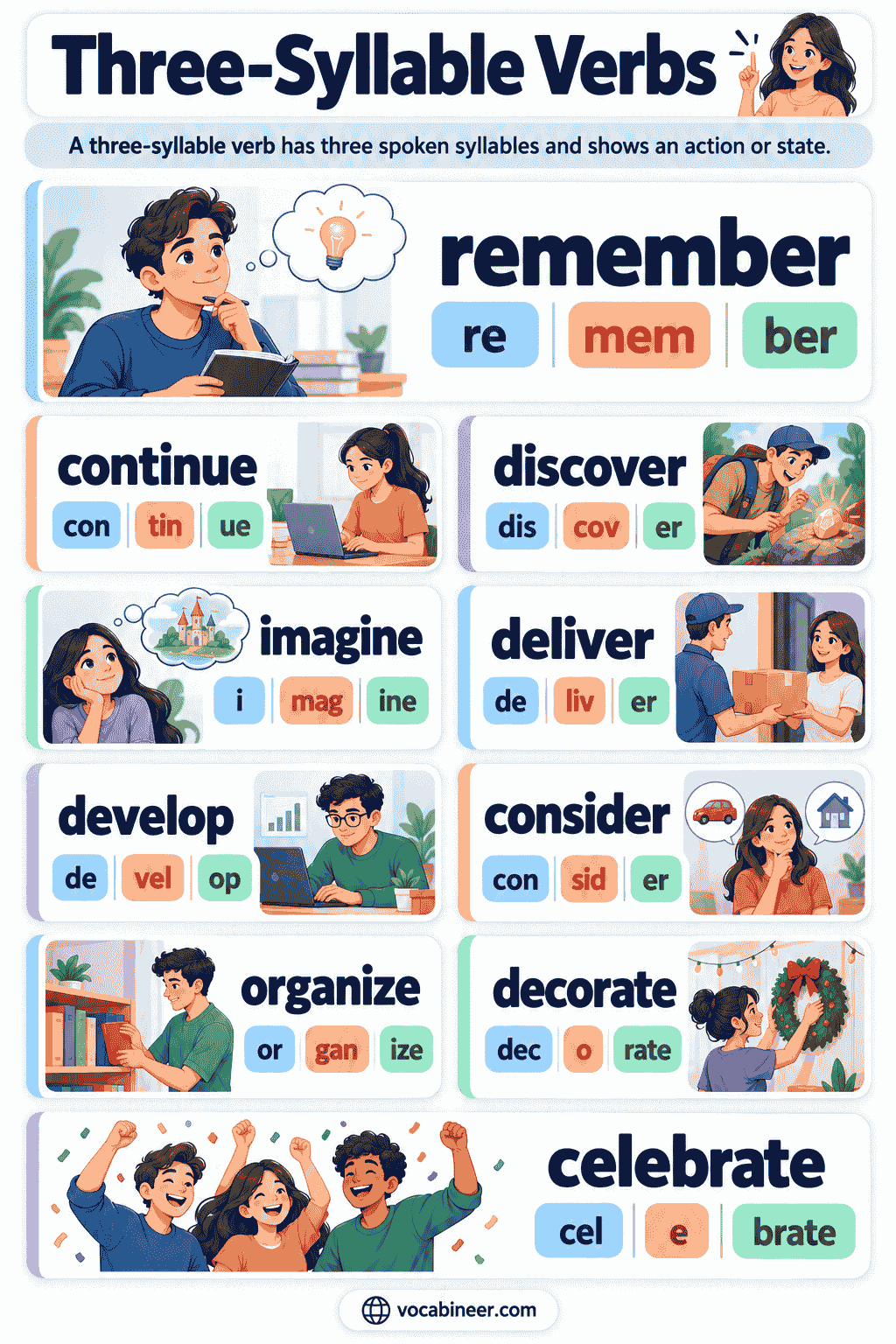
Three-syllable verbs are action, state, or process words pronounced with three separate syllables. Common examples include recognize, organize, clarify, consider, determine, calculate, and remember. These verbs appear frequently in everyday communication, academic writing, instructions, and professional English.
This guide contains 160 three-syllable verbs with simple meanings. It also explains common verb endings such as -ize, -ify, and -ate, syllable division, word stress, pronunciation patterns, and how verb forms can affect syllable count.
In This Page
Common Three-Syllable Verbs
Recognize
To identify someone or something you have seen or known before.
Organize
To arrange things in a planned or orderly way.
Realize
To become aware of something or understand it clearly.
Clarify
To make an idea or statement easier to understand.
Consider
To think carefully about something.
Remember
To keep or bring information back to mind.
Imagine
To form a picture or idea in your mind.
Determine
To discover, establish, or decide something.
Continue
To keep doing something without stopping.
Develop
To grow, improve, or create something gradually.
Discover
To find something for the first time.
Deliver
To take something to a person or place.
Encounter
To meet or experience something unexpectedly.
Entertain
To provide enjoyment or interest.
Introduce
To present someone or something for the first time.
Understand
To know the meaning or nature of something.
Calculate
To find an amount or answer using numbers.
Decorate
To make something more attractive by adding details.
Generate
To produce or create something.
Exercise
To perform physical activity or use a skill.
160 Three-Syllable Verbs With Meanings
The eight groups below contain 20 unique base verbs each, giving a total of 160 three-syllable verbs.
Three-Syllable Verbs Ending in -ize
- Recognize — to identify something previously known.
- Organize — to arrange things systematically.
- Realize — to become aware of something.
- Criticize — to express disapproval or point out faults.
- Maximize — to make something as large or effective as possible.
- Minimize — to reduce something to the smallest possible amount.
- Memorize — to learn something so it can be remembered exactly.
- Legalize — to make something lawful.
- Symbolize — to represent an idea or quality.
- Specialize — to concentrate on a particular subject or activity.
- Advertise — to promote a product, service, or event.
- Emphasize — to give special importance to something.
- Modernize — to make something more modern.
- Finalize — to complete the last details of something.
- Neutralize — to make something ineffective or neutral.
- Standardize — to make things follow the same standard.
- Summarize — to state the main points briefly.
- Authorize — to give official permission.
- Civilize — to develop social or cultural organization.
- Mobilize — to prepare people or resources for action.
Three-Syllable Verbs Ending in -ify
- Clarify — to make something clearer.
- Classify — to arrange things into groups.
- Simplify — to make something easier to understand or do.
- Qualify — to meet the conditions required for something.
- Modify — to change something slightly.
- Verify — to check that something is true or accurate.
- Specify — to state something clearly and exactly.
- Justify — to provide a good reason for something.
- Beautify — to make something more attractive.
- Purify — to remove unwanted or harmful substances.
- Terrify — to frighten someone greatly.
- Signify — to mean or represent something.
- Notify — to formally inform someone.
- Certify — to officially confirm that something meets a standard.
- Fortify — to strengthen or protect something.
- Falsify — to alter or present something dishonestly.
- Magnify — to make something appear larger.
- Unify — to bring separate things together.
- Rectify — to correct a problem or mistake.
- Mystify — to confuse or puzzle someone.
Common Three-Syllable Verbs Ending in -ate
- Calculate — to determine an amount mathematically.
- Decorate — to make something more attractive.
- Separate — to divide or move things apart.
- Generate — to produce or create.
- Regulate — to control something through rules.
- Tolerate — to accept something unpleasant without stopping it.
- Educate — to teach or provide knowledge.
- Operate — to control, use, or run something.
- Motivate — to give someone a reason to act.
- Activate — to make something start working.
- Celebrate — to mark an important event happily.
- Demonstrate — to show how something works or prove something.
- Illustrate — to explain something with examples or pictures.
- Concentrate — to direct attention toward one thing.
- Integrate — to combine parts into a whole.
- Moderate — to make something less extreme.
- Nominate — to formally suggest someone for a role or award.
- Formulate — to develop a plan, idea, or system carefully.
- Stimulate — to encourage activity, interest, or growth.
- Dominate — to control or strongly influence something.
More Three-Syllable Verbs Ending in -ate
- Dedicate — to give time or effort to a particular purpose.
- Imitate — to copy someone’s actions or style.
- Indicate — to show or point out something.
- Complicate — to make something more difficult.
- Duplicate — to make an exact copy.
- Estimate — to roughly calculate an amount or value.
- Hesitate — to pause because of uncertainty.
- Isolate — to separate something from others.
- Elevate — to raise something to a higher level.
- Validate — to confirm that something is acceptable or correct.
- Violate — to break a rule, agreement, or right.
- Mediate — to help people settle a disagreement.
- Allocate — to distribute something for a particular purpose.
- Alternate — to switch repeatedly between two things.
- Fabricate — to make or construct something.
- Penetrate — to enter or pass through something.
- Terminate — to bring something to an end.
- Aggravate — to make a problem or condition worse.
- Captivate — to hold someone’s attention strongly.
- Cultivate — to develop, improve, or grow something.
Everyday and Academic Three-Syllable Verbs
- Consider — to think carefully about something.
- Remember — to bring something back to mind.
- Imagine — to form an idea or picture mentally.
- Determine — to discover or decide something.
- Continue — to keep doing something.
- Develop — to grow or improve gradually.
- Discover — to find something previously unknown.
- Recover — to return to a normal condition.
- Deliver — to take something to a destination.
- Encounter — to meet or experience unexpectedly.
- Entertain — to provide enjoyment.
- Introduce — to present someone or something.
- Interrupt — to stop someone or something temporarily.
- Understand — to grasp the meaning of something.
- Recommend — to suggest something as suitable.
- Represent — to stand for or act for someone or something.
- Disappear — to stop being visible.
- Volunteer — to offer to do something willingly.
- Guarantee — to promise that something will happen or work.
- Disagree — to have a different opinion.
Three-Syllable Verbs With Prefixes
- Overcome — to successfully deal with a difficulty.
- Undertake — to accept responsibility for a task.
- Overlook — to fail to notice or deliberately ignore something.
- Reassure — to make someone feel less worried.
- Rearrange — to organize something in a different order.
- Reunite — to bring people or things together again.
- Reappear — to appear again.
- Influence — to affect someone’s behavior or a situation.
- Interpret — to explain the meaning of something.
- Interview — to ask someone questions formally.
- Exercise — to use the body physically or practice a skill.
- Analyze — to examine something carefully.
- Correspond — to match or communicate in writing.
- Disappoint — to fail to meet someone’s hopes.
- Interfere — to become involved in a way that causes difficulty.
- Disapprove — to have an unfavorable opinion.
- Misbehave — to behave badly.
- Misinform — to give someone incorrect information.
- Overreact — to react too strongly.
- Overuse — to use something too much.
Three-Syllable Action and Process Verbs
- Abandon — to leave someone or something behind.
- Abolish — to officially end a system or practice.
- Accomplish — to successfully complete something.
- Acknowledge — to accept or recognize something as true.
- Assemble — to bring parts or people together.
- Astonish — to surprise someone greatly.
- Awaken — to wake someone or become awake.
- Confiscate — to officially take something away.
- Contribute — to give something toward a shared purpose.
- Distinguish — to recognize a difference.
- Embarrass — to make someone feel uncomfortable or self-conscious.
- Encourage — to give support or confidence.
- Examine — to inspect something carefully.
- Exhibit — to display something publicly.
- Overthrow — to remove someone or a system from power.
- Satisfy — to meet a need, condition, or expectation.
- Surrender — to stop resisting or give something up.
- Undergo — to experience a process or change.
- Utilize — to make practical use of something.
- Jeopardize — to put something at risk.
Additional Three-Syllable Process Verbs
- Navigate — to find or direct a route.
- Populate — to live in or fill a place.
- Circulate — to move continuously through an area or system.
- Simulate — to imitate a real process or situation.
- Vaccinate — to give a vaccine for protection against disease.
- Contemplate — to think deeply about something.
- Meditate — to focus the mind calmly.
- Levitate — to rise or cause something to rise without visible support.
- Irritate — to annoy someone or cause discomfort.
- Agitate — to disturb, upset, or stir something.
- Delegate — to give responsibility to another person.
- Predicate — to base something on a particular condition or assumption.
- Advocate — to publicly support an idea or cause.
- Renovate — to repair and improve an old building or object.
- Replicate — to copy or reproduce something.
- Relegate — to move someone or something to a lower position.
- Segregate — to separate people or things into groups.
- Stipulate — to state a condition clearly as part of an agreement.
- Speculate — to form an opinion without complete evidence.
- Oscillate — to move repeatedly from side to side or between states.
Together, these eight groups contain 160 unique three-syllable base verbs.
Common Three-Syllable Action Verbs
Several three-syllable verbs describe practical actions or processes.
Organize
Arrange things into an orderly structure.
Calculate
Work out a number or quantity.
Decorate
Add features that make something attractive.
Exercise
Use the body physically or practice a skill.
Assemble
Bring separate parts together.
Examine
Look at something carefully.
Navigate
Find or follow a route.
Renovate
Repair and improve something old.
Replicate
Create a copy.
Separate
Move or divide things apart.
These verbs work naturally in phrases such as organize the files, calculate the cost, examine the results, and renovate the house.
Three-Syllable Verbs for Speaking and Communication
Several three-syllable verbs involve giving, explaining, or exchanging information.
- Clarify — make information clearer.
- Notify — formally inform someone.
- Specify — state something precisely.
- Summarize — give the main points.
- Recommend — suggest a suitable option.
- Interpret — explain meaning.
- Interview — ask questions formally.
- Misinform — provide incorrect information.
- Advocate — publicly support something.
- Guarantee — give a firm promise.
Three-Syllable Verbs for Thinking and Decisions
Three-syllable verbs can also describe mental processes.
- Analyze — examine something carefully.
- Consider — think about something.
- Determine — establish or decide something.
- Imagine — form a mental picture.
- Remember — bring information back to mind.
- Recognize — identify something familiar.
- Realize — become aware of something.
- Contemplate — think deeply.
- Speculate — form an opinion with limited evidence.
- Interpret — decide or explain meaning.
Three-Syllable Verbs for Change and Processes
Many longer verbs describe change, development, or transformation.
- Develop — grow or improve.
- Modify — make a limited change.
- Modernize — make more modern.
- Minimize — make smaller or less important.
- Maximize — make as large or effective as possible.
- Integrate — combine into a whole.
- Regulate — control according to rules.
- Stimulate — encourage activity or growth.
- Elevate — raise to a higher level.
- Renovate — restore and improve.
Three-Syllable Verbs Ending in -ize
The suffix -ize frequently forms verbs. Cambridge Grammar lists -ise/-ize among common English verb-forming suffixes, alongside -ate and -ify.
Examples from the master list include:
recognize
organize
realize
criticize
maximize
minimize
memorize
modernize
finalize
summarize
In American English, -ize spellings are common, while British English often uses -ise for many of the same verbs.
A suffix can help identify a verb, but it does not guarantee that the complete word contains exactly three syllables.
Three-Syllable Verbs Ending in -ify
The suffix -ify is another productive verb-forming ending. Cambridge gives examples such as specify and qualify, while its word-formation guidance also identifies -ify as a verb-forming suffix.
Examples include:
clarify
classify
simplify
qualify
modify
verify
specify
justify
beautify
purify
Many -ify verbs can be recognized easily by their spelling, but learners should still count the spoken syllables rather than assume every -ify word has three.
Three-Syllable Verbs Ending in -ate
The ending -ate also forms many English verbs. Cambridge lists words such as complicate, dominate, and irritate as examples of this verb-forming suffix.
Three-syllable examples include:
calculate
decorate
generate
regulate
educate
operate
activate
celebrate
dominate
irritate
Again, the suffix signals verb formation more reliably than syllable count. Some -ate verbs contain more or fewer than three syllables.
How to Divide Three-Syllable Verbs
A three-syllable verb contains three spoken vowel-centered units.
Examples:
recognize
rec / og / nize
organize
or / gan / ize
clarify
clar / i / fy
determine
de / ter / mine
encounter
en / coun / ter
entertain
en / ter / tain
calculate
cal / cu / late
These divisions are learner-friendly pronunciation guides rather than strict morphological analyses.
A simple method is:
- Say the base verb naturally.
- Listen for three spoken beats or vowel centers.
- Avoid counting written vowels by themselves.
- Check that the word genuinely functions as a verb.
- Consult a dictionary when pronunciation is uncertain.
Stress in Three-Syllable Verbs
Three-syllable verbs do not all place primary stress on the same syllable.
English lexical words contain a primary stressed syllable, while other syllables may be unstressed or carry weaker secondary stress.
For example, learners may hear different stress positions in verbs such as:
ORganize
CLARify
deTERmine
enterTAIN
underSTAND
This variation is why stress should be learned with the pronunciation of each verb rather than predicted only from the number of syllables.
Three-Syllable Verbs With First-Syllable Stress
Many familiar three-syllable verbs place primary stress toward the beginning of the word.
Examples include:
ORganize
RECognize
MEMorize
CLARify
MODify
VERify
CALculate
DECorate
EDucate
OPerate
These examples show a common pattern, but the pattern is not universal.
Three-Syllable Verbs With Middle-Syllable Stress
Other verbs place primary stress on the second syllable.
Examples include:
deTERmine
conSIDer
reMEMber
deVELop
disCOVer
reCOVer
deLIVer
enCOUNter
inTERpret
exAMine
Learners should listen for the syllable that sounds most prominent rather than simply stressing the middle because the word has three syllables.
Three-Syllable Verbs With Final-Syllable Stress
Some three-syllable verbs place strong stress on their last syllable.
Examples include:
enterTAIN
underSTAND
recomMEND
disapPEAR
volunTEER
guaranTEE
disagREE
reapPEAR
reunITE
overCOME
These verbs demonstrate why a single stress rule cannot cover every three-syllable verb.
Prefixes in Three-Syllable Verbs
English verbs often begin with prefixes such as re-, de-, dis-, in-, and over-. Cambridge Grammar identifies several prefixes frequently found in verbs, including de-, in-, and re-.
Examples from this article include:
reappear
reunite
reassure
disagree
disapprove
disappoint
overcome
overlook
overreact
Prefixes can change meaning and syllable count, but they do not provide a perfect rule for predicting stress.
Can Verb Endings Change the Syllable Count?
Yes. A base verb and its inflected forms do not always contain the same number of spoken syllables.
English verbs have several forms, including the base form, past form, past participle, -ing form, and third-person singular form.
This article counts only the base verb.
For example:
organize counts once.
The forms:
organizes
organized
organizing
do not count as additional verbs in the 160-word total.
The same rule applies to every entry in the master list.
Stress Can Affect Verb Spelling
Stress matters not only for pronunciation but sometimes for spelling.
Cambridge notes that when a verb ends in a vowel followed by one consonant, the consonant is doubled before certain endings when the final syllable is stressed. It contrasts forms such as commit → committed with unstressed-final-syllable forms such as develop → developed.
This is another reason learners should pay attention to both:
- syllable count
- word stress
rather than studying spelling alone.
Three-Syllable Verbs vs Other Three-Syllable Words
Not every three-syllable word is a verb.
Compare:
organize → verb
computer → noun
beautiful → adjective
carefully → adverb
Cambridge also notes that form alone does not always identify a verb, although endings such as -ate, -ify, and -ize can provide useful clues.
A strict three-syllable verb list therefore needs to check both:
- pronunciation
- grammatical function
Words With More Than One Grammatical Role
Some English words can function as more than one word class depending on context.
The important question in this article is whether the word has an established verb use.
For example:
Exercise
Verb: “They exercise every morning.”
Noun: “Regular exercise is useful.”
Estimate
Verb: “Please estimate the cost.”
Noun: “The builder gave us an estimate.”
Delegate
Verb: “Managers should delegate tasks.”
Noun: “Each country sent a delegate.”
The same spelling can therefore belong to different grammatical classes.
Can Three-Syllable Verbs Vary by Pronunciation?
Yes. Accent, speaking speed, and vowel reduction can affect how clearly unstressed syllables are heard.
English stress makes one syllable more prominent than surrounding syllables, while unstressed syllables often sound weaker.
For a fixed-number list, it is therefore better to use verbs with established three-syllable base pronunciations and avoid highly unstable examples.
Common Mistakes When Counting Three-Syllable Verbs
Counting Written Vowels
The number of vowel letters does not automatically equal the number of syllables.
Count spoken units instead.
Including Other Word Classes
A three-syllable noun or adjective should not enter a verb-only list unless the same form has a genuine verb use.
Assuming Every Verb Has the Same Stress
Three-syllable verbs can stress the first, middle, or final syllable.
Assuming a Suffix Determines the Count
The endings -ize, -ify, and -ate can signal verbs, but they do not guarantee exactly three syllables.
Counting Inflected Forms Separately
Organize, organizes, organized, and organizing are forms of one base verb.
Confusing Syllable Division With Word Formation
A learner-friendly pronunciation division may not match the boundaries between a prefix, root, and suffix.
Why Learn Three-Syllable Verbs?
Three-syllable verbs appear frequently in everyday, academic, and professional English.
Learning them can improve:
- verb vocabulary
- pronunciation
- syllable recognition
- word stress
- listening
- reading fluency
- academic writing
- speaking accuracy
- word formation awareness
They also help learners move from basic verbs such as make, get, and use toward more precise verbs such as determine, clarify, organize, regulate, and recommend.
FAQs
A three-syllable verb is an action, state, or process word pronounced with three syllables, such as recognize, organize, clarify, determine, or remember.
Common examples include consider, remember, imagine, determine, continue, develop, discover, calculate, organize, recognize, and recommend.
No. Primary stress can occur in different positions. For example, organize stresses the first syllable, determine stresses the middle syllable, and entertain stresses the final syllable.
Common verb-forming endings include -ize, -ify, and -ate, as in organize, clarify, and calculate. These endings are useful clues but do not guarantee that a word contains exactly three syllables.
No. A fixed list normally counts the base form once. Forms such as organized and organizing belong to the base verb organize and do not increase the 160-word total.
Read More
- What is a Syllable?
- Four-Syllable Nouns
- Three-Syllable Nouns
- Three-Syllable Adjectives
- Two-Syllable Adjectives
- One-Syllable Nouns
- Two-Syllable Verbs
- One-Syllable Verbs
- Four-Syllable Adjectives