

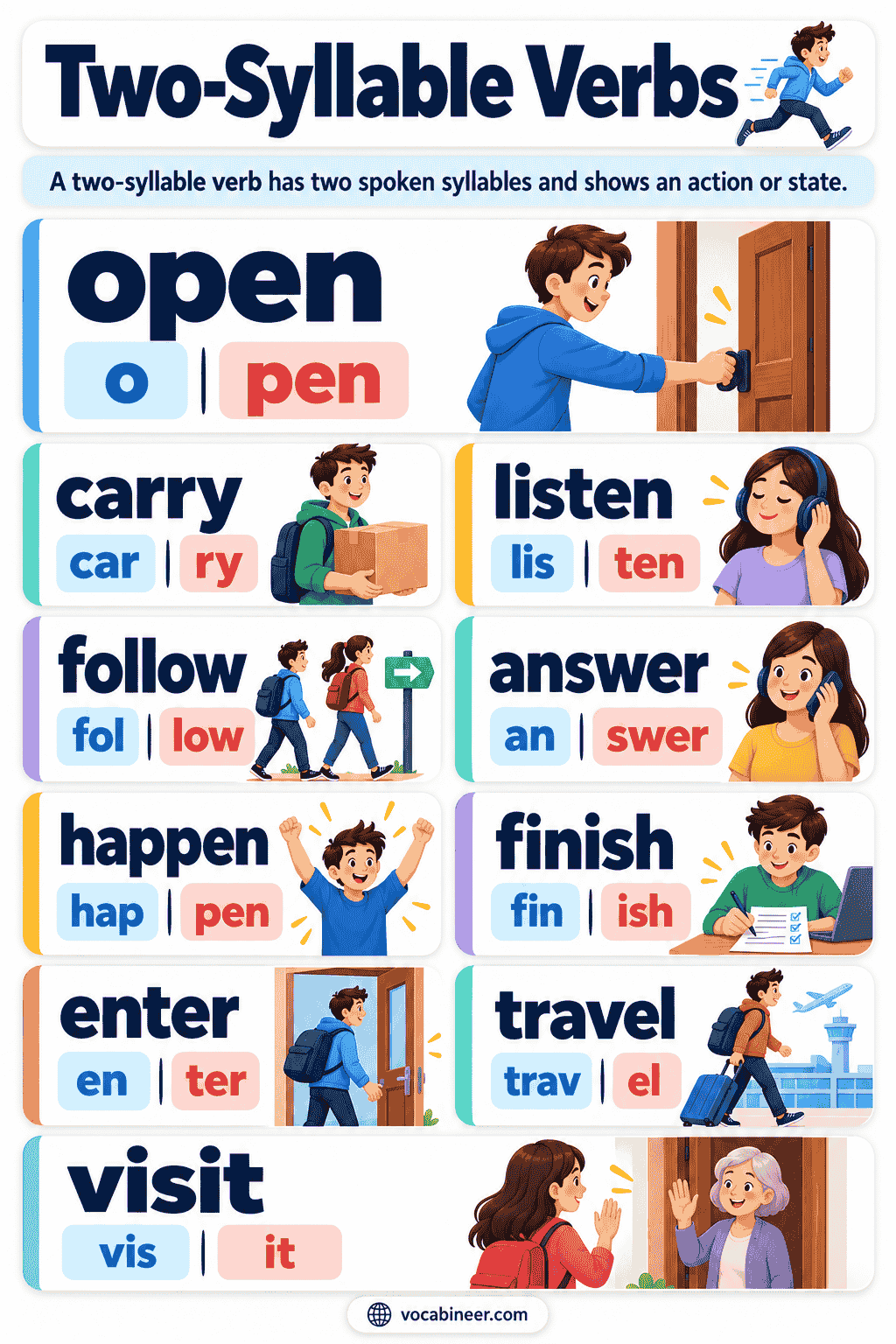
Two-syllable verbs are action, state, or process words pronounced with two separate syllables. Common examples include follow, answer, listen, begin, arrive, explain, protect, and repeat. These verbs appear constantly in everyday conversation, schoolwork, instructions, and descriptive writing.
This guide includes 170 two-syllable verbs with simple meanings. It also explains syllable division, first- and second-syllable stress, noun–verb stress changes, and how verb endings can affect syllable count.
In This Page
Common Two-Syllable Verbs
Follow
To move behind someone or act according to instructions.
Answer
To respond to a question or request.
Listen
To pay attention to sound.
Travel
To go from one place to another.
Carry
To hold and move something.
Study
To spend time learning about a subject.
Finish
To complete an activity or task.
Borrow
To take something temporarily and return it later.
Offer
To present something for another person to accept.
Open
To move or change something so it is no longer closed.
Begin
To start something.
Arrive
To reach a place.
Accept
To agree to receive or take something.
Agree
To have the same opinion or give consent.
Repeat
To say or do something again.
Explain
To make something easier to understand.
Protect
To keep someone or something safe.
Collect
To bring things together.
Prepare
To make something ready.
Prefer
To like one option more than another.
170 Two-Syllable Verbs With Meanings
The ten groups below contain 17 unique base verbs each, giving a total of 170 two-syllable verbs.
Everyday Two-Syllable Verbs
- Answer — to respond to a question.
- Borrow — to use something temporarily and return it.
- Carry — to hold and move something.
- Copy — to make something similar to an original.
- Enter — to go into a place.
- Follow — to go after someone or something.
- Happen — to take place.
- Listen — to pay attention to sound.
- Offer — to present something for acceptance.
- Open — to make something no longer closed.
- Study — to learn about a subject.
- Travel — to go from place to place.
- Visit — to go and spend time at a place or with someone.
- Finish — to bring something to an end.
- Gather — to bring people or things together.
- Measure — to find the size, length, or amount of something.
- Order — to request something or arrange things systematically.
Two-Syllable Verbs for Handling and Creating
- Manage — to control or deal with something successfully.
- Damage — to harm something.
- Practice — to do something repeatedly to improve.
- Purchase — to buy something.
- Rescue — to save someone or something from danger.
- Settle — to resolve something or become established.
- Tackle — to deal with a problem or task.
- Handle — to deal with or physically hold something.
- Capture — to catch or take control of something.
- Cover — to place something over another thing.
- Balance — to keep something steady.
- Challenge — to test someone’s ability or question something.
- Channel — to direct something toward a particular purpose.
- Target — to direct an action toward something.
- Value — to consider something important.
- Hammer — to strike something repeatedly.
- Bottle — to put liquid into bottles.
Two-Syllable Verbs for Speaking and Communication
- Whisper — to speak very quietly.
- Mention — to refer briefly to something.
- Question — to ask someone about something.
- Promise — to say that you will definitely do something.
- Report — to give information about something.
- Request — to ask for something formally or politely.
- Reply — to respond to someone.
- Explain — to make an idea clear.
- Complain — to express dissatisfaction.
- Invite — to ask someone to come or participate.
- Announce — to make information publicly known.
- Appeal — to make a serious request.
- Command — to order someone to do something.
- Consult — to ask someone for advice or information.
- Contact — to communicate with someone.
- Describe — to tell what someone or something is like.
- Discuss — to talk about a subject in detail.
Two-Syllable Verbs for Starting, Choosing, and Connecting
- Begin — to start.
- Accept — to agree to receive something.
- Admit — to acknowledge that something is true.
- Agree — to share an opinion or give consent.
- Allow — to give permission.
- Apply — to make a formal request or put something into use.
- Arrive — to reach a destination.
- Collect — to gather things together.
- Compare — to examine similarities and differences.
- Complete — to finish something.
- Confirm — to show that something is true or definite.
- Connect — to join things together.
- Contain — to hold something within.
- Control — to direct or regulate something.
- Decide — to make a choice.
- Demand — to ask firmly for something.
- Deny — to say that something is not true.
Two-Syllable Verbs for Actions and Results
- Design — to plan how something will look or work.
- Destroy — to damage something completely.
- Divide — to separate something into parts.
- Enjoy — to take pleasure in something.
- Escape — to get away from somewhere.
- Explore — to examine or travel through a place.
- Forget — to fail to remember.
- Ignore — to pay no attention to something.
- Obey — to do what a rule or person requires.
- Occur — to happen.
- Prefer — to like one thing more than another.
- Prepare — to make something ready.
- Protect — to keep something safe.
- Provide — to supply something that is needed.
- Receive — to get or accept something.
- Reduce — to make something smaller or less.
- Refuse — to say that you will not do or accept something.
Common Two-Syllable Verbs Beginning With Re- and Related Forms
- Relax — to become less tense.
- Remain — to continue to be in the same state or place.
- Remove — to take something away.
- Repeat — to say or do something again.
- Return — to go or come back.
- Select — to choose something.
- Support — to help or provide assistance.
- Surprise — to cause someone to feel unexpected amazement.
- Survive — to continue living or existing.
- Produce — to make or create something.
- Present — to show, give, or introduce something.
- Permit — to allow something.
- Record — to store information, sound, or images.
- Conduct — to organize or carry out something.
- Progress — to move forward or improve.
- Object — to express disagreement.
- Increase — to make or become greater.
Two-Syllable Verbs With Strong Noun–Verb Connections
- Decrease — to make or become smaller.
- Import — to bring goods into a country.
- Export — to send goods to another country.
- Insult — to speak or act disrespectfully toward someone.
- Conflict — to clash or be incompatible.
- Contest — to challenge or dispute something.
- Contract — to become smaller or enter a formal agreement.
- Convert — to change something into another form.
- Convict — to find someone legally guilty.
- Digest — to break down food or understand information.
- Extract — to remove something.
- Insert — to put something inside.
- Project — to estimate, display, or send outward.
- Reject — to refuse to accept.
- Subject — to cause someone or something to experience something.
- Address — to deal with a subject or speak to someone.
- Adjust — to change something slightly.
Two-Syllable Verbs for Decisions and Processes
- Adopt — to take up or begin using something.
- Advance — to move forward.
- Advise — to give guidance.
- Afford — to have enough money or resources for something.
- Appear — to become visible or seem to be.
- Assist — to help.
- Attack — to act aggressively against someone or something.
- Attempt — to try to do something.
- Attend — to go to or be present at something.
- Avoid — to stay away from something.
- Commit — to promise yourself to an action or carry it out.
- Concern — to relate to or worry someone.
- Conclude — to reach an ending or judgment.
- Consent — to agree or give permission.
- Consist — to be made up of particular things.
- Correct — to remove or fix an error.
- Create — to make something new.
Two-Syllable Verbs for Interaction and Change
- Debate — to discuss opposing views.
- Defend — to protect against criticism or attack.
- Delay — to make something happen later.
- Depend — to rely on someone or something.
- Deserve — to be worthy of something.
- Detect — to discover or notice something.
- Direct — to guide or control something.
- Display — to show something publicly.
- Disturb — to interrupt someone’s peace or activity.
- Engage — to become involved in something.
- Ensure — to make certain that something happens.
- Excuse — to forgive or give a reason for something.
- Exist — to be real or present.
- Expand — to become or make something larger.
- Expect — to believe something will happen.
- Express — to communicate a thought or feeling.
- Extend — to make something longer or larger.
Two-Syllable Verbs for Development and Response
- Include — to contain something as part of a group.
- Insist — to demand something firmly.
- Intend — to plan or mean to do something.
- Invest — to put money, time, or effort into something.
- Involve — to include someone or something in an activity.
- Maintain — to keep something in good condition or continue it.
- Obtain — to get something.
- Prevent — to stop something from happening.
- Proceed — to continue or move forward.
- Promote — to encourage, advertise, or raise in rank.
- Propose — to suggest a plan or idea.
- Pursue — to follow or try to achieve something.
- React — to respond to something.
- Recall — to remember something.
- Relate — to connect or show a relationship.
- Release — to let something go or make it available.
- Replace — to put something in the position of another thing.
Together, these ten groups contain 170 unique two-syllable base verbs.
Common Two-Syllable Action Verbs
Many two-syllable verbs describe actions that learners use in everyday situations.
Carry means to move something while holding it.
Follow means to move behind someone or act according to guidance.
Travel means to move between places.
Finish means to complete something.
Gather means to bring things together.
Enter means to go inside.
Open means to make something accessible.
Measure means to find the size or amount of something.
Handle means to deal with or hold something.
Rescue means to save someone or something from danger.
These verbs work naturally in everyday phrases such as carry the bag, follow the road, finish the work, and open the door.
Two-Syllable Verbs for Speaking and Communication
Communication verbs are especially useful in conversation and writing.
- Answer — respond to a question.
- Reply — respond to someone.
- Explain — make something clear.
- Whisper — speak quietly.
- Promise — give your word that something will happen.
- Complain — express dissatisfaction.
- Report — provide information.
- Invite — ask someone to participate.
- Request — ask for something.
- Discuss — talk about a subject.
Two-Syllable Verbs for Movement
Several common two-syllable verbs describe movement or changes of location.
- Travel — go from one place to another.
- Enter — go inside.
- Arrive — reach a place.
- Escape — get away.
- Return — come or go back.
- Follow — move behind.
- Advance — move forward.
- Proceed — continue moving or acting.
- Pursue — follow someone or something.
- Wander — move around without a fixed route.
Two-Syllable Verbs for Thoughts and Decisions
Other two-syllable verbs describe thinking, choosing, remembering, or judging.
- Decide — make a choice.
- Prefer — like one option more.
- Expect — believe something will happen.
- Believe — accept something as true.
- Forget — fail to remember.
- Ignore — deliberately pay no attention.
- Select — choose.
- Recall — remember.
- Compare — examine similarities and differences.
- Conclude — reach a judgment.
How to Divide Two-Syllable Verbs
A two-syllable verb contains two spoken syllables.
For example:
follow → fol / low
answer → an / swer
begin → be / gin
arrive → ar / rive
repeat → re / peat
protect → pro / tect
These divisions are useful for learners because they show two spoken units rather than simply counting letters.
A practical method is:
- Say the base verb naturally.
- Listen for two spoken syllables.
- Avoid adding extra vowel sounds.
- Check that the word functions as a verb.
- Use a dictionary pronunciation if the count is unclear.
Stress in Two-Syllable Verbs
English often places primary stress on the second syllable of two-syllable verbs, although this is a common tendency rather than an absolute rule. Cambridge teaching materials and the British Council both teach this as a useful pronunciation pattern.
Compare:
beGIN
arRIVE
rePEAT
proTECT
exPLAIN
However, many common verbs stress the first syllable instead:
ANswer
FOLlow
LISten
CARry
TRAVel
Therefore, learners should use stress patterns as helpful guidance rather than treat them as a rule with no exceptions.
Two-Syllable Verbs With First-Syllable Stress
Examples include:
ANswer
BORrow
CANcel
CARry
COPy
ENter
FOLlow
HAPpen
LISten
OFfer
OPen
PUNish
STUDy
TRAVel
VISit
First-syllable stress is especially common among many familiar everyday verbs.
Two-Syllable Verbs With Second-Syllable Stress
Many other verbs place their strongest stress on syllable two:
acCEPT
adMIT
aGREE
alLOW
apPLY
arRIVE
beGIN
beLIEVE
colLECT
deCIDE
deNY
deSIGN
enJOY
exPLAIN
igNORE
inVITE
oBEY
preFER
prePARE
proTECT
reCEIVE
reLAX
rePEAT
rePLY
Stress is important because the stressed syllable sounds more prominent than the unstressed one.
Two-Syllable Words That Change Stress as Nouns and Verbs
Some two-syllable English words change their stress according to grammatical function.
For example:
| Noun | Verb |
|---|---|
| REcord | reCORD |
| PREsent | preSENT |
| PERmit | perMIT |
| OBject | obJECT |
| CONduct | conDUCT |
| PROgress | proGRESS |
This noun–verb contrast is an established English pronunciation pattern. British Council teaching materials illustrate the same principle with pairs such as permit, desert, and refuse, where the noun typically stresses the first syllable and the verb the second.
Cambridge also gives insert as an example: the noun and verb differ in stress placement, with the verb taking second-syllable stress.
Do All Noun-Verb Pairs Change Stress?
No. The stress-shift pattern does not apply to every English word that can function as both a noun and a verb.
For example, words such as answer, promise, travel, and visit can appear in different grammatical roles without following the classic first-syllable-noun/second-syllable-verb contrast.
Therefore, learners should treat noun–verb stress change as a useful pattern rather than a universal rule.
Can Verb Endings Change the Syllable Count?
Yes. Inflected forms can contain a different number of syllables from their base verbs.
For example:
visit → visited
The base form has two syllables, while visited normally has three.
However:
finish → finished
Both forms normally remain two syllables.
The pronunciation of endings such as -ed depends partly on the final sound of the base verb.
This article therefore counts the base form only.
For example:
follow counts once.
The forms follows, followed, and following do not count as additional verbs.
Stress and Verb Spelling
Stress can sometimes affect spelling when English adds endings.
Cambridge notes that when a base verb ends in a vowel followed by one consonant, the consonant is typically doubled before certain endings when the final syllable is stressed, as in begin → beginning and prefer → preferred. Verbs whose final syllable is unstressed, such as happen and open, do not follow that same doubling pattern.
This gives learners another reason to pay attention to word stress rather than syllable count alone.
Two-Syllable Verbs That Can Also Be Nouns
Several verbs in everyday English can also function as nouns.
For example:
Answer
Verb: “Please answer the question.”
Noun: “Your answer is correct.”
Offer
Verb: “They offer free help.”
Noun: “She accepted the offer.”
Promise
Verb: “I promise to help.”
Noun: “He kept his promise.”
Report
Verb: “Please report the problem.”
Noun: “I read the report.”
Design
Verb: “They design new products.”
Noun: “I like the design.”
A strict verb list can include these words because they clearly function as verbs in the meanings shown.
Two-Syllable Verbs vs Other Two-Syllable Words
Not every two-syllable word is a verb.
Compare:
follow → verb
teacher → noun
happy → adjective
slowly → adverb
All have two syllables, but their grammatical roles differ.
A reliable two-syllable verb list must therefore check both:
- pronunciation
- grammatical function
Common Mistakes When Counting Two-Syllable Verbs
Counting Written Vowels
Written vowels do not directly determine syllable count.
Learners should listen to pronunciation rather than count letters.
Including Other Word Classes
A two-syllable noun or adjective does not belong in a verb-only list unless the same word has a genuine verb use.
Assuming Every Verb Stresses Syllable Two
Many do, but verbs such as answer, follow, listen, carry, and travel commonly stress syllable one.
Assuming Every Noun-Verb Pair Changes Stress
Only some words show the classic stress shift.
Counting Verb Forms Separately
Follow, follows, followed, and following are forms of the same base verb, not four separate entries in the 170-word total.
Ignoring Stress When Adding Endings
Stress can affect spelling patterns such as consonant doubling, so learners benefit from studying syllable count and stress together.
Why Learn Two-Syllable Verbs?
Two-syllable verbs appear throughout everyday spoken and written English.
Learning them can improve:
- action vocabulary
- syllable recognition
- pronunciation
- word stress
- speaking fluency
- spelling
- reading
- grammatical awareness
They are particularly useful for understanding English stress because they contain clear examples of both first-syllable and second-syllable stress.
FAQs
A two-syllable verb is an action, state, or process word pronounced with two syllables, such as follow, listen, begin, arrive, or repeat.
Common examples include answer, borrow, carry, follow, listen, travel, study, finish, begin, accept, explain, protect, prepare, and return.
No. Many do, including begin, arrive, repeat, and protect, but others such as answer, follow, listen, carry, and travel stress the first syllable.
Some two-syllable words use stress to help distinguish grammatical roles. For example, REcord is commonly the noun, while reCORD is the verb. This pattern occurs in several English noun–verb pairs.
Yes. For example, visit has two syllables, while visited normally has three. The 170-word list therefore counts base verbs rather than their inflected forms.
Read More
- What is a Syllable?
- Closed syllable words
- Open syllable words
- Open and closed syllable words
- Multisyllabic Words List
- 1 syllable words
- 2 syllable words
- 3 syllable words
- 4 syllable words
- 5 syllable words
- Six syllable words