

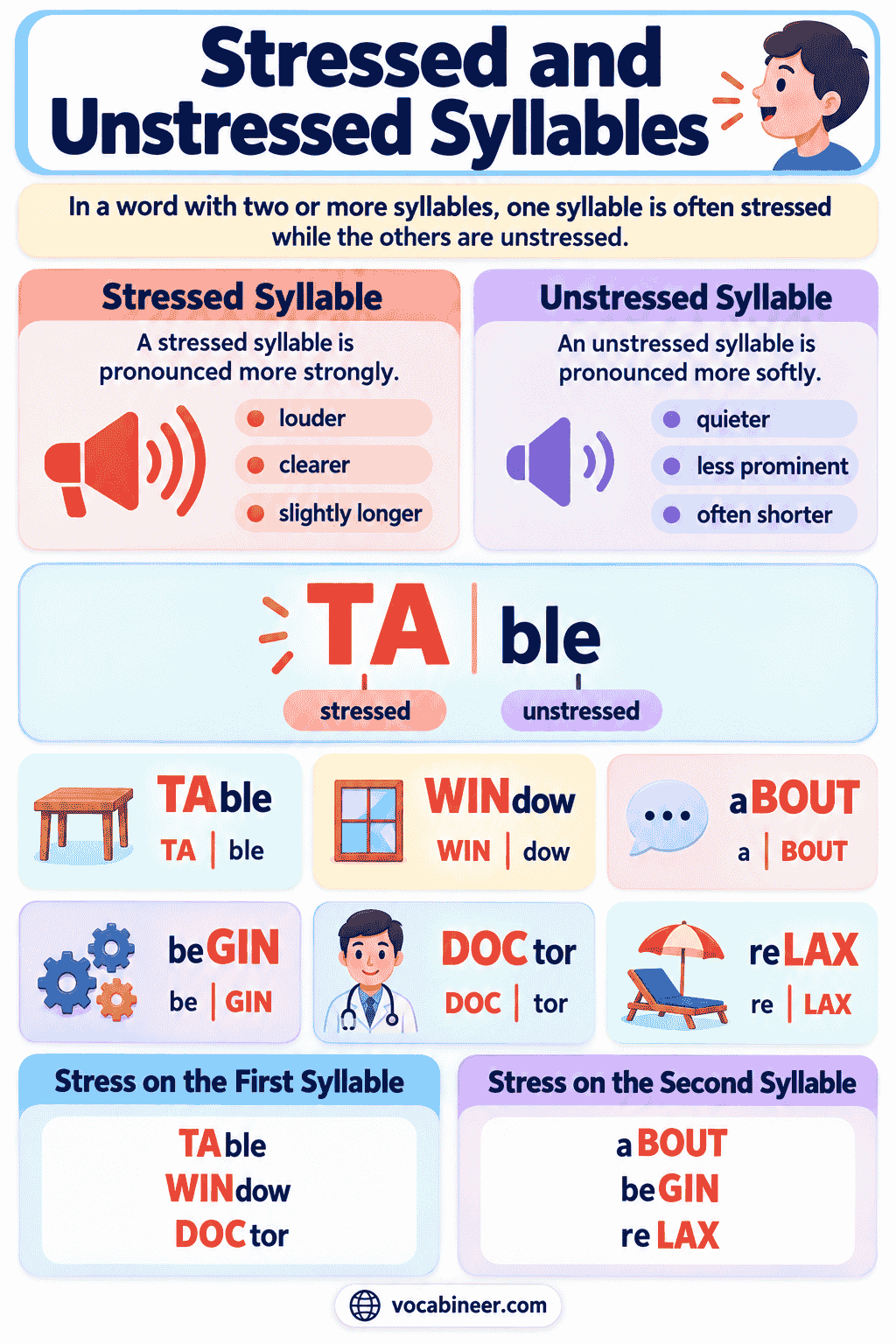
Stressed and unstressed syllables help create the rhythm of spoken English. In a multisyllabic word, one syllable usually stands out more clearly, while the others sound weaker or less prominent. For example, the first syllable is stressed in TAble, while the middle syllable is stressed in comPUter.
Learning the difference between stressed and unstressed syllables can improve pronunciation, listening, and word recognition. It also helps explain why some vowels sound clear and strong while others become reduced, especially in unstressed parts of a word.
In This Page
What Are Stressed and Unstressed Syllables?
A stressed syllable is the syllable that receives the strongest prominence in a word.
An unstressed syllable is less prominent and is usually shorter, weaker, and less clearly pronounced.
For example:
TAble
- TA = stressed
- ble = unstressed
comPUter
- com = unstressed
- PU = stressed
- ter = unstressed
baNAna
- ba = unstressed
- NA = stressed
- na = unstressed
The stressed syllable stands out, while the unstressed syllables support the overall rhythm of the word.
Stressed vs Unstressed Syllables
The main difference is not just loudness. Stress involves several pronunciation features working together.
| Feature | Stressed Syllable | Unstressed Syllable |
|---|---|---|
| Length | Usually longer | Usually shorter |
| Prominence | Stronger | Weaker |
| Vowel quality | Usually clearer | Often reduced |
| Loudness | Often greater | Usually softer |
| Pitch | More noticeable | Less prominent |
| Speech effort | Stronger articulation | Lighter articulation |
A stressed syllable normally sounds more complete and noticeable.
An unstressed syllable is often pronounced more quickly and may contain a weaker vowel.
How a Stressed Syllable Sounds
A stressed syllable usually has several noticeable features.
It Is Often Longer
The vowel or syllable may last slightly longer than the surrounding unstressed syllables.
For example:
TAble
The first syllable receives more time and prominence.
Its Vowel Is Usually Clearer
Stressed syllables often preserve a fuller vowel sound.
In:
comPUter
the vowel in PU is clearer and more prominent than the vowels in the surrounding syllables.
It May Sound Stronger
A stressed syllable often receives more vocal energy.
However, stress should not be identified by loudness alone.
It Often Has More Noticeable Pitch
The voice may rise, fall, or change pitch on the stressed syllable.
This pitch movement helps the syllable stand out.
How an Unstressed Syllable Sounds
An unstressed syllable is usually less prominent than the stressed syllable.
It may sound:
- shorter
- weaker
- faster
- quieter
- less clearly articulated
- reduced in vowel quality
For example:
baNAna
The first and final syllables are weaker than NA.
Similarly:
comPUter
The syllables com and ter are less prominent than PU.
Unstressed syllables are an important part of natural English rhythm. They should not normally receive the same strength as the stressed syllable.
Examples of Stressed and Unstressed Syllables
Stress can fall on different syllables depending on the word.
Stress on the First Syllable
TAble
DOCtor
WINdow
HAPpy
GARden
In these words, the first syllable carries the main stress.
Stress on the Middle Syllable
comPUter
baNAna
reMEMber
toMAto
poTAto
The stressed syllable appears between weaker syllables.
Stress on the Final Syllable
hoTEL
beGIN
reLAX
arRIVE
deCIDE
These words place the main stress near the end.
The position of stress is not always predictable from spelling alone, so learners may need to listen carefully or check a dictionary.
Why Unstressed Syllables Often Use Schwa
One of the most important sounds in unstressed English syllables is schwa.
Schwa is written in the International Phonetic Alphabet as:
/ə/
It is a weak, neutral vowel sound that commonly appears in unstressed syllables.
For example:
about → /əˈbaʊt/
The first syllable is unstressed and contains schwa.
Another example:
baNAna
The first and final syllables may contain reduced vowel sounds depending on accent and pronunciation.
Schwa is especially important because it shows that written vowels do not always keep their full sound when they are unstressed.
Vowel Reduction in Unstressed Syllables
When a syllable loses stress, its vowel may become shorter and less distinct.
This process is called vowel reduction.
A full vowel in a stressed syllable may be pronounced clearly, while an unstressed vowel may weaken toward schwa or another reduced vowel.
For example, compare the strong vowel in a stressed syllable with the weaker vowel in an unstressed one.
This reduction helps spoken English move smoothly between stronger and weaker syllables.
Without vowel reduction, every syllable would sound equally strong, which would make English pronunciation sound less natural.
Which Vowels Can Become Schwa?
Schwa is not tied to one spelling.
Different written vowels can produce a schwa sound when they occur in unstressed syllables.
For example, the letters:
- a
- e
- i
- o
- u
may all sound reduced in certain words.
This means learners should avoid assuming that a written vowel always keeps its full alphabet sound.
The exact reduced vowel can vary by word and accent, but unstressed syllables commonly show weaker vowel quality.
Syllable Count vs Syllable Stress
Syllable count and syllable stress are related, but they are not the same thing.
Consider:
banana
Syllable count:
ba / na / na
The word has three syllables.
Stress pattern:
ba / NA / na
Only the middle syllable carries the main stress.
Another example:
computer
Syllable count:
com / pu / ter
Stress pattern:
com / PU / ter
Again, the word has three syllables, but only one carries the primary stress.
Counting syllables tells you how many parts a word has.
Finding stress tells you which part is most prominent.
Does Unstressed Mean Silent?
No.
An unstressed syllable is not automatically silent.
It still forms part of the spoken word, but it receives less emphasis.
For example:
TAble
The second syllable is unstressed, but it is still pronounced.
Likewise:
comPUter
The first and final syllables remain part of the word even though they do not carry the main stress.
Some unstressed vowels become very weak, but weak pronunciation is not the same as complete silence.
Primary, Secondary, and Unstressed Syllables
Longer words can contain more than one level of stress.
Primary Stress
Primary stress is the strongest stress in a word.
For example:
comPUter
The syllable PU carries the primary stress.
Secondary Stress
Some longer words contain a weaker additional stress called secondary stress.
It is less prominent than primary stress but stronger than a completely unstressed syllable.
Unstressed Syllables
These syllables carry little or no stress and are usually shorter and less prominent.
For beginners, identifying the primary stress is the most important first step.
How to Hear the Stressed Syllable
Listening for stress becomes easier with practice.
Use this method:
- Say the word naturally.
- Divide it into syllables.
- Listen for the syllable that stands out most.
- Notice which vowel sounds clearest.
- Listen for extra length or pitch movement.
- Compare the other syllables for weakness or reduction.
- Check a dictionary if you are unsure.
For example:
banana
Say:
ba / na / na
Then compare:
BAna na
ba NA na
ba na NA
The natural pronunciation places the strongest stress on the middle syllable:
baNAna
Trying different stress positions can make the correct pattern easier to hear.
How to Mark Stressed and Unstressed Syllables
Several visual systems can show word stress.
Capital Letters
TAble
comPUter
baNAna
Bold Text
TAble
comPUter
Strong and Weak Symbols
A large symbol can represent stress, while a small one represents an unstressed syllable.
O o → table
o O o → computer
o O o → banana
Dictionary Stress Marks
Dictionaries commonly use:
ˈ = primary stress
ˌ = secondary stress
For example:
/kəmˈpjuː.tər/
The mark ˈ appears immediately before the syllable with primary stress.
These systems make stress patterns easier to see as well as hear.
Why Unstressed Syllables Matter
Unstressed syllables are just as important as stressed syllables because they help create natural English rhythm.
They contribute to:
- smooth pronunciation
- vowel reduction
- word rhythm
- listening comprehension
- natural speech timing
If every syllable receives equal force, a word may sound unnatural.
For example, natural pronunciation of:
comPUter
depends not only on making PU stronger but also on keeping com and ter weaker.
Stress and unstress work together.
Strong and Weak Syllables
Learners sometimes hear the terms strong syllable and weak syllable.
In beginner pronunciation teaching, stressed syllables are usually stronger and clearer, while unstressed syllables are usually weaker and more reduced.
However, these terms should not be treated as perfectly interchangeable in every technical phonological analysis.
For practical pronunciation learning, the important idea is simple:
Stronger syllables stand out, while weaker syllables receive less prominence.
Common Mistakes With Stressed and Unstressed Syllables
Several pronunciation mistakes can make stress harder to hear.
Stressing Every Syllable Equally
English words usually contain a contrast between stronger and weaker syllables.
Giving every syllable the same force removes that contrast.
Listening Only for Loudness
A stressed syllable is not simply the loudest syllable.
Length, vowel clarity, prominence, and pitch can also indicate stress.
Pronouncing Every Written Vowel Fully
Unstressed vowels often become reduced.
Trying to pronounce every written vowel with its strongest possible sound can make speech sound unnatural.
Ignoring Schwa
Schwa is extremely common in unstressed syllables.
Recognizing it helps learners understand why spoken English sometimes sounds different from its spelling.
Thinking Unstressed Means Silent
An unstressed syllable is usually weaker, not absent.
Assuming Stress Is Always on the First Syllable
English stress can appear at the beginning, middle, or end of a word.
Compare:
TAble
comPUter
hoTEL
Confusing Syllable Count With Stress
A word may contain several syllables but usually has one main stressed syllable.
For example:
ba / NA / na
contains three syllables but one primary stress.
FAQs
A stressed syllable is the most prominent syllable in a word. It is usually longer, clearer, and stronger than the surrounding unstressed syllables.
An unstressed syllable receives less prominence. It is often shorter, weaker, and more likely to contain a reduced vowel.
Listen for the syllable that sounds most prominent. It may be longer, clearer, slightly louder, or marked by a noticeable pitch change. A dictionary can also show the primary stress.
Schwa /ə/ is a weak, neutral vowel sound that commonly appears in unstressed syllables. It often results from vowel reduction.
Words with more than one syllable normally have a main stressed syllable. Longer words may also contain secondary stress, while the remaining syllables are unstressed.
Read More
- What is a Syllable?
- Closed syllable words
- Open syllable words
- Open and closed syllable words
- Multisyllabic Words List
- 1 syllable words
- 2 syllable words
- 3 syllable words
- 4 syllable words
- 5 syllable words
- Six syllable words