

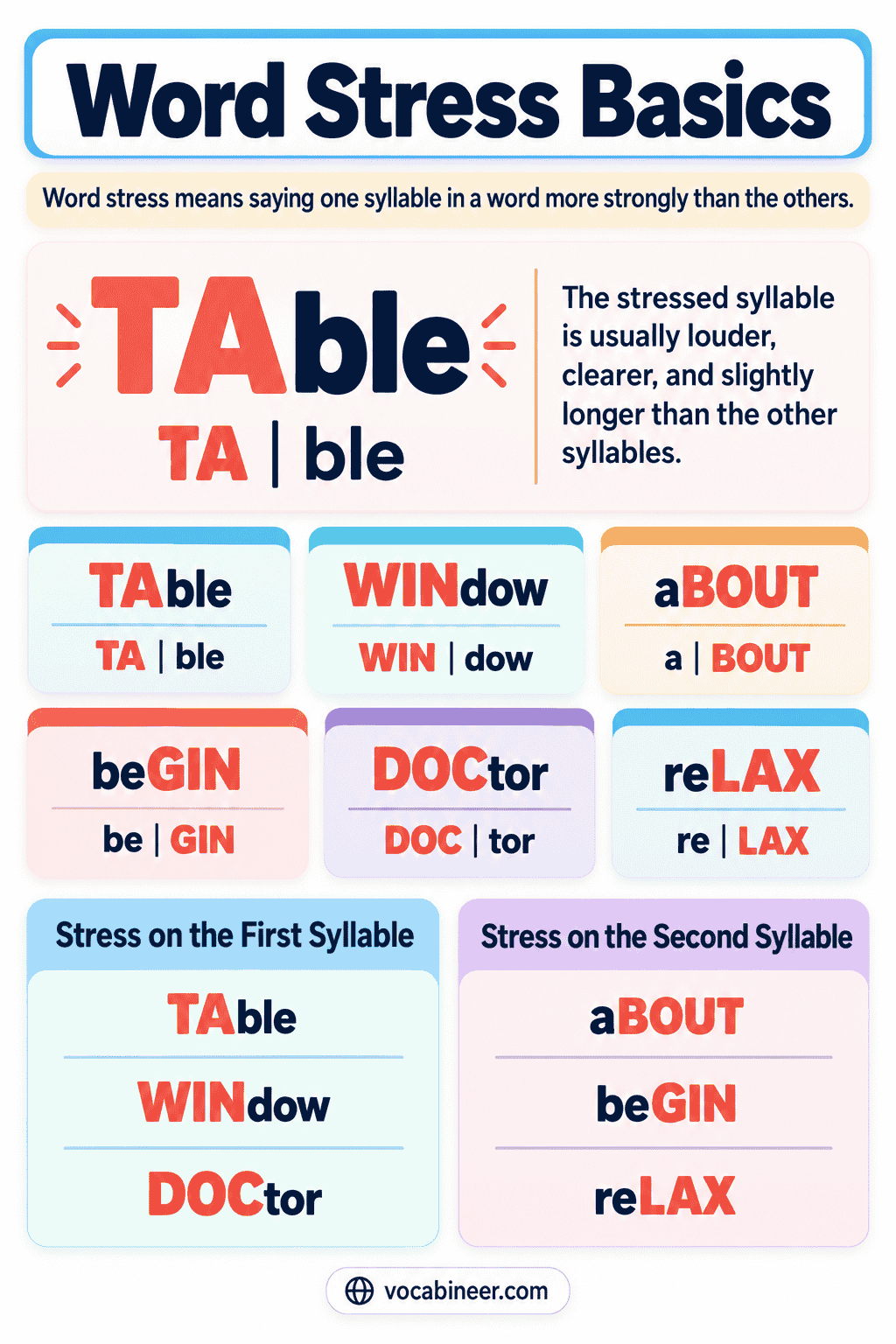
Word stress is the extra emphasis given to one syllable in a word. In English, a stressed syllable is usually longer, clearer, and stronger than the other syllables, and it may also have a noticeable change in pitch. For example, the first syllable is stressed in TAble, while the middle syllable is stressed in comPUter.
Learning word stress basics helps improve pronunciation, listening, and spoken English. It also makes longer words easier to understand because readers can recognize which syllable carries the main stress and which syllables are weaker or reduced.
In This Page
What Is Word Stress?
Word stress is the prominence given to one syllable within a word.
A multisyllabic word usually contains one syllable that receives the strongest emphasis.
Examples:
TAble
comPUter
baNAna
reMEMber
In each example, one syllable stands out more clearly than the others.
Word stress is not created by loudness alone. A stressed syllable may also be:
- longer
- clearer
- slightly louder
- pronounced with a fuller vowel
- marked by a noticeable pitch change
These features work together to make the stressed syllable more prominent.
Why Word Stress Matters
Correct word stress makes spoken English easier to understand.
It helps with:
- clearer pronunciation
- better listening
- natural speech rhythm
- recognizing familiar words
- pronouncing longer words
- understanding dictionary pronunciation
- distinguishing some nouns from verbs
Incorrect stress can make a familiar word sound unusual or harder for a listener to recognize.
For example, changing the stress pattern of a multisyllabic word can make the pronunciation sound unnatural even when the individual consonant and vowel sounds are otherwise correct.
How a Stressed Syllable Sounds
A stressed syllable usually stands out from the surrounding syllables.
Consider:
TAble
The first syllable sounds stronger and clearer than the second.
In:
comPUter
the middle syllable receives the main stress.
Several features can signal stress.
Longer Duration
A stressed syllable is often held slightly longer than an unstressed syllable.
Clearer Vowel
The vowel in a stressed syllable is usually pronounced more fully and clearly.
Greater Prominence
The stressed syllable may sound stronger or slightly louder than the others.
Pitch Change
The voice may rise, fall, or otherwise change pitch on the stressed syllable.
Learners should therefore listen for the overall prominence of a syllable rather than relying only on volume.
Stressed vs Unstressed Syllables
Stressed and unstressed syllables differ in several ways.
| Feature | Stressed Syllable | Unstressed Syllable |
|---|---|---|
| Length | Often longer | Usually shorter |
| Clarity | Clearer | Often reduced |
| Loudness | Usually stronger | Usually weaker |
| Vowel quality | Often full | May become reduced |
| Prominence | Stands out | Less noticeable |
For example:
TAble
- TA = stressed
- ble = unstressed
comPUter
- PU = stressed
- com and ter = unstressed
Understanding this contrast helps learners hear English rhythm more accurately.
Primary Stress in English Words
The strongest stress in a word is called primary stress.
For example:
comPUter
The syllable PU carries the primary stress.
In:
baNAna
the syllable NA carries the primary stress.
Most beginner-level stress practice focuses on finding this main stressed syllable.
Longer words can sometimes contain secondary stress, which is weaker than the primary stress but stronger than completely unstressed syllables. However, primary stress is the most important pattern for beginners to recognize first.
How to Identify the Stressed Syllable
A simple listening process can help identify word stress.
- Say the whole word naturally.
- Divide the word into syllables.
- Listen for the syllable that sounds strongest or clearest.
- Notice which vowel sounds fuller.
- Compare the length and pitch of the syllables.
- Check a dictionary if the stress is unclear.
For example:
banana
Say the syllables:
ba / na / na
The middle syllable stands out:
ba / NA / na
So the stress falls on the second syllable.
Another example:
table
ta / ble
The first syllable is stronger:
TA / ble
Common Stress Patterns in Two-Syllable Words
Two-syllable words provide some useful stress tendencies.
These patterns are helpful, but they are not absolute rules.
Nouns and Adjectives
Many two-syllable nouns and adjectives tend to stress the first syllable.
Examples:
TAble
WINdow
HAPpy
CLEver
QUIet
The first syllable is more prominent in these words.
Verbs
Many two-syllable verbs tend to stress the second syllable.
Examples:
reLAX
deCIDE
beGIN
arRIVE
exPLAIN
Again, this is a common tendency rather than a rule that applies to every English word.
Words That Change Stress as Nouns and Verbs
Some words change their stress depending on how they are used.
For example:
| Noun | Verb |
|---|---|
| PREsent | preSENT |
| REcord | reCORD |
| CONtract | conTRACT |
| PROduce | proDUCE |
| INcrease | inCREASE |
In many of these pairs, the noun stresses the first syllable while the verb stresses the second.
For example:
REcord — a stored piece of information
reCORD — to capture sound or information
This shows that word stress can sometimes help communicate grammatical meaning.
Stress in Three-Syllable and Longer Words
Longer words can place their main stress on different syllables.
Examples:
comPUter
baNAna
reMEMber
ANimal
toMAto
The stress position is not always predictable simply from the number of syllables.
For this reason, learners should combine common stress tendencies with listening and dictionary checking.
In longer words, one syllable normally carries the primary stress, while the other syllables are less prominent.
How Stress Changes in Word Families
Related words do not always keep the same stress pattern.
A well-known example is:
PHOtograph
phoTOGraphy
photoGRAPHic
Although these words belong to the same family, the primary stress shifts as the word changes.
Another example can occur when a suffix changes the shape and rhythm of a word.
This means learners should avoid assuming that a related word automatically keeps the same stressed syllable.
Checking the pronunciation of each new form is often useful.
Unstressed Syllables and the Schwa Sound
Unstressed syllables often contain a reduced vowel sound.
One of the most common reduced vowels in English is the schwa, written in the International Phonetic Alphabet as:
/ə/
Schwa is a weak, neutral vowel sound commonly found in unstressed syllables.
For example, an unstressed vowel may lose the clear sound suggested by its spelling and become shorter and less distinct.
This process is called vowel reduction.
Understanding schwa helps explain why unstressed syllables can sound different from the way they appear in writing.
It also explains why learners should not pronounce every written vowel with equal strength.
Stress in Compound Words
Compound words contain two or more meaningful parts joined together.
Many compound nouns tend to place stronger stress on the first part.
Examples:
BLACKboard
FOOTball
BEDroom
TOOTHbrush
RAINcoat
This pattern can help distinguish some compound nouns from other word combinations.
However, compound stress can vary, so learners should treat this as another useful tendency rather than a fixed rule.
How Dictionaries Show Word Stress
Dictionaries often mark the stressed syllable with a small stress symbol.
The primary stress mark usually appears immediately before the stressed syllable:
ˈ
For example:
table may be shown with the stress mark before the first syllable.
computer places the stress mark before the stressed middle syllable.
In phonetic transcription, a dictionary might show forms such as:
/ˈteɪ.bəl/
and:
/kəmˈpjuː.tər/
The mark ˈ shows where the primary stress begins.
Some dictionaries also use a lower stress mark for secondary stress in longer words.
Learning to recognize these symbols makes it much easier to check unfamiliar pronunciation independently.
How to Mark Word Stress
Word stress can be shown in several learner-friendly ways.
Capital Letters
TAble
comPUter
baNAna
Bold Text
TAble
comPUter
Stress Mark
The dictionary-style primary stress mark can appear before the stressed syllable:
/ˈteɪ.bəl/
Stress Patterns
Teachers and learners may also represent syllables with strong and weak symbols.
For example:
O o → table
o O o → computer
These visual patterns make it easier to compare words with different stress positions.
Word Stress vs Sentence Stress
Word stress and sentence stress are related but different.
Word stress refers to emphasis inside one word.
For example:
comPUter
The middle syllable is stressed.
Sentence stress refers to the emphasis placed on important words in a complete sentence.
For example, nouns, main verbs, adjectives, and other key words may receive stronger emphasis depending on meaning and context.
The key distinction is:
- word stress = prominence within a word
- sentence stress = prominence across words in a sentence
This article focuses on word stress.
Common Word Stress Mistakes
Several common mistakes can make English pronunciation less natural.
Stressing Every Syllable Equally
English words usually contain stronger and weaker syllables.
Pronouncing every syllable with equal force can make speech sound unnatural.
Listening Only for Loudness
Stress involves more than volume.
Length, vowel clarity, and pitch also help identify the stressed syllable.
Ignoring Unstressed Vowels
Unstressed vowels often become reduced, especially to schwa.
Pronouncing every vowel fully can distort the natural rhythm of a word.
Treating Stress Tendencies as Absolute Rules
Not every two-syllable noun stresses the first syllable, and not every two-syllable verb stresses the second.
Stress rules in English contain many exceptions.
Keeping the Same Stress Across a Word Family
Related words may shift stress.
Compare:
PHOtograph
phoTOGraphy
Learners should check each form separately.
Ignoring Dictionary Stress Marks
A dictionary can quickly confirm which syllable carries primary stress.
Learning the stress symbol ˈ makes pronunciation checking much easier.
Confusing Word Stress With Sentence Stress
A stressed syllable within a word is different from emphasizing an entire word within a sentence.
Keeping these concepts separate helps learners understand English rhythm more clearly.
FAQs
Word stress is the extra prominence given to one syllable within a word. A stressed syllable is often longer, clearer, and stronger than the surrounding unstressed syllables.
Say the word naturally and listen for the syllable that sounds most prominent. Notice its length, vowel clarity, loudness, and pitch. If you are unsure, check the stress mark in a dictionary.
Many two-syllable nouns and adjectives tend to stress the first syllable, while many two-syllable verbs tend to stress the second. However, these are common tendencies rather than fixed rules.
Schwa /ə/ is a weak, neutral vowel sound commonly found in unstressed syllables. It results from vowel reduction and is very common in natural English pronunciation.
Dictionaries commonly place the primary stress mark ˈ immediately before the stressed syllable in phonetic transcription. This mark helps readers identify the main stress of unfamiliar words.
Read More
- What is a Syllable?
- Closed syllable words
- Open syllable words
- Open and closed syllable words
- Multisyllabic Words List
- 1 syllable words
- 2 syllable words
- 3 syllable words
- 4 syllable words
- 5 syllable words
- Six syllable words