

Syllable division rules help readers break longer words into smaller parts so they can decode, pronounce, and spell them more easily. Common patterns such as VCCV, VCCCV, VCV, VV, consonant-le, prefixes, suffixes, and compound words provide useful clues about where a word may be divided.
These rules are best understood as reading and spelling generalizations, not perfect laws for every English word. Some words follow a clear pattern, while others require readers to try another division or pronunciation. This guide explains the major syllable division rules with examples and shows when each pattern is most useful.
In This Page
What Are Syllable Division Rules?
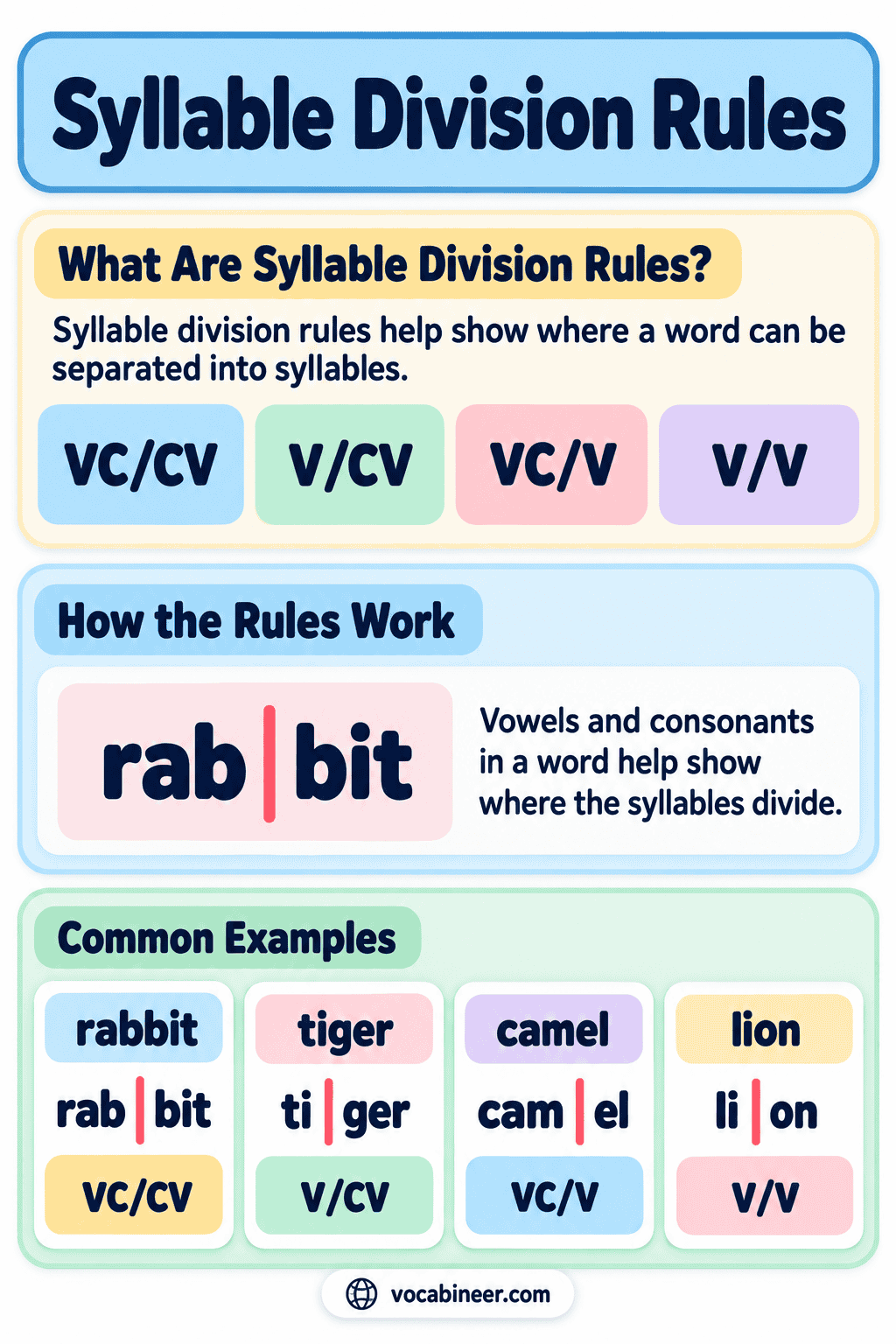
Syllable division rules are patterns that help readers decide where to separate a multisyllabic word into smaller spoken units.
For example:
napkin → nap / kin
robot → ro / bot
candle → can / dle
neon → ne / on
These patterns help readers focus on one syllable at a time before blending the parts back into the complete word.
Syllable division may also be called syllabication or syllabification, but syllable division is the clearest term for everyday phonics instruction.
Syllable Division Rules at a Glance
The table below summarizes the major patterns.
| Pattern | General Division Rule | Example |
|---|---|---|
| VCCV | Divide between two consonants | nap / kin |
| VCCCV | Keep useful blends or digraphs together | hun / dred |
| VCV | Try V/CV, then VC/V | ro / bot, cab / in |
| Consonant-le | Divide before the final C-le syllable | can / dle |
| VV | Divide only when vowels have separate sounds | ne / on |
| Vowel team | Keep the vowel spelling together | rain / coat |
| Diphthong | Keep the diphthong together | boil / ing |
| Prefix/Suffix | Separate meaningful affixes | un / load / ed |
| Compound word | Divide between meaningful base words | sun / set |
These patterns give readers a useful starting point, but the pronunciation and structure of the complete word should always be checked.
VCCV Rule: Divide Between Two Consonants
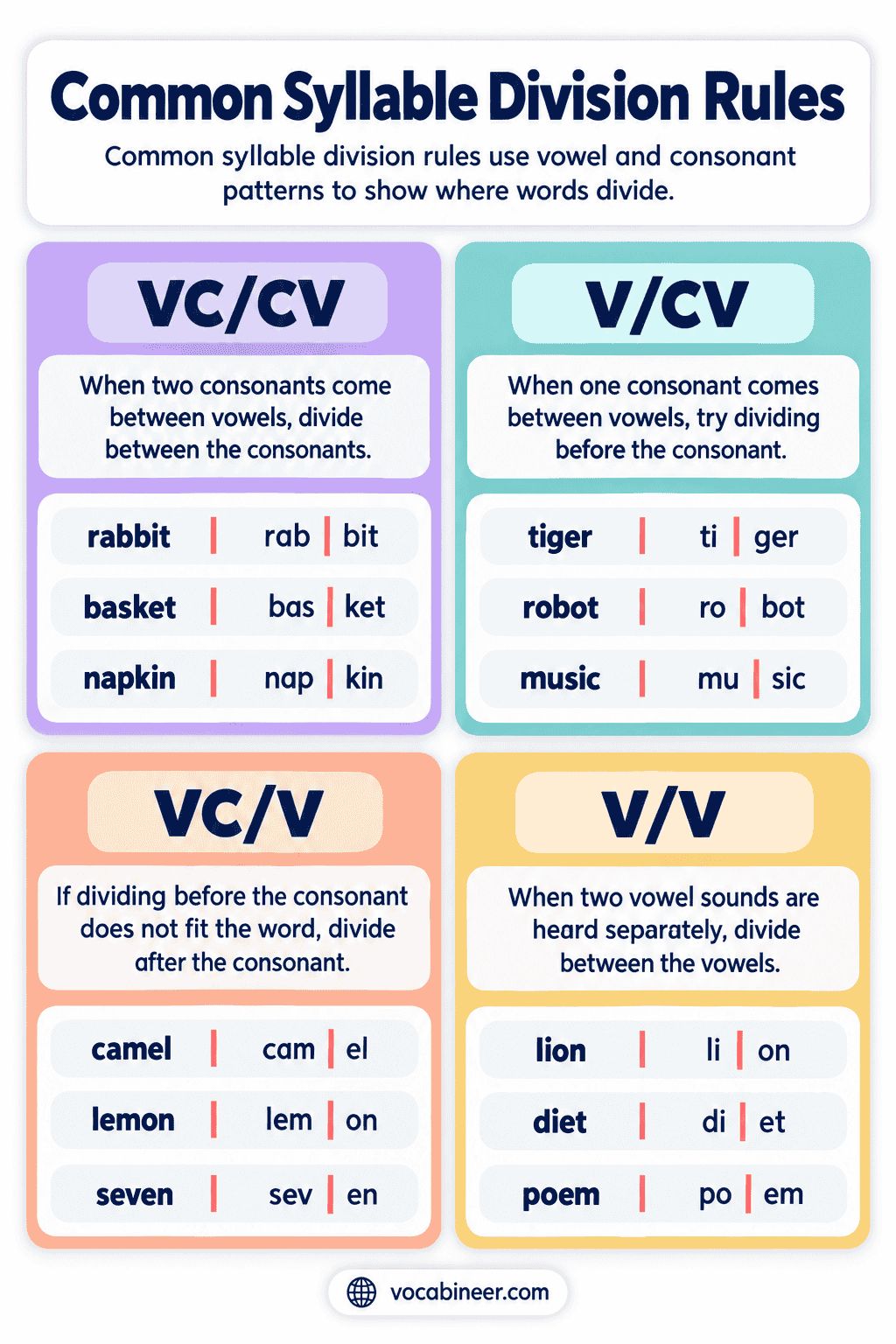
The VCCV pattern has two consonants between vowel sounds.
A common division strategy is to split between the two consonants.
Examples:
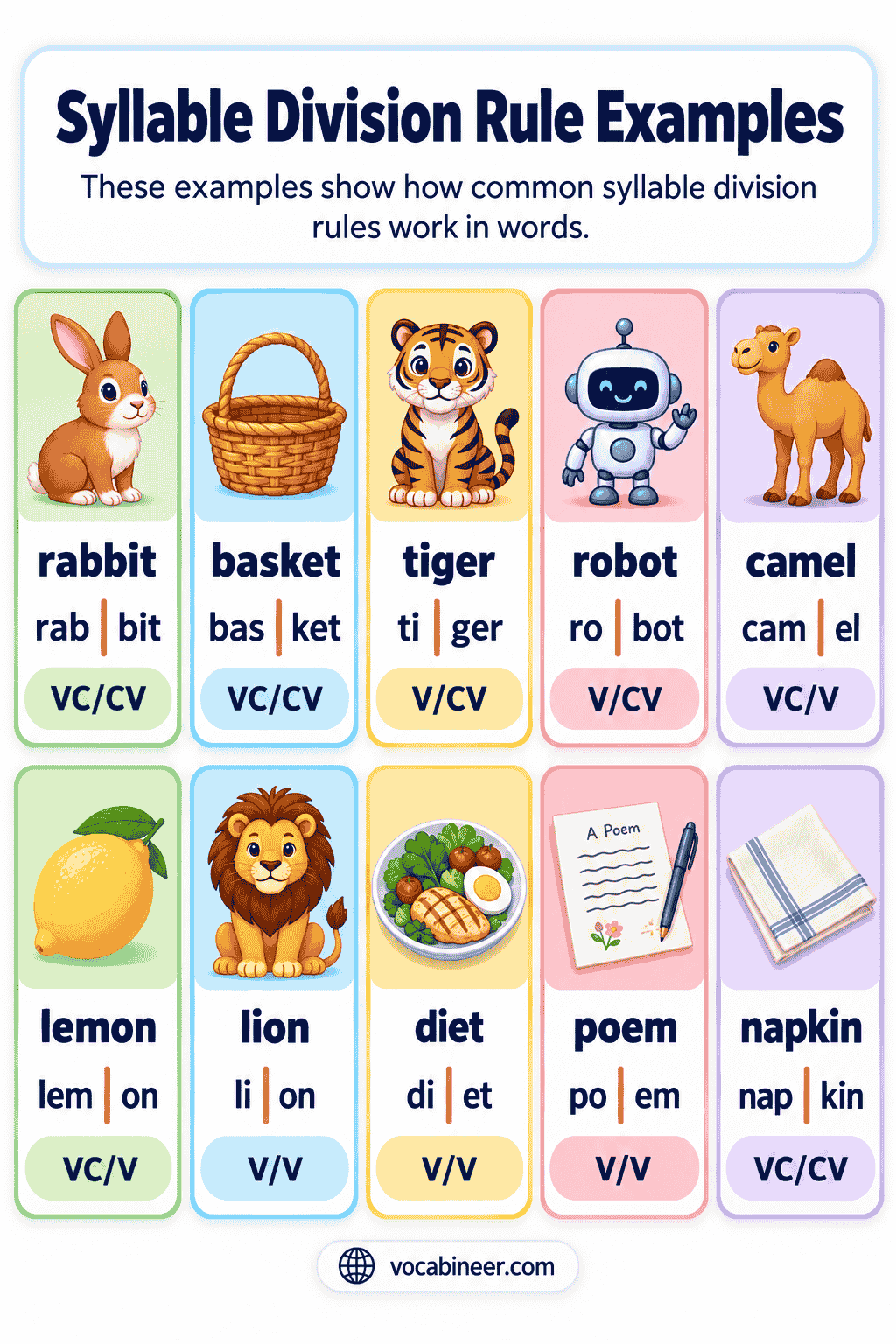
napkin → nap / kin
rabbit → rab / bit
velvet → vel / vet
picnic → pic / nic
helmet → hel / met
The first syllable often becomes a closed syllable, which usually contains a short vowel sound.
For example:
rabbit → rab / bit
Both syllables are closed.
However, the VCCV rule should not be applied mechanically when the two consonants form a special sound unit.
When Not to Split a Consonant Digraph
Two consonant letters sometimes work together to represent one consonant sound. This combination is called a digraph.
Common digraphs include:
sh
ch
th
ph
When these letters belong together as one sound, they should not usually be separated simply because they appear between vowels.
For example, words containing th or ph may need to be treated differently from ordinary VCCV words.
The important principle is:
Do not split two consonant letters automatically if they work together as one consonant sound.
This is one reason syllable division rules should be treated as flexible decoding patterns rather than rigid formulas.
VCCCV Rule: Keep Blends and Digraphs Together
A VCCCV pattern has three consonants between vowel sounds.
In these words, readers need to decide which consonants belong together.
For example:
hundred → hun / dred
The dr blend remains together at the beginning of the second syllable.
Other examples include:
pumpkin → pump / kin
conflict → con / flict
A useful principle is to preserve familiar consonant combinations.
A blend contains consonant sounds that remain individually audible, such as:
dr
bl
gr
tr
A digraph represents one consonant sound, such as:
sh
ch
th
ph
Keeping these sound units together can make decoding more accurate.
VCV Rule: Try V/CV, Then VC/V
The VCV pattern has one consonant between two vowel sounds.
Unlike VCCV, this pattern can divide in two common ways.
V/CV Pattern
First, try dividing after the first vowel:
V/CV
Examples:
robot → ro / bot
tiger → ti / ger
music → mu / sic
humid → hu / mid
The first syllable is usually open and often contains a long vowel sound.
For example:
robot → ro / bot
The first syllable ro is open.
VC/V Pattern
If the V/CV split does not give the expected pronunciation, try placing the consonant with the first syllable:
VC/V
Examples:
cabin → cab / in
lemon → lem / on
timid → tim / id
planet → plan / et
The first syllable is usually closed and commonly contains a short vowel.
A useful strategy is:
Try V/CV first. If the result does not sound like the word you know, try VC/V.
This is one of the clearest examples of why syllable division rules are flexible.
Consonant-le Rule: Count Back Three
A consonant-le syllable occurs at the end of a multisyllabic word and usually contains:
consonant + l + silent e
Examples:
table → ta / ble
candle → can / dle
marble → mar / ble
purple → pur / ple
A common division method is count back three.
Start at the final e, count back three letters, and divide before the consonant-le syllable.
For example:
candle
e → l → d
Divide before d:
can / dle
This keeps the final consonant-le syllable together.
VV Rule: Divide Only When Vowels Have Separate Sounds
The VV pattern involves adjacent vowels.
However, readers should divide between them only when the vowels represent separate vowel sounds or syllables.
Examples:
neon → ne / on
lion → li / on
In these words, the adjacent vowels do not work together as one vowel team.
Compare:
boat
The letters oa form one vowel team, so they should not be divided.
Likewise:
coin
The letters oi form one diphthong and should remain together.
So the useful rule is:
Divide adjacent vowels only when they belong to separate syllable sounds.
Keep Vowel Teams and Diphthongs Together
Vowel teams and diphthongs normally stay together within the same syllable because the letters work together to represent one vowel unit.
Examples:
raincoat → rain / coat
Do not divide ai or oa.
teacher → teach / er
Keep ea together.
boiling → boil / ing
Keep oi together.
cloudy → cloud / y
Keep ou together when it represents the diphthong in cloud.
This rule prevents readers from splitting important vowel spellings unnecessarily.
Prefix and Suffix Rule: Separate Meaningful Word Parts
Prefixes and suffixes can provide strong clues about where to divide longer words.
A useful strategy is to identify the base word first, then separate meaningful affixes.
Examples:
unkind → un / kind
unloaded → un / load / ed
redoing → re / do / ing
helpful → help / ful
careless → care / less
quickly → quick / ly
This approach combines syllable division with word meaning and structure.
In longer words, readers can separate the prefix or suffix first, then divide the base word further if needed.
Compound Word Rule: Divide Between Meaningful Base Words
Compound words contain two smaller words that work together to create a new meaning.
Examples:
sunset → sun / set
bedroom → bed / room
raincoat → rain / coat
workbook → work / book
toothbrush → tooth / brush
The important point is that both parts should be meaningful components of the compound.
For example, a word should not be split into two familiar-looking pieces simply because both letter groups happen to form words. The division should match the actual structure of the compound.
Syllable Division Patterns vs Syllable Types
Syllable division patterns and syllable types are related, but they answer different questions.
Division patterns help determine:
Where should the word be split?
Examples include:
- VCCV
- VCCCV
- VCV
- VV
Syllable types help determine:
What kind of syllable is each resulting part, and how is its vowel likely to sound?
Common syllable types include:
- closed
- open
- VCe
- R-controlled
- vowel team
- consonant-le
For example:
robot → ro / bot
The division pattern is VCV.
After division:
- ro = open syllable
- bot = closed syllable
This distinction helps learners use both division and pronunciation strategies correctly.
Check the Syllable Type After Dividing
After dividing a word, identify the type of each syllable whenever possible.
Sunrise
sun / rise
- sun = closed
- rise = VCe
Purple
pur / ple
- pur = R-controlled
- ple = consonant-le
Raincoat
rain / coat
- both syllables contain vowel teams
Table
ta / ble
- ta = open
- ble = consonant-le
Knowing the syllable type can help predict how the vowel should be pronounced.
Which Syllable Division Rule Should You Use?
When several patterns are possible, use the word’s structure to decide which rule to try first.
| What You Notice | Rule to Try |
|---|---|
| Two meaningful base words | Divide the compound |
| Prefix or suffix | Separate the affix |
| Final consonant + le | Use consonant-le division |
| Two consonants between vowels | Try VCCV |
| Three consonants between vowels | Preserve blends/digraphs |
| One consonant between vowels | Try V/CV, then VC/V |
| Two adjacent vowels | Check whether they are separate sounds |
| Vowel team or diphthong | Keep the letters together |
This decision guide helps readers choose the most relevant rule instead of applying every pattern in the same way.
Using Several Syllable Division Rules in Longer Words
Longer words often require more than one strategy.
Fantastic
fan / tas / tic
The word contains several closed syllables.
Unloaded
un / load / ed
First separate the prefix un- and suffix -ed, then recognize load as the base.
Remember
re / mem / ber
The word contains multiple syllables with different vowel and consonant patterns.
Computer
com / pu / ter
The word combines several syllable structures.
Raincoat
rain / coat
The compound-word rule and vowel-team rule both apply.
The key is to work with one recognizable part at a time rather than trying to decode the full word as one uninterrupted string.
Common Exceptions and Flexible Patterns
English spelling is not perfectly regular, so syllable division does not always follow one mechanical formula.
This is especially true with:
- VCV words
- unstressed syllables
- unusual vowel spellings
- words borrowed from other languages
- words with less predictable pronunciation
When one division does not produce a recognizable pronunciation, try another reasonable split.
This flexibility is particularly important with VCV patterns.
For example:
cabin
A reader might first try:
ca / bin
If that does not match the known word, try:
cab / in
The second option gives the expected pronunciation.
Common Mistakes With Syllable Division Rules
Several errors can make syllable division less accurate.
Treating Every VCCV Word the Same
Two consonants may form a digraph or another sound unit, so readers should check before splitting them.
Splitting a Digraph
Do not separate letters such as sh, ch, th, or ph when they work together as one consonant sound.
Breaking a Vowel Team
Incorrect:
ra / in
Correct:
rain
The ai spelling represents one vowel unit.
Splitting a Diphthong
Incorrect:
bo / il
Correct:
boil
The oi spelling represents one gliding vowel sound.
Forcing V/CV in Every VCV Word
Not every VCV word has an open first syllable.
For example:
cabin → cab / in
not:
ca / bin
Dividing Every Pair of Vowels
Adjacent vowels may form a vowel team or diphthong.
Compare:
ne / on
with:
boat
Only the first example divides between the vowels.
Ignoring Prefixes and Suffixes
A longer word may become much easier when meaningful word parts are identified first.
For example:
unloaded → un / load / ed
Confusing Division Patterns With Syllable Types
VCCV and VCV help locate a syllable break.
Closed, open, VCe, and other syllable types help explain how the resulting syllables behave.
These are connected skills, but they are not the same thing.
FAQs
The main patterns include VCCV, VCCCV, VCV, consonant-le, VV, vowel-team protection, prefixes and suffixes, and compound-word division. Each pattern provides clues about where a longer word can be separated.
In a typical VCCV word, two consonants occur between vowel sounds, and the word is often divided between them. Examples include nap/kin, rab/bit, and pic/nic. However, consonant digraphs should not be split automatically.
Both are possible divisions for VCV words. In V/CV, the first vowel ends the first syllable, as in ro/bot. In VC/V, the consonant closes the first syllable, as in cab/in.
Two adjacent vowels should generally be divided only when they represent separate vowel sounds or syllables, as in ne/on. If they form a vowel team or diphthong, such as oa in boat or oi in coin, keep them together.
No. They are useful decoding generalizations, but English contains exceptions and flexible patterns. When one division does not produce a recognizable pronunciation, readers may need to try another reasonable split.
Read More
- What is a Syllable?
- Closed syllable words
- Open syllable words
- Open and closed syllable words
- Multisyllabic Words List
- 1 syllable words
- 2 syllable words
- 3 syllable words
- 4 syllable words
- 5 syllable words
- Six syllable words