

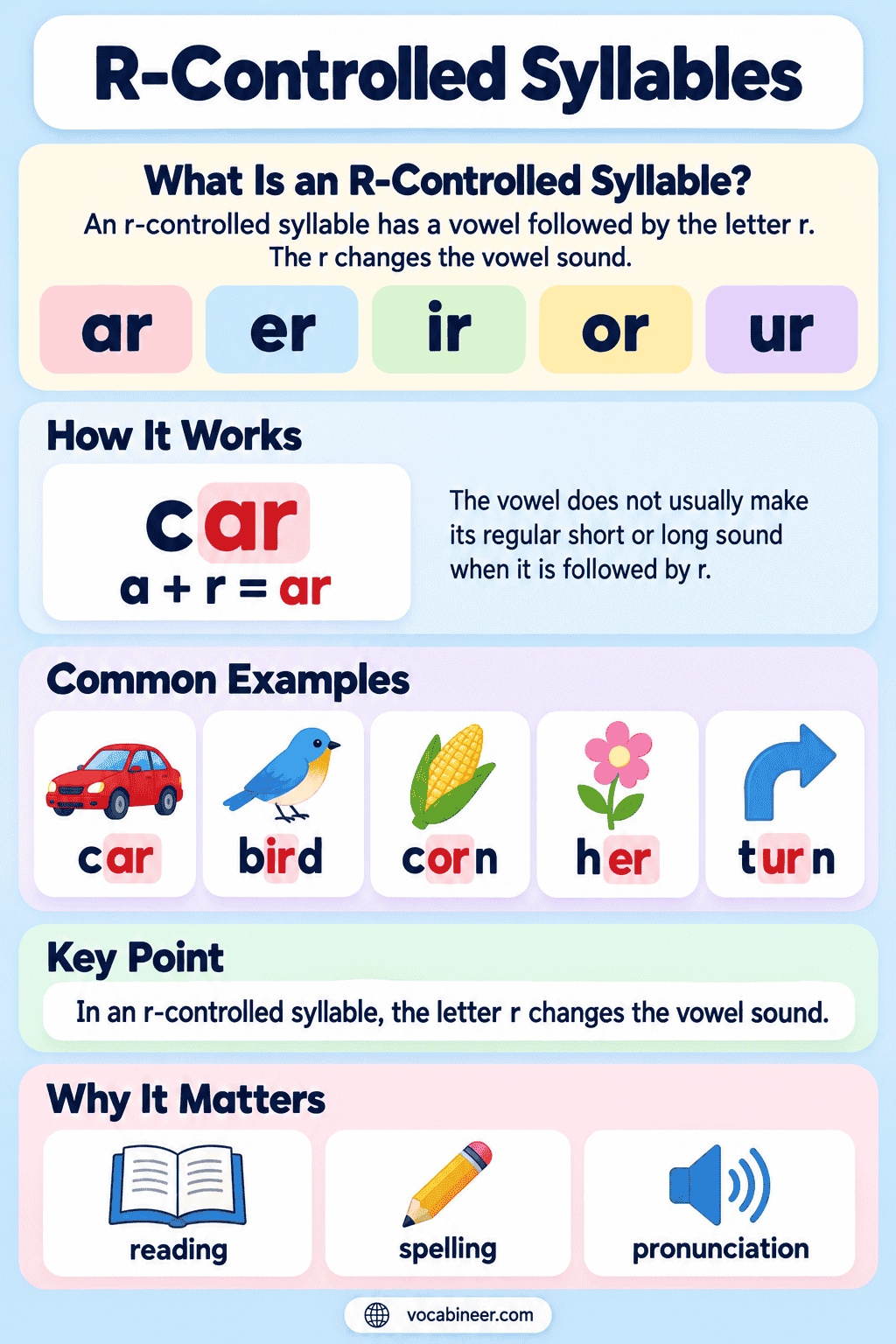
R-controlled syllables are syllables in which a vowel is followed by the letter r, causing the vowel sound to change. Instead of making its usual short or long sound, the vowel combines with r to create a different sound, as in car, bird, corn, and turn. This pattern is also commonly called bossy R.
Learning R-controlled syllables helps readers recognize common vowel-r patterns, improve decoding, spell words more accurately, and read longer words with greater confidence. This guide explains the five main patterns ar, er, ir, or, and ur, along with examples, multisyllabic words, comparisons, and common spelling challenges.
In This Page
What Is an R-Controlled Syllable?
An R-controlled syllable contains a vowel followed directly by r within the same syllable. The r changes the usual sound of the vowel.
Examples include:
car → ar
her → er
bird → ir
corn → or
turn → ur
In each example, the vowel does not behave like a normal short or long vowel. Instead, the vowel and r work together to create an R-controlled sound.
Why Are R-Controlled Syllables Important?
Recognizing R-controlled syllables helps learners understand how vowel sounds change when r follows a vowel.
This knowledge supports:
- reading unfamiliar words
- recognizing vowel-r patterns
- improving spelling
- decoding longer words
- dividing multisyllabic words
- distinguishing R-controlled vowels from regular short and long vowels
- understanding common phonics patterns
For example, the a in car does not sound like the short a in cat or the long a in cake. The following r changes the vowel sound.
How R Changes the Vowel Sound
In many words, a vowel followed by r has a special R-controlled sound.
Compare these examples:
| Regular Vowel Word | R-Controlled Word | Pattern |
|---|---|---|
| cat | car | ar |
| hen | her | er |
| bit | bird | ir |
| hot | horn | or |
| cut | curl | ur |
The vowel sound changes because r directly follows the vowel.
R-controlled vowels are often described as r-colored vowels because the sound of r influences the vowel before it.
R-Controlled Patterns: AR, ER, IR, OR, and UR
There are five main R-controlled spelling patterns:
ar, er, ir, or, and ur
Each pattern appears in many common English words.
AR Pattern
The ar pattern commonly appears in words where a is followed directly by r.
Examples:
car
star
farm
park
dark
shark
yard
hard
barn
card
The vowel sound in these words differs from both the short a in cat and the long a in cake.
ER Pattern
The er pattern appears in many common words.
Examples:
her
term
verb
herd
fern
person
teacher
river
winter
sister
The pronunciation of er can vary depending on its position in the word and the speaker’s accent.
IR Pattern
The ir pattern often has the same or a very similar sound to er and ur.
Examples:
bird
girl
shirt
first
dirt
third
firm
stir
skirt
birth
Because ir can sound similar to other R-controlled patterns, spelling often needs to be learned word by word.
OR Pattern
The or pattern is common in many familiar words.
Examples:
corn
fork
storm
horse
short
north
sport
cord
horn
porch
In these words, o and r work together to create an R-controlled sound.
UR Pattern
The ur pattern often sounds similar to er and ir.
Examples:
turn
hurt
nurse
curl
burn
fur
surf
burst
church
purple
Learners often need to remember whether a word uses er, ir, or ur because the sounds can be very similar.
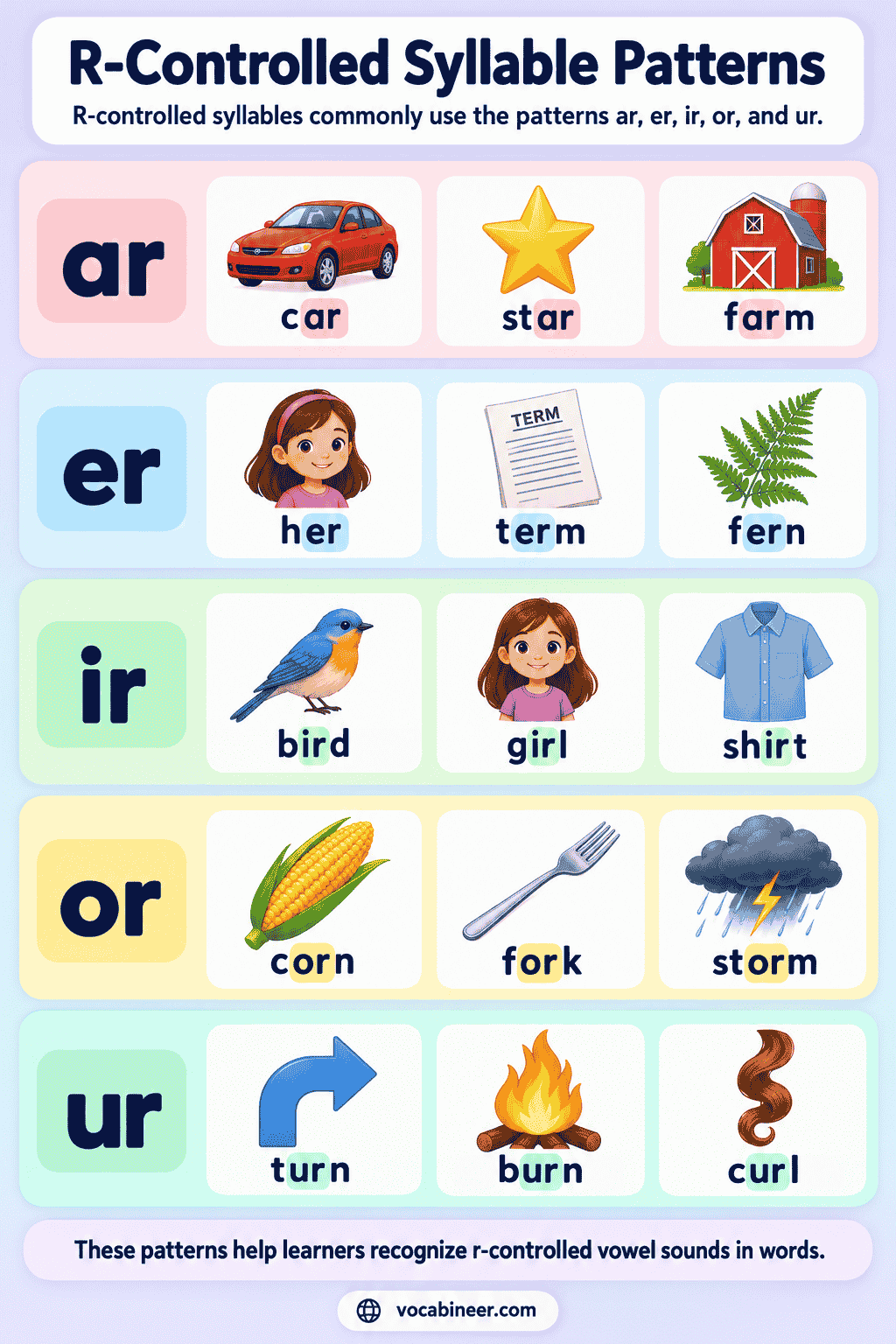
Common R-Controlled Syllable Examples
The table below shows familiar examples of each main pattern.
| Word | Pattern | R-Controlled Part |
|---|---|---|
| car | ar | ar |
| star | ar | ar |
| farm | ar | ar |
| her | er | er |
| fern | er | er |
| bird | ir | ir |
| shirt | ir | ir |
| corn | or | or |
| horse | or | or |
| turn | ur | ur |
| nurse | ur | ur |
| curl | ur | ur |
These examples make it easier to see how the vowel and r appear together in the same syllable.
Why ER, IR, and UR Often Sound Alike
One of the most important spelling challenges with R-controlled vowels involves er, ir, and ur.
Consider:
her
bird
turn
In many English accents, the R-controlled vowel sound in these words is the same or very similar.
This means learners cannot always determine the correct spelling simply by listening to the word.
For example:
- her uses er
- bird uses ir
- turn uses ur
Because the pronunciation is so similar, these spellings often need to be learned through reading, practice, and familiarity with individual words.
How to Identify an R-Controlled Syllable
You can identify an R-controlled syllable by looking for a vowel followed immediately by r in the same syllable.
A simple method is:
- Find the vowel.
- Check whether r comes directly after it.
- Look at the vowel-r pattern.
- Listen for the R-controlled vowel sound.
- Decide whether the pattern is ar, er, ir, or, or ur.
For example:
farm
- vowel: a
- next letter: r
- pattern: ar
- R-controlled syllable: farm
Another example:
bird
- vowel: i
- next letter: r
- pattern: ir
- R-controlled syllable: bird
The presence of an r somewhere in a word does not automatically make every nearby vowel R-controlled. The r must belong directly with the vowel in the same syllable.
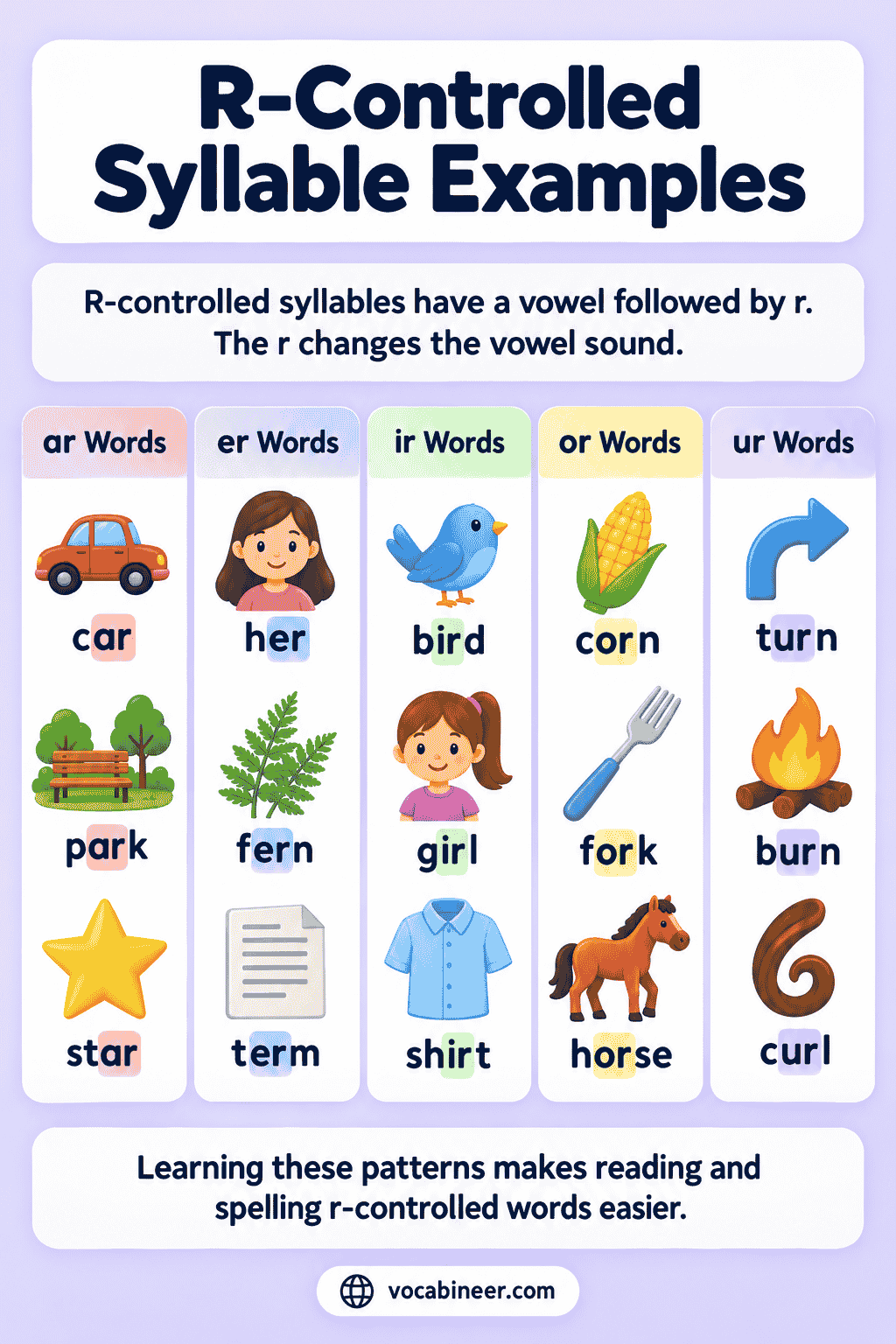
R-Controlled Vowels vs R-Controlled Syllables
An R-controlled vowel refers to the vowel spelling and sound affected by r.
An R-controlled syllable refers to the entire syllable containing that pattern.
For example:
car
- ar = R-controlled vowel pattern
- car = R-controlled syllable
Another example:
bird
- ir = R-controlled vowel pattern
- bird = R-controlled syllable
This distinction becomes especially useful when analyzing longer words.
R-Controlled Syllables in Multisyllabic Words
R-controlled syllables can also appear inside words with two or more syllables.
Recognizing the vowel-r pattern can make longer words easier to decode.
garden → gar / den
The first syllable, gar, contains the ar pattern.
market → mar / ket
The first syllable contains ar.
corner → cor / ner
The first syllable contains or, while the second includes an R-colored ending.
birthday → birth / day
The first syllable, birth, contains the ir pattern.
turkey → tur / key
The first syllable contains ur.
return → re / turn
The final syllable, turn, contains the ur pattern.
person → per / son
The first syllable contains er.
Recognizing these patterns inside longer words can help learners divide and pronounce multisyllabic vocabulary more confidently.
R-Controlled Syllables vs Closed Syllables
R-controlled syllables and closed syllables behave differently even though both may contain consonants after vowels.
| Closed Syllable | R-Controlled Syllable |
|---|---|
| cat | car |
| hen | her |
| bit | bird |
| hot | horn |
| cut | curl |
A closed syllable usually contains a short vowel followed by one or more consonants.
Examples:
cat
hen
bit
An R-controlled syllable contains a vowel followed directly by r, which changes the vowel sound.
Examples:
car
her
bird
The main difference is that r affects the vowel sound, so the vowel does not usually keep its normal short-vowel pronunciation.
Common Spelling and Pronunciation Challenges
R-controlled syllables are generally easy to recognize once learners know the five main patterns, but some words create extra difficulty.
ER, IR, and UR Spelling
These three spellings can sound alike.
Examples:
her
bird
turn
Because pronunciation alone may not reveal the correct spelling, repeated reading and spelling practice are helpful.
Accent Differences
R-controlled vowel pronunciation can vary across English accents.
In some accents, r is pronounced strongly after a vowel. In others, the r may be weaker or not pronounced in the same way.
The spelling patterns ar, er, ir, or, and ur remain useful for recognizing the words even when pronunciation differs.
Pattern Position
R-controlled patterns can appear at different places within words.
Examples:
start — pattern near the beginning
birthday — pattern in the first syllable
return — pattern in the final syllable
corner — R-controlled patterns occur across the word
This is why learners should examine syllables rather than only looking at the first or last letters of a word.
R-Controlled Syllable Examples With Pictures
Picture-based examples are especially helpful because learners can connect the spelling pattern with familiar objects, people, animals, or places.
Car — ar pattern
Car is a simple picture-friendly example of an R-controlled ar syllable.
Star — ar pattern
The word star contains the ar pattern.
Farm — ar pattern
Farm gives learners another familiar example of ar.
Shark — ar pattern
The ar in shark creates an R-controlled vowel sound.
Bird — ir pattern
Bird is an easy visual example of the ir pattern.
Shirt — ir pattern
The word shirt contains the R-controlled ir spelling.
Fork — or pattern
Fork is a clear picture example of the or pattern.
Corn — or pattern
The word corn contains an R-controlled or sound.
Horse — or pattern
Horse provides another familiar example of or.
Nurse — ur pattern
The word nurse contains the ur pattern.
Turtle — ur pattern
The first syllable of turtle begins with an R-controlled ur pattern.
Purple — ur pattern
The first syllable of purple also contains the ur pattern.
FAQs
An R-controlled syllable contains a vowel followed directly by r, which changes the vowel’s usual sound. Examples include car, bird, corn, and turn.
The five main R-controlled patterns are ar, er, ir, or, and ur. Examples include car, her, bird, corn, and turn.
The term bossy R is used because the letter r changes or controls the sound of the vowel before it. The vowel usually does not keep its normal short or long sound.
In many English accents, er, ir, and ur produce the same or a very similar R-colored vowel sound. This is why words such as her, bird, and turn can be difficult to spell correctly from sound alone.
Yes. R-controlled syllables appear in many multisyllabic words, including garden, market, birthday, person, and return. Recognizing the vowel-r pattern can make these words easier to decode.
Read More
- What is a Syllable?
- Closed syllable words
- Open syllable words
- Open and closed syllable words
- Multisyllabic Words List
- 1 syllable words
- 2 syllable words
- 3 syllable words
- 4 syllable words
- 5 syllable words
- Six syllable words