

VCe syllables are a common phonics pattern in which a vowel is followed by a consonant and a final silent e. In a typical VCe syllable, the final e is not pronounced, while the earlier vowel usually has its long sound, as in cake, bike, and home. This pattern is also commonly called magic e, silent e, or final e.
Learning VCe syllables helps readers recognize long-vowel patterns, decode unfamiliar words, improve spelling, and understand how syllables work in longer words. This guide explains the VCe pattern with clear examples, vowel-by-vowel word groups, multisyllabic words, comparisons, and common exceptions.
In This Page
What Is a VCe (Magic-E) Syllable?
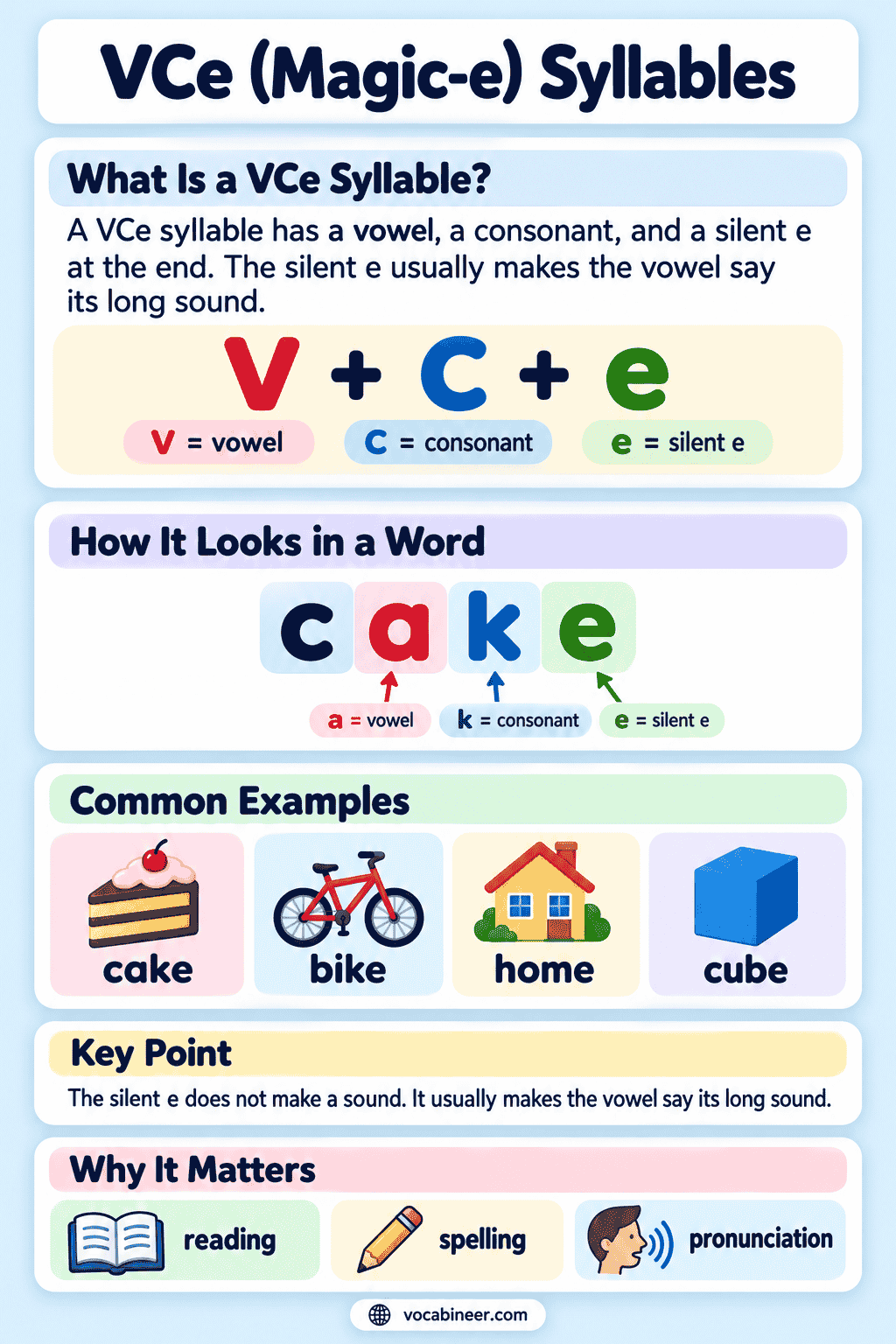
A VCe syllable follows the basic pattern vowel + consonant + final silent e.
The letters in VCe stand for:
- V = vowel
- C = consonant
- e = final silent e
For example:
cake → a + k + e
bike → i + k + e
home → o + m + e
cube → u + b + e
In each example, the first vowel is followed by a consonant and a final silent e. The final e usually signals that the earlier vowel has its long sound.
Why Are VCe Syllables Important?
Recognizing VCe syllables helps learners understand one of the most common long-vowel spelling patterns in English.
This knowledge can help with:
- recognizing long vowel sounds
- reading unfamiliar words
- distinguishing short and long vowels
- improving spelling
- dividing longer words into syllables
- decoding multisyllabic words
- recognizing common phonics patterns
For example, understanding the difference between cap and cape helps a learner see how the final silent e changes both the spelling pattern and vowel sound.
How the Vowel-Consonant-E Pattern Works
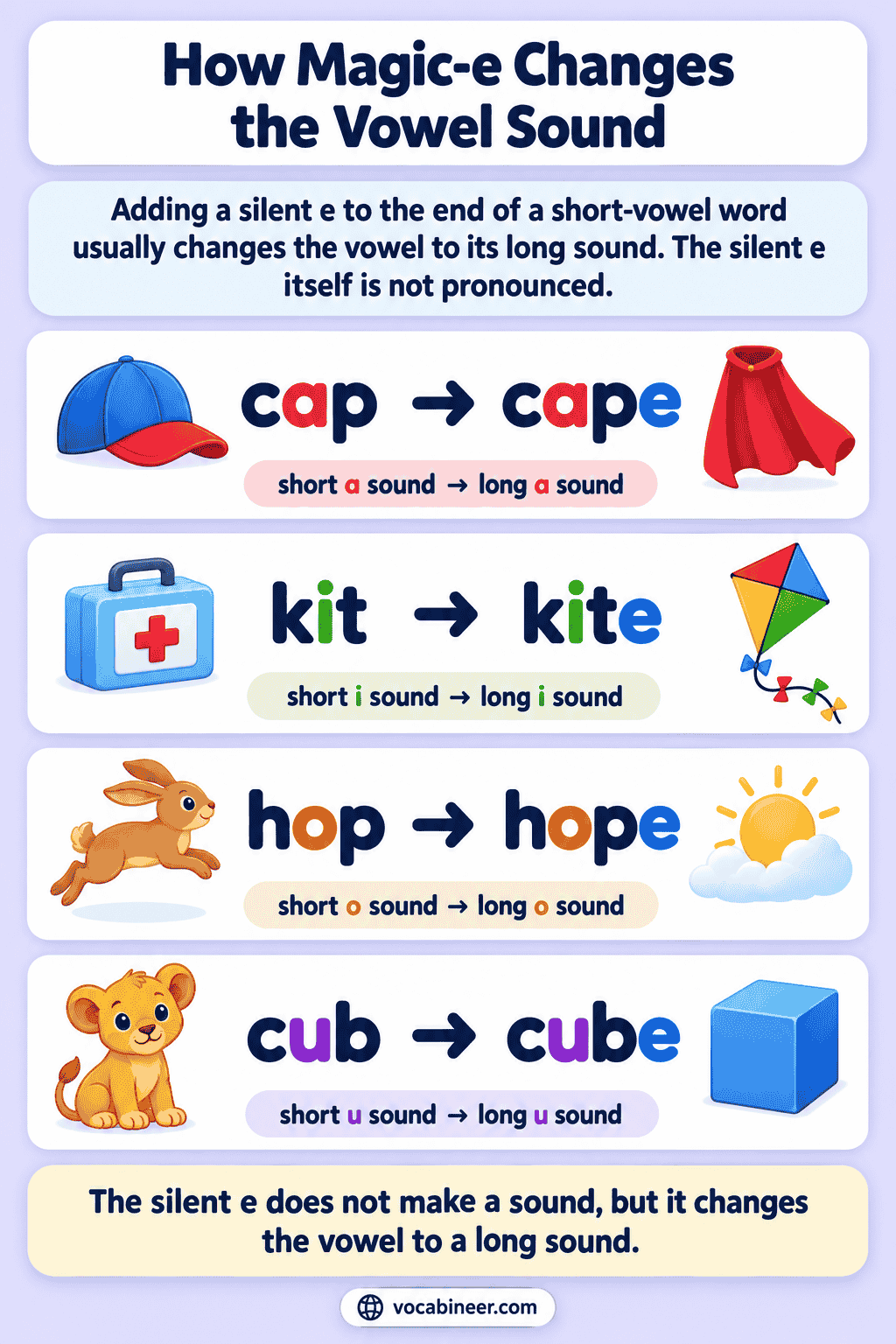
A short word without final e may contain a short vowel sound. When silent e is added, the earlier vowel often changes to its long sound.
| Short-Vowel Word | VCe Word | Sound Change |
|---|---|---|
| cap | cape | short a → long a |
| tap | tape | short a → long a |
| pin | pine | short i → long i |
| kit | kite | short i → long i |
| hop | hope | short o → long o |
| rob | robe | short o → long o |
| cub | cube | short u → long u |
The final e is generally silent. Its main job in these examples is to help signal a different vowel sound.
However, this is a common phonics pattern rather than an absolute rule. Some English words that look similar do not follow the usual pronunciation.
VCe Patterns With A, E, I, O, and U
VCe syllables can occur with several vowels. Some patterns are very common, while others appear less frequently.
A-E Pattern
The a-e pattern usually gives a its long sound.
Examples:
cake
name
game
gate
late
wave
plane
grape
snake
shape
E-E Pattern
The e-e pattern is less common than a-e, i-e, and o-e. It can appear in both short and longer words.
One-syllable examples include:
theme
these
In longer words, a similar VCe pattern may appear in syllables such as the final syllable of:
complete
Because e-e occurs less often, learners may encounter fewer simple examples of this pattern.
I-E Pattern
The i-e pattern usually gives i its long sound.
Examples:
bike
kite
five
time
ride
smile
slide
white
shine
drive
O-E Pattern
The o-e pattern usually gives o its long sound.
Examples:
home
hope
rope
note
bone
cone
stone
globe
joke
rose
U-E Pattern
The u-e pattern can have more than one pronunciation depending on the word and accent.
Examples include:
cube
cute
mule
tube
June
flute
In words such as cube and cute, the vowel may include a /y/ sound before the long-u sound. In some other words and accents, u-e may sound more like the vowel in tube or flute.
The important point is that final silent e forms part of the spelling pattern, even though pronunciation can vary.
Common VCe Syllable Examples
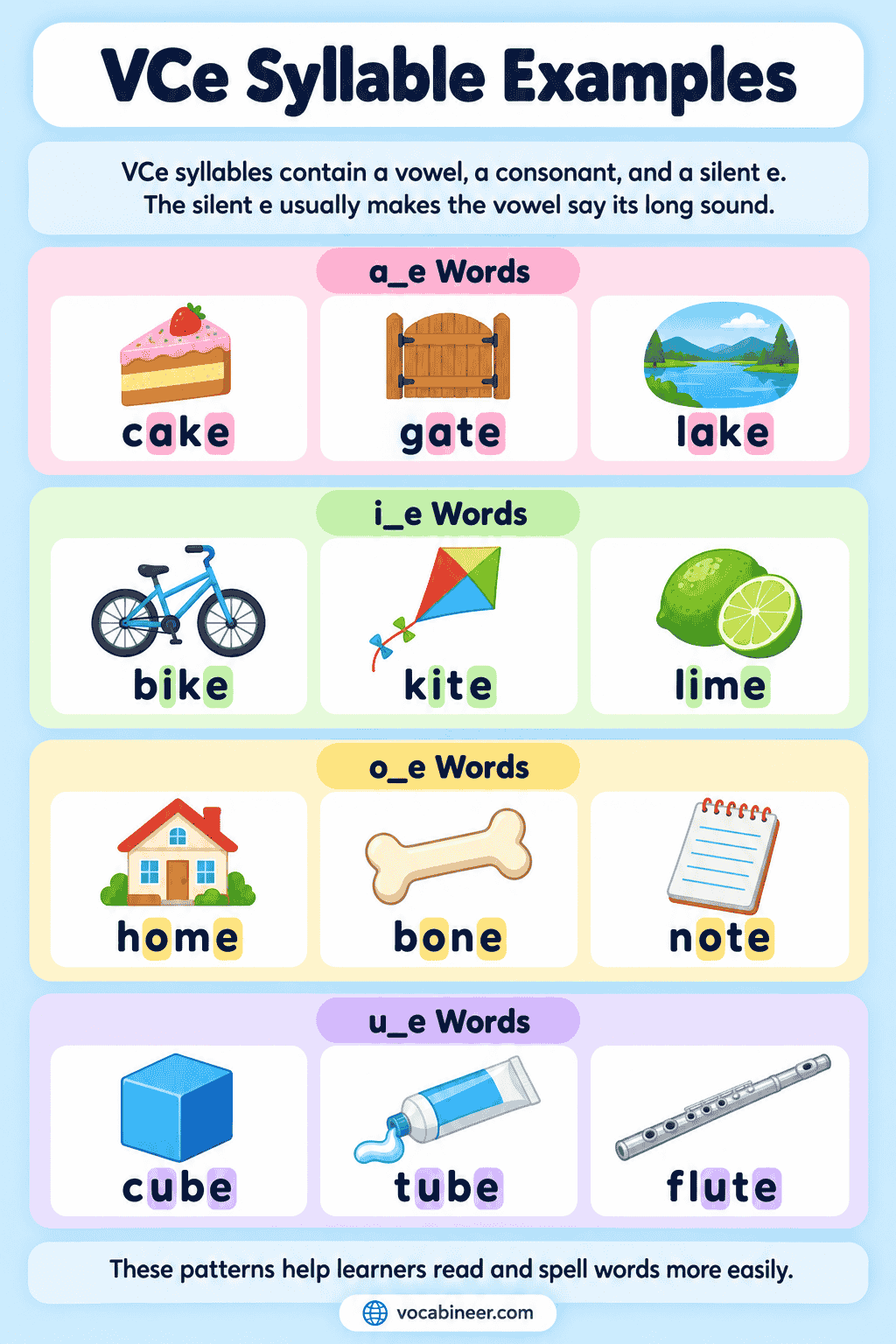
Here are some common examples organized by pattern.
| Word | Pattern | Vowel Sound |
|---|---|---|
| cake | a-e | long a |
| plane | a-e | long a |
| grape | a-e | long a |
| bike | i-e | long i |
| smile | i-e | long i |
| drive | i-e | long i |
| home | o-e | long o |
| stone | o-e | long o |
| globe | o-e | long o |
| cube | u-e | long u |
| mule | u-e | long u |
| flute | u-e | long u |
This type of grouping makes it easier to see the spelling pattern instead of memorizing each word separately.
How to Identify a VCe Syllable
A typical VCe syllable can be recognized by checking its spelling and pronunciation.
Look for:
- a vowel,
- a consonant after the vowel,
- a final silent e,
- a vowel sound that usually matches the long sound of the first vowel.
For example:
plane
- vowel: a
- consonant: n
- final silent letter: e
- vowel sound: long a
So plane follows the VCe pattern.
Another example:
stone
- vowel: o
- consonant: n
- final silent letter: e
- vowel sound: long o
The final e is silent, while the earlier vowel carries the main vowel sound.
Not every word ending in e is a VCe syllable, so learners should check the complete spelling pattern rather than looking only at the final letter.
VCe Words vs VCe Syllables
The terms VCe word and VCe syllable are related, but they do not always mean exactly the same thing.
A one-syllable word can consist entirely of a VCe syllable.
Examples:
cake
bike
home
cube
Longer words, however, can contain a VCe syllable as only one part of the word.
For example:
inside → in / side
The word has two syllables. The second syllable, side, follows the VCe pattern.
Similarly:
mistake → mis / take
The whole word is not one VCe syllable, but take is.
Understanding this difference becomes especially useful when learners begin reading longer words.
VCe Syllables in Multisyllabic Words
VCe syllables can appear at the beginning, middle, or end of longer words. Recognizing them can make multisyllabic words easier to decode.
mistake → mis / take
The final syllable take follows the a-e pattern.
inside → in / side
The second syllable side follows the i-e pattern.
invite → in / vite
The final syllable contains the i-e pattern.
tadpole → tad / pole
The second syllable pole follows the o-e pattern.
sunrise → sun / rise
The final syllable rise contains a long i sound.
complete → com / plete
The final syllable contains an e-consonant-e spelling pattern with a long e sound.
Looking for familiar syllable patterns inside longer words can make reading and spelling them easier.
VCe Syllables vs Closed Syllables
A closed syllable and a VCe syllable often differ in both spelling and vowel sound.
| Closed Syllable | VCe Syllable |
|---|---|
| mad | made |
| pin | pine |
| rid | ride |
| rob | robe |
| cut | cute |
A closed syllable usually ends in a consonant and contains a short vowel sound.
Examples:
mad
pin
rob
A VCe syllable usually ends with silent e, while the earlier vowel usually has its long sound.
Examples:
made
pine
robe
Recognizing the contrast between these two syllable types helps learners predict vowel pronunciation more accurately.
Words That Look Like VCe but Do Not Follow the Usual Pattern
The VCe rule is useful, but English contains important exceptions.
Some words have a vowel-consonant-e spelling but do not give the first vowel its expected long sound.
Have
The a in have does not have the long-a sound heard in cake.
Give
The i in give does not have the long-i sound heard in five.
Love
The o in love does not have the long-o sound heard in home.
Come
The vowel in come does not follow the regular o-e pronunciation found in home or stone.
Done
The o in done does not have the long-o sound expected from a regular o-e pattern.
These examples show why the VCe pattern should be taught as a common spelling pattern, not a rule without exceptions.
VCe Syllable Examples With Pictures
Picture-based examples can make VCe patterns easier to recognize and remember. Concrete words are especially useful because learners can connect the spelling with a familiar object or image.
Plane — a-e pattern
A plane provides a clear picture example of the long-a VCe pattern.
Grape — a-e pattern
The word grape contains the a-e pattern with a long a sound.
Snake — a-e pattern
Snake provides another familiar example of a long-a VCe word.
Bike — i-e pattern
The i in bike has its long sound.
Kite — i-e pattern
Kite is an easy picture word for recognizing the i-e pattern.
Smile — i-e pattern
The word smile contains a long i sound and final silent e.
Globe — o-e pattern
Globe follows the o-e pattern.
Cone — o-e pattern
The final e in cone is silent, while the o has its long sound.
Rose — o-e pattern
Rose is another picture-friendly example of the o-e pattern.
Cube — u-e pattern
Cube is a clear example of a u-e spelling pattern.
Mule — u-e pattern
The word mule contains the u-e pattern.
Flute — u-e pattern
Flute provides another useful u-e example for picture-based learning.
FAQs
VCe stands for vowel-consonant-e. It describes a syllable pattern in which a vowel is followed by a consonant and a final silent e, as in cake, bike, and home. The earlier vowel usually has its long sound.
VCe is often called magic e because adding a final silent e can change the vowel sound in a word. For example, cap becomes cape and hop becomes hope. The final e itself is usually not pronounced.
Common examples include cake, plane, bike, smile, home, stone, cube, mule, and flute. These words show several common VCe vowel patterns.
Yes. VCe syllables can appear inside multisyllabic words. For example, inside can be divided as in/side, while mistake can be divided as mis/take. In each word, one syllable follows the VCe pattern.
No. English contains exceptions such as have, give, love, come, and done. These words resemble the VCe spelling pattern but do not give the first vowel its usual long sound.
Read More
- What is a Syllable?
- Closed syllable words
- Open syllable words
- Open and closed syllable words
- Multisyllabic Words List
- 1 syllable words
- 2 syllable words
- 3 syllable words
- 4 syllable words
- 5 syllable words
- Six syllable words