

Diphthong syllables contain a vowel sound that glides from one sound toward another within the same syllable. Common examples include coin, boy, cloud, and cow. In phonics, diphthongs are usually taught as part of the broader vowel-team category because two or more letters work together to represent one moving vowel sound.
Learning diphthong syllables helps readers recognize common vowel patterns, improve pronunciation, spell words more accurately, and decode longer words. This guide explains the main oi, oy, ou, and ow patterns, how diphthongs work, where these spellings usually appear, and how they differ from other vowel teams.
In This Page
What Is a Diphthong Syllable?
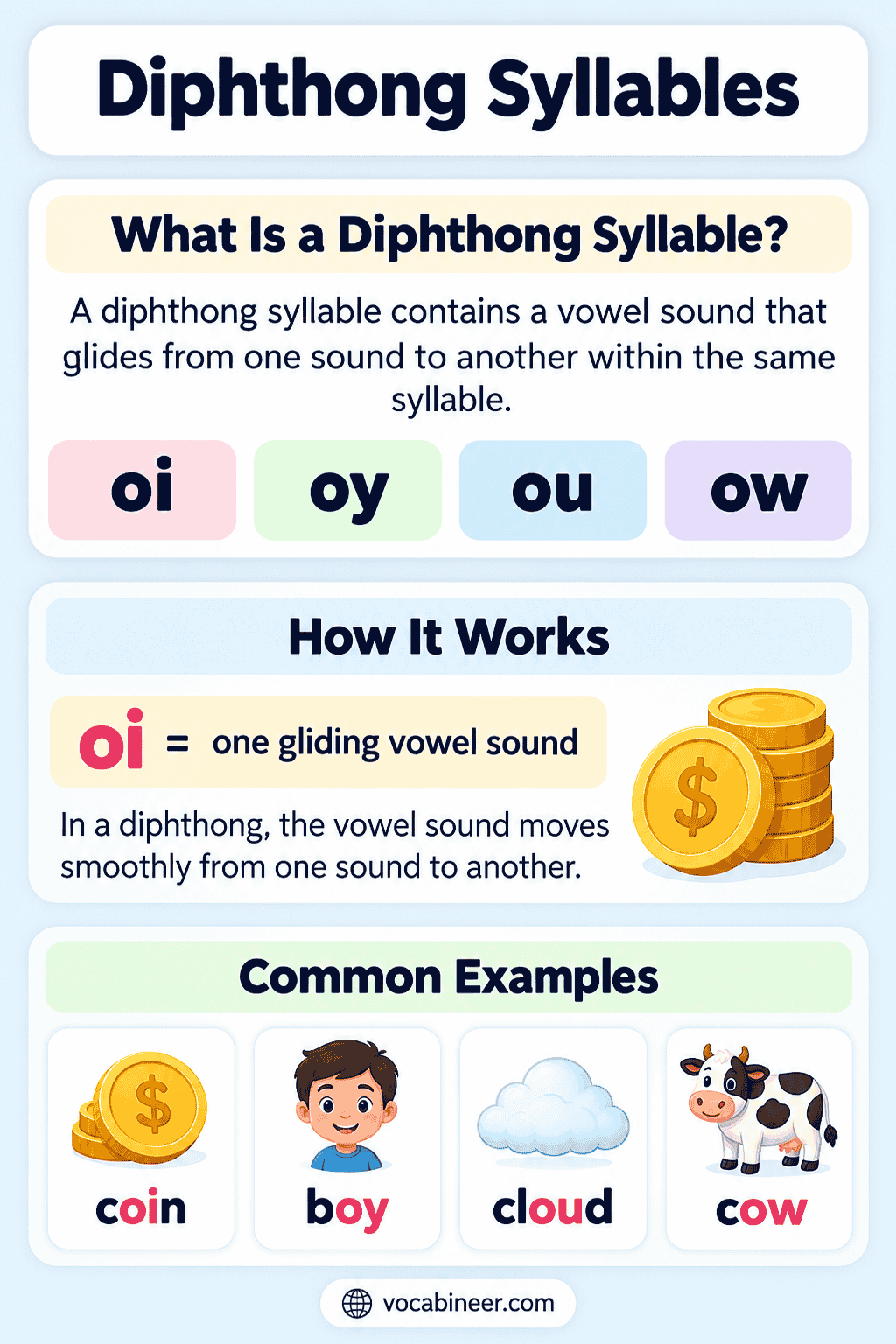
A diphthong syllable is a syllable that contains a vowel sound that changes or glides while it is being pronounced.
Examples include:
coin → oi
boy → oy
cloud → ou
cow → ow
In each word, the vowel sound moves from one position toward another, but the sound still belongs to a single syllable.
In many phonics programs, diphthongs are treated as a special type of vowel-team pattern rather than a completely separate basic syllable type.
Why Are Diphthongs Important?
Recognizing diphthongs helps learners understand why some vowel combinations do not produce a simple short or long vowel sound.
This knowledge supports:
- reading unfamiliar words
- recognizing common vowel patterns
- improving pronunciation
- choosing between similar spellings
- decoding multisyllabic words
- keeping vowel spellings together during syllable division
- distinguishing diphthongs from other vowel teams
For example, recognizing oi in coin helps a reader treat the letters as one vowel unit instead of pronouncing them separately.
How a Diphthong Sound Works
A diphthong differs from a steady vowel sound because the mouth position changes during pronunciation.
Consider:
coin
The vowel sound begins in one position and moves toward another. Even though the sound changes, it is pronounced continuously.
The same happens in:
boy
cloud
cow
This movement is often called a vowel glide.
By contrast, a vowel team such as ee in feet usually represents a more stable vowel sound.
Why a Diphthong Is Still One Syllable
A diphthong may contain two noticeable vowel qualities, but they are joined into one continuous sound within a single syllable.
For example:
coin = one syllable
boy = one syllable
cow = one syllable
cloud = one syllable
The sound glides rather than breaking into two separate syllables.
This distinction is important because learners may hear movement in the vowel and incorrectly assume that the word contains an extra syllable.
Common Diphthong Patterns and Examples
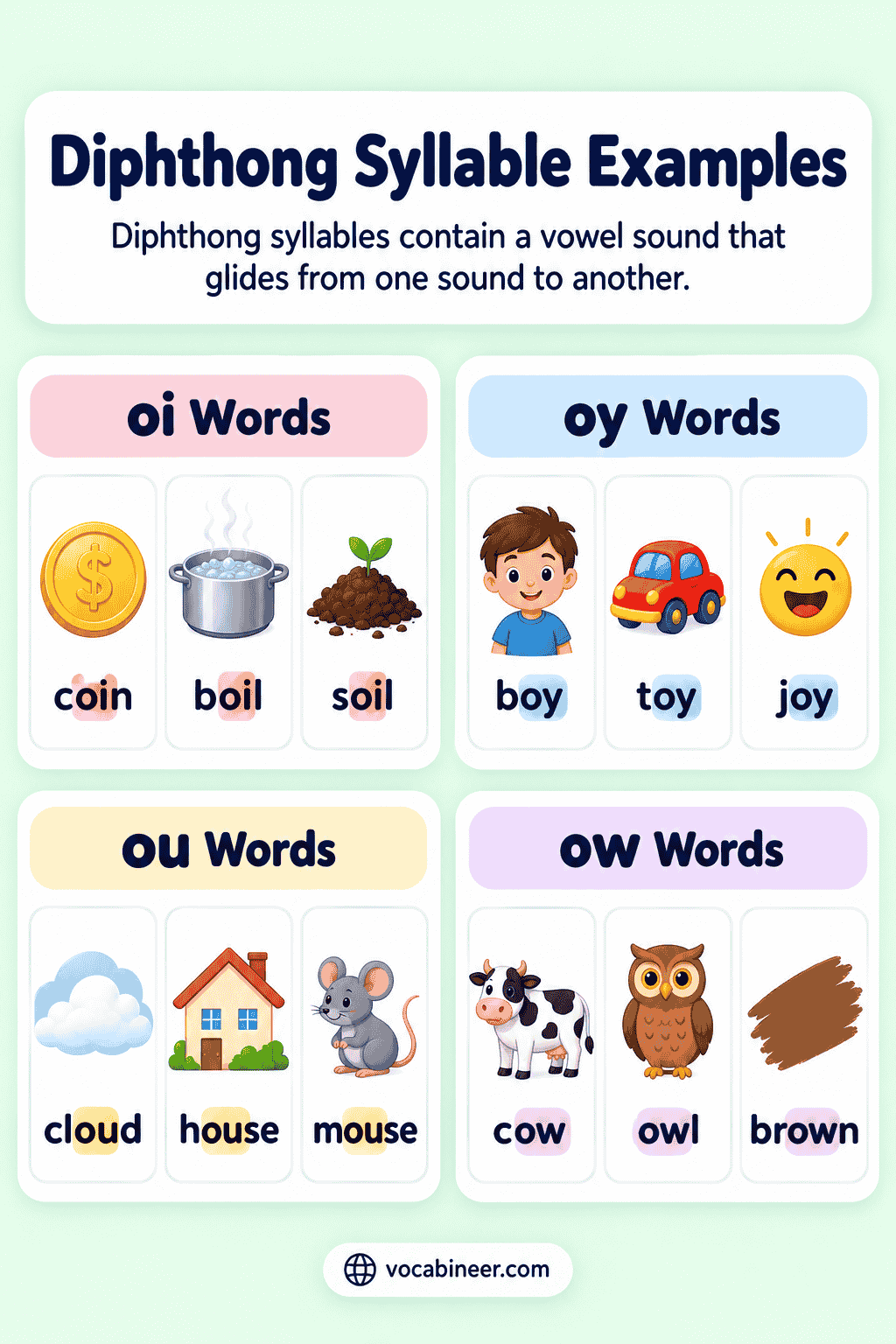
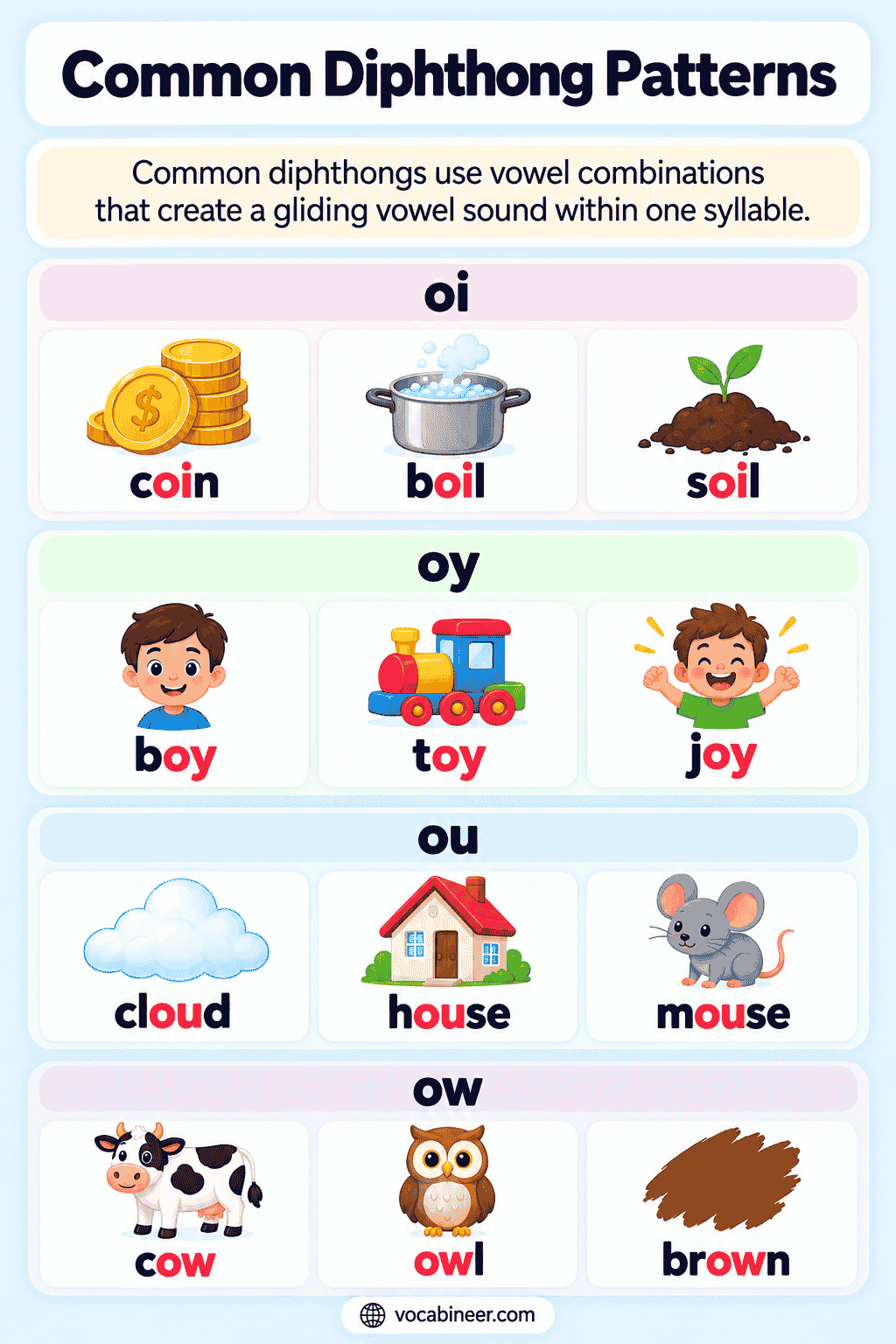
The most common diphthong spellings taught in basic phonics are oi, oy, ou, and ow.
OI Pattern
The spelling oi commonly represents the diphthong heard in coin.
Examples:
coin
oil
boil
soil
point
join
voice
choice
moist
spoil
The oi spelling commonly appears near the beginning or middle of a word or syllable.
OY Pattern
The spelling oy usually represents the same diphthong as oi.
Examples:
boy
toy
joy
soy
enjoy
royal
The oy spelling commonly appears at the end of a word or syllable.
OU Pattern
The spelling ou can represent the diphthong heard in out.
Examples:
out
cloud
house
round
sound
shout
mouse
ground
mouth
south
However, ou can represent several other vowel sounds, so it does not always function as this diphthong.
OW Pattern
The spelling ow can represent the diphthong heard in cow.
Examples:
cow
town
brown
clown
owl
crown
down
how
flower
towel
The ow spelling can also represent a long-o sound, as in snow and grow.
OI vs OY: Where Each Spelling Usually Appears
The patterns oi and oy commonly represent the same sound, but their positions often differ.
| Pattern | Common Position | Examples |
|---|---|---|
| oi | Beginning or middle | oil, coin, point |
| oy | End of word or syllable | boy, toy, enjoy |
Compare:
coin → oi inside the word
toy → oy at the end
This positional clue can help learners choose the correct spelling in many common words.
However, English spelling contains exceptions, so this should be treated as a useful pattern rather than an absolute rule.
OU vs OW: Common Spelling Patterns
The spellings ou and ow can both represent the /ow/-type diphthong.
Examples:
ou → cloud, house, round
ow → cow, town, brown
A useful spelling tendency is:
- ou often appears inside words
- ow often appears near the end of a word or before certain consonants
For example:
cloud
round
but:
cow
how
Because both spellings have exceptions, learners should also become familiar with the spelling of individual words.
Diphthongs vs Other Vowel Teams
Diphthongs and other vowel teams both use groups of letters to represent vowel sounds, but the sounds behave differently.
| Other Vowel Team | Diphthong |
|---|---|
| ee in feet | oi in coin |
| oa in boat | oy in toy |
| ai in rain | ou in cloud |
| ea in team | ow in cow |
An ordinary vowel team often represents a relatively steady vowel sound.
A diphthong contains a vowel sound that moves or glides during pronunciation.
Both can still form one vowel unit within a syllable.
When OW Is and Is Not a Diphthong
The spelling ow does not always represent the same sound.
Compare:
cow — diphthong
town — diphthong
brown — diphthong
with:
snow — long o
grow — long o
show — long o
This means learners should not assume that every ow spelling is a diphthong.
The whole word and its pronunciation determine which sound ow represents.
Why OU Can Have Different Sounds
The spelling ou is one of the less predictable vowel patterns in English.
Compare:
cloud — diphthong sound
soup — different vowel sound
young — different vowel sound
could — another vowel sound
Only some ou words use the diphthong heard in out.
This is why readers sometimes need to try more than one possible pronunciation when decoding an unfamiliar word containing ou.
How to Identify a Diphthong Syllable
A simple process can help learners recognize diphthong syllables.
- Find the main vowel spelling.
- Look for common diphthong patterns such as oi, oy, ou, or ow.
- Listen for a vowel sound that glides during pronunciation.
- Check that the glide stays within one syllable.
- Consider the whole word because ou and ow can also represent other sounds.
For example:
coin
- vowel spelling: oi
- sound: gliding diphthong
- syllables: one
- diphthong syllable: coin
Another example:
cloud
- vowel spelling: ou
- sound: /ow/-type diphthong
- syllables: one
- diphthong syllable: cloud
Diphthong Pattern vs Diphthong Syllable
A diphthong pattern refers to the letters that spell the diphthong.
A diphthong syllable refers to the complete syllable containing that pattern.
For example:
coin
- oi = diphthong spelling
- coin = diphthong syllable
In:
cow
- ow = diphthong spelling
- cow = diphthong syllable
This distinction makes it easier to discuss both spelling and syllable structure accurately.
Diphthongs in Multisyllabic Words
Diphthongs also appear inside longer words.
Recognizing them can help learners keep the vowel spelling together while dividing and decoding the word.
boiling → boil / ing
The first syllable contains the oi diphthong.
enjoy → en / joy
The final syllable contains the oy diphthong.
cowboy → cow / boy
Both syllables contain diphthong spellings.
outside → out / side
The first syllable contains the ou diphthong.
shouting → shout / ing
The first syllable contains ou.
pointing → point / ing
The first syllable contains oi.
Keeping the diphthong letters together makes these words easier to decode.
Common Spelling and Pronunciation Challenges
Diphthongs can be difficult because several spellings may represent similar sounds, while the same spelling may also represent different sounds.
Choosing Between OI and OY
Both spellings usually represent the same diphthong.
A useful clue is:
oi → often inside the word
oy → often at the end
Examples:
coin
point
but:
boy
toy
Choosing Between OU and OW
Both may represent the vowel sound heard in out.
Examples:
cloud
round
and:
cow
town
Because the position rule is less consistent than with oi/oy, word familiarity is especially important.
Reading OW Correctly
The spelling ow may have a diphthong sound:
cow
or a long-o sound:
snow
Readers need to use the entire word to choose the correct pronunciation.
Reading OU Correctly
The spelling ou has several possible pronunciations.
Compare:
cloud
soup
young
As a result, learners sometimes need to test different known sounds while decoding.
Diphthong Syllable Examples With Pictures
Picture-based examples can help learners connect diphthong spellings with familiar objects, animals, and ideas.
Coin — oi pattern
The oi in coin forms a diphthong.
Oil — oi pattern
The vowel sound in oil glides within one syllable.
Boy — oy pattern
The oy in boy represents the same common diphthong as oi.
Toy — oy pattern
Toy is an easy visual example of the oy spelling.
Cow — ow pattern
The ow in cow represents a diphthong.
Owl — ow pattern
Owl contains the same common ow glide.
Cloud — ou pattern
The ou in cloud represents the diphthong heard in out.
House — ou pattern
House provides another clear ou example.
Crown — ow pattern
The ow in crown forms a diphthong.
Clown — ow pattern
Clown is a familiar picture word containing ow.
Soil — oi pattern
The word soil contains the oi diphthong.
Point — oi pattern
The oi in point represents one gliding vowel sound.
FAQs
A diphthong syllable contains a vowel sound that glides from one sound toward another within the same syllable. Common examples include coin, boy, cloud, and cow.
The most common basic phonics spellings are oi, oy, ou, and ow. Examples include coin, toy, cloud, and cow.
Although the vowel sound moves during pronunciation, the movement happens continuously within one vowel unit. Words such as coin and cow therefore contain only one syllable.
Diphthongs are commonly taught within the vowel-team category. A regular vowel team may represent a steady vowel sound, while a diphthong contains a vowel sound that glides during pronunciation.
No. OW represents a diphthong in cow but a long-o sound in snow. OU also has several pronunciations, as seen in cloud, soup, and young.
Read More
- What is a Syllable?
- Closed syllable words
- Open syllable words
- Open and closed syllable words
- Multisyllabic Words List
- 1 syllable words
- 2 syllable words
- 3 syllable words
- 4 syllable words
- 5 syllable words
- Six syllable words