

Vowel team syllables contain a group of letters that work together to represent a vowel sound within one syllable. Common examples include rain, boat, feet, coin, and cow. Although many vowel teams contain two vowel letters, some spelling patterns also include letters such as y or w, as in day, toy, and snow.
Learning vowel team syllables helps readers recognize common vowel patterns, decode unfamiliar words, improve spelling, and read longer words more confidently. This guide explains common vowel teams, diphthongs, multiple pronunciations, multisyllabic examples, and ways to identify these patterns.
In This Page
What Is a Vowel Team Syllable?
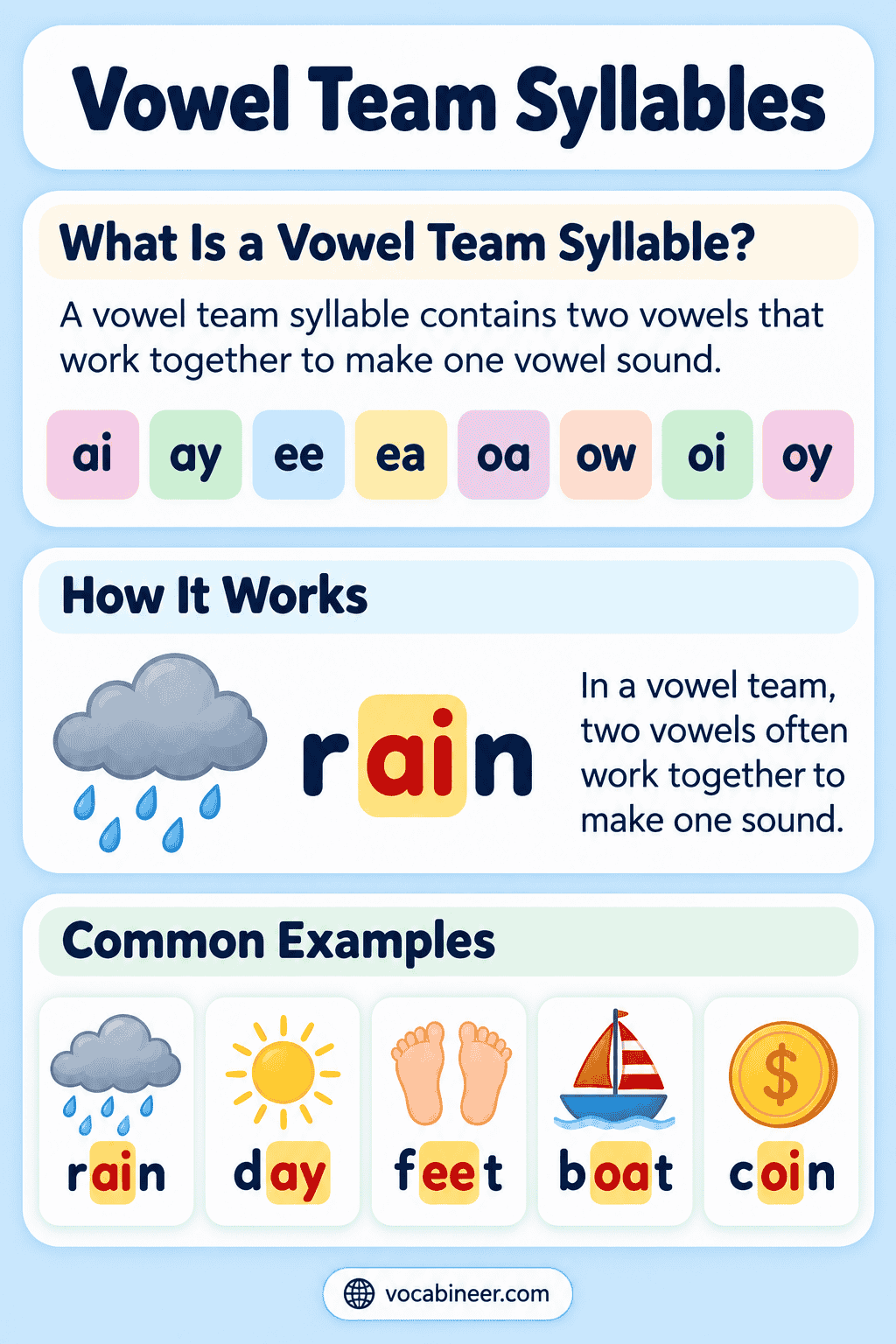
A vowel team syllable contains a group of letters that work together to spell the main vowel sound in that syllable.
For example:
rain → ai
feet → ee
boat → oa
coin → oi
toy → oy
In each word, the highlighted letter group represents one vowel sound within the syllable.
A vowel team should not simply be defined as “two vowels together.” Some vowel spellings include y, w, or more than two letters, such as:
ay → day
ow → snow
oy → toy
igh → light
The exact groups included under the term vowel team can vary slightly between phonics programs, but the main idea is that the letters work together to represent a vowel sound.
Why Are Vowel Team Syllables Important?
Recognizing vowel teams helps learners connect common spelling patterns with their sounds.
This knowledge supports:
- decoding unfamiliar words
- recognizing long-vowel patterns
- reading diphthongs
- improving spelling
- dividing longer words into syllables
- keeping vowel spellings together while decoding
- understanding why the same vowel sound can have different spellings
For example, recognizing ai as a unit in rain prevents a reader from trying to pronounce a and i separately.
How Vowel Teams Work
Vowel teams work as spelling units. Two or more letters combine to represent the main vowel sound in a syllable.
Consider:
boat
The letters oa work together to represent the long o sound.
In:
coin
The letters oi work together to represent a diphthong.
And in:
cow
The letters ow combine to represent the vowel sound heard in the word.
Vowel teams do not all produce long vowel sounds. Depending on the spelling and word, they may represent a long vowel, another vowel sound, or a diphthong.
Common Vowel Team Patterns and Examples
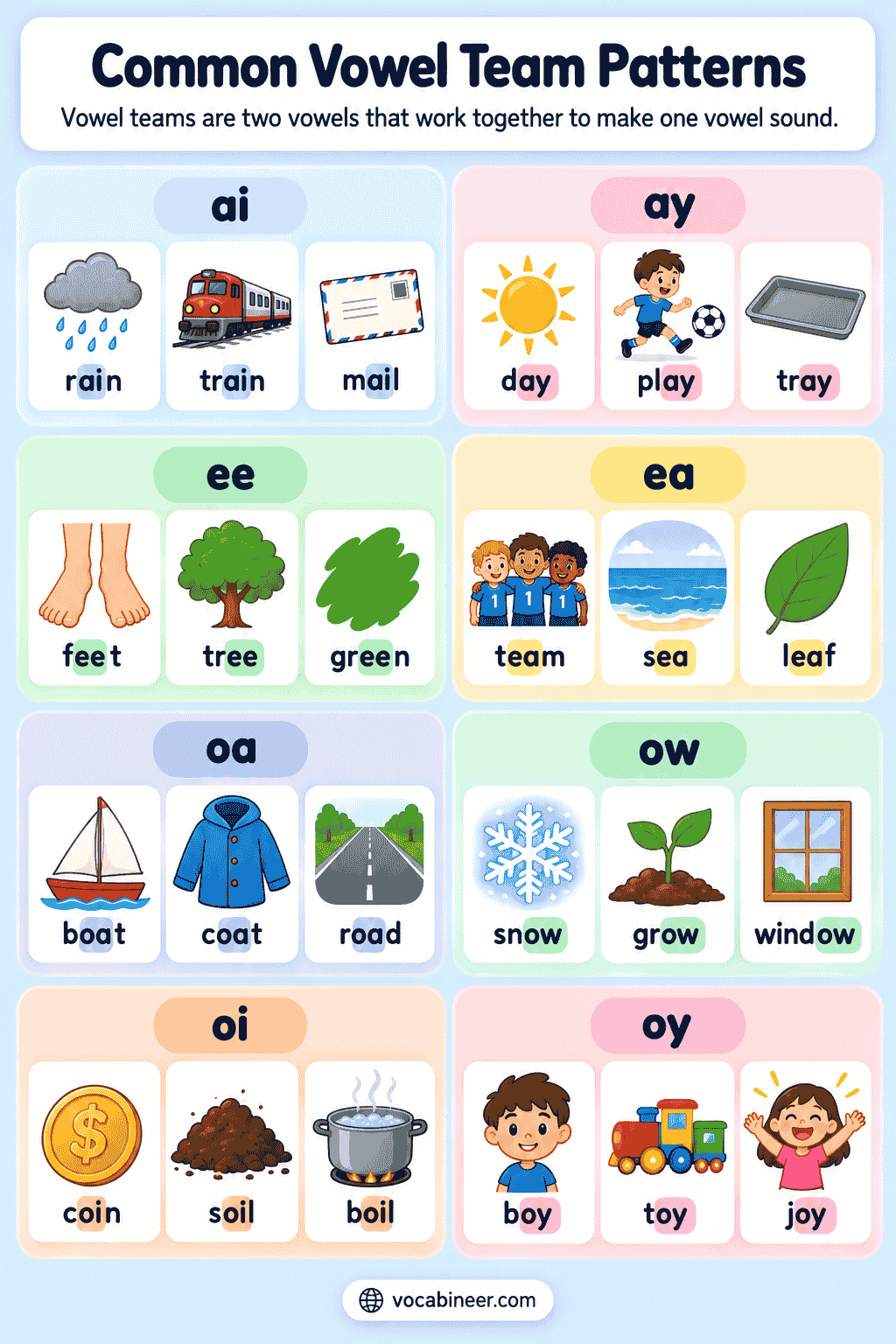
English contains many vowel-team spelling patterns. The following groups are especially useful for beginning and developing readers.
AI and AY
Both ai and ay commonly represent the long a sound.
AI examples:
rain
train
mail
paint
tail
snail
AY examples:
day
play
stay
tray
gray
clay
A useful spelling pattern is that ai commonly appears inside a word or syllable, while ay often appears at the end.
EE and EA
Both ee and ea commonly represent the long e sound.
EE examples:
tree
feet
green
seed
sheep
sleep
EA examples:
sea
team
leaf
beach
clean
read
However, ea does not always make the long-e sound. Words such as bread and head show another pronunciation.
OA and OE
The spellings oa and oe can represent the long o sound.
OA examples:
boat
road
coat
goat
soap
float
OE examples:
toe
hoe
doe
The oa pattern appears more frequently than oe in common vocabulary.
IE and IGH
Several spelling patterns can represent the long i sound.
IE examples:
pie
tie
lie
IGH examples:
high
light
night
right
bright
sight
The spelling igh shows why a vowel sound is not always represented by only two vowel letters.
OI and OY
The patterns oi and oy commonly represent the same diphthong.
OI examples:
coin
soil
boil
point
join
oil
OY examples:
boy
toy
joy
soy
A useful spelling clue is that oi commonly appears inside words, while oy often appears at the end.
OU and OW
The patterns ou and ow can represent the vowel sound heard in words such as cloud and cow.
OU examples:
out
cloud
house
round
sound
mouse
OW examples:
cow
town
brown
owl
clown
However, ow can also represent the long-o sound, as in snow and grow.
AU and AW
The patterns au and aw often represent a similar vowel sound.
AU examples:
author
August
cause
pause
haunt
AW examples:
saw
draw
claw
straw
yawn
These spellings are especially useful for recognizing words with the broad vowel sound commonly heard in saw.
OO
The spelling oo is common, but it does not always have the same pronunciation.
Examples with the sound in moon include:
moon
food
room
spoon
boot
Examples with the sound in book include:
book
foot
look
cook
wood
Because oo can represent different sounds, readers need to consider the whole word.
What Sounds Can Vowel Teams Make?
Vowel teams do not represent only long vowels.
They can represent several types of vowel sounds.
| Type | Pattern | Example |
|---|---|---|
| Long vowel | ai | rain |
| Long vowel | ee | feet |
| Long vowel | oa | boat |
| Long vowel | igh | light |
| Diphthong | oi | coin |
| Diphthong | oy | toy |
| Diphthong | ou | cloud |
| Diphthong | ow | cow |
| Other vowel sound | ea | bread |
| Other vowel sound | oo | book |
This is why learning individual vowel patterns is more useful than relying on the idea that vowel teams always make a long sound.
Vowel Teams and Diphthongs
A diphthong is a vowel sound in which the pronunciation glides from one vowel position toward another within the same syllable.
Common diphthong spellings include:
oi → coin
oy → toy
ou → cloud
ow → cow
Diphthongs are commonly taught alongside vowel teams because several letters work together to represent a single vowel unit within the syllable.
However, not every vowel team is a diphthong.
For example:
ai in rain
ee in feet
oa in boat
These patterns represent comparatively steady vowel sounds rather than the glide heard in coin or cow.
Vowel Teams That Can Make More Than One Sound
Some vowel spellings are less predictable because they can represent different sounds in different words.
EA
team — long e
bread — different vowel sound
steak — another pronunciation
OO
moon — sound in food
book — sound in foot
OW
snow — long o
cow — diphthong
OU
cloud — sound in out
soup — different vowel sound
young — another vowel sound
These variations are an important reason readers cannot always determine pronunciation from the vowel-team spelling alone.
Different Vowel Teams That Can Make the Same Sound
English often uses more than one spelling for the same or a similar vowel sound.
| Vowel Sound | Spelling | Example |
|---|---|---|
| Long a | ai | rain |
| Long a | ay | play |
| Long e | ee | feet |
| Long e | ea | team |
| Long o | oa | boat |
| Long o | ow | snow |
| Diphthong /oi/ | oi | coin |
| Diphthong /oi/ | oy | toy |
Recognizing these spelling alternatives can improve both reading and spelling.
How to Identify a Vowel Team Syllable
A simple process can help learners recognize vowel-team syllables.
- Find the letters representing the main vowel sound.
- Check whether two or more letters work together as one vowel spelling.
- Keep the vowel-team spelling together within the syllable.
- Try the common sound associated with that pattern.
- If the word does not sound correct, consider another pronunciation the team can represent.
For example:
boat
- vowel spelling: oa
- letters working together: o + a
- sound: long o
- vowel team syllable: boat
Another example:
coin
- vowel spelling: oi
- letters working together: o + i
- sound: /oi/
- vowel team syllable: coin
This method becomes especially useful when reading unfamiliar or multisyllabic words.
Vowel Teams vs Vowel Team Syllables
A vowel team refers to the group of letters representing the vowel sound.
A vowel team syllable refers to the complete syllable containing that spelling.
For example:
rain
- ai = vowel team
- rain = vowel team syllable
In:
boat
- oa = vowel team
- boat = vowel team syllable
This distinction helps learners talk more precisely about spelling patterns and syllable structure.
Vowel Teams vs Separate Vowels
Two vowel letters next to each other do not always have to function as one vowel team.
The important question is whether the letters work together to represent the vowel sound in the syllable.
In:
boat
oa works together as one vowel spelling.
In words where neighboring vowels belong to separate syllables or represent separate sounds, they should not automatically be treated as one vowel team.
Therefore, learners should identify the sound and syllable structure rather than simply grouping every pair of vowel letters.
Vowel Team Syllables in Multisyllabic Words
Vowel teams also appear in longer words.
Recognizing them can help readers divide and decode multisyllabic vocabulary.
rainbow → rain / bow
The first syllable contains ai.
teacher → teach / er
The first syllable contains ea.
season → sea / son
The first syllable contains ea.
floating → float / ing
The first syllable contains oa.
boiling → boil / ing
The first syllable contains oi.
refrain → re / frain
The final syllable contains ai.
Keeping the vowel-team letters together while dividing longer words can make decoding easier.
Vowel Team Syllables vs VCe Syllables
Vowel team and VCe syllables can both contain long vowel sounds, but their spelling structures differ.
| Vowel Team Syllable | VCe Syllable |
|---|---|
| rain | plane |
| boat | home |
| feet | theme |
| road | rode |
| male |
In a vowel team syllable, a group of letters works together to spell the vowel sound.
For example:
rain → ai
boat → oa
In a VCe syllable, the typical pattern is:
vowel + consonant + silent e
For example:
plane → a + n + e
home → o + m + e
Recognizing the spelling structure helps distinguish these two syllable types.
Common Spelling and Pronunciation Challenges
Vowel teams can be difficult because English does not always use one spelling for one sound.
Choosing Between AI and AY
Both commonly represent long a, but their positions often differ.
ai commonly appears inside a word:
rain
train
paint
ay commonly appears at the end:
day
play
stay
Choosing Between OI and OY
A similar pattern occurs with oi and oy.
oi commonly appears inside:
coin
point
soil
oy commonly appears at the end:
boy
toy
joy
Reading OO
The spelling oo can represent different sounds.
Compare:
moon
book
Learners need to recognize both common pronunciations.
Reading OW
The spelling ow may represent:
long o → snow
diphthong → cow
The surrounding word helps determine the correct pronunciation.
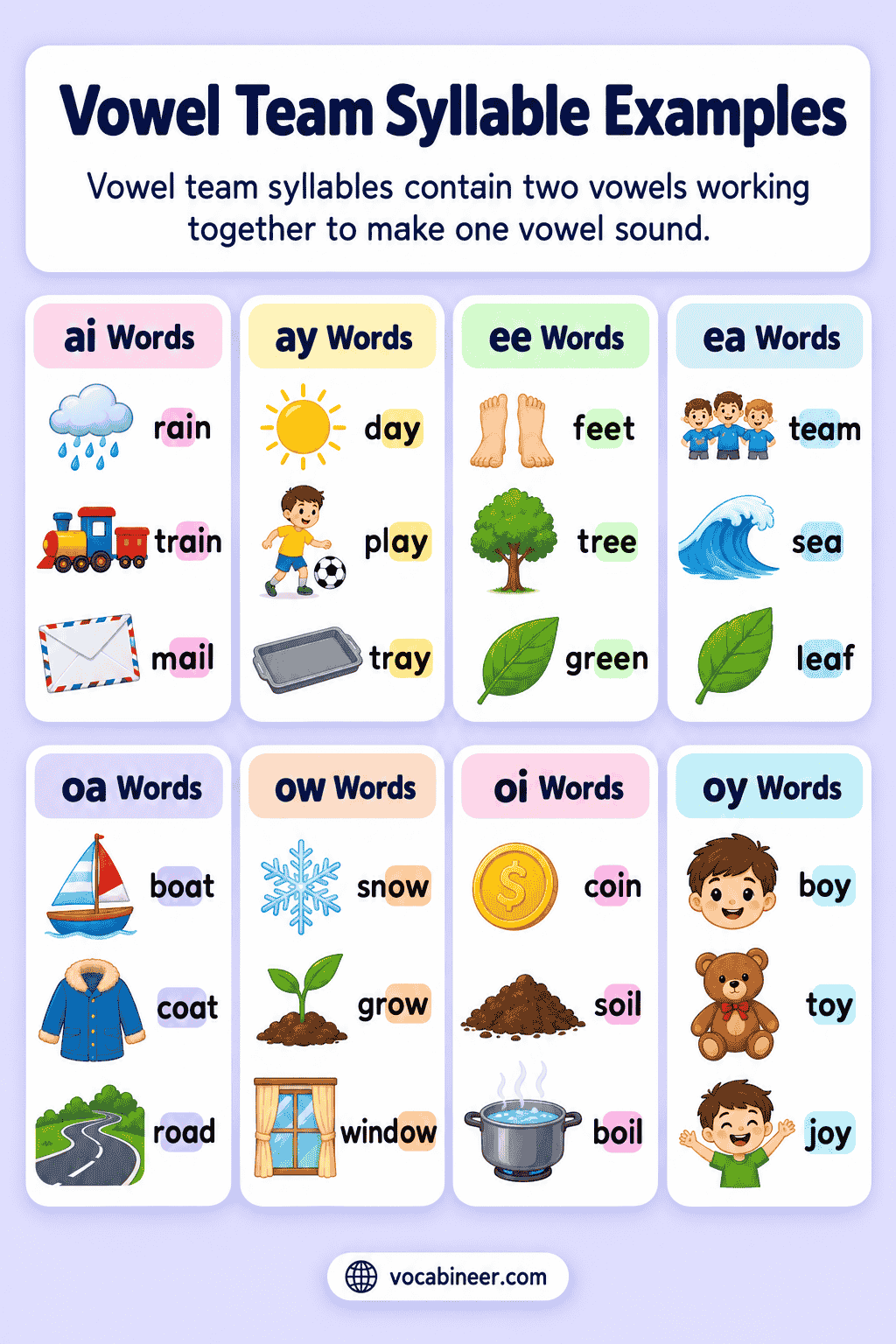
Vowel Team Syllable Examples With Pictures
Picture-friendly words can help learners connect vowel spellings with familiar objects and ideas.
Rain — ai pattern
The ai in rain represents the long-a sound.
Tree — ee pattern
The ee in tree represents the long-e sound.
Boat — oa pattern
The oa in boat represents the long-o sound.
Pie — ie pattern
The ie in pie represents the long-i sound.
Moon — oo pattern
The oo in moon represents one of the common oo sounds.
Book — oo pattern
The oo in book represents a different sound from the one in moon.
Coin — oi pattern
The oi in coin represents a diphthong.
Toy — oy pattern
The oy in toy represents the same common diphthong heard in coin.
Cow — ow pattern
The ow in cow represents a diphthong.
Snow — ow pattern
The ow in snow represents the long-o sound.
Feet — ee pattern
The ee in feet represents the long-e sound.
Straw — aw pattern
The aw in straw represents a common vowel-team spelling.
FAQs
A vowel team syllable contains a group of letters that work together to represent a vowel sound within one syllable. Examples include rain, feet, boat, coin, and cow.
Common patterns include ai, ay, ee, ea, oa, oe, ie, igh, oi, oy, ou, ow, au, aw, and oo. Some represent long vowels, while others represent diphthongs or additional vowel sounds.
No. Some vowel teams represent long vowels, but others make diphthongs or different vowel sounds. For example, oi in coin is a diphthong, while ea sounds different in team and bread.
Yes. Several vowel teams have more than one pronunciation. For example, ow sounds different in snow and cow, while oo differs in moon and book.
Yes. Vowel team syllables appear in longer words such as rainbow, teacher, season, floating, boiling, and refrain. Recognizing the vowel team helps readers divide and decode these words.
Read More
- What is a Syllable?
- Closed syllable words
- Open syllable words
- Open and closed syllable words
- Multisyllabic Words List
- 1 syllable words
- 2 syllable words
- 3 syllable words
- 4 syllable words
- 5 syllable words
- Six syllable words