

Consonant-le syllables are final syllables that usually contain a consonant followed by l and silent e. They appear at the end of multisyllabic words such as table, little, candle, and purple. In these words, the final e is silent, while the consonant + le forms a stable final syllable.
Learning consonant-le syllables helps readers divide longer words, recognize common endings, improve spelling, and decode multisyllabic words more accurately. This guide explains how consonant-le syllables sound, how to divide them, how doubled consonants work, and how this syllable type differs from other patterns.
In This Page
What Is a Consonant-le Syllable?
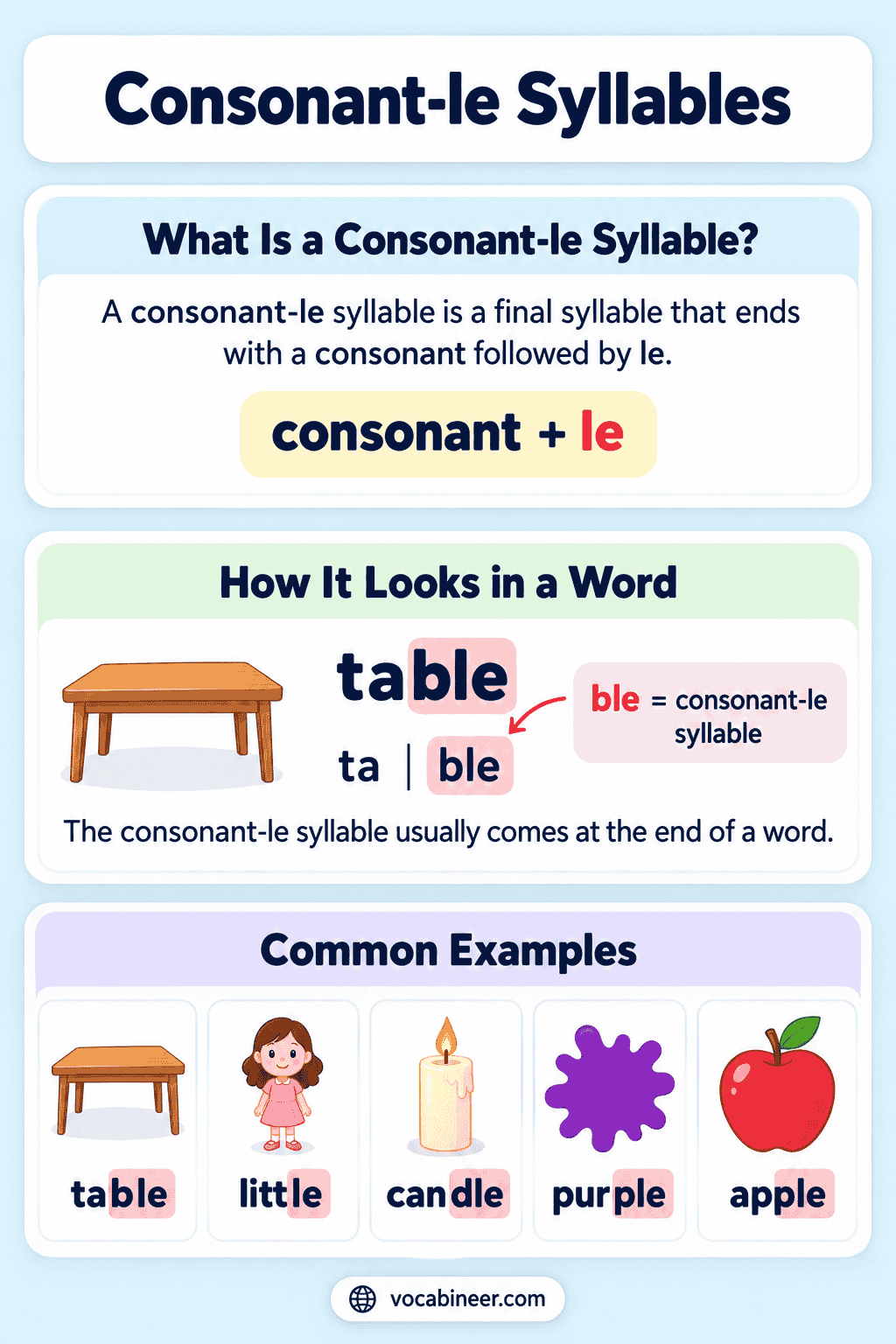
A consonant-le syllable is a final syllable made of a consonant followed by l and silent e.
Examples:
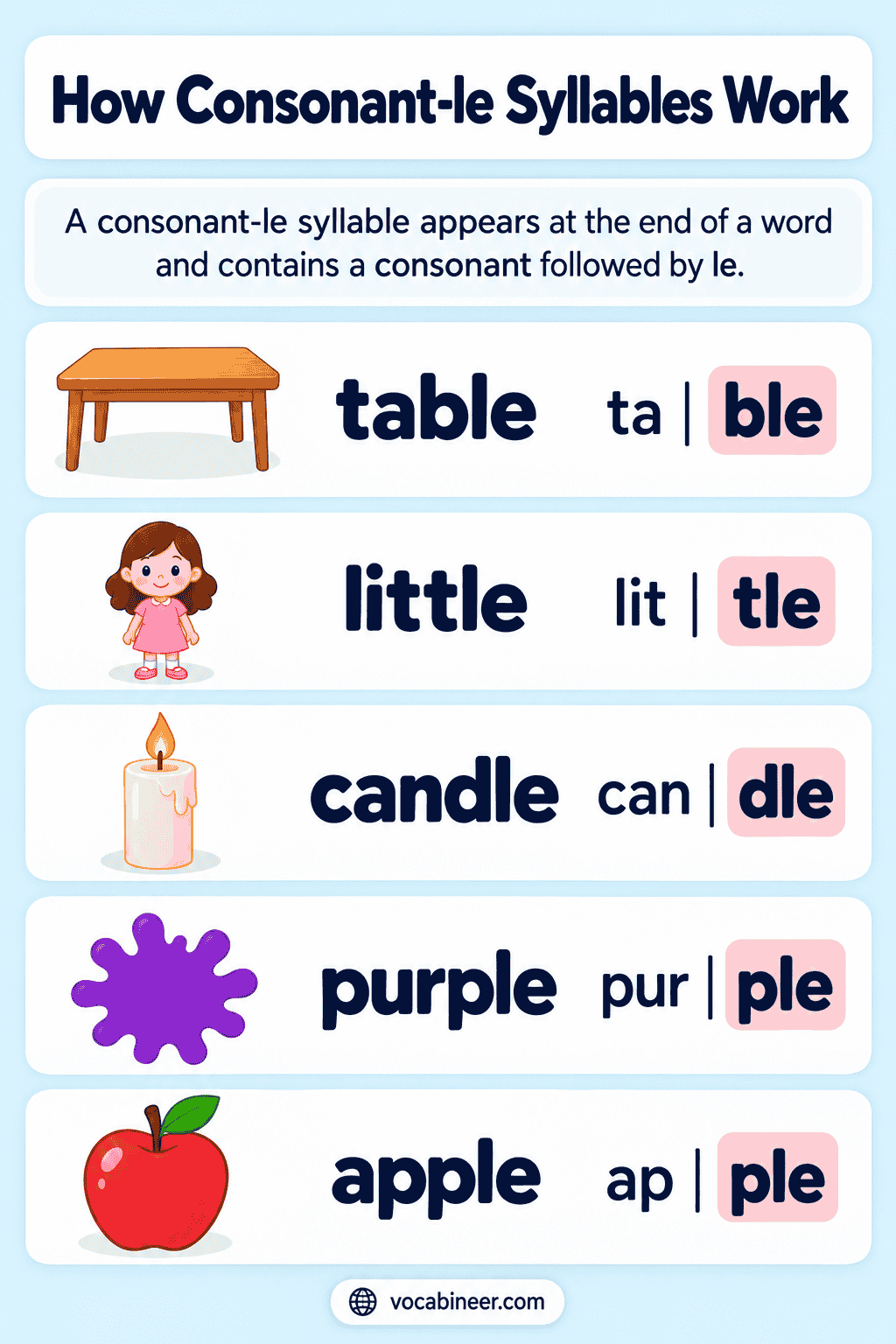
table → ta / ble
little → lit / tle
candle → can / dle
purple → pur / ple
In each word, the final consonant + le forms its own syllable.
For example:
table
- whole word: table
- syllables: ta / ble
- consonant-le syllable: ble
Consonant-le syllables appear at the end of multisyllabic words rather than standing alone as separate words.
They are also called stable final syllables in some phonics programs.
Why Are Consonant-le Syllables Important?
Consonant-le syllables are useful because they provide a predictable ending pattern in many longer English words.
Recognizing them can help learners:
- divide multisyllabic words
- decode unfamiliar vocabulary
- read word endings more accurately
- understand silent e
- improve spelling
- recognize doubled consonants
- connect consonant-le endings with other syllable types
For example, identifying -tle in little makes it easier to divide the word as lit / tle.
How Consonant-le Syllables Sound
The final -le in a consonant-le syllable is usually unstressed.
It often produces a weak sound similar to /əl/.
Examples include:
table
apple
little
candle
purple
The final e is silent, but the consonant + le still forms a separate syllable.
For example:
apple → ap / ple
The final syllable is not pronounced as separate letter sounds. Instead, ple forms one weak final syllable.
Common Consonant-le Patterns and Examples
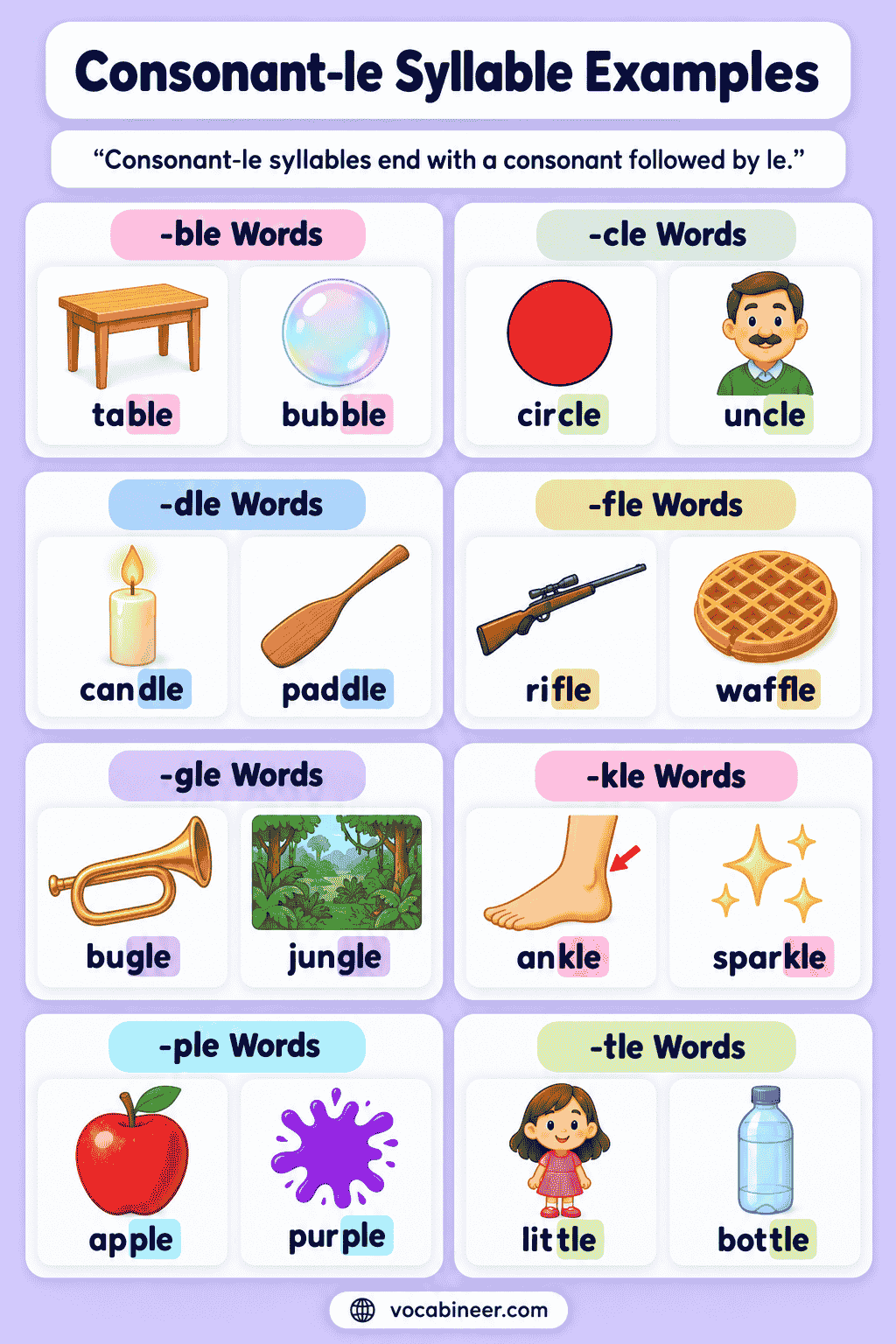
Several consonants commonly appear before -le.
-BLE
Examples:
table
cable
bubble
marble
double
noble
In these words, the final -ble forms the consonant-le syllable.
-DLE
Examples:
candle
handle
middle
cradle
paddle
bundle
The final -dle forms the last syllable.
-FLE
Examples:
rifle
waffle
trifle
shuffle
The ending -fle appears less often than some other consonant-le patterns.
-GLE
Examples:
bugle
giggle
eagle
juggle
wiggle
In each word, the final -gle forms a separate syllable.
-KLE
Examples:
pickle
ankle
sparkle
buckle
tackle
The ending -kle commonly appears in familiar multisyllabic words.
-PLE
Examples:
apple
simple
purple
staple
sample
people
The -ple ending forms the final syllable.
-TLE
Examples:
little
bottle
title
turtle
battle
kettle
The final -tle is one of the most familiar consonant-le patterns.
-CLE
Examples:
uncle
circle
bicycle
article
vehicle
The final -cle forms the last syllable in these words.
How to Identify a Consonant-le Syllable
A consonant-le syllable is usually easy to recognize once you know where to look.
Follow these steps:
- Look at the end of the word.
- Check for a consonant followed by l + e.
- Make sure the final e is silent.
- Keep the consonant + le together as the final syllable.
- Divide the word before that final syllable.
For example:
candle
The ending is dle.
So:
can / dle
Another example:
maple
The ending is ple.
So:
ma / ple
How to Divide Consonant-le Words Into Syllables
A common strategy for dividing consonant-le words is known as count back three.
Start at the final e, count back three letters, and divide before the consonant-le syllable.
For example:
table
Count back from the final e:
e → l → b
Divide before b:
ta / ble
Another example:
little
Count back:
e → l → t
Divide before the final t:
lit / tle
More examples:
purple → pur / ple
marble → mar / ble
pickle → pic / kle
candle → can / dle
bottle → bot / tle
This strategy works well for many common consonant-le words.
Consonant-le Pattern vs Consonant-le Syllable
The consonant-le pattern refers to the ending itself.
The consonant-le syllable refers to the complete final syllable containing that pattern.
For example:
table → ta / ble
- -ble = consonant-le pattern
- ble = consonant-le syllable
- table = complete word
Another example:
little → lit / tle
- -tle = consonant-le pattern
- tle = consonant-le syllable
- little = complete word
This distinction is useful when discussing spelling and syllable division.
Consonant-le After Open and Closed Syllables
The syllable before a consonant-le ending may be open or closed.
Open Syllable + Consonant-le
An open syllable usually ends in a vowel and often has a long vowel sound.
Examples:
| Word | Division | First Syllable | Final Syllable |
|---|---|---|---|
| table | ta / ble | open | ble |
| cable | ca / ble | open | ble |
| title | ti / tle | open | tle |
| bugle | bu / gle | open | gle |
| staple | sta / ple | open | ple |
Closed Syllable + Consonant-le
A closed syllable ends in a consonant and usually contains a short vowel.
Examples:
| Word | Division | First Syllable | Final Syllable |
|---|---|---|---|
| little | lit / tle | closed | tle |
| dabble | dab / ble | closed | ble |
| topple | top / ple | closed | ple |
| middle | mid / dle | closed | dle |
| pickle | pic / kle | closed | kle |
Recognizing the first syllable helps learners understand both pronunciation and spelling.
Why Some Consonant-le Words Double the Consonant
Some consonant-le words contain a doubled consonant before -le, while others do not.
Compare:
cable
title
bugle
with:
dabble
little
topple
The doubled consonant often helps keep the earlier syllable closed, which supports a short vowel sound.
For example:
dabble → dab / ble
The first syllable dab is closed and contains a short a sound.
Similarly:
little → lit / tle
The first syllable lit remains closed because of the doubled t.
By contrast:
cable → ca / ble
The first syllable ca is open, so the consonant is not doubled.
Consonant-le With Other Syllable Types
A consonant-le syllable often appears after another syllable type.
| Word | Earlier Syllable Type | Final Consonant-le Syllable |
|---|---|---|
| table | open | ble |
| little | closed | tle |
| purple | R-controlled | ple |
| needle | vowel team | dle |
| turtle | R-controlled | tle |
| sparkle | R-controlled | kle |
This shows how consonant-le syllables combine with other phonics patterns in longer words.
Understanding both syllables can make a word easier to decode.
Consonant-le Syllables in Multisyllabic Words
Consonant-le syllables always appear as part of longer words.
Examples include:
table → ta / ble
The final syllable is ble.
candle → can / dle
The final syllable is dle.
pickle → pic / kle
The final syllable is kle.
marble → mar / ble
The first syllable is R-controlled, while ble is consonant-le.
simple → sim / ple
The final ple forms the consonant-le syllable.
turtle → tur / tle
The first syllable is R-controlled, while tle forms the final syllable.
assemble → as / sem / ble
The word contains three syllables, with ble as the final consonant-le syllable.
Recognizing the final pattern helps learners break longer words into manageable parts.
Consonant-le Syllables vs VCe Syllables
Consonant-le and VCe syllables may both end in e, but they follow different spelling patterns.
| Consonant-le Syllable | VCe Syllable |
|---|---|
| table | plane |
| little | kite |
| purple | home |
| maple | cube |
| bottle | note |
A consonant-le syllable ends in:
consonant + l + silent e
Examples:
ble
tle
ple
A VCe syllable follows:
vowel + consonant + silent e
Examples:
plane
kite
home
In a VCe syllable, the silent e usually affects the earlier vowel sound. In a consonant-le syllable, the final consonant + le forms its own unstressed syllable.
Common Spelling and Pronunciation Challenges
Consonant-le syllables are fairly predictable, but several features can cause confusion.
Finding the Correct Syllable Break
Learners may divide the word in the wrong place.
The count-back-three strategy helps keep the final consonant-le pattern together.
For example:
bottle → bot / tle
not:
bott / le
Doubled Consonants
Some words contain doubled consonants:
little
bubble
middle
topple
Others do not:
table
cable
title
staple
Recognizing whether the earlier syllable is open or closed can help explain the difference.
Silent E
The final e in consonant-le words is silent, but it still helps form the spelling pattern.
For example:
candle
purple
pickle
Weak Final Syllable
The consonant-le syllable is usually unstressed, so its vowel sound is weak.
This can make the spelling harder to hear clearly when learners try to write the word from pronunciation alone.
Consonant-le Syllable Examples With Pictures
Picture-friendly examples can help learners connect the final syllable pattern with familiar objects, foods, colors, and animals.
Table — -ble pattern
Table divides as ta / ble.
Apple — -ple pattern
Apple divides as ap / ple.
Candle — -dle pattern
Candle divides as can / dle.
Bottle — -tle pattern
Bottle divides as bot / tle.
Turtle — -tle pattern
Turtle divides as tur / tle.
Purple — -ple pattern
Purple divides as pur / ple.
Pickle — -kle pattern
Pickle divides as pic / kle.
Maple — -ple pattern
Maple divides as ma / ple.
Puzzle — consonant-le ending
Puzzle contains a stable final consonant-le syllable.
Staple — -ple pattern
Staple divides as sta / ple.
Marble — -ble pattern
Marble divides as mar / ble.
Circle — -cle pattern
Circle ends with the consonant-le pattern -cle.
FAQs
A consonant-le syllable is a final syllable containing a consonant followed by l and silent e. Examples include the final syllables in table, little, candle, and purple.
Common endings include -ble, -dle, -fle, -gle, -kle, -ple, -tle, and -cle. These endings appear in words such as table, candle, rifle, bugle, pickle, apple, little, and circle.
A common method is to start at the final e, count back three letters, and divide before the consonant-le syllable. For example, table becomes ta/ble, while little becomes lit/tle.
A doubled consonant often helps keep the earlier syllable closed and preserve a short vowel sound. For example, little divides as lit/tle, while cable divides as ca/ble without doubling.
A consonant-le syllable ends with consonant + l + silent e, as in table. A VCe syllable follows vowel + consonant + silent e, as in plane. In VCe words, the silent e usually affects the earlier vowel sound.
Read More
- What is a Syllable?
- Closed syllable words
- Open syllable words
- Open and closed syllable words
- Multisyllabic Words List
- 1 syllable words
- 2 syllable words
- 3 syllable words
- 4 syllable words
- 5 syllable words
- Six syllable words