

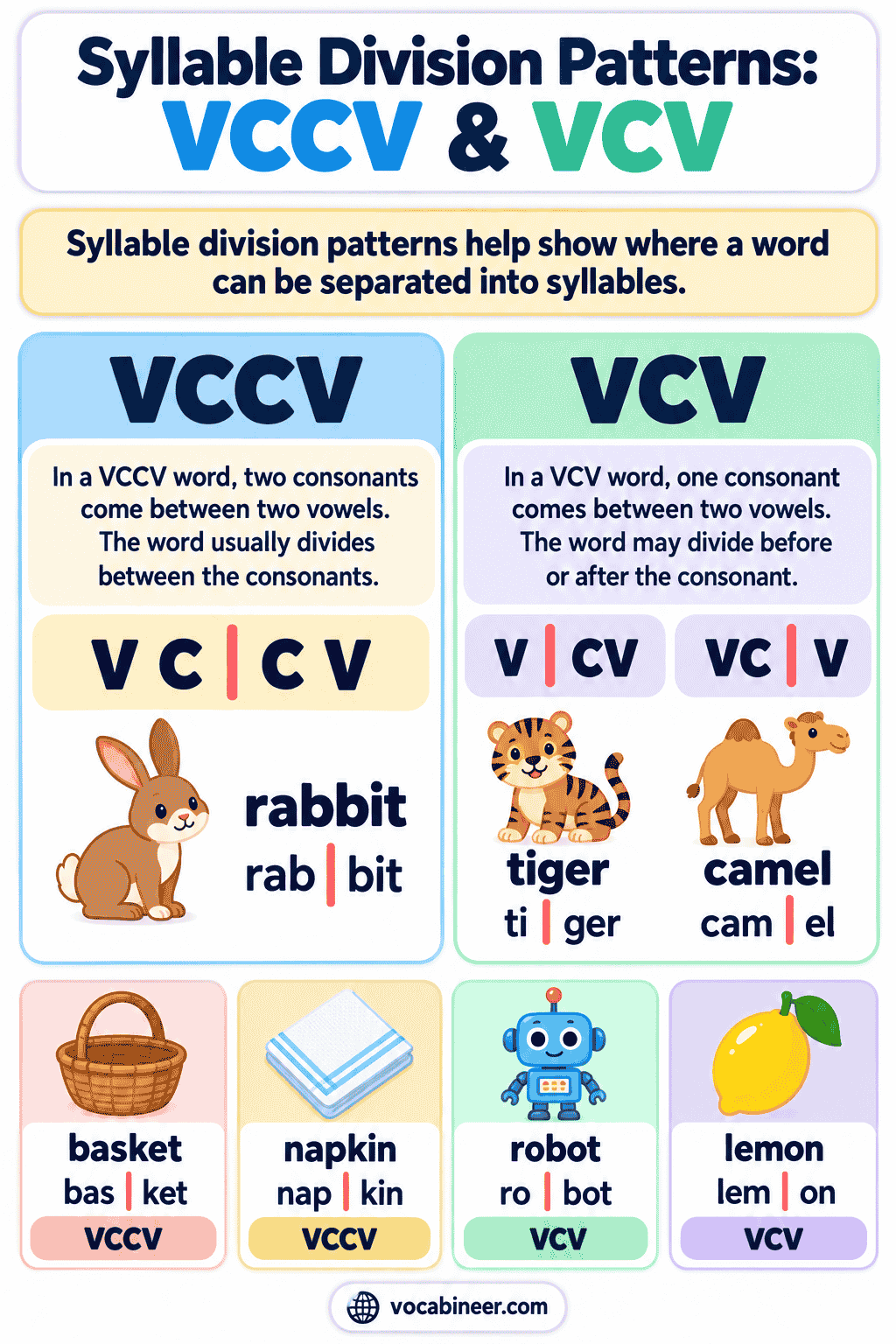
Syllable division patterns such as VCCV and VCV help readers decide where to split longer words into smaller parts. These patterns are especially useful for decoding two-syllable and multisyllabic words because they show how vowels and consonants are arranged around a possible syllable break.
Learning VCCV and VCV syllable division patterns helps readers recognize open and closed syllables, predict vowel sounds, and choose the most likely division when reading unfamiliar words. This guide explains how both patterns work, how they differ, and when a word may require a different split.
In This Page
What Are VCCV and VCV Syllable Division Patterns?
The letters V and C describe vowel and consonant positions around a syllable division pattern.
- V = vowel
- C = consonant
So:
VCCV means vowel + consonant + consonant + vowel.
VCV means vowel + consonant + vowel.
These labels do not describe the entire word. Instead, they show the letter pattern around the area where a syllable break may occur.
For example:
napkin → nap / kin
The middle pattern contains two consonants, so it follows a VCCV division pattern.
robot → ro / bot
The middle pattern contains one consonant between vowels, so it follows a VCV pattern.
What Is the VCCV Pattern?
A VCCV pattern has two consonants between vowel sounds.
A common strategy is to divide between the two consonants.
Examples:
napkin → nap / kin
rabbit → rab / bit
picnic → pic / nic
velvet → vel / vet
helmet → hel / met
The division often creates a closed first syllable, which usually contains a short vowel sound.
For example:
napkin → nap / kin
The first syllable nap ends in a consonant, so it is closed.
How to Divide VCCV Words
When two consonants appear between vowels, first check whether they belong to separate syllables.
If they do, divide between them.
Examples:
sunset → sun / set
magnet → mag / net
basket → bas / ket
rabbit → rab / bit
picnic → pic / nic
This pattern is usually easier to apply than VCV because the two consonants often provide a clear division point.
However, readers should still check whether the consonants form a special sound combination before splitting them.
VCCV Words With Doubled Consonants
Many VCCV words contain doubled consonants in the middle.
Examples:
rabbit → rab / bit
summer → sum / mer
letter → let / ter
happy → hap / py
dinner → din / ner
In these words, the doubled consonants divide between the syllables.
For example:
summer
The two m letters fall on opposite sides of the syllable break:
sum / mer
The first syllable remains closed and usually keeps its short vowel sound.
When the VCCV Rule Does Not Apply
The VCCV rule should not be applied automatically every time two consonant letters appear between vowels.
Some consonant letters form a digraph, meaning they work together to represent one consonant sound.
Common digraphs include:
sh
ch
th
ph
These letters usually stay together when they function as one sound.
The key principle is:
Do not split two consonant letters simply because they appear together. First check whether they form a sound unit.
This is one reason VCCV should be treated as a useful division pattern rather than an absolute rule.
VCCV Examples With Different Syllable Types
VCCV words do not always produce the same types of syllables.
Rabbit
rab / bit
- rab = closed
- bit = closed
Market
mar / ket
- mar = R-controlled
- ket = closed
Sunset
sun / set
- sun = closed
- set = closed
Helmet
hel / met
- hel = closed
- met = closed
The VCCV pattern tells readers where the word may divide, while the syllable types explain how the vowels behave after division.
What Is the VCV Pattern?
A VCV pattern has one consonant between two vowel sounds.
Unlike VCCV, VCV can often divide in two different ways:
V/CV
or:
VC/V
The reader usually tries the first option and then checks whether the resulting pronunciation forms the expected word.
V/CV: Divide Before the Consonant
In the V/CV pattern, the division comes before the middle consonant.
Examples:
robot → ro / bot
tiger → ti / ger
music → mu / sic
humid → hu / mid
The first syllable usually ends in a vowel, so it is often an open syllable.
For example:
robot → ro / bot
The first syllable ro is open, and the vowel usually has its long sound.
VC/V: Divide After the Consonant
In the VC/V pattern, the middle consonant joins the first syllable.
Examples:
cabin → cab / in
lemon → lem / on
timid → tim / id
planet → plan / et
The first syllable usually ends in a consonant, so it is often a closed syllable.
For example:
cabin → cab / in
The first syllable cab is closed and contains a short vowel sound.
Long and Short Vowels in VCV Words
The two VCV divisions often produce different vowel patterns.
| Pattern | Example | First Syllable | Typical Vowel Sound |
|---|---|---|---|
| V/CV | ro / bot | open | long |
| V/CV | ti / ger | open | long |
| VC/V | cab / in | closed | short |
| VC/V | lem / on | closed | short |
This contrast is one of the most useful clues when deciding how to divide a VCV word.
However, English contains exceptions, so the pronunciation of the complete word should always be checked.
How to Choose Between V/CV and VC/V
A practical strategy is to try V/CV first.
For example:
robot
Try:
ro / bot
This produces the expected pronunciation, so the division works.
Now consider:
cabin
Trying:
ca / bin
does not give the usual pronunciation of the word.
So try:
cab / in
This produces the expected word.
A useful process is:
- Find the VCV pattern.
- Try V/CV.
- Read the divided word.
- If it does not sound like a familiar word, try VC/V.
- Choose the division that matches the known pronunciation.
This is why oral vocabulary can help with syllable division. Readers often need to recognize the spoken word in order to select the correct split.
VCCV vs VCV Syllable Division
VCCV and VCV patterns differ mainly in the number of consonants between the vowel sounds.
| Feature | VCCV | VCV |
|---|---|---|
| Middle consonants | Two | One |
| Main strategy | Divide between consonants | Try V/CV, then VC/V |
| Example | nap / kin | ro / bot |
| Alternate example | rab / bit | cab / in |
| Flexibility | Usually more predictable | Often requires testing |
VCCV usually provides a clearer break because there are two consonants.
VCV requires more decision-making because the single consonant can belong to either syllable.
VCCV and VCV Patterns vs Syllable Types
VCCV and VCV are division patterns, not syllable types.
They help answer:
Where might the word divide?
Syllable types help answer:
What kind of syllable is each part after division?
Common syllable types include:
- closed
- open
- VCe
- R-controlled
- vowel team
- consonant-le
For example:
robot → ro / bot
- division pattern = VCV
- ro = open syllable
- bot = closed syllable
Another example:
market → mar / ket
- division pattern = VCCV
- mar = R-controlled
- ket = closed
Understanding both ideas makes decoding more accurate.
What If There Are Three Consonants?
When three consonants appear between vowel sounds, the pattern is often described as VCCCV.
The main goal is to preserve familiar consonant combinations.
For example:
hundred → hun / dred
The dr blend stays together at the beginning of the second syllable.
Readers should avoid breaking apart blends or digraphs that function as useful sound units.
Because this article focuses on VCCV and VCV, VCCCV is best understood as an extension of the same consonant-pattern logic.
VCCV and VCV Patterns in Longer Words
VCCV and VCV patterns can also appear inside words with more than two syllables.
Fantastic
fan / tas / tic
The word contains several consonant-vowel patterns that can be divided into manageable syllables.
Remember
re / mem / ber
Different parts of the word use different division relationships.
Computer
com / pu / ter
The middle syllable shows an open-syllable pattern after division.
Important
im / por / tant
Several consonant and vowel relationships work together in the word.
In longer words, readers should identify one possible syllable break at a time instead of trying to decode the entire word at once.
Common Mistakes With VCCV and VCV Patterns
Several errors can make these patterns confusing.
Splitting Every VCCV Word Automatically
Two consonants may form a digraph or another useful sound unit. Check the consonants before dividing.
Splitting a Consonant Digraph
Do not break apart letters such as sh, ch, th, or ph when they represent one consonant sound.
Assuming Every VCV Word Uses V/CV
Some VCV words use VC/V.
For example:
cabin → cab / in
not:
ca / bin
Assuming Every VCV Word Uses VC/V
Other words divide with V/CV.
For example:
robot → ro / bot
not:
rob / ot
Confusing the Pattern With the Syllable Type
VCCV and VCV show where a word may divide.
Open, closed, R-controlled, and other labels describe the resulting syllables.
Ignoring the Whole Word
After dividing a word, read it naturally and check whether the pronunciation matches a familiar word.
A division that looks possible on paper may not produce the expected pronunciation.
FAQs
What does VCCV mean in syllable division?
VCCV means vowel-consonant-consonant-vowel. A common strategy is to divide between the two consonants, as in nap/kin and rab/bit.
What does VCV mean in syllable division?
VCV means vowel-consonant-vowel. The word may divide as V/CV, such as ro/bot, or as VC/V, such as cab/in.
How do you know whether to use V/CV or VC/V?
Try V/CV first. If the resulting pronunciation does not sound like the familiar word, try VC/V. The correct division usually matches the expected pronunciation.
Are VCCV and VCV syllable types?
No. VCCV and VCV are syllable division patterns. After dividing the word, each syllable can be identified as open, closed, VCe, R-controlled, vowel team, consonant-le, or another syllable type.
Does the VCCV rule always mean dividing between two consonants?
No. If the consonants form a digraph or another sound unit that should stay together, the simple VCCV split may not apply. Always check how the consonants function in the word.
Read More
- What is a Syllable?
- Closed syllable words
- Open syllable words
- Open and closed syllable words
- Multisyllabic Words List
- 1 syllable words
- 2 syllable words
- 3 syllable words
- 4 syllable words
- 5 syllable words
- Six syllable words