

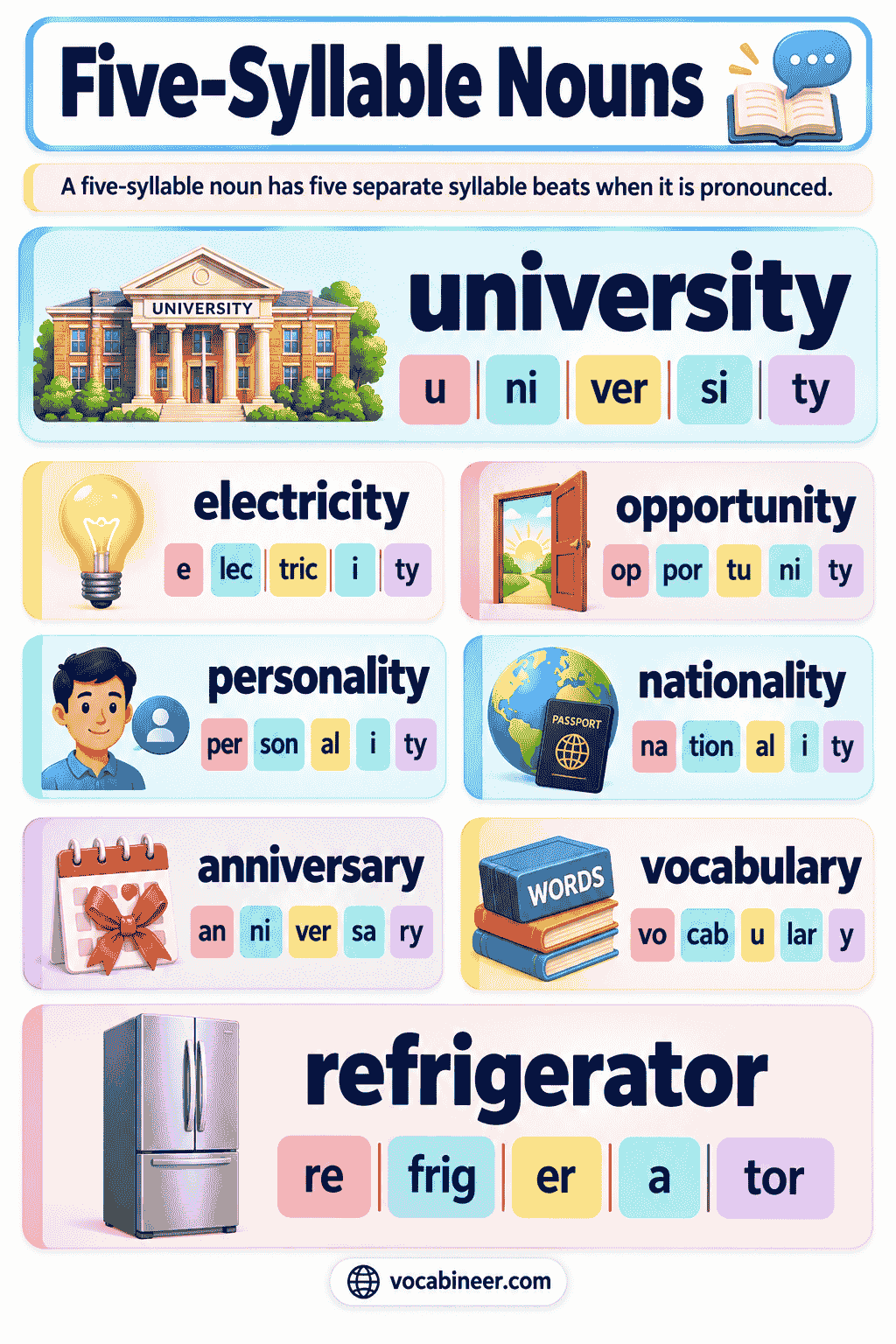
Five-syllable nouns are naming words pronounced with five separate syllables. Familiar examples include opportunity, university, communication, imagination, and electricity. These longer nouns appear frequently in academic writing, everyday communication, science, education, and professional English.
Learning five-syllable nouns can improve vocabulary, syllable counting, pronunciation, and word stress. This guide includes common examples, simple meanings, syllable divisions, noun categories, and pronunciation patterns to help you recognize and use these words correctly.
In This Page
What Are Five-Syllable Nouns?
A five-syllable noun is a noun pronounced with five separate syllables or spoken units.
For example:
opportunity
op / por / tu / ni / ty
university
u / ni / ver / si / ty
communication
com / mu / ni / ca / tion
Each word names a person, place, thing, idea, quality, process, or field of study and contains five spoken syllables.
Syllable count depends on pronunciation, not simply on the number of letters or written vowels in a word.
Common Five-Syllable Nouns
Many five-syllable nouns appear regularly in school, work, news, books, and everyday conversation.
Opportunity
A favorable chance or situation that makes something possible.
University
An institution where students pursue higher education and academic study.
Communication
The exchange of information, ideas, or messages between people.
Organization
An organized group, institution, or system.
Electricity
A form of energy associated with electric charge.
Imagination
The ability to form ideas, images, or situations in the mind.
Personality
The collection of qualities and behaviors that characterize a person.
Possibility
Something that may happen or be true.
Anniversary
The yearly date on which an important past event is remembered.
Curiosity
A strong desire to learn, discover, or understand something.
Generosity
The quality of being willing to give or share freely.
Cafeteria
A dining area where people choose and collect food before sitting down.
Vocabulary
The collection of words known or used by a person, language, or subject.
Refrigerator
An appliance that keeps food and drinks cold.
Hippopotamus
A large African mammal that spends much of its time in or near water.
Five-Syllable Nouns With Meanings
The following table gives a wider selection of nouns with five syllables.
| Noun | Syllable Division | Simple Meaning |
|---|---|---|
| Accommodation | ac / com / mo / da / tion | a place or arrangement for staying |
| Administration | ad / min / is / tra / tion | management of an organization |
| Anniversary | an / ni / ver / sa / ry | yearly remembrance of an event |
| Association | as / so / ci / a / tion | an organized group or connection |
| Capability | ca / pa / bil / i / ty | ability to do something |
| Classification | clas / si / fi / ca / tion | arrangement into groups |
| Communication | com / mu / ni / ca / tion | exchange of information |
| Consideration | con / sid / er / a / tion | careful thought about something |
| Determination | de / ter / mi / na / tion | firmness of purpose |
| Disability | dis / a / bil / i / ty | a condition affecting certain activities |
| Discrimination | dis / crim / i / na / tion | unfair treatment based on a characteristic |
| Electricity | e / lec / tric / i / ty | electrical energy |
| Evaluation | e / val / u / a / tion | judgment or assessment |
| Examination | ex / am / i / na / tion | a test or detailed inspection |
| Flexibility | flex / i / bil / i / ty | ability to bend or adapt |
| Ideology | i / de / ol / o / gy | a system of ideas or beliefs |
| Imagination | i / mag / i / na / tion | ability to create ideas mentally |
| Implementation | im / ple / men / ta / tion | process of putting a plan into action |
| Interpretation | in / ter / pre / ta / tion | explanation of meaning |
| Investigation | in / ves / ti / ga / tion | careful search for facts |
| Liability | li / a / bil / i / ty | legal responsibility or obligation |
| Modification | mod / i / fi / ca / tion | a change made to something |
| Negotiation | ne / go / ti / a / tion | discussion aimed at reaching agreement |
| Opportunity | op / por / tu / ni / ty | a favorable chance |
| Organization | or / gan / i / za / tion | an organized group or system |
| Participation | par / tic / i / pa / tion | act of taking part |
| Personality | per / son / al / i / ty | a person’s characteristic qualities |
| Possibility | pos / si / bil / i / ty | something that may happen |
| Probability | prob / a / bil / i / ty | likelihood that something will happen |
| Productivity | pro / duc / tiv / i / ty | rate or ability of producing results |
| Qualification | qual / i / fi / ca / tion | skill or achievement required for something |
| Recommendation | rec / om / men / da / tion | advice about what should be chosen |
| Representation | rep / re / sen / ta / tion | act of representing something |
| Sociology | so / ci / ol / o / gy | study of society and social behavior |
| Specification | spec / i / fi / ca / tion | detailed description of requirements |
| University | u / ni / ver / si / ty | institution of higher education |
Five-Syllable Nouns for People
Some five-syllable nouns name people by occupation, role, or relationship.
Representative
A person chosen or authorized to speak or act for others.
Administrator
A person responsible for managing an organization, institution, or system. Pronunciation can vary somewhat by accent.
Investigator
A person who examines facts, events, or evidence in order to discover information.
Veterinarian
A medical professional who treats animals. Its syllable count can vary in faster or regional pronunciation, so dictionary pronunciation is useful when studying it specifically.
Person nouns require particular care because natural speech may reduce some syllables more strongly than careful pronunciation.
Abstract Five-Syllable Nouns
Abstract nouns name ideas, qualities, states, or concepts rather than physical objects.
Capability
The ability or power to do something.
Curiosity
A desire to know or learn.
Determination
A strong decision to continue working toward a goal.
Flexibility
The ability to change, adapt, or bend.
Generosity
The quality of giving or sharing willingly.
Imagination
The ability to form mental ideas and images.
Liability
A responsibility, obligation, or legal burden.
Opportunity
A favorable chance to do something.
Personality
The qualities and behaviors that make a person distinctive.
Possibility
The state of being possible.
Probability
The likelihood that an event will occur.
Productivity
The ability or rate at which useful work is produced.
These words are especially common in academic, professional, and descriptive English.
Five-Syllable Nouns for Actions and Processes
Many five-syllable nouns describe actions, processes, or their results.
Administration
The process of managing an institution or organization.
Classification
The process of arranging things into categories.
Communication
The process of exchanging information.
Evaluation
The process of judging quality, value, or performance.
Examination
The act of testing or inspecting something carefully.
Implementation
The process of putting a decision or plan into effect.
Interpretation
The process of explaining or understanding meaning.
Investigation
The process of examining something in detail.
Modification
The process or result of making a change.
Negotiation
Discussion between people or groups seeking agreement.
Organization
The process of arranging things systematically or an organized body.
Participation
The act of taking part in something.
Qualification
The process or result of becoming qualified.
Recommendation
The act of suggesting a suitable choice or course of action.
Representation
The act of speaking, acting, or standing for someone or something.
Five-syllable nouns ending in -ation are especially common in this group.
Concrete Five-Syllable Nouns
Concrete nouns name people, animals, places, or objects that can be experienced more directly.
University
A place of higher education.
Cafeteria
A dining area where customers or students collect their meals.
Auditorium
A large room or hall designed for an audience.
Refrigerator
A household or commercial appliance used to keep items cold.
Hippopotamus
A large semiaquatic African mammal.
Planetarium
A building or room where images of stars and planets are projected for education or entertainment.
These examples show that five-syllable nouns are not limited to abstract academic vocabulary.
Five-Syllable Nouns by Common Endings
Several endings appear frequently in five-syllable nouns.
Nouns Ending in -ation
Many -ation words name actions, processes, or results.
Examples:
administration
ad / min / is / tra / tion
classification
clas / si / fi / ca / tion
communication
com / mu / ni / ca / tion
determination
de / ter / mi / na / tion
examination
ex / am / i / na / tion
imagination
i / mag / i / na / tion
investigation
in / ves / ti / ga / tion
organization
or / gan / i / za / tion
participation
par / tic / i / pa / tion
recommendation
rec / om / men / da / tion
The ending itself does not guarantee five syllables, but many familiar five-syllable nouns use this pattern.
Nouns Ending in -ity
The ending -ity often forms abstract nouns describing states, qualities, or conditions.
Examples:
capability
ca / pa / bil / i / ty
electricity
e / lec / tric / i / ty
flexibility
flex / i / bil / i / ty
opportunity
op / por / tu / ni / ty
personality
per / son / al / i / ty
possibility
pos / si / bil / i / ty
probability
prob / a / bil / i / ty
productivity
pro / duc / tiv / i / ty
university
u / ni / ver / si / ty
Again, not every noun ending in -ity has five syllables.
Nouns Ending in -ology
The ending -ology commonly names a field or branch of study.
Examples:
archaeology
ar / chae / ol / o / gy
cardiology
car / di / ol / o / gy
dermatology
der / ma / tol / o / gy
ideology
i / de / ol / o / gy
methodology
meth / od / ol / o / gy
sociology
so / ci / ol / o / gy
terminology
ter / mi / nol / o / gy
These words are common in academic and professional vocabulary.
How to Divide Five-Syllable Nouns
The most reliable way to count five syllables is to focus on spoken pronunciation.
For example:
opportunity
op / por / tu / ni / ty
There are five spoken syllables.
Another example:
communication
com / mu / ni / ca / tion
Again, there are five syllables.
A useful process is:
- Say the word naturally.
- Slow it down without adding extra vowel sounds.
- Listen for each separate syllabic beat.
- Divide the word into five spoken parts.
- Check a reliable dictionary if the pronunciation is uncertain.
Do not simply count written vowels. Two or more vowel letters can belong to the same syllable, while unstressed vowels may sound very different from their spelling.
Stress in Five-Syllable Nouns
Five-syllable nouns contain five syllables, but the syllables do not receive equal emphasis.
One syllable normally carries the primary stress.
For example:
communiCAtion
organiZAtion
imagiNAtion
elecTRIcity
opporTUnity
The surrounding syllables are less prominent.
Many nouns ending in -ation place primary stress on the syllable immediately before -tion, while many -ity nouns place stress earlier in the word. These are useful tendencies rather than rules that should be applied blindly.
Learning stress together with syllable count makes long nouns much easier to pronounce naturally.
Five-Syllable Nouns vs Other Five-Syllable Words
Not every five-syllable word is a noun.
Compare:
communication → noun
technological → adjective
differentiate → verb
accidentally → adverb
All may appear on general five-syllable word lists, but only communication belongs in a strict list of five-syllable nouns.
This part-of-speech distinction is important when learning vocabulary by grammatical category.
Can Five-Syllable Nouns Vary by Accent?
Yes. Some words can have slightly different syllable counts or divisions depending on accent, regional pronunciation, or speaking speed.
Reduced vowels are especially important. A carefully pronounced word may preserve a syllable that becomes less distinct in rapid speech.
For that reason, syllable counts should follow an established pronunciation rather than spelling alone.
Words such as university clearly retain five syllables in standard British and American dictionary pronunciations, although the exact vowel sounds differ between the two accents.
Why Learn Five-Syllable Nouns?
Five-syllable nouns occur frequently in education, science, business, government, and formal communication.
Learning them can help with:
- vocabulary development
- syllable recognition
- spelling
- pronunciation
- word stress
- reading longer words
- academic English
Breaking a long noun into smaller spoken parts also makes an unfamiliar word less difficult to read and remember.
FAQs
A five-syllable noun is a naming word pronounced with five syllables, such as opportunity, university, communication, or electricity.
Common examples include anniversary, curiosity, electricity, imagination, opportunity, organization, personality, university, vocabulary, and communication.
Divide it according to its spoken pronunciation. For example, opportunity can be heard as op / por / tu / ni / ty, giving five syllables.
Many are abstract nouns, particularly words ending in -ation and -ity, but concrete examples also exist, including cafeteria, refrigerator, auditorium, hippopotamus, and planetarium.
Sometimes. Regional pronunciation and vowel reduction can change how certain words are heard or divided, so dictionary pronunciation is useful when a word is uncertain.
Read More
- What is a Syllable?
- Closed syllable words
- Open syllable words
- Open and closed syllable words
- Multisyllabic Words List
- 1 syllable words
- 2 syllable words
- 3 syllable words
- 4 syllable words
- 5 syllable words
- Six syllable words