

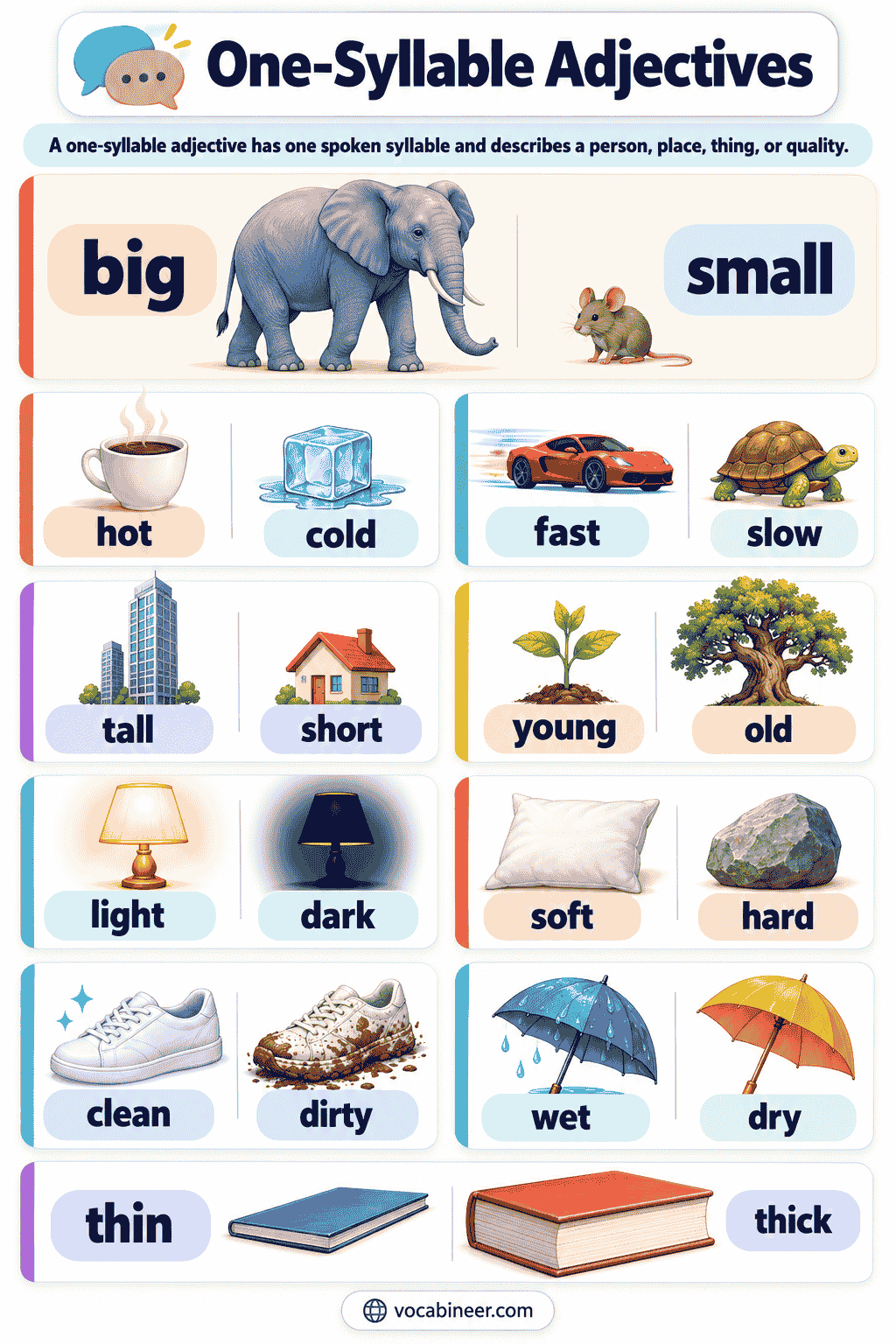
One-syllable adjectives are describing words pronounced with a single spoken syllable. Common examples include big, small, tall, cold, fast, kind, bright, and strong. These words are useful for describing size, color, appearance, feelings, personality, texture, speed, and many other everyday qualities.
Learning one-syllable adjectives helps with vocabulary, pronunciation, and grammar. Many of these adjectives also form their comparative and superlative forms with -er and -est, so they are especially useful for learning how English comparisons work.
In This Page
What Are One-Syllable Adjectives?
A one-syllable adjective is an adjective pronounced with one spoken syllable.
Examples:
big
cold
fast
kind
bright
Each word has one syllable and describes a noun or subject.
One-syllable adjectives are also called monosyllabic adjectives.
For example:
a big house
cold water
a fast car
a kind teacher
a bright room
The syllable count depends on pronunciation, not the number of written vowel letters.
Common One-Syllable Adjectives
Here are common one-syllable adjectives used in everyday English.
Big
Large in size.
Small
Little in size.
Tall
Having greater height.
Short
Having little height or length.
Long
Extending a great distance from one end to another.
Old
Having existed for a long time.
Young
Not old in age.
New
Recently made, obtained, or introduced.
Good
Having a positive or desirable quality.
Bad
Having a poor or undesirable quality.
Hot
Having a high temperature.
Cold
Having a low temperature.
Warm
Moderately hot.
Cool
Slightly cold or pleasantly low in temperature.
Fast
Moving quickly.
Slow
Moving without much speed.
Hard
Firm, solid, or difficult to bend.
Soft
Easy to press, bend, or touch gently.
Dark
Having little light or a deep color.
Light
Not dark or not heavy, depending on context.
Bright
Giving or reflecting much light.
Strong
Having great physical power or force.
Weak
Lacking strength or power.
Kind
Caring and helpful toward others.
Brave
Willing to face danger or difficulty.
Calm
Peaceful and not excited or nervous.
Shy
Uncomfortable or nervous around other people.
Wise
Showing good judgment.
Proud
Feeling pleased about an achievement or quality.
Smart
Intelligent or quick to understand.
Safe
Protected from danger.
One-Syllable Adjectives With Meanings
The table below gives more one-syllable adjectives with short meanings and example phrases.
| Adjective | Meaning | Example |
|---|---|---|
| big | large in size | a big house |
| small | little in size | a small box |
| tall | having great height | a tall tree |
| short | not tall or long | a short wall |
| wide | broad from side to side | a wide road |
| thin | having little thickness | a thin sheet |
| thick | having great thickness | a thick book |
| flat | having a level surface | a flat stone |
| round | shaped like a circle or ball | a round plate |
| red | having a red color | a red rose |
| blue | having a blue color | a blue sky |
| green | having a green color | green grass |
| black | very dark in color | a black bag |
| white | having a white color | a white shirt |
| brown | having a brown color | a brown dog |
| pale | light or weak in color | a pale shade |
| hard | firm or solid | a hard floor |
| soft | pleasant or easy to press | a soft pillow |
| rough | not smooth | a rough wall |
| smooth | having an even surface | smooth glass |
| wet | covered with water | wet clothes |
| dry | without moisture | dry soil |
| sharp | having a fine cutting edge | a sharp knife |
| blunt | not sharp | a blunt pencil |
| clean | free from dirt | a clean room |
| kind | caring toward others | a kind friend |
| brave | showing courage | a brave child |
| wise | showing good judgment | a wise leader |
| calm | peaceful and relaxed | a calm voice |
| shy | nervous around people | a shy student |
| rude | not polite | a rude remark |
| mean | unkind | a mean act |
| glad | pleased or happy | a glad smile |
| sad | unhappy | a sad face |
| sick | not well | a sick child |
| tired | needing rest | a tired worker |
| free | not controlled or occupied | a free seat |
| safe | protected from danger | a safe place |
One-Syllable Adjectives for Size and Shape
Many one-syllable adjectives describe the size, length, height, width, thickness, or shape of something.
Big
Large in size.
Small
Little in size.
Tall
High from bottom to top.
Short
Not tall or long.
Long
Extending a considerable distance.
Wide
Having a large distance from side to side.
Broad
Wide across.
Thin
Having little thickness.
Thick
Having considerable thickness.
Flat
Having a level surface.
Round
Circular or curved in shape.
Huge
Extremely large.
Slim
Thin in an attractive or narrow way.
Deep
Extending far downward or inward.
These adjectives are useful for describing people, buildings, objects, spaces, and natural features.
One-Syllable Adjectives for Color and Appearance
Some one-syllable adjectives describe color, brightness, or visible appearance.
Red
Having a red color.
Blue
Having a blue color.
Green
Having a green color.
Black
Very dark in color.
White
Having the lightest common color.
Brown
Having a brown color.
Gray
Having a color between black and white.
Pink
Having a light red color.
Tan
Having a light brown color.
Pale
Having little color or a light shade.
Dark
Having little light or a deep color.
Bright
Full of light or vivid color.
Dull
Not bright, shiny, or vivid.
Clear
Easy to see through or understand.
These words are useful when describing clothes, rooms, objects, weather, and natural scenes.
One-Syllable Adjectives for Texture and Physical Qualities
One-syllable adjectives can describe how something feels, looks, or behaves physically.
Hard
Firm and difficult to press.
Soft
Easy to press or pleasant to touch.
Rough
Having an uneven surface.
Smooth
Having an even surface.
Wet
Covered or filled with moisture.
Dry
Without moisture.
Warm
Moderately hot.
Cold
Having a low temperature.
Cool
Slightly cold.
Hot
Having a high temperature.
Clean
Free from dirt.
Sharp
Having a fine cutting point or edge.
Blunt
Not sharp.
Light
Not heavy.
Dense
Closely packed or thick.
Firm
Solid and not easily moved or pressed.
One-Syllable Adjectives to Describe People
Many short adjectives are useful for describing personality, behavior, and character.
Kind
Caring and helpful.
Brave
Ready to face fear or danger.
Wise
Showing good judgment.
Calm
Peaceful and relaxed.
Shy
Nervous or quiet around other people.
Proud
Pleased about something achieved or valued.
Fair
Just and reasonable.
Nice
Pleasant or kind.
Mean
Unkind or cruel.
Rude
Not polite.
Stern
Strict and serious.
Smart
Intelligent or clever.
Keen
Very interested, eager, or sharp-minded.
Bold
Confident and willing to take risks.
These adjectives can describe a person’s character without requiring long or complicated vocabulary.
One-Syllable Adjectives for Feelings and States
Some one-syllable adjectives describe emotions, physical conditions, or temporary states.
Glad
Feeling pleased or happy.
Sad
Feeling unhappy.
Mad
Angry or, in some contexts, mentally unwell.
Calm
Free from worry or excitement.
Scared
Feeling afraid.
Tired
Needing rest.
Sick
Feeling unwell.
Well
Healthy.
Safe
Protected from harm.
Free
Not controlled, trapped, or occupied.
Glad, sad, and scared describe feelings, while words such as sick, well, and tired commonly describe physical states.
One-Syllable Adjective Opposites
Learning adjective pairs can make vocabulary easier to remember.
| Adjective | Opposite |
|---|---|
| big | small |
| tall | short |
| long | short |
| hot | cold |
| warm | cool |
| fast | slow |
| hard | soft |
| rough | smooth |
| wet | dry |
| dark | light |
| bright | dull |
| strong | weak |
| young | old |
| clean | dirty |
| kind | mean |
| brave | scared |
| glad | sad |
| safe | unsafe |
Not every opposite has one syllable. For example, dirty and unsafe have more than one syllable, but they are still useful semantic opposites.
How to Identify a One-Syllable Adjective
A word must meet two conditions to count as a one-syllable adjective.
First, it must function as an adjective.
For example:
a bright light
The word bright describes the noun light.
Second, it must have one spoken syllable.
Say:
bright
It is pronounced as one syllable.
A useful method is:
- Check whether the word describes a noun or subject.
- Say the word naturally.
- Listen for one spoken syllable.
- Do not count written vowel letters.
- Check a dictionary if the pronunciation is unclear.
For example:
blue contains several vowel letters but has one syllable.
clean also contains two written vowel letters but has one syllable.
bright contains several letters but is still pronounced in one spoken unit.
Comparative and Superlative Forms of One-Syllable Adjectives
Most gradable one-syllable adjectives form the comparative with -er and the superlative with -est.
The comparative compares two people, things, or situations.
The superlative identifies the highest degree among three or more.
Examples:
| Adjective | Comparative | Superlative |
|---|---|---|
| tall | taller | tallest |
| short | shorter | shortest |
| long | longer | longest |
| cold | colder | coldest |
| warm | warmer | warmest |
| fast | faster | fastest |
| slow | slower | slowest |
| bright | brighter | brightest |
| strong | stronger | strongest |
| weak | weaker | weakest |
For example:
Tom is taller than Ben.
Tom is the tallest boy in the group.
Not every adjective can naturally be compared, so -er and -est are mainly used with gradable qualities.
Spelling Rules for One-Syllable Adjectives
The spelling may change when -er or -est is added.
Add -er and -est
For many one-syllable adjectives, simply add the endings.
tall → taller → tallest
cold → colder → coldest
fast → faster → fastest
dark → darker → darkest
long → longer → longest
Adjectives Ending in -e
If the adjective already ends in e, add only -r and -st.
nice → nicer → nicest
safe → safer → safest
large → larger → largest
wise → wiser → wisest
This avoids adding an unnecessary second e.
Double the Final Consonant
Many short adjectives ending in a consonant-vowel-consonant pattern double the final consonant before adding -er or -est.
big → bigger → biggest
hot → hotter → hottest
thin → thinner → thinnest
sad → sadder → saddest
wet → wetter → wettest
This spelling change preserves the short vowel sound.
Irregular One-Syllable Adjectives
Some common adjectives do not use the regular -er and -est forms.
| Adjective | Comparative | Superlative |
|---|---|---|
| good | better | best |
| bad | worse | worst |
| far | farther/further | farthest/furthest |
For example:
This book is better than that one.
It is the best book in the series.
Because these forms are irregular, they need to be learned separately.
One-Syllable vs Two-Syllable Adjectives
Comparing one- and two-syllable adjectives can make syllable counting easier.
| One-Syllable Adjective | Two-Syllable Adjective |
|---|---|
| small | tiny |
| glad | happy |
| fast | rapid |
| kind | gentle |
| calm | peaceful |
| smart | clever |
| dull | boring |
| scared | frightened |
For example:
small has one spoken syllable.
tiny has two:
ti / ny
The number of letters does not determine the number of syllables. Pronunciation does.
Common Mistakes With One-Syllable Adjectives
Several common errors can make this topic confusing.
Assuming Every One-Syllable Word Is an Adjective
A one-syllable word can be a noun, verb, adjective, adverb, or another part of speech.
For example:
door is one syllable, but it is mainly a noun.
bright is one syllable and commonly functions as an adjective.
Counting Written Vowels Instead of Spoken Syllables
Words such as blue and clean contain more than one vowel letter but still have one spoken syllable.
Using More Instead of -er in Basic Comparisons
Standard:
taller
rather than:
more tall
For most common gradable one-syllable adjectives, -er is the normal comparative form.
Forgetting to Double the Final Consonant
Correct:
big → bigger
not:
biger
Adding an Extra E
Correct:
nice → nicer
not:
niceer
Making Irregular Forms Regular
Correct:
good → better → best
not:
gooder → goodest
Assuming Every Adjective Can Be Compared
Some adjectives do not naturally describe qualities that vary by degree.
Therefore, do not automatically add -er and -est to every one-syllable adjective.
FAQs
A one-syllable adjective is a describing word pronounced with one spoken syllable, such as big, cold, fast, kind, or bright.
Common examples include big, small, tall, short, long, old, young, hot, cold, fast, slow, hard, soft, kind, brave, strong, and weak.
Most gradable one-syllable adjectives take -er for the comparative and -est for the superlative, such as tall, taller, tallest.
Many one-syllable adjectives with a consonant-vowel-consonant ending double the final consonant before -er and -est, as in big → bigger and hot → hotter.
No. Some forms are irregular, such as good → better → best, and some adjectives are not normally gradable. Therefore, -er and -est apply to most common gradable one-syllable adjectives rather than every adjective.
Read More
- What is a Syllable?
- Closed syllable words
- Open syllable words
- Open and closed syllable words
- Multisyllabic Words List
- 1 syllable words
- 2 syllable words
- 3 syllable words
- 4 syllable words
- 5 syllable words
- Six syllable words