

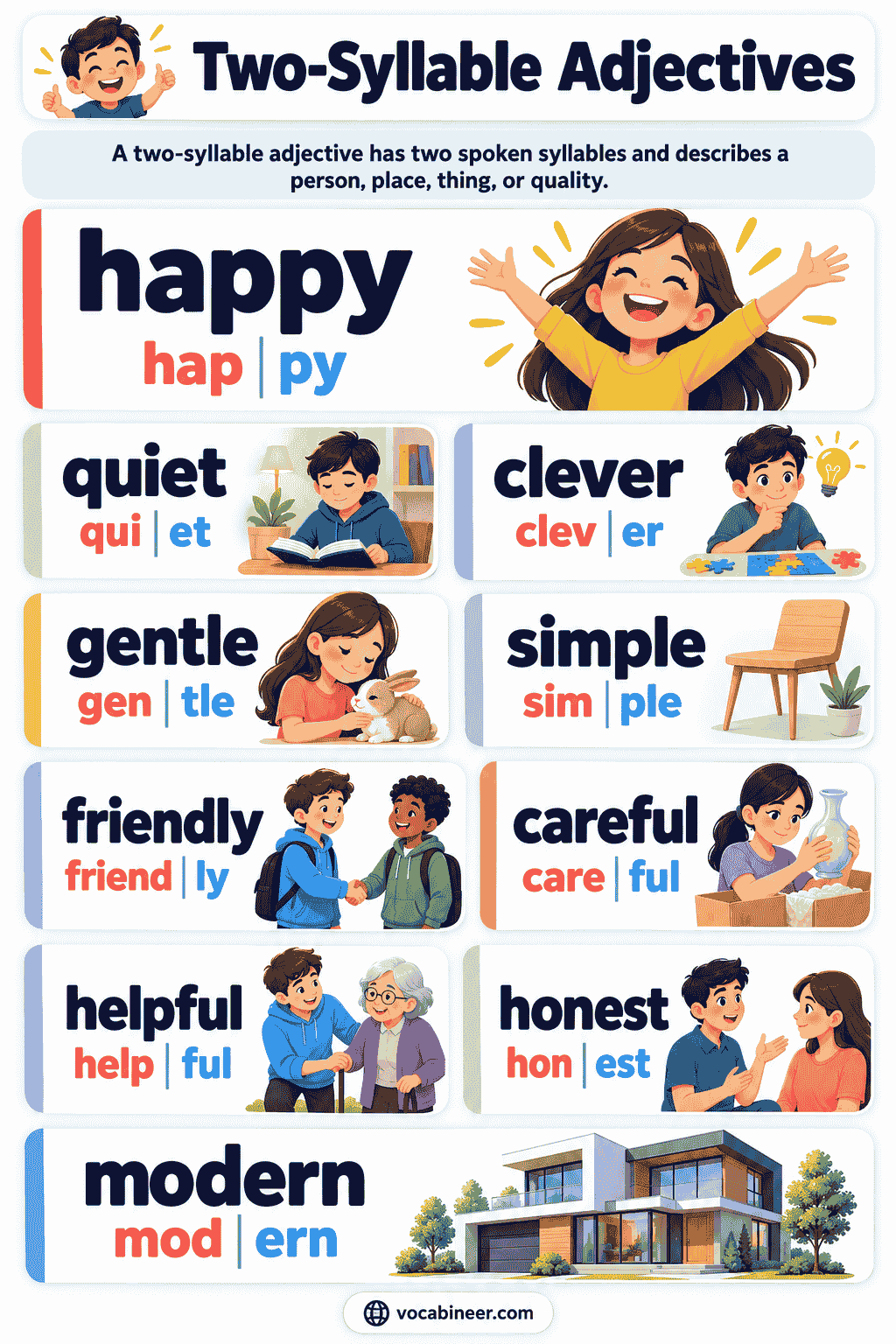
Two-syllable adjectives are describing words pronounced with two separate syllables. Familiar examples include happy, careful, modern, gentle, narrow, friendly, and polite. These adjectives help describe appearance, personality, feelings, condition, size, quality, and many other features.
This guide includes 160 two-syllable adjectives with simple meanings. It also explains common adjective endings, syllable division, word stress, and an important grammar point: some two-syllable adjectives take -er and -est, others use more and most, and a smaller group can use either pattern.
In This Page
What Are Two-Syllable Adjectives?
A two-syllable adjective is an adjective pronounced with two separate syllables or spoken units.
For example:
happy
hap / py
careful
care / ful
modern
mod / ern
polite
po / lite
Each word describes a noun or subject while containing two spoken syllables.
Syllable count depends on pronunciation, not simply on the number of written vowels.
Common Two-Syllable Adjectives
Some familiar two-syllable adjectives include:
Happy
Feeling or showing pleasure.
Careful
Giving close attention to avoid mistakes or danger.
Modern
Relating to the present or recent times.
Gentle
Kind, mild, or not rough.
Narrow
Having little width.
Quiet
Making little or no noise.
Clever
Quick to understand or learn.
Friendly
Kind and pleasant toward others.
Polite
Showing good manners.
Honest
Truthful and sincere.
Useful
Helpful for a particular purpose.
Famous
Known by many people.
Healthy
In good physical condition.
Lovely
Very pleasant or attractive.
Nervous
Worried, anxious, or easily excited.
160 Two-Syllable Adjectives With Meanings
The eight groups below contain 20 unique adjectives each, giving a total of 160 two-syllable adjectives.
Common Adjectives Ending in -y
| Adjective | Meaning |
|---|---|
| happy | feeling pleased |
| easy | not difficult |
| busy | having much to do |
| funny | causing amusement |
| noisy | making a lot of noise |
| pretty | attractive or pleasing |
| silly | lacking good judgment |
| messy | untidy or disorganized |
| lucky | having good fortune |
| healthy | in good physical condition |
| wealthy | having a lot of money |
| friendly | kind and welcoming |
| lovely | very pleasant or attractive |
| lonely | feeling without companionship |
| sleepy | ready or wanting to sleep |
| hungry | needing or wanting food |
| thirsty | needing or wanting a drink |
| angry | feeling strong displeasure |
| cloudy | covered with clouds |
| sunny | receiving or giving plenty of sunlight |
Two-Syllable Adjectives for Appearance and Physical Qualities
| Adjective | Meaning |
|---|---|
| rainy | having frequent or current rain |
| windy | having a lot of wind |
| snowy | covered with or bringing snow |
| stormy | affected by storms |
| smoky | full of smoke |
| dusty | covered with dust |
| muddy | covered with mud |
| rocky | covered with or made of rocks |
| bumpy | having an uneven surface |
| curly | forming curls |
| shiny | reflecting light |
| tiny | very small |
| heavy | having a lot of weight |
| empty | containing nothing |
| ugly | unpleasant in appearance |
| tidy | neat and organized |
| dirty | not clean |
| guilty | responsible for wrongdoing |
| worthy | deserving respect or attention |
| tricky | difficult or requiring care |
Two-Syllable Adjectives Ending in -ful
| Adjective | Meaning |
|---|---|
| careful | giving close attention |
| useful | helpful for a purpose |
| helpful | providing assistance |
| harmful | causing damage |
| cheerful | noticeably happy |
| hopeful | feeling or giving hope |
| fearful | feeling afraid |
| painful | causing pain |
| peaceful | calm and free from conflict |
| playful | fond of fun or games |
| thankful | feeling gratitude |
| thoughtful | showing careful consideration |
| truthful | telling or expressing the truth |
| joyful | very happy |
| graceful | moving or appearing elegantly |
| skillful | showing ability or skill |
| tasteful | showing good judgment in style |
| wasteful | using resources carelessly |
| wakeful | unable or unwilling to sleep |
| bashful | shy and easily embarrassed |
Two-Syllable Adjectives Ending in -less
| Adjective | Meaning |
|---|---|
| careless | not giving enough attention |
| hopeless | without hope |
| fearless | not afraid |
| painless | causing no pain |
| restless | unable to relax or stay still |
| useless | not useful |
| harmless | unlikely to cause harm |
| speechless | unable to speak, often from surprise |
| sleepless | without sleep |
| thoughtless | not considering others |
| countless | too numerous to count |
| endless | having no apparent end |
| tasteless | lacking flavor or good taste |
| homeless | without a permanent home |
| lifeless | showing no sign of life |
| shapeless | lacking a clear shape |
| timeless | not affected by changing fashion or time |
| priceless | extremely valuable |
| ruthless | showing no pity |
| reckless | acting without considering danger |
Everyday Two-Syllable Adjectives
| Adjective | Meaning |
|---|---|
| simple | easy to understand |
| gentle | mild, kind, or soft |
| narrow | not wide |
| quiet | making little noise |
| clever | quick to understand |
| honest | truthful |
| common | occurring frequently |
| perfect | completely correct or suitable |
| modern | relating to current times |
| pleasant | enjoyable or agreeable |
| polite | showing good manners |
| famous | widely known |
| nervous | worried or tense |
| jealous | unhappy about another person’s advantage |
| eager | strongly wanting to do something |
| basic | simple or fundamental |
| local | relating to a nearby area |
| global | relating to the whole world |
| final | coming at the end |
| total | complete or entire |
Two-Syllable Adjectives for Qualities and Conditions
| Adjective | Meaning |
|---|---|
| vocal | relating to the voice or openly expressed |
| legal | allowed by law |
| equal | the same in amount or value |
| loyal | faithful and supportive |
| royal | relating to a king or queen |
| formal | following established rules or style |
| secure | safe or protected |
| mature | fully developed |
| complete | having all necessary parts |
| correct | free from error |
| direct | going straight to the point or destination |
| exact | completely accurate |
| distinct | clearly different |
| remote | far away |
| aware | knowing about something |
| awake | not asleep |
| alive | living |
| alone | without other people |
| afraid | feeling fear |
| alert | watchful and ready to respond |
Descriptive Two-Syllable Adjectives
| Adjective | Meaning |
|---|---|
| asleep | in a state of sleep |
| sincere | genuine and honest |
| severe | very serious or harsh |
| supreme | highest in rank or degree |
| concise | brief but clear |
| precise | exact and accurate |
| obscure | difficult to understand or not well known |
| absurd | completely unreasonable |
| antique | old and often valuable |
| unique | unlike anything else |
| elite | belonging to a select group |
| extreme | very great or intense |
| immense | extremely large |
| handsome | attractive in appearance |
| wholesome | good for health or well-being |
| awesome | extremely impressive |
| tiresome | causing annoyance or tiredness |
| lonesome | lonely |
| gruesome | causing horror or disgust |
| fearsome | causing fear |
Two-Syllable Adjectives With Prefixes and Strong Descriptive Meanings
| Adjective | Meaning |
|---|---|
| unfair | not just or reasonable |
| unkind | not kind |
| unsafe | not safe |
| unsure | not certain |
| unwell | ill or not healthy |
| unfit | not suitable or physically fit |
| unclean | not clean |
| unclear | difficult to understand |
| unknown | not known |
| untold | not revealed or extremely great |
| unseen | not seen |
| unpaid | not paid |
| unused | not used |
| unreal | not real |
| immune | protected against something |
| intact | complete and undamaged |
| intense | very strong |
| inert | lacking movement or activity |
| abrupt | sudden or unexpected |
| adept | highly skilled |
Together, these eight groups contain 160 different two-syllable adjectives.
Two-Syllable Adjectives for Appearance
Several two-syllable adjectives describe how a person, object, or place looks.
Pretty
Attractive in a delicate or pleasing way.
Lovely
Very attractive or pleasant.
Handsome
Attractive in appearance.
Shiny
Reflecting light.
Curly
Having curls.
Messy
Untidy or disorganized.
Tidy
Neat and organized.
Dusty
Covered with fine dry particles.
Muddy
Covered with mud.
Ugly
Unpleasant in appearance.
These adjectives work naturally in phrases such as a pretty dress, a shiny surface, and a messy room.
Two-Syllable Adjectives to Describe People
Many two-syllable adjectives describe personality, behavior, or character.
Friendly
Kind and pleasant toward other people.
Honest
Truthful and trustworthy.
Clever
Quick to understand things.
Gentle
Kind and not rough.
Polite
Showing good manners.
Cheerful
Happy and positive.
Careful
Acting with attention.
Thoughtful
Considering the needs or feelings of others.
Loyal
Faithful and supportive.
Sincere
Genuine in feelings or intentions.
Two-Syllable Adjectives for Feelings and States
Many common two-syllable adjectives describe emotions or temporary conditions.
Happy
Feeling pleasure.
Angry
Feeling strong displeasure.
Lonely
Feeling without companionship.
Sleepy
Feeling ready to sleep.
Hungry
Wanting food.
Thirsty
Wanting a drink.
Nervous
Feeling worried or tense.
Afraid
Feeling fear.
Hopeful
Feeling optimistic about the future.
Restless
Unable to relax or remain still.
Positive and Negative Two-Syllable Adjectives
Two-syllable adjectives can describe both favorable and unfavorable qualities.
| Positive | Negative |
|---|---|
| friendly | unkind |
| honest | dishonest |
| careful | careless |
| useful | useless |
| hopeful | hopeless |
| peaceful | restless |
| harmless | harmful |
| tidy | messy |
| lucky | unlucky |
| cheerful | gloomy |
Some opposites in this table may contain a different number of syllables. The numbered master list counts only the verified two-syllable entries above.
Common Endings in Two-Syllable Adjectives
Several endings appear frequently in two-syllable adjectives.
-y
Examples:
happy
busy
funny
noisy
pretty
messy
This ending is especially important because it affects comparative spelling.
-ful
Examples:
careful
useful
helpful
hopeful
joyful
The suffix -ful often means “full of” or “showing.”
-less
Examples:
careless
hopeless
fearless
useless
endless
The suffix -less commonly means “without.”
-le
Examples:
simple
gentle
Some common two-syllable adjectives ending in -le readily take -er and -est.
-ow
Narrow is a common example.
It can form:
narrow → narrower → narrowest
An adjective ending can provide useful clues, but it does not guarantee a particular syllable count or comparative pattern.
Two-Syllable Adjectives Ending in -y
Two-syllable adjectives ending in consonant + y commonly change y to i before adding -er or -est.
Examples:
happy → happier → happiest
easy → easier → easiest
busy → busier → busiest
funny → funnier → funniest
noisy → noisier → noisiest
pretty → prettier → prettiest
messy → messier → messiest
lucky → luckier → luckiest
This is one of the most consistent comparative patterns among two-syllable adjectives.
How to Divide Two-Syllable Adjectives
To identify a two-syllable adjective, listen to how it is pronounced.
For example:
happy
hap / py
There are two spoken syllables.
Another example:
careful
care / ful
Again, there are two.
Other examples include:
modern → mod / ern
narrow → nar / row
polite → po / lite
A useful method is:
- Say the adjective naturally.
- Listen for two vowel-centered spoken units.
- Avoid adding extra sounds.
- Divide the word according to pronunciation.
- Check a dictionary when the count is uncertain.
Written vowels alone do not determine syllable count.
Stress in Two-Syllable Adjectives
Two-syllable adjectives can place primary stress on either syllable.
Examples with first-syllable stress:
HAPpy
CAREful
MODern
GENtle
QUIet
Other adjectives stress the second syllable:
poLITE
seCURE
maTURE
aWARE
aFRAID
Therefore, learners should not assume that every two-syllable adjective follows the same stress pattern.
Comparative and Superlative Two-Syllable Adjectives
Two-syllable adjectives are especially interesting because they do not all form comparisons in the same way.
Three broad patterns occur:
- some take -er and -est
- many use more and most
- some allow both patterns
The correct choice depends partly on the adjective’s ending, stress pattern, and established usage.
Two-Syllable Adjectives That Take -er and -est
Many adjectives ending in -y readily take -er/-est.
happy → happier → happiest
busy → busier → busiest
easy → easier → easiest
funny → funnier → funniest
noisy → noisier → noisiest
Other common two-syllable adjectives can also take these endings.
simple → simpler → simplest
gentle → gentler → gentlest
narrow → narrower → narrowest
This pattern is particularly common with some adjectives ending in -y, -le, and -ow.
Two-Syllable Adjectives That Use More and Most
Many other two-syllable adjectives normally use more and most.
Examples:
careful → more careful → most careful
useful → more useful → most useful
modern → more modern → most modern
famous → more famous → most famous
honest → more honest → most honest
secure → more secure → most secure
For these adjectives, adding -er/-est can sound unnatural or be nonstandard.
Two-Syllable Adjectives With Both Comparative Forms
Some two-syllable adjectives can appear with either form.
Examples include:
simple → simpler / more simple
gentle → gentler / more gentle
narrow → narrower / more narrow
polite → politer / more polite
common → commoner / more common
clever → cleverer / more clever
quiet → quieter / more quiet
pleasant → pleasanter / more pleasant
Usage preference may vary by adjective, context, region, and style. One form is often more common than the other.
Using Less and Least
Two-syllable adjectives can also show a lower degree of a quality with less and least.
For example:
less careful
least careful
less useful
least useful
less famous
least famous
This pattern is especially helpful when the opposite meaning would be awkward or less precise.
Common Comparison Mistakes
Using More With an -er Form
Incorrect:
more happier
Correct:
happier
Forgetting the Y-to-I Change
Incorrect:
happyer
Correct:
happier
Adding -er to Adjectives That Normally Use More
Awkward or nonstandard:
carefuller
Standard:
more careful
Assuming Every Two-Syllable Adjective Uses the Same Pattern
Two-syllable adjectives differ. Some take -er/-est, some prefer more/most, and some allow both.
Learning common patterns is more accurate than applying one rule to every word.
Two-Syllable Adjectives vs Other Two-Syllable Words
Not every two-syllable word is an adjective.
For example:
happy → adjective
teacher → noun
arrive → verb
slowly → adverb
A strict adjective list must therefore check both:
- syllable count
- grammatical function
This prevents nouns, verbs, and adverbs from being included merely because they contain two syllables.
Can Two-Syllable Adjectives Vary by Pronunciation?
Yes. Accent and natural speaking speed can affect how clearly some syllables are heard.
For a fixed-number vocabulary list, adjectives with stable two-syllable pronunciations are safer than words that regularly vary between pronunciations.
When the count is unclear, check an established dictionary pronunciation rather than relying on spelling alone.
Common Mistakes When Counting Two Syllables
One common error is counting written vowel letters instead of spoken syllables.
Another is including any two-syllable word without confirming that it functions as an adjective.
Learners may also assume that a suffix such as -ful, -less, or -y automatically determines the number of syllables. It does not.
Finally, syllable count should not be confused with word stress. A word can have two syllables while stressing either the first or the second.
Why Learn Two-Syllable Adjectives?
Two-syllable adjectives appear throughout everyday spoken and written English.
Learning them can improve:
- descriptive vocabulary
- syllable recognition
- pronunciation
- word stress
- comparative grammar
- spelling
- speaking accuracy
- writing variety
They also form an important bridge between simple one-syllable adjectives and longer descriptive vocabulary.
FAQs
A two-syllable adjective is a describing word pronounced with two syllables, such as happy, careful, modern, gentle, or polite.
Common examples include happy, simple, careful, modern, friendly, lovely, quiet, clever, useful, famous, healthy, and narrow.
Some do. Adjectives ending in -y, and several ending in -le or -ow, commonly take -er/-est, as in happier, simpler, and narrower.
Many two-syllable adjectives use more and most, especially when an -er/-est form sounds unnatural. Examples include more careful, more modern, and more useful.
Yes. Some adjectives allow both, such as simpler / more simple, gentler / more gentle, and politer / more polite, although one form may be more common in particular contexts.
Read More
- What is a Syllable?
- Closed syllable words
- Open syllable words
- Open and closed syllable words
- Multisyllabic Words List
- 1 syllable words
- 2 syllable words
- 3 syllable words
- 4 syllable words
- 5 syllable words
- Six syllable words