

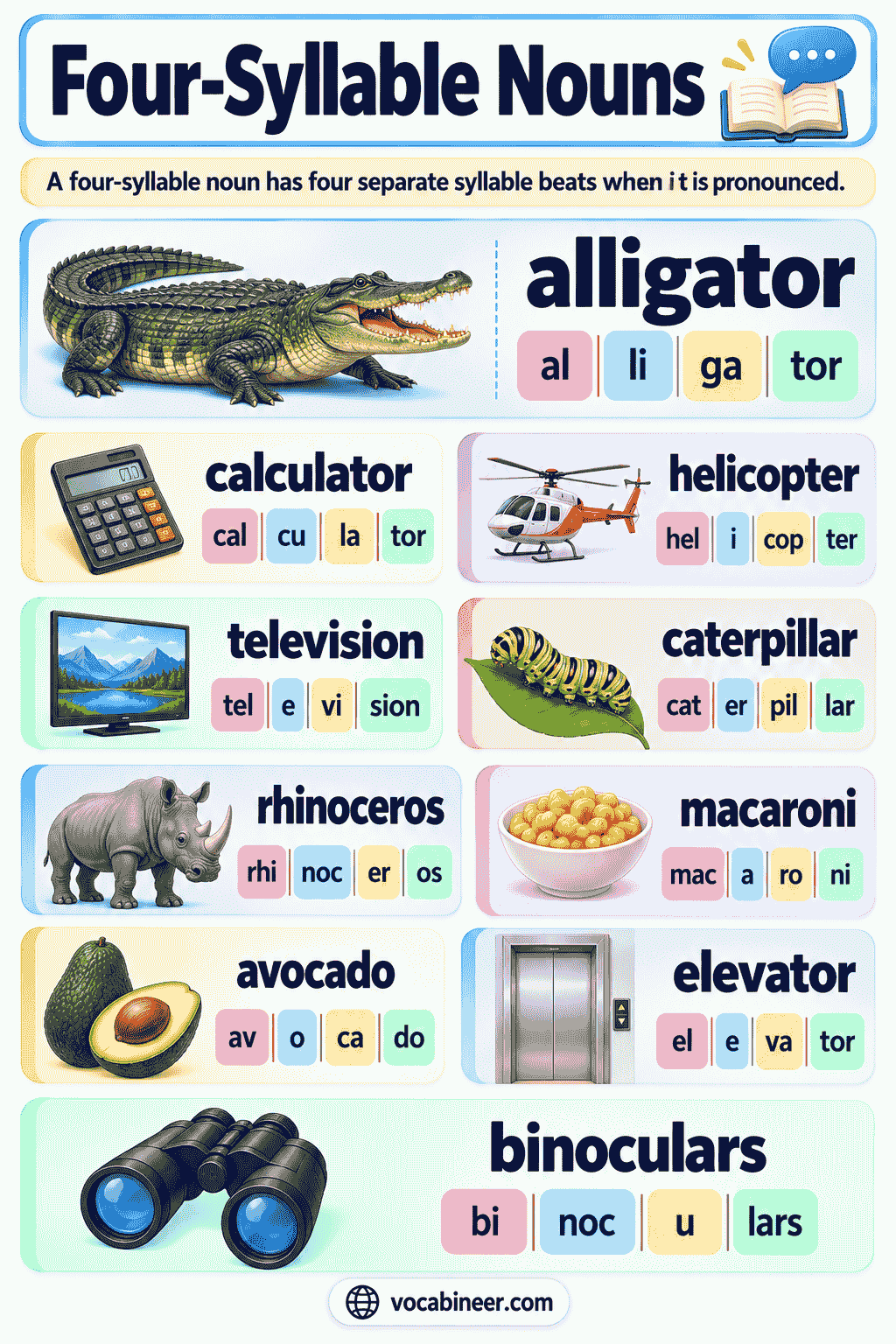
Four-syllable nouns are naming words pronounced with four separate syllables. Familiar examples include alligator, avocado, calculator, helicopter, television, and thermometer. These longer nouns appear in everyday English as well as science, education, technology, nature, and formal communication.
This guide includes 150 four-syllable nouns with simple meanings. The examples are grouped by meaning so that the list is easier to learn, while later sections explain syllable division, word stress, common noun endings, and pronunciation.
In This Page
What Are Four-Syllable Nouns?
A four-syllable noun is a noun pronounced with four separate syllables or spoken units.
For example:
alligator
al / li / ga / tor
avocado
av / o / ca / do
calculator
cal / cu / la / tor
helicopter
hel / i / cop / ter
Each word has four spoken syllables and functions as a noun.
Syllable count depends on pronunciation, not simply on the number of letters or written vowels in a word.
Common Four-Syllable Nouns
Several four-syllable nouns occur regularly in everyday speech and writing.
Alligator
A large semiaquatic reptile.
Avocado
A fruit with soft green flesh and a large seed.
Calculator
A device used to perform mathematical calculations.
Caterpillar
The larval stage of a butterfly or moth.
Elevator
A machine that carries people or goods between floors.
Helicopter
An aircraft that flies using rotating blades.
Television
A system or device used to display moving images and sound.
Thermometer
An instrument used to measure temperature.
Watermelon
A large fruit with juicy flesh.
Motorcycle
A two-wheeled motor vehicle.
Aquarium
A tank or building used for keeping aquatic life.
Automobile
A road vehicle powered by an engine or motor.
Escalator
A moving staircase.
Harmonica
A small musical instrument played with the mouth.
Barometer
An instrument used to measure air pressure.
Community
A group of people connected by place or shared interests.
Education
The process of teaching and learning.
Information
Facts or knowledge communicated about something.
Technology
The application of knowledge to practical tools and systems.
Celebration
An event held to mark a special occasion.
150 Four-Syllable Nouns With Meanings
The complete collection below contains 150 unique nouns. Each noun appears once in the counted list.
Four-Syllable Objects, Devices, and Everyday Things
Calculator
A device used for mathematical calculations.
Elevator
A machine that moves people or goods between levels.
Helicopter
An aircraft with rotating blades.
Television
A device or system for displaying moving images and sound.
Thermometer
An instrument for measuring temperature.
Binoculars
An optical instrument used to view distant objects.
Radiator
A device that gives off heat or removes heat from a system.
Escalator
A moving staircase.
Generator
A machine that produces electrical power.
Harmonica
A small wind instrument played with the mouth.
Motorcycle
A motorized two-wheeled vehicle.
Unicycle
A vehicle with one wheel.
Kaleidoscope
A viewing tube that produces changing symmetrical patterns.
Conditioner
A substance or device used to improve a condition, such as hair or air.
Machinery
Machines considered collectively.
Barometer
An instrument that measures atmospheric pressure.
Centimeter
A metric unit equal to one hundredth of a meter.
Pacifier
A rubber or silicone object given to a baby to suck.
Locomotive
A powered railway vehicle that pulls or pushes train cars.
Extinguisher
A device used to put out a fire.
Four-Syllable Animal and Nature Nouns
Alligator
A large freshwater reptile.
Caterpillar
The larval form of a butterfly or moth.
Rhinoceros
A large thick-skinned mammal with one or two horns.
Tarantula
A large hairy spider.
Chameleon
A lizard known for changing its coloration.
Stegosaurus
A plant-eating dinosaur with bony plates along its back.
Millipede
A many-legged invertebrate with a long segmented body.
Yellowjacket
A type of social wasp.
Salamander
An amphibian with an elongated body and tail.
Armadillo
A mammal covered with protective bony plates.
Anaconda
A very large South American snake.
Barracuda
A long predatory marine fish.
Dromedary
A camel with one hump.
Orangutan
A large ape native to Southeast Asia.
Hippocampus
A brain structure involved in memory and learning.
Four-Syllable Food and Plant Nouns
Avocado
A fruit with creamy green flesh.
Macaroni
A type of short tubular pasta.
Watermelon
A large sweet fruit with a thick rind.
Pepperoni
A seasoned sausage commonly used as a pizza topping.
Ravioli
Small pasta parcels containing a filling.
Oregano
An aromatic herb used in cooking.
Asparagus
A vegetable with long green shoots.
Pistachio
A small green edible nut.
Enchilada
A filled tortilla dish often served with sauce.
Tapioca
A starch obtained from cassava.
Coriander
An herb whose leaves and seeds are used in cooking.
Cappuccino
A coffee drink made with espresso and foamed milk.
Guacamole
A dish or dip made mainly from avocado.
Cannelloni
Large pasta tubes usually filled and baked.
Dandelion
A flowering plant with bright yellow flowers.
Four-Syllable Nouns for People
Ambassador
An official representative sent to another country.
Barbarian
A person regarded historically as belonging to a foreign or uncivilized group.
Biologist
A scientist who studies living organisms.
Comedian
A person who performs comedy.
Decorator
A person who decorates rooms, buildings, or objects.
Electrician
A person trained to install or repair electrical systems.
Educator
A person involved in teaching or education.
Gladiator
A fighter who competed in public contests in ancient Rome.
Illustrator
A person who creates pictures for books or other publications.
Librarian
A person who manages or works professionally in a library.
Moderator
A person who guides a discussion or manages an activity.
Narrator
A person or voice that tells a story.
Operator
A person who controls a machine, system, or service.
Paramedic
A trained emergency medical professional.
Politician
A person active in politics or government.
Photographer
A person who takes photographs.
Commentator
A person who provides spoken or written commentary.
Animator
A person who creates animated images or films.
Parachutist
A person who descends using a parachute.
Benefactor
A person who provides help, money, or support.
Four-Syllable Academic, Scientific, and Technical Nouns
Anatomy
The structure of a living body or the study of that structure.
Bacteria
Microscopic single-celled organisms.
Cerebellum
The part of the brain involved in coordination and balance.
Democracy
A system of government based on participation by the people.
Geography
The study of places, environments, and Earth’s surface.
Geometry
The branch of mathematics concerned with shapes and space.
Heroism
Brave or heroic behavior.
Humidity
The amount of water vapor present in the air.
Mathematics
The study of numbers, quantities, structures, and patterns.
Neurology
The branch of medicine concerned with the nervous system.
Pacifism
The belief that conflict should be resolved without war or violence.
Petroleum
A naturally occurring liquid used to produce fuels and other materials.
Photography
The practice or art of making photographs.
Psychology
The scientific study of mind and behavior.
Technology
Practical systems and tools developed through knowledge and science.
Velocity
Speed in a particular direction.
Zoology
The scientific study of animals.
Agriculture
The practice and science of farming.
Architecture
The art and practice of designing buildings and structures.
Ecosystem
A community of organisms and their physical environment.
Economy
A system through which goods and services are produced and exchanged.
Academy
An institution devoted to education, study, or training.
Category
A group of things sharing particular characteristics.
Certificate
An official document confirming a fact, qualification, or achievement.
Ceremony
A formal event performed according to established customs.
Diagnosis
The identification of an illness or problem from its signs and evidence.
Hypothesis
A proposed explanation that can be tested.
Phenomenon
An event or fact that can be observed or experienced.
Inventory
A detailed list of goods, materials, or possessions.
Environment
The surroundings and conditions in which something exists.
Four-Syllable Abstract and Process Nouns
Accusation
A claim that someone has done something wrong.
Activation
The process of making something active.
Admiration
A feeling of respect or approval.
Animation
The process or art of creating moving images.
Calculation
The process or result of working something out mathematically.
Celebration
An event or activity marking a special occasion.
Circulation
The movement of something through a system or area.
Compensation
Payment or another benefit given for work, loss, or injury.
Complication
A difficulty that makes a situation more complex.
Concentration
Focused attention or the amount of a substance in a mixture.
Constitution
A set of fundamental principles or laws.
Conversation
Spoken communication between people.
Decoration
Something added to make a place or object more attractive.
Definition
A statement explaining the meaning of a word or concept.
Demonstration
An act of showing how something works or expressing a public view.
Education
The process of teaching, learning, or gaining knowledge.
Elevation
Height or the act of raising something.
Generation
A group born around the same period or the process of producing something.
Graduation
The completion of a course of study, often marked by a ceremony.
Hibernation
A state of greatly reduced activity in some animals during winter.
Illustration
A picture or example used to explain something.
Information
Facts or knowledge communicated or learned.
Innovation
A new idea, method, or development.
Invitation
A request asking someone to attend or take part.
Irritation
Annoyance or physical discomfort.
Liberation
The act of becoming or making something free.
Medication
Medicine used to treat or prevent illness.
Meditation
A practice involving focused attention or quiet reflection.
Motivation
A reason or desire that encourages action.
Navigation
The process of finding or directing a route.
Observation
The act of watching or noticing carefully.
Occupation
A job or regular form of employment.
Operation
An organized activity, process, or medical procedure.
Population
The people or organisms living in a particular area.
Preparation
The process of getting something ready.
Publication
A work issued for public reading or the act of publishing.
Regulation
An official rule or the act of controlling something.
Relaxation
A state or process of becoming less tense.
Repetition
The act of doing or saying something again.
Reputation
The general opinion people have about someone or something.
Reservation
An arrangement to keep a place, seat, or service available.
Resolution
A firm decision or the solution to a problem.
Revelation
A surprising or previously unknown fact that becomes known.
Revolution
A major change in politics, society, technology, or another field.
Satisfaction
A feeling of pleasure that comes from achieving or receiving something.
Simulation
A model or imitation of a real process or situation.
Situation
A set of circumstances existing at a particular time.
Transportation
The movement of people or goods from one place to another.
Vegetation
Plants considered collectively in a particular area.
Variation
A difference or change from a usual form.
Vaccination
The administration of a vaccine.
Ability
The capacity or skill to do something.
Authority
The power or right to make decisions or give orders.
Community
A group connected by location, identity, or shared interests.
Difficulty
A problem or something that is hard to do.
Discovery
The act or result of finding something previously unknown.
Emergency
A serious situation requiring immediate action.
Humanity
People collectively or the quality of being humane.
Identity
The characteristics that define a person or thing.
Majority
The greater number or larger part of a group.
Together, these sections contain 150 different four-syllable nouns.
Concrete and Abstract Four-Syllable Nouns
Four-syllable nouns can be classified according to what they name.
Concrete nouns refer to physical people, animals, objects, foods, or other things that can usually be experienced through the senses.
Examples include:
alligator
avocado
calculator
helicopter
pistachio
thermometer
Abstract nouns name ideas, qualities, states, processes, or concepts.
Examples include:
admiration
education
motivation
reputation
satisfaction
authority
The syllable count stays separate from the noun type. Both concrete and abstract nouns can contain four syllables.
Four-Syllable Nouns Ending in -tion
Many four-syllable nouns in English end in -tion.
Examples include:
accusation
ac / cu / sa / tion
celebration
cel / e / bra / tion
decoration
dec / o / ra / tion
education
ed / u / ca / tion
generation
gen / er / a / tion
invitation
in / vi / ta / tion
motivation
mo / ti / va / tion
operation
op / er / a / tion
population
pop / u / la / tion
relaxation
re / lax / a / tion
The ending -tion commonly forms nouns describing actions, processes, states, or results. However, not every -tion noun has four syllables, so the full pronunciation still needs to be counted.
Other Common Endings in Four-Syllable Nouns
Four-syllable nouns appear with several recurring endings.
-ator and -ator-related Forms
Examples include:
calculator
generator
moderator
operator
illustrator
These endings often occur in nouns naming people, machines, or things that perform an action.
-ity
Examples include:
ability
community
humanity
identity
majority
The -ity ending frequently creates abstract nouns describing states, qualities, or conditions.
-ology and -graphy
Examples include:
neurology
psychology
zoology
geography
photography
These endings appear frequently in academic and scientific vocabulary.
An ending can help learners recognize word structure, but it does not guarantee a particular syllable count.
How to Divide Four-Syllable Nouns
To identify four syllables, focus on the spoken word.
For example:
alligator
al / li / ga / tor
There are four spoken syllables.
Another example:
helicopter
hel / i / cop / ter
Again, there are four.
You can use this process:
- Say the noun naturally.
- Slow it down without adding extra sounds.
- Listen for four vowel-centered spoken units.
- Divide the pronunciation into four parts.
- Check a reliable dictionary when the pronunciation is uncertain.
Do not simply count written vowel letters. Spelling and spoken syllable structure do not always match.
Stress in Four-Syllable Nouns
Four-syllable nouns can place their primary stress on different syllables.
Examples include:
calCUlator
avoCAdo
eduCAtion
teleVIsion
psyCHOLogy
The stressed syllable sounds more prominent than the others. It may be longer, clearer, or accompanied by a noticeable pitch change.
Unlike many common two-syllable nouns, four-syllable nouns do not follow one simple stress rule that applies to every word.
Therefore, learners should study syllable count and stress together.
Unstressed Syllables and Vowel Reduction
The remaining syllables in a four-syllable noun are usually less prominent than the syllable carrying primary stress.
For example:
calCUlator
The stressed syllable stands out, while the surrounding syllables sound weaker.
In natural English, vowels in unstressed syllables may reduce toward a weaker sound such as schwa /ə/. Because of this reduction, some long words may sound less clearly segmented in fast speech than they do when pronounced carefully.
Four-Syllable Nouns vs Other Four-Syllable Words
Having four syllables does not automatically make a word a noun.
For example:
calculator → noun
spectacular → adjective
innovative → adjective
relatively → adverb
A reliable list of four-syllable nouns therefore needs two checks:
- the word has four spoken syllables
- the word genuinely functions as a noun
This prevents general four-syllable word lists from being mistaken for noun-only vocabulary.
Can Four-Syllable Nouns Vary by Pronunciation?
Some English words can have different syllable counts depending on accent, speech rate, or vowel reduction.
This is one reason the main list favors words with relatively clear four-syllable pronunciations.
When a word sounds uncertain, check an established dictionary pronunciation rather than relying only on spelling.
Common Mistakes When Counting Four Syllables
One common mistake is counting written vowels instead of spoken syllables. Several vowel letters can belong to the same syllable.
Another mistake is assuming that every long-looking word contains four syllables. Word length and syllable count are different features.
Learners may also mix adjectives, verbs, and adverbs into a noun list simply because those words contain four syllables. Part of speech must be checked separately.
Finally, do not assume that primary stress always appears in the same position. Four-syllable nouns show several stress patterns.
Why Learn Four-Syllable Nouns?
Four-syllable nouns occur frequently in everyday vocabulary as well as academic, scientific, professional, and formal English.
Learning them can improve:
- vocabulary recognition
- syllable counting
- pronunciation
- word stress
- spelling
- reading fluency
- listening skills
- academic vocabulary
Breaking longer nouns into four spoken units also makes unfamiliar words easier to approach.
FAQs
A four-syllable noun is a naming word pronounced with four syllables, such as alligator, avocado, calculator, or helicopter.
Common examples include alligator, calculator, elevator, helicopter, television, thermometer, watermelon, education, information, and celebration.
Say the noun naturally and listen for four separate vowel-centered spoken units. A dictionary pronunciation can help when the count is uncertain.
No. Four-syllable nouns can place their primary stress in different positions, so stress should be learned with each individual word.
Yes. Accent and vowel reduction can affect how some words are pronounced. For that reason, the most reliable lists favor words with relatively stable four-syllable pronunciations.
Read More
- What is a Syllable?
- Closed syllable words
- Open syllable words
- Open and closed syllable words
- Multisyllabic Words List
- 1 syllable words
- 2 syllable words
- 3 syllable words
- 4 syllable words
- 5 syllable words
- Six syllable words