

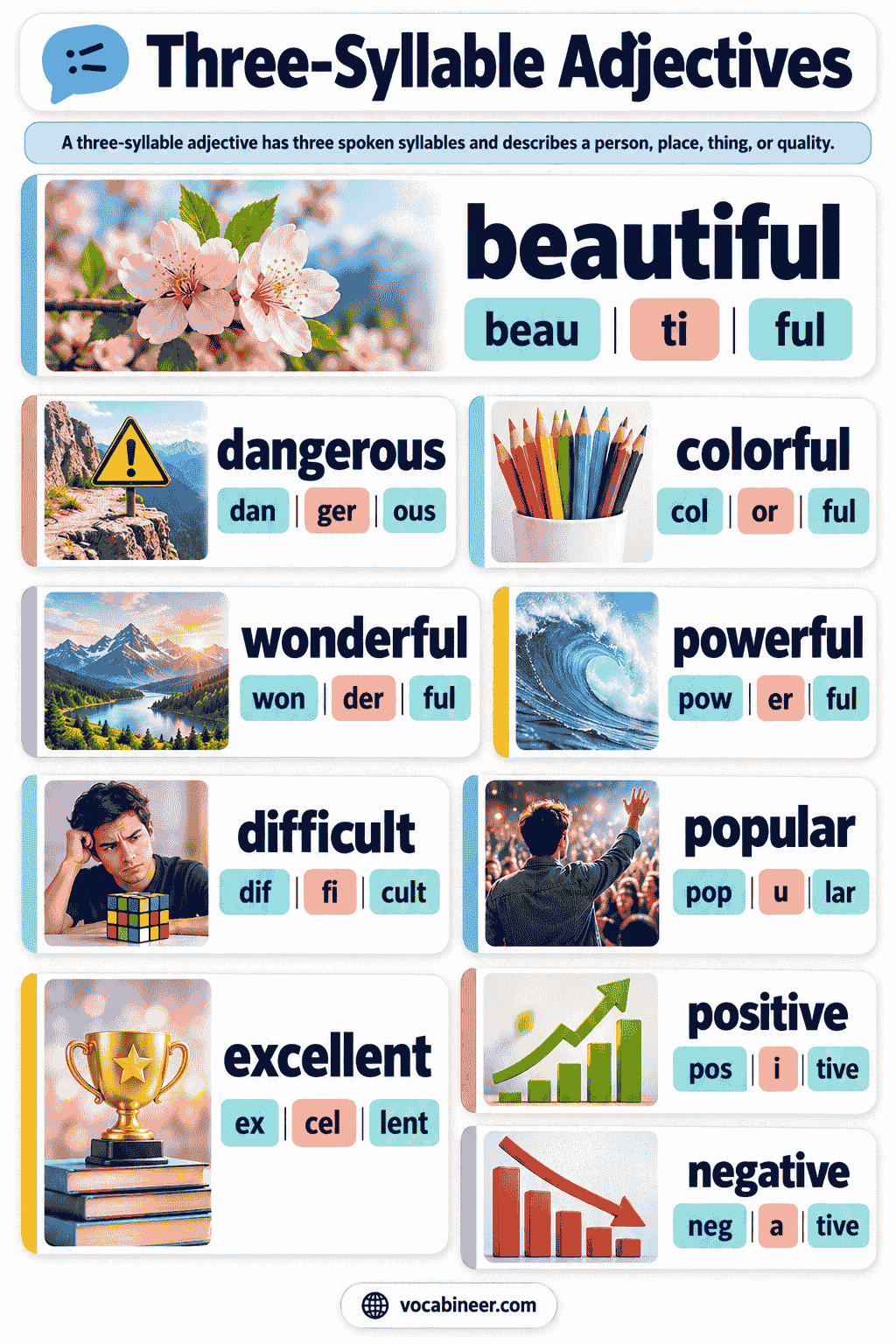
Three-syllable adjectives are describing words pronounced with three separate syllables. Familiar examples include beautiful, dangerous, expensive, popular, positive, generous, and important. These adjectives describe appearance, personality, condition, value, behavior, feelings, and many other qualities.
This guide includes 180 three-syllable adjectives with simple meanings. It also explains common adjective endings, syllable division, word stress, and the correct use of more, less, most, and least when making comparisons.
In This Page
What Are Three-Syllable Adjectives?
A three-syllable adjective is an adjective pronounced with three separate syllables or spoken units.
For example:
beautiful
beau / ti / ful
dangerous
dan / ger / ous
expensive
ex / pen / sive
popular
pop / u / lar
Each word describes a person, place, object, condition, or idea and contains three spoken syllables.
Syllable count depends on pronunciation, not simply on the number of letters or written vowels.
Common Three-Syllable Adjectives
Some frequently used three-syllable adjectives include:
Beautiful
Very attractive or pleasing.
Dangerous
Likely to cause harm.
Expensive
Costing a lot of money.
Popular
Liked or supported by many people.
Positive
Hopeful, favorable, or constructive.
Negative
Unfavorable or expressing disagreement.
Difficult
Hard to do or understand.
Important
Having great value or significance.
Excellent
Extremely good.
Colorful
Full of different or vivid colors.
Wonderful
Extremely good or enjoyable.
Powerful
Having great strength or influence.
Generous
Willing to give or share freely.
Serious
Important, thoughtful, or not humorous.
Curious
Eager to know or learn something.
180 Three-Syllable Adjectives With Meanings
The master list below contains 180 unique three-syllable adjectives.
Three-Syllable Adjectives Ending in -ive
Expensive
Costing a large amount of money.
Positive
Favorable, hopeful, or constructive.
Negative
Unfavorable or expressing denial.
Sensitive
Quick to notice, feel, or react.
Attractive
Pleasant or appealing.
Creative
Able to produce original ideas.
Supportive
Giving help or encouragement.
Aggressive
Forceful, hostile, or ready to attack.
Effective
Producing the intended result.
Defensive
Intended to protect or defend.
Offensive
Unpleasant, insulting, or attacking.
Selective
Careful about choosing particular things.
Protective
Intended to keep someone or something safe.
Reflective
Showing careful thought or reflecting light.
Productive
Producing useful results.
Destructive
Causing serious damage.
Constructive
Helpful and intended to improve something.
Extensive
Large in amount, area, or range.
Intensive
Involving great effort or concentration.
Exclusive
Limited to particular people or things.
Inclusive
Including many different people or things.
Impressive
Causing admiration.
Expressive
Showing thoughts or feelings clearly.
Progressive
Developing gradually or favoring change.
Possessive
Wanting strong control or ownership.
Successive
Following one after another.
Excessive
Greater than is reasonable or necessary.
Decisive
Able to make decisions quickly and clearly.
Divisive
Likely to cause disagreement.
Abrasive
Rough or harsh in manner or texture.
Persuasive
Good at convincing others.
Cohesive
Forming a united whole.
Elusive
Difficult to find, catch, or understand.
Abusive
Cruel, insulting, or harmful.
Intrusive
Entering where unwanted or unwelcome.
Explosive
Able to explode or likely to cause sudden conflict.
Corrosive
Able to gradually destroy a material.
Compulsive
Driven by a difficult-to-control urge.
Repulsive
Extremely unpleasant or disgusting.
Responsive
Reacting quickly or appropriately.
Assertive
Confident in expressing needs or opinions.
Attentive
Listening or watching carefully.
Inventive
Skilled at creating new ideas or solutions.
Preventive
Intended to stop something from happening.
Respective
Belonging separately to each person or thing mentioned.
Objective
Based on facts rather than personal feelings.
Subjective
Based on personal feelings or opinions.
Collective
Shared or done by a group.
Corrective
Intended to correct a mistake or problem.
Three-Syllable Adjectives Ending in -ous, -ful, and -less
Beautiful
Very attractive or pleasing.
Dangerous
Likely to cause injury or harm.
Colorful
Containing many bright colors.
Wonderful
Extremely pleasing or impressive.
Powerful
Having great strength or influence.
Generous
Willing to give or share.
Serious
Important or requiring careful thought.
Curious
Interested in learning or discovering something.
Glamorous
Attractive in an exciting or stylish way.
Hazardous
Dangerous or risky.
Marvelous
Extremely good or impressive.
Poisonous
Containing or producing poison.
Riotous
Wild, noisy, or disorderly.
Envious
Wanting something another person has.
Obvious
Easy to notice or understand.
Previous
Existing or happening before something else.
Various
Several different kinds.
Furious
Extremely angry.
Meaningful
Having an important or useful meaning.
Sorrowful
Feeling or showing deep sadness.
Masterful
Showing great skill or authority.
Merciful
Showing kindness toward someone who could be punished.
Plentiful
Existing in large amounts.
Pitiful
Deserving pity or showing weakness.
Bountiful
Available in generous amounts.
Dutiful
Careful to perform expected duties.
Fanciful
Imaginary or highly decorative.
Forgetful
Likely to forget things.
Resentful
Feeling anger because of unfair treatment.
Successful
Achieving the intended result.
Effortless
Requiring little or no apparent effort.
Motionless
Not moving.
Powerless
Without power or control.
Colorless
Having no color.
Bottomless
Appearing to have no bottom or limit.
Limitless
Without an apparent limit.
Merciless
Showing no pity or mercy.
Penniless
Having no money.
Three-Syllable Adjectives Ending in -al and -ic
Natural
Existing in nature rather than being artificial.
Personal
Relating to a particular person.
General
Affecting or concerning most things.
Several
More than two but not many.
Musical
Relating to music.
Physical
Relating to the body or material things.
Critical
Extremely important or involving careful judgment.
Typical
Showing the usual features of something.
Logical
Based on clear and sensible reasoning.
Magical
Relating to magic or seeming extraordinary.
Digital
Using electronic or computer technology.
Medical
Relating to medicine or health care.
Tropical
Relating to hot regions near the equator.
Chemical
Relating to chemistry or chemicals.
Classical
Relating to an established traditional style.
Practical
Useful and suitable for real situations.
Technical
Relating to specialized methods or skills.
Vertical
Going straight up and down.
Radical
Very different from what is usual or traditional.
Gradual
Happening slowly over time.
Mutual
Shared by two or more people.
Cultural
Relating to the ideas and customs of a society.
Dramatic
Sudden, exciting, or connected with drama.
Fantastic
Extremely good or imaginative.
Romantic
Relating to love or an idealized view.
Gigantic
Extremely large.
Specific
Clearly defined or particular.
Terrific
Extremely good or very intense.
Athletic
Strong, fit, or related to sports.
Electric
Powered by or relating to electricity.
Organic
Relating to living things or natural production.
Poetic
Relating to poetry or having an imaginative quality.
Heroic
Extremely brave or admirable.
Ironic
Showing an unexpected contrast.
Historic
Important in history.
Symbolic
Representing another idea or meaning.
Dynamic
Energetic, active, or constantly changing.
Atomic
Relating to atoms.
Aquatic
Living or growing in water.
Chaotic
Completely disorganized or confused.
Unequal
Not equal in size, amount, value, or status.
Three-Syllable Adjectives Ending in -able and -ible
Suitable
Right or appropriate for a particular purpose.
Capable
Having the ability to do something.
Portable
Easy to carry or move.
Notable
Important or worthy of attention.
Lovable
Easy to love.
Movable
Able to be moved.
Readable
Easy or pleasant to read.
Usable
Able to be used.
Visible
Able to be seen.
Edible
Safe and suitable for eating.
Terrible
Extremely bad or unpleasant.
Flexible
Able to bend or adapt easily.
Sensible
Showing good judgment.
Credible
Able to be believed.
Possible
Able to happen or exist.
Probable
Likely to happen or be true.
Durable
Able to last a long time.
Breakable
Able to be broken.
Changeable
Likely or able to change.
Countable
Able to be counted.
Favorable
Helpful, positive, or showing approval.
Valuable
Worth a lot or especially useful.
Additional Common Three-Syllable Adjectives
Popular
Liked or admired by many people.
Difficult
Hard to do, understand, or deal with.
Important
Having great significance.
Excellent
Extremely good.
Confident
Sure of yourself or your abilities.
Delicate
Fine, fragile, or requiring careful handling.
Elegant
Graceful and stylish.
Unhappy
Sad or dissatisfied.
Unfriendly
Not kind or welcoming.
Unlucky
Having bad luck.
Unhealthy
Not good for health.
Untidy
Not neat or organized.
Uncertain
Not completely sure.
Uncommon
Not often seen or found.
Unpleasant
Not enjoyable or agreeable.
Regular
Following a normal or repeated pattern.
Similar
Almost the same but not identical.
Singular
Unusual, unique, or relating to one.
Circular
Having the shape of a circle.
Maximum
Greatest or highest possible.
Minimum
Smallest or lowest possible.
Ultimate
Final, greatest, or most important.
Infinite
Without an end or limit.
Innocent
Not guilty or not intending harm.
Arrogant
Showing an exaggerated sense of importance.
Ignorant
Lacking knowledge about something.
Relevant
Closely connected to the subject.
Accurate
Correct and free from mistakes.
Fortunate
Having good luck or favorable circumstances.
Adequate
Good enough for a particular need.
Together, these sections contain 180 unique three-syllable adjectives.
Three-Syllable Adjectives for Appearance
Several three-syllable adjectives are especially useful for describing how people, places, or objects look.
Beautiful
Very attractive.
Colorful
Full of vivid colors.
Glamorous
Stylish and exciting in appearance.
Elegant
Graceful and refined.
Attractive
Pleasant or appealing to look at.
Delicate
Fine, light, or easily damaged.
Natural
Not artificial or heavily changed.
Dramatic
Striking or visually impressive.
These adjectives work naturally in phrases such as a beautiful garden, an elegant dress, or a colorful painting.
Three-Syllable Adjectives to Describe People
Three-syllable adjectives can describe personality, behavior, intelligence, and social qualities.
Generous
Willing to share with others.
Sensitive
Aware of feelings and small changes.
Confident
Sure of oneself.
Assertive
Able to express opinions confidently.
Attentive
Careful and considerate.
Creative
Good at producing original ideas.
Supportive
Ready to help or encourage.
Arrogant
Showing too much pride.
Curious
Interested in discovering new things.
Sensible
Showing sound judgment.
Three-Syllable Adjectives for Feelings and States
Some adjectives describe emotional or temporary conditions.
Unhappy
Feeling sad or dissatisfied.
Furious
Extremely angry.
Envious
Wanting something another person has.
Resentful
Feeling angry about unfair treatment.
Confident
Feeling sure of oneself.
Uncertain
Not feeling completely sure.
Sorrowful
Deeply sad.
Serious
Thoughtful or concerned about something important.
Positive and Negative Three-Syllable Adjectives
Three-syllable adjectives can describe both favorable and unfavorable qualities.
| Positive | Negative |
|---|---|
| beautiful | dangerous |
| generous | arrogant |
| excellent | terrible |
| supportive | aggressive |
| successful | unsuccessful |
| marvelous | hazardous |
| sensible | abusive |
| creative | destructive |
| attentive | intrusive |
| powerful | powerless |
The same adjective may sound positive, negative, or neutral depending on context.
Common Endings in Three-Syllable Adjectives
Recognizing adjective endings can make longer vocabulary easier to understand.
Adjectives Ending in -ive
Examples include:
creative
effective
protective
productive
responsive
attentive
The ending -ive often describes a quality, tendency, or function.
Adjectives Ending in -ous
Examples include:
dangerous
generous
curious
hazardous
poisonous
The ending -ous commonly forms adjectives meaning “having” or “full of” a particular quality.
Adjectives Ending in -ful
Examples include:
beautiful
colorful
powerful
meaningful
merciful
The ending -ful often means “full of” or “showing.”
Adjectives Ending in -less
Examples include:
effortless
motionless
powerless
colorless
limitless
The ending -less often means “without.”
Adjectives Ending in -al
Examples include:
natural
personal
musical
medical
cultural
The ending -al often means “relating to.”
These suffixes are useful clues, but no suffix guarantees that an adjective has exactly three syllables.
How to Divide Three-Syllable Adjectives
To count syllables accurately, focus on the spoken pronunciation.
For example:
beautiful
beau / ti / ful
There are three spoken syllables.
Another example:
expensive
ex / pen / sive
Again, there are three.
A useful method is:
- Say the adjective naturally.
- Slow it down without adding extra sounds.
- Listen for three vowel-centered spoken units.
- Divide the pronunciation into three parts.
- Check a reliable dictionary if the pronunciation is uncertain.
Do not simply count vowel letters.
Stress in Three-Syllable Adjectives
Three-syllable adjectives do not all stress the same syllable.
For example:
GENerous
POSitive
exPENsive
imPORtant
The stressed syllable sounds more prominent than the other two.
Stress can affect how clearly a word is understood, so syllable count and word stress should be learned together.
Three-Syllable Adjectives With First-Syllable Stress
Many common three-syllable adjectives place primary stress on the first syllable.
Examples:
GENerous
POSitive
NEGative
EXcellent
DELicate
ELegant
NATural
POPular
First-syllable stress is common, but it is not a rule for every three-syllable adjective.
Three-Syllable Adjectives With Middle-Syllable Stress
Other adjectives stress the second syllable.
Examples:
exPENsive
imPORtant
atTRACtive
agGRESsive
efFECtive
deFENsive
perSUAsive
These examples show why learners should listen to the complete pronunciation rather than predict stress from syllable count alone.
Comparative and Superlative Three-Syllable Adjectives
Most gradable three-syllable adjectives form comparisons with more and most rather than -er and -est.
For example:
| Adjective | Comparative | Superlative |
|---|---|---|
| beautiful | more beautiful | most beautiful |
| dangerous | more dangerous | most dangerous |
| expensive | more expensive | most expensive |
| attractive | more attractive | most attractive |
| powerful | more powerful | most powerful |
| difficult | more difficult | most difficult |
| important | more important | most important |
| generous | more generous | most generous |
For example:
This watch is more expensive than that one.
It is the most expensive watch in the store.
Using More, Less, Most, and Least
Three-syllable adjectives can also show lower degrees of a quality.
more expensive
A higher degree of expense.
less expensive
A lower degree of expense.
most expensive
The highest degree.
least expensive
The lowest degree.
Another example:
more dangerous
less dangerous
most dangerous
least dangerous
These forms are especially useful with longer gradable adjectives.
Common Comparison Mistakes
Learners sometimes apply the -er/-est pattern used with short adjectives to longer adjectives.
Incorrect:
beautifuller
Correct:
more beautiful
Incorrect:
dangerousest
Correct:
most dangerous
Another error is using more together with an -er form.
Incorrect:
more expensiver
Correct:
more expensive
For most three-syllable gradable adjectives, use more/most or less/least.
Three-Syllable Adjectives vs Other Three-Syllable Words
Not every three-syllable word is an adjective.
For example:
beautiful → adjective
computer → noun
understand → verb
carefully → adverb
A reliable adjective list must therefore check both:
- syllable count
- part of speech
This prevents nouns, verbs, and adverbs from being mixed into adjective vocabulary.
Can Three-Syllable Adjectives Vary by Pronunciation?
Yes. Some English words can be compressed differently depending on accent, region, or speaking speed.
For a strict numbered list, it is better to choose adjectives with relatively stable three-syllable pronunciations.
If the count sounds uncertain, check an established dictionary pronunciation rather than relying only on spelling.
Common Mistakes When Counting Three Syllables
Counting Vowel Letters
The number of written vowels does not determine the number of spoken syllables.
Mixing Other Parts of Speech Into the List
A three-syllable noun or verb is not automatically a three-syllable adjective.
Assuming Every Adjective Has the Same Stress
Three-syllable adjectives can stress different syllables.
Assuming a Suffix Determines the Count
Endings such as -ous, -ful, -ive, and -al can help identify adjectives, but they do not guarantee three syllables.
Ignoring Reduced Vowels
An unstressed vowel may sound weak but can still form part of a syllable.
Using -er and -est With Long Adjectives
Most three-syllable gradable adjectives normally use more and most instead.
Why Learn Three-Syllable Adjectives?
Three-syllable adjectives are common in everyday, academic, and professional English.
Learning them can improve:
- descriptive vocabulary
- pronunciation
- syllable recognition
- word stress
- comparative grammar
- reading fluency
- writing variety
- speaking accuracy
They also help learners move beyond basic adjectives such as big, small, good, and bad toward more precise descriptions.
FAQs
A three-syllable adjective is a describing word pronounced with three syllables, such as beautiful, dangerous, expensive, or popular.
Common examples include beautiful, dangerous, expensive, popular, positive, negative, difficult, important, generous, and excellent.
Most gradable three-syllable adjectives use more for the comparative, such as more beautiful and more expensive.
Most use most, as in most beautiful, most dangerous, and most attractive.
No. Stress can fall on different syllables depending on the adjective, so it is best to learn stress with the pronunciation of each word.
Read More
- What is a Syllable?
- Closed syllable words
- Open syllable words
- Open and closed syllable words
- Multisyllabic Words List
- 1 syllable words
- 2 syllable words
- 3 syllable words
- 4 syllable words
- 5 syllable words
- Six syllable words