

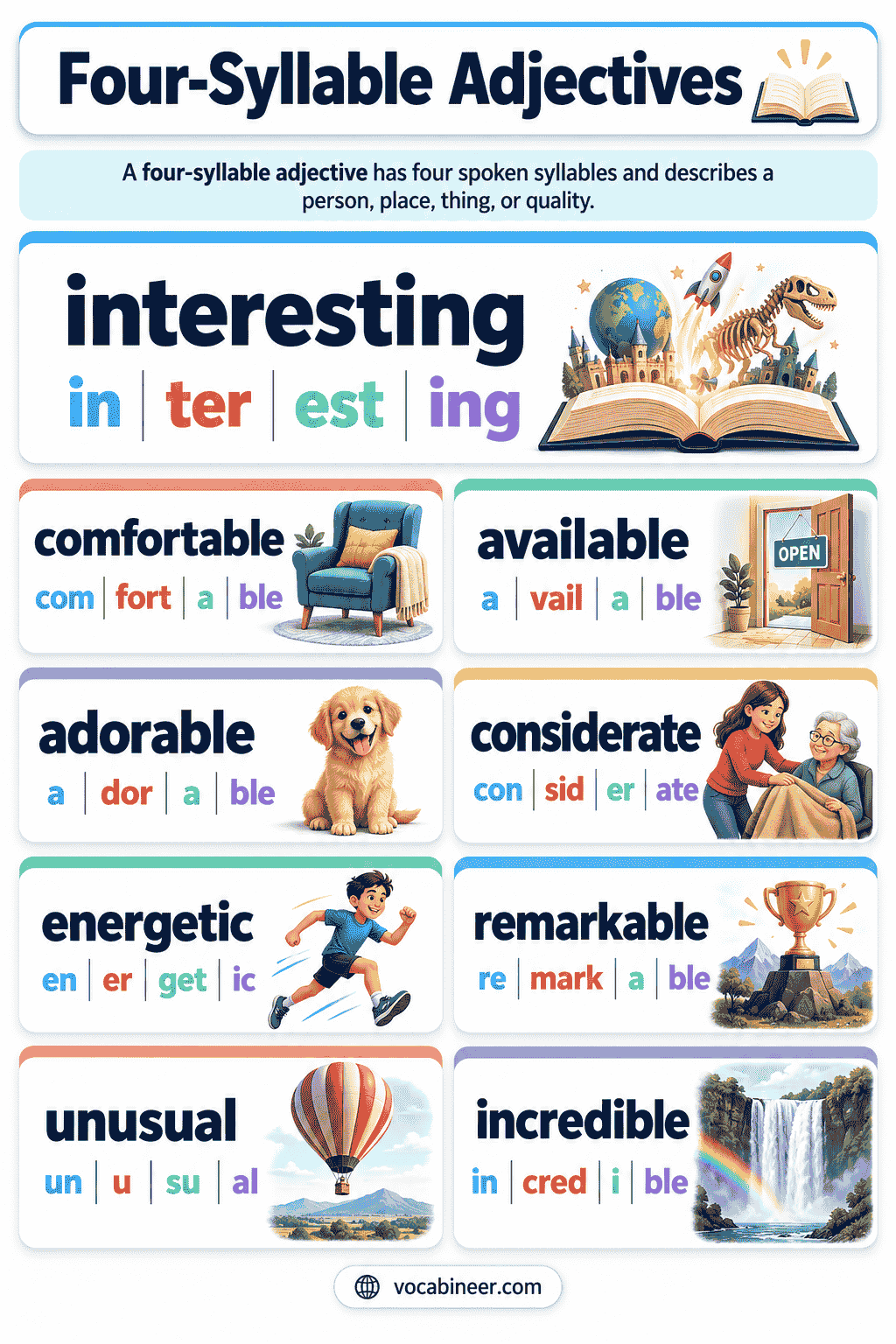
Four-syllable adjectives are describing words pronounced with four separate syllables. Examples include adorable, necessary, responsible, spectacular, historical, and automatic. These longer adjectives help describe people, objects, situations, qualities, opinions, and conditions with greater precision.
This guide contains 150 four-syllable adjectives with simple meanings. It also explains syllable division, common adjective endings, word stress, pronunciation variation, and how four-syllable adjectives form comparative and superlative structures.
In This Page
Common Four-Syllable Adjectives
Adorable
Very attractive, lovable, or charming.
Available
Ready to be used, obtained, or reached.
Compatible
Able to exist or work well together.
Dependable
Reliable and trustworthy.
Enjoyable
Giving pleasure or satisfaction.
Memorable
Worth remembering.
Predictable
Easy to expect or anticipate.
Reliable
Able to be trusted or depended on.
Remarkable
Unusual or impressive enough to attract attention.
Responsible
Having a duty or behaving sensibly.
Vulnerable
Open to harm, damage, or attack.
Necessary
Needed for a particular purpose.
Ordinary
Normal or not unusual.
Historical
Connected with history or past events.
Automatic
Working by itself with little human control.
Meticulous
Extremely careful about small details.
Intelligent
Able to learn, understand, and think well.
Magnificent
Extremely impressive or beautiful.
Professional
Connected with a profession or showing high skill.
Spectacular
Extremely impressive or striking.
What Are Four-Syllable Adjectives?
A four-syllable adjective is a describing word pronounced with four separate spoken syllables.
For example:
adorable
a / dor / a / ble
necessary
nec / es / sar / y
responsible
re / spon / si / ble
spectacular
spec / tac / u / lar
Each adjective describes a quality, condition, characteristic, or relationship while containing four spoken syllables.
Syllable count depends on pronunciation rather than spelling. A word may contain several written vowels without each vowel forming a separate syllable.
150 Four-Syllable Adjectives With Meanings
The following master list contains 150 unique adjectives treated as four syllables in standard American pronunciation.
Four-Syllable Adjectives Ending in -able and Related Forms
These adjectives commonly express possibility, suitability, or a particular quality.
- Adorable — very lovable or attractive.
- Adaptable — able to adjust to new conditions.
- Affordable — inexpensive enough to buy.
- Agreeable — pleasant or acceptable.
- Available — ready for use or access.
- Avoidable — able to be prevented.
- Believable — easy or possible to believe.
- Compatible — able to work or exist together.
- Dependable — reliable and trustworthy.
- Enjoyable — pleasant or satisfying.
- Forgettable — not memorable or impressive.
- Honorable — deserving respect.
- Manageable — possible to control or deal with.
- Measurable — able to be measured.
- Memorable — worth remembering.
Useful Four-Syllable Adjectives for Qualities and Conditions
These words describe reliability, possibility, value, and other qualities.
- Noticeable — easy to see or recognize.
- Predictable — easy to anticipate.
- Preventable — able to be stopped from happening.
- Profitable — producing financial gain or another benefit.
- Reliable — consistently trustworthy.
- Remarkable — unusually impressive.
- Renewable — able to be naturally replaced or renewed.
- Repeatable — able to be done again.
- Respectable — considered socially acceptable or worthy of respect.
- Responsible — having a duty or acting sensibly.
- Reversible — able to return to a previous state.
- Tolerable — acceptable or bearable.
- Variable — likely or able to change.
- Vulnerable — easily harmed or affected.
- Acceptable — satisfactory or permitted.
Four-Syllable Adjectives for Possibility and Function
These adjectives often describe whether something can be used, changed, detected, or achieved.
- Accessible — easy to reach, enter, or use.
- Collectible — worth collecting.
- Controllable — able to be controlled.
- Convertible — able to change into another form.
- Detectable — able to be noticed or discovered.
- Digestible — able to be digested or understood easily.
- Excitable — easily made excited.
- Applicable — relevant or suitable for a situation.
- Impossible — unable to happen or be done.
- Incredible — extremely impressive or difficult to believe.
- Invisible — unable to be seen.
- Susceptible — easily affected or influenced.
- Necessary — required or needed.
- Ordinary — usual or normal.
- Secondary — less important than something primary.
Four-Syllable Adjectives Connected With Time, Rules, and Classification
These adjectives often describe duration, obligation, tradition, or categories.
- Temporary — lasting for a limited time.
- Voluntary — done by choice rather than force.
- Mandatory — required by a rule or law.
- Legendary — famous enough to become part of legend.
- Customary — usual according to tradition.
- Arbitrary — based on personal choice rather than a clear reason.
- Honorary — given as an honor without normal duties.
- Literary — connected with literature or writing.
- Historical — connected with history.
- Identical — exactly the same.
- Electrical — connected with electricity.
- Political — connected with government or public affairs.
- Mechanical — connected with machines or machinery.
- Automatic — operating with little direct human control.
- Systematic — done according to an organized method.
Academic, Scientific, and Descriptive Four-Syllable Adjectives
These words appear frequently in academic, professional, and descriptive English.
- Problematic — causing difficulty or concern.
- Academic — connected with education or study.
- Energetic — active and full of energy.
- Scientific — connected with science.
- Democratic — based on democratic principles.
- Economic — connected with money, trade, or the economy.
- Meticulous — extremely careful and precise.
- Ridiculous — extremely unreasonable or silly.
- Miraculous — extremely surprising or seemingly impossible.
- Mysterious — difficult to understand or explain.
- Hilarious — extremely funny.
- Continuous — continuing without interruption.
- Spontaneous — happening naturally without prior planning.
- Adventurous — willing to try unusual or exciting experiences.
- Alternative — providing another possibility or choice.
Four-Syllable Adjectives for Ideas, Judgments, and Ability
These adjectives help describe opinions, approaches, abilities, and importance.
- Competitive — involving or eager for competition.
- Conservative — cautious about change or favoring traditional ideas.
- Informative — providing useful information.
- Innovative — introducing new ideas or methods.
- Affirmative — expressing agreement or confirmation.
- Comparative — involving comparison.
- Superlative — showing the highest degree or extremely good quality.
- Definitive — complete, authoritative, or final.
- Intelligent — able to understand and learn well.
- Independent — not controlled by another person or thing.
- Significant — important or meaningful.
- Magnificent — extremely impressive or beautiful.
- Considerate — thoughtful about other people’s needs.
- Appropriate — suitable for a particular situation.
- Immediate — happening without delay.
Four-Syllable Adjectives for People, Feelings, and Standards
These adjectives are useful for describing behavior, emotions, quality, and social situations.
- Affectionate — showing love or fondness.
- Compassionate — showing sympathy and concern for others.
- Spectacular — extremely impressive.
- Professional — connected with a profession or showing high standards.
- Irregular — not following a normal pattern.
- Original — new, unusual, or not copied.
- Allowable — permitted or acceptable.
- Beneficial — producing a helpful result.
- Confidential — intended to remain private.
- Conventional — following traditional or accepted practices.
- Controversial — likely to cause disagreement.
- Emotional — connected with strong feelings.
- Exceptional — unusually good or uncommon.
- Fundamental — basic and extremely important.
- Industrial — connected with manufacturing or industry.
Social, Cultural, and Relational Four-Syllable Adjectives
These adjectives commonly appear in descriptions of society, relationships, systems, and change.
- Material — connected with physical things or substances.
- Memorial — intended to remember a person or event.
- Relational — connected with relationships between things.
- Traditional — based on long-established customs.
- Conditional — depending on particular conditions.
- Directional — relating to direction or movement.
- Intentional — done deliberately.
- Sensational — extremely exciting or attention-grabbing.
- Transitional — connected with a period of change.
- Anonymous — having an unknown or unstated identity.
- Autonomous — able to govern or control itself.
- Monotonous — lacking variety and becoming boring.
- Harmonious — forming a pleasing or balanced whole.
- Notorious — famous for something negative.
- Luxurious — extremely comfortable and expensive.
Four-Syllable Adjectives for Status, Influence, and Description
These words describe achievement, systems, locations, influence, and appearance.
- Victorious — having won a competition or struggle.
- Industrious — hardworking and productive.
- Accidental — happening unintentionally.
- Continental — connected with a continent.
- Governmental — connected with government.
- Horizontal — parallel to the ground.
- Incidental — occurring as a minor part of something else.
- Influential — able to affect decisions or behavior.
- Instrumental — important in making something happen.
- Monumental — extremely important, large, or impressive.
- Ornamental — designed mainly for decoration.
- Presidential — connected with a president.
- Residential — connected with places where people live.
- Sentimental — strongly influenced by feelings or memories.
- Obedient — willing to follow rules or instructions.
Additional Four-Syllable Adjectives
These adjectives cover comparison, culture, appearance, preference, spirituality, and negative qualities.
- Equivalent — equal in value, meaning, or effect.
- Extravagant — spending or using more than necessary.
- Colonial — connected with colonies or colonial rule.
- Perennial — lasting for a long time or recurring regularly.
- Proverbial — connected with a familiar saying or widely known quality.
- Artificial — made by people rather than occurring naturally.
- Superficial — concerned only with the surface or obvious features.
- Preferential — giving an advantage to one person or group.
- Universal — applying to everyone or everything.
- Spiritual — connected with the spirit rather than material things.
- Inaccurate — not completely correct.
- Inadequate — not sufficient or good enough.
- Inanimate — not alive.
- Unfortunate — unlucky or regrettable.
- Unpopular — not liked by many people.
Together, these sections contain 150 unique four-syllable adjectives.
Four-Syllable Adjectives for Appearance and Description
Several four-syllable adjectives work especially well when describing appearance, style, or overall impression.
- Adorable — charming and lovable.
- Magnificent — extremely impressive.
- Spectacular — visually striking.
- Luxurious — richly comfortable or expensive.
- Ornamental — mainly decorative.
- Artificial — made to imitate something natural.
- Remarkable — noticeably unusual.
- Ordinary — normal or unremarkable.
- Identical — exactly alike.
- Horizontal — extending from side to side.
These adjectives work naturally in phrases such as a spectacular view, an adorable puppy, a magnificent building, and a luxurious hotel.
Four-Syllable Adjectives to Describe People
Four-syllable adjectives can also describe character, behavior, ability, and social qualities.
- Responsible — sensible and dependable.
- Intelligent — quick to understand and learn.
- Considerate — thoughtful toward others.
- Compassionate — sympathetic toward people who are suffering.
- Affectionate — openly loving.
- Professional — skilled and appropriate in behavior.
- Independent — able to act without unnecessary help.
- Obedient — willing to follow instructions.
- Industrious — hardworking.
- Adventurous — willing to try new experiences.
Positive and Negative Four-Syllable Adjectives
Four-syllable adjectives can express favorable, unfavorable, or neutral qualities.
| Positive | Negative |
|---|---|
| admirable | ridiculous |
| dependable | vulnerable |
| enjoyable | problematic |
| reliable | notorious |
| remarkable | monotonous |
| respectable | controversial |
| responsible | unfortunate |
| intelligent | inadequate |
| magnificent | inaccurate |
| beneficial | unpopular |
The exact tone still depends on context. Some adjectives may be neutral in one sentence and positive or negative in another.
Common Endings in Four-Syllable Adjectives
Long adjectives often contain recognizable suffixes. These endings can help learners identify word class, although they do not guarantee a four-syllable pronunciation.
-able and -ible
Examples include:
adorable
adaptable
affordable
dependable
responsible
accessible
These endings often express ability, suitability, or possibility.
-ary and Related Endings
Examples include:
necessary
ordinary
secondary
temporary
customary
legendary
Pronunciation of these endings can vary somewhat between accents and speaking styles.
-ic and -ical
Examples include:
automatic
academic
scientific
economic
historical
mechanical
These endings commonly appear in academic, scientific, and technical adjectives.
-ous
Examples include:
meticulous
ridiculous
miraculous
mysterious
continuous
adventurous
-ive
Examples include:
alternative
competitive
conservative
informative
innovative
affirmative
A suffix can provide a useful clue, but learners should still check the full pronunciation.
How to Divide Four-Syllable Adjectives
A four-syllable adjective contains four spoken vowel-centered units.
Examples:
adorable
a / dor / a / ble
responsible
re / spon / si / ble
spectacular
spec / tac / u / lar
automatic
au / to / mat / ic
historical
his / tor / i / cal
A useful method is:
- Say the adjective naturally.
- Slow it down without adding artificial sounds.
- Listen for four spoken syllables.
- Separate the word into four pronunciation units.
- Check a reliable dictionary when the pronunciation is uncertain.
Syllable division for learners represents spoken pronunciation, so it does not always match prefixes, roots, or suffix boundaries.
Stress in Four-Syllable Adjectives
Four-syllable adjectives do not share one universal stress pattern.
For example, different adjectives may place their strongest syllable in different positions. This is why learners should study syllable count and stress separately.
Words such as automatic, responsible, historical, spectacular, and meticulous demonstrate that longer English adjectives can have different stress placements.
A useful method is to pronounce the whole adjective naturally and listen for the syllable that sounds strongest, clearest, or most prominent.
Why Word Stress Matters
Correct stress helps make longer adjectives easier for listeners to recognize.
A learner may identify all four syllables correctly but still produce an unfamiliar pronunciation if stress falls on the wrong syllable.
Therefore, when learning a new four-syllable adjective, it helps to learn three things together:
- meaning
- syllable count
- word stress
Comparative and Superlative Four-Syllable Adjectives
Four-syllable adjectives generally form comparisons with more and most, rather than by adding -er and -est. Cambridge Grammar gives the same rule for adjectives with three or more syllables.
For example:
| Adjective | Comparative | Superlative |
|---|---|---|
| responsible | more responsible | most responsible |
| spectacular | more spectacular | most spectacular |
| meticulous | more meticulous | most meticulous |
| adorable | more adorable | most adorable |
| reliable | more reliable | most reliable |
| remarkable | more remarkable | most remarkable |
For example:
Maya is more responsible than before.
That was the most spectacular performance of the evening.
Using More, Less, Most, and Least
Long adjectives can describe both higher and lower degrees of a quality.
more reliable
A higher degree of reliability.
less reliable
A lower degree of reliability.
most reliable
The highest degree.
least reliable
The lowest degree.
The same pattern works with many other four-syllable adjectives:
more spectacular / less spectacular
most spectacular / least spectacular
more responsible / less responsible
most responsible / least responsible
Cambridge likewise uses more/less and most/least with longer adjectives.
Common Comparison Mistakes
Learners should normally avoid adding -er or -est directly to four-syllable adjectives.
Incorrect:
responsibler
Correct:
more responsible
Incorrect:
spectacularest
Correct:
most spectacular
Another mistake is combining the two comparison systems.
Incorrect:
more responsibler
Correct:
more responsible
For long adjectives, more/most and less/least provide the normal comparison pattern.
Four-Syllable Adjectives vs Other Four-Syllable Words
Not every four-syllable word is an adjective.
For example:
responsible → adjective
information → noun
community → noun
calculator → noun
communicate → verb
A strict four-syllable adjective list must therefore check both:
- syllable count
- grammatical function
This distinction prevents nouns and verbs from being added simply because they contain four syllables.
Can Four-Syllable Adjectives Vary by Pronunciation?
Yes. English speakers sometimes reduce unstressed syllables, especially in longer words.
Accent, region, and speaking speed can therefore affect how some adjectives sound.
Endings such as -ary, -ory, -able, and similar unstressed sequences may be compressed differently by different speakers.
For a fixed-number list, it is better to favor words with an established four-syllable pronunciation and avoid highly unstable examples.
Prefixes in Four-Syllable Adjectives
Prefixes can change an adjective’s meaning and sometimes its syllable count.
For example:
accurate → inaccurate
adequate → inadequate
popular → unpopular
possible → impossible
Cambridge notes that prefixes such as un-, in-, im-, il-, and ir- commonly create negative adjective forms.
However, adding a prefix does not automatically produce a four-syllable word. The resulting pronunciation must still be checked.
Participial Forms and Four-Syllable Adjectives
Some -ing and -ed forms can function as adjectives. Cambridge recognizes these forms as adjectives when they describe qualities or feelings.
However, an -ing or -ed form should not enter a strict adjective list merely because it follows a noun.
Its grammatical role and syllable count both need verification.
For that reason, the main 150-word list emphasizes established lexical adjectives rather than relying heavily on participial forms to increase the total.
Common Mistakes When Counting Four Syllables
Counting Written Vowels
Written vowels do not directly equal syllables.
Listen to pronunciation instead.
Including Nouns or Verbs
A four-syllable word belongs in this list only when it genuinely functions as an adjective.
Assuming Every Long Adjective Has the Same Stress
Four-syllable adjectives can stress different syllables.
Using -er and -est
Long adjectives normally use more/most rather than forms such as responsibler.
Ignoring Accent Differences
Some words lose or compress unstressed syllables in particular accents.
Counting the Same Word More Than Once
An adjective should appear only once in a fixed-number master list, even if it fits several semantic categories.
Why Learn Four-Syllable Adjectives?
Four-syllable adjectives occur frequently in academic, professional, descriptive, and everyday English.
Learning them can improve:
- descriptive vocabulary
- pronunciation
- syllable recognition
- word stress
- comparative grammar
- academic reading
- formal writing
- speaking precision
They also help learners move from basic descriptions toward words such as responsible, influential, spectacular, beneficial, and meticulous.
FAQs
What is a four-syllable adjective?
A four-syllable adjective is a describing word pronounced with four syllables, such as adorable, necessary, responsible, automatic, or spectacular.
What are some common four-syllable adjectives?
Common examples include available, reliable, remarkable, necessary, historical, automatic, intelligent, responsible, professional, and spectacular.
How do four-syllable adjectives form comparatives?
Most use more or less, such as more responsible, less reliable, and more spectacular.
How do four-syllable adjectives form superlatives?
Most use most or least, such as most responsible, most remarkable, and least reliable.
Do all four-syllable adjectives have the same stress pattern?
No. Stress placement differs among longer adjectives, so learners should check the pronunciation of individual words rather than assume one fixed pattern.
Read More
- What is a Syllable?
- Closed syllable words
- Open syllable words
- Open and closed syllable words
- Multisyllabic Words List
- 1 syllable words
- 2 syllable words
- 3 syllable words
- 4 syllable words
- 5 syllable words
- Six syllable words