

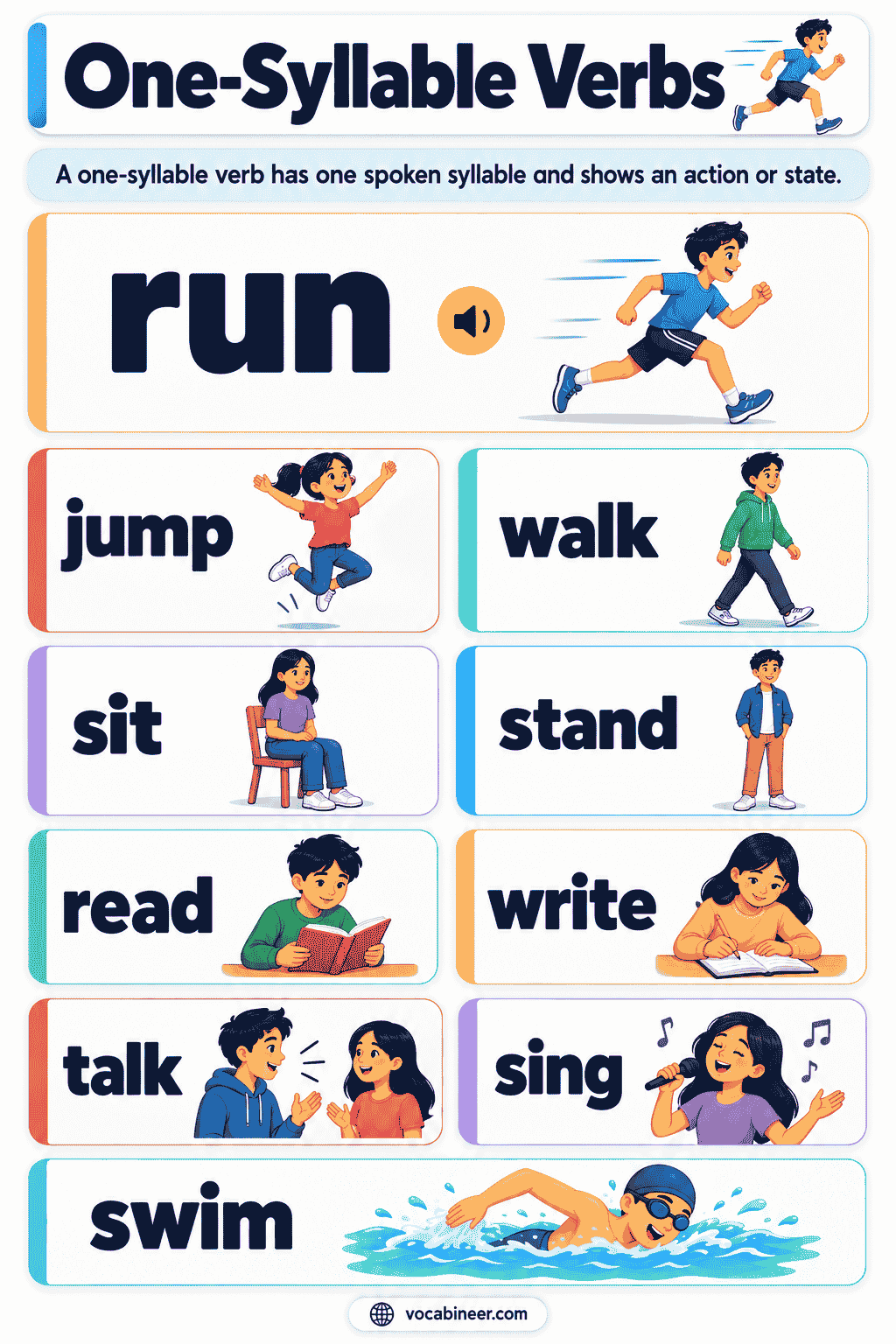
One-syllable verbs are action, state, or process words pronounced with a single spoken syllable. Common examples include run, eat, think, make, work, speak, drive, help, and learn. Many of the verbs English learners use every day belong to this short and practical group.
This guide contains 220 one-syllable verbs with simple meanings. It also explains regular and irregular forms, final-consonant doubling, silent-e spelling, verbs ending in y, and how -ed and -ing can affect pronunciation and syllable count.
In This Page
Common One-Syllable Verbs
Ask
To request information or make a request.
Break
To damage something so that it separates into pieces or stops working.
Bring
To carry or move something toward a person or place.
Build
To make something by putting parts together.
Buy
To obtain something by paying money for it.
Call
To speak to someone by phone, shout to someone, or give something a name.
Come
To move toward a person, place, or point.
Cook
To prepare food with heat.
Cut
To divide something with a sharp tool.
Draw
To make a picture or pull something toward you.
Drink
To take liquid into the mouth and swallow it.
Drive
To control and operate a vehicle.
Eat
To take food into the mouth and swallow it.
Feel
To experience an emotion, condition, or physical sensation.
Find
To discover or locate someone or something.
Give
To provide or hand something to another person.
Help
To make something easier for someone.
Learn
To gain knowledge or skill.
Make
To create or produce something.
Think
To use your mind to consider something.
220 One-Syllable Verbs With Meanings
The eleven groups below contain 20 unique base verbs each, giving a total of 220 one-syllable verbs.
Everyday One-Syllable Verbs
- Ask — to request information.
- Bake — to cook using dry heat.
- Bend — to curve or move something from a straight position.
- Bite — to cut with the teeth.
- Blow — to move air from the mouth.
- Break — to damage or separate something.
- Bring — to carry something toward a place.
- Build — to make something from parts.
- Buy — to obtain something by paying money.
- Call — to contact, shout to, or name someone.
- Catch — to stop and hold something moving through the air.
- Choose — to select from different options.
- Clean — to remove dirt.
- Climb — to move upward.
- Close — to shut something.
- Come — to move toward a place.
- Cook — to prepare food.
- Cut — to divide with a sharp edge.
- Dance — to move rhythmically to music.
- Draw — to make a picture or pull something.
One-Syllable Verbs for Actions and Daily Tasks
- Drink — to swallow a liquid.
- Drive — to operate a vehicle.
- Drop — to let something fall.
- Eat — to consume food.
- Fall — to move downward unexpectedly.
- Feel — to experience a sensation or emotion.
- Fight — to struggle or argue.
- Find — to discover something.
- Fix — to repair or correct something.
- Fly — to move through the air.
- Get — to receive or obtain something.
- Give — to provide something.
- Go — to move from one place to another.
- Grab — to take hold of something quickly.
- Grow — to increase in size or develop.
- Help — to assist someone.
- Hide — to put or stay out of sight.
- Hit — to strike something.
- Hold — to keep something in your hand or arms.
- Hope — to want something good to happen.
One-Syllable Verbs for Learning, Movement, and Feelings
- Jump — to push yourself off the ground.
- Keep — to continue having or holding something.
- Kick — to strike with the foot.
- Know — to have knowledge of something.
- Laugh — to make a sound showing amusement.
- Learn — to gain knowledge or ability.
- Leave — to go away from a place.
- Lift — to raise something.
- Like — to find something pleasant.
- Live — to be alive or reside somewhere.
- Look — to direct your eyes toward something.
- Love — to feel strong affection.
- Make — to create or produce something.
- March — to walk with regular, firm steps.
- Meet — to come together with someone.
- Move — to change position or place.
- Need — to require something.
- Pray — to speak to or worship a deity.
- Paint — to apply paint or create a picture with paint.
- Pay — to give money for something.
One-Syllable Verbs for Physical Actions
- Pick — to choose or take something.
- Plan — to decide in advance what to do.
- Play — to take part in a game or enjoyable activity.
- Pull — to move something toward you.
- Push — to move something away with force.
- Read — to understand written words.
- Ride — to travel on or in something.
- Ring — to make a bell-like sound or call by phone.
- Rise — to move upward.
- Run — to move quickly on foot.
- Save — to keep something safe or preserve it.
- Say — to express something in words.
- See — to notice with the eyes.
- Sell — to give something in exchange for money.
- Send — to cause something to go somewhere.
- Shake — to move rapidly back and forth.
- Share — to use or give something with others.
- Shout — to speak very loudly.
- Sing — to produce musical sounds with the voice.
- Sit — to rest your body on a seat.
Common One-Syllable Action Verbs
- Sleep — to rest in a natural state of unconsciousness.
- Slide — to move smoothly across a surface.
- Smile — to form a pleased expression with the mouth.
- Speak — to say words aloud.
- Spend — to use money, time, or another resource.
- Spin — to turn around quickly.
- Stand — to be upright on your feet.
- Start — to begin something.
- Stay — to remain in a place or state.
- Step — to move by lifting and placing a foot.
- Stop — to end movement or activity.
- Swim — to move through water.
- Take — to get or carry something.
- Talk — to communicate through speech.
- Teach — to help someone learn.
- Tell — to give information in words.
- Think — to use the mind.
- Throw — to send something through the air.
- Touch — to make physical contact.
- Try — to attempt something.
One-Syllable Verbs for Work and Interaction
- Turn — to move around a point or change direction.
- Use — to employ something for a purpose.
- Wait — to remain until something happens.
- Walk — to move on foot at a regular pace.
- Want — to desire something.
- Wash — to clean with water.
- Watch — to look at something carefully.
- Wear — to have clothing or an item on the body.
- Win — to succeed in a contest.
- Wish — to want something to happen.
- Work — to perform a job or task.
- Write — to form words or text.
- Yell — to shout loudly.
- Join — to connect or become part of something.
- Lead — to guide or direct.
- Lend — to give something temporarily.
- Lose — to stop having something.
- Mean — to signify or intend something.
- Pass — to move by or give something to another person.
- Reach — to arrive at or stretch toward something.
One-Syllable Verbs for Motion and Response
- Rest — to stop activity and relax.
- Roll — to move by turning over.
- Rush — to move or act quickly.
- Search — to look carefully for something.
- Serve — to provide something or help someone.
- Show — to let someone see something.
- Shut — to close something.
- Sign — to write your name or make a signal.
- Skip — to move lightly or leave something out.
- Smell — to notice an odor with the nose.
- Taste — to detect flavor.
- Test — to check quality, knowledge, or ability.
- Thank — to express gratitude.
- Trust — to believe someone is reliable.
- Vote — to make a formal choice.
- Wake — to stop sleeping.
- Wave — to move your hand or another object back and forth.
- Weigh — to measure how heavy something is.
- Yelp — to make a short sharp cry.
- Wrap — to cover something by folding material around it.
One-Syllable Verbs for Making and Handling Things
- Brush — to clean or smooth with a brush.
- Burn — to damage or consume with fire or heat.
- Burst — to break open suddenly.
- Change — to make or become different.
- Check — to examine something.
- Cheer — to shout encouragement or make someone happier.
- Chop — to cut with strong downward blows.
- Claim — to state that something is true or belongs to you.
- Count — to determine a number.
- Cross — to move from one side to another.
- Deal — to handle a situation or distribute something.
- Dig — to break or move earth.
- Dream — to experience images while sleeping or imagine something.
- Dress — to put clothes on.
- Feed — to give food.
- Fill — to make something full.
- Fold — to bend one part over another.
- Freeze — to become or make very cold.
- Guess — to answer without being certain.
- Hang — to suspend something from above.
One-Syllable Verbs for Tasks and Processes
- Hunt — to search for animals or something difficult to find.
- Knock — to strike a surface to make a sound.
- Lock — to secure something with a lock.
- Melt — to change from solid to liquid.
- Miss — to fail to hit, reach, or experience something.
- Pack — to put things into a container.
- Pour — to make liquid flow from one container.
- Print — to produce words or images on paper.
- Prove — to show that something is true.
- Raise — to lift or increase something.
- Rent — to pay to use something temporarily.
- Mend — to repair something.
- Sail — to travel in a boat or ship.
- Shoot — to fire a weapon or propel something quickly.
- Shop — to look for or buy goods.
- Solve — to find an answer to a problem.
- Sort — to arrange things into groups.
- Spell — to say or write the letters of a word.
- Sweep — to clean with a broom.
- Train — to teach or practice a skill.
One-Syllable Verbs for Body Movement and Sensation
- Bleed — to lose blood.
- Boil — to heat a liquid until it bubbles.
- Breathe — to take air into and out of the lungs.
- Chew — to crush food with the teeth.
- Crawl — to move close to the ground.
- Creep — to move slowly and quietly.
- Dive — to jump or move downward into water.
- Drag — to pull something along a surface.
- Float — to stay on the surface of a liquid or in the air.
- Glow — to produce a steady light.
- Grin — to smile broadly.
- Grip — to hold something firmly.
- Kneel — to rest on one or both knees.
- Leap — to jump a long or high distance.
- Lick — to pass the tongue over something.
- Nod — to move the head up and down.
- Peel — to remove an outer layer.
- Point — to direct attention with a finger or object.
- Press — to push firmly.
- Scratch — to rub or scrape with nails or a sharp object.
One-Syllable Verbs for Sound, Motion, and Force
- Scream — to make a loud high-pitched cry.
- Sigh — to breathe out audibly.
- Smoke — to produce smoke or inhale tobacco smoke.
- Snore — to make a rough sound while sleeping.
- Squeeze — to press something firmly.
- Stare — to look at something for a long time.
- Steal — to take something without permission.
- Stick — to attach something or remain attached.
- Stir — to move something around in a liquid.
- Stretch — to extend or lengthen something.
- Suck — to draw something into the mouth.
- Swing — to move backward and forward.
- Tear — to pull something apart.
- Thrust — to push suddenly or forcefully.
- Toss — to throw something lightly.
- Treat — to behave toward someone in a particular way.
- Weep — to cry.
- Whip — to strike or move something quickly.
- Wink — to close one eye briefly.
- Yawn — to open the mouth and breathe deeply when tired.
Together, these eleven groups contain 220 unique one-syllable base verbs.
One-Syllable Verbs for Movement
Short movement verbs are especially useful in spoken English.
Walk
To move on foot.
Run
To move quickly on foot.
Jump
To push the body off the ground.
Hop
To make a short jump.
Climb
To move upward.
Crawl
To move close to the ground.
Swim
To move through water.
Ride
To travel on or in something.
Drive
To operate a vehicle.
Fly
To move through the air.
Slide
To move smoothly across a surface.
Move
To change position.
Turn
To change direction.
Step
To move by placing one foot ahead of the other.
March
To walk with firm, regular steps.
One-Syllable Verbs for Speaking and Sound
Many common one-syllable verbs describe communication or sounds.
- Say — express something in words.
- Tell — give information.
- Ask — request information.
- Speak — produce spoken words.
- Talk — communicate through speech.
- Shout — speak loudly.
- Yell — shout strongly.
- Scream — make a loud cry.
- Sing — produce musical sounds.
- Cheer — shout encouragement.
- Sigh — breathe out audibly.
- Yelp — make a short sharp cry.
- Snore — make a sound while sleeping.
- Ring — produce a bell-like sound.
One-Syllable Verbs for Thoughts and Feelings
Not every one-syllable verb describes visible physical movement.
- Think — use your mind.
- Know — have knowledge.
- Feel — experience an emotion or sensation.
- Like — find something pleasant.
- Love — feel strong affection.
- Want — desire something.
- Need — require something.
- Hope — want something good to happen.
- Wish — desire a particular situation.
- Trust — believe someone is reliable.
- Guess — give an answer without certainty.
- Mean — intend or signify something.
Regular and Irregular One-Syllable Verbs
Some one-syllable verbs form the past tense by adding -ed. These are regular verbs.
Others change form in different ways. These are irregular verbs.
| Base Verb | Past Form | Type |
|---|---|---|
| walk | walked | regular |
| jump | jumped | regular |
| clean | cleaned | regular |
| help | helped | regular |
| wash | washed | regular |
| run | ran | irregular |
| eat | ate | irregular |
| think | thought | irregular |
| speak | spoke | irregular |
| drive | drove | irregular |
| sing | sang | irregular |
| take | took | irregular |
Both groups contain many high-frequency English verbs.
Common Irregular One-Syllable Verbs
Some of the most useful one-syllable verbs are irregular.
Be → was/were
Buy → bought
Come → came
Do → did
Drink → drank
Drive → drove
Eat → ate
Fall → fell
Feel → felt
Find → found
Fly → flew
Get → got
Give → gave
Go → went
Know → knew
Make → made
Read → read
Ride → rode
Run → ran
Say → said
See → saw
Sing → sang
Sleep → slept
Speak → spoke
Swim → swam
Take → took
Teach → taught
Think → thought
Throw → threw
Write → wrote
Because these verbs do not simply add -ed, learners normally need to learn their past forms individually.
One-Syllable Verbs That Double the Final Consonant
Many one-syllable verbs ending in a consonant-vowel-consonant pattern double the final consonant before adding -ed or -ing.
Examples:
stop → stopped → stopping
plan → planned → planning
drop → dropped → dropping
grab → grabbed → grabbing
hop → hopped → hopping
nod → nodded → nodding
wrap → wrapped → wrapping
slip → slipped → slipping
The doubled consonant helps preserve the short vowel sound in the base word.
However, spelling patterns have exceptions, so learners should not double every final consonant automatically.
When the Final Consonant Is Not Doubled
Letters such as w, x, and y normally do not double in this pattern.
For example:
snow → snowed → snowing
fix → fixed → fixing
play → played → playing
Therefore:
fixxing ❌
fixing ✅
and:
playying ❌
playing ✅
One-Syllable Verbs Ending in Silent E
Many one-syllable verbs end in a final silent e.
Examples include:
make
take
write
drive
ride
hope
bake
save
Before adding -ing, the final silent e is usually dropped:
make → making
take → taking
write → writing
drive → driving
ride → riding
hope → hoping
However, the e normally remains before -d in the past tense:
hope → hoped
save → saved
bake → baked
One-Syllable Verbs Ending in Y
Spelling also changes with some verbs ending in y.
When a consonant comes before y, the y usually changes to i before -ed:
try → tried
cry → cried
However, when a vowel comes before y, the y normally stays:
play → played
stay → stayed
With -ing, the y generally remains:
try → trying
cry → crying
play → playing
How -ed Is Pronounced in One-Syllable Verbs
The written ending -ed has three common pronunciations.
-ed Pronounced /t/
After certain voiceless sounds, -ed sounds like /t/.
Examples:
walk → walked
wash → washed
help → helped
kick → kicked
-ed Pronounced /d/
After many voiced sounds, -ed sounds like /d/.
Examples:
clean → cleaned
call → called
play → played
love → loved
-ed Pronounced as an Extra Syllable
After verbs ending in a t or d sound, -ed normally adds another syllable.
Examples:
want → wanted
need → needed
The ending therefore affects syllable count differently depending on pronunciation.
Can Verb Endings Change the Syllable Count?
Yes.
Some one-syllable base verbs remain one syllable in the past tense:
walk → walked
1 syllable → 1 syllable
jump → jumped
1 → 1
clean → cleaned
1 → 1
However:
want → wanted
1 → 2
need → needed
1 → 2
The counted list in this article therefore uses base forms, not every possible verb form.
For example, jump counts as one verb. Jumps, jumped, and jumping do not count as additional entries.
How -ing Changes One-Syllable Verbs
Adding -ing normally creates another syllable in pronunciation.
For example:
run → running
jump → jumping
walk → walking
sing → singing
work → working
The base verb is still classified as a one-syllable verb even though an inflected form may contain more than one syllable.
Spelling may also change:
run → running
stop → stopping
make → making
write → writing
This is why base-form pronunciation should control a fixed one-syllable verb list.
One-Syllable Verbs That Can Also Be Nouns
Many short English words belong to more than one word class.
For example:
Watch
Verb: “Watch the road.”
Noun: “My watch is new.”
Paint
Verb: “Paint the wall.”
Noun: “The paint is dry.”
Work
Verb: “I work at home.”
Noun: “The work is complete.”
Call
Verb: “Call your friend.”
Noun: “I received a call.”
Hope
Verb: “I hope you win.”
Noun: “There is still hope.”
Drink
Verb: “Drink some water.”
Noun: “I need a drink.”
Play
Verb: “Children play outside.”
Noun: “We watched a play.”
These words belong in a one-syllable verb list when they clearly function as verbs.
One-Syllable Verbs vs Other One-Syllable Words
Not every one-syllable word is a verb.
Compare:
run → verb
chair → noun
bright → adjective
fast → can function as an adjective or adverb
A word can also have several grammatical roles depending on context.
For that reason, a strict one-syllable verb list must check both:
- syllable count
- verb function
Stress in One-Syllable Verbs
A one-syllable verb has no internal first- or second-syllable stress pattern because it contains only one syllable.
For example:
RUN
WORK
THINK
SPEAK
In sentences, however, main verbs may receive sentence stress because they carry important information.
For example:
“They WORK here.”
The verb may sound more prominent depending on what the speaker wants to emphasize.
Common Mistakes With One-Syllable Verbs
Counting Letters Instead of Sounds
Syllable count depends on pronunciation, not word length.
For example, squeeze, strength, and breathe may look long but are pronounced with one syllable.
Including Words Without Checking Verb Use
A one-syllable noun or adjective does not automatically belong in a verb list.
Counting Different Verb Forms Separately
Walk, walks, walked, and walking are forms of the same base verb.
Doubling the Wrong Consonant
Not every final consonant doubles before -ed or -ing.
For example:
fix → fixing, not fixxing.
Forgetting Silent E Before -ing
Correct:
make → making
Incorrect:
makeing
Assuming Every -ed Ending Adds a Syllable
Walked remains one syllable, while wanted has two.
Assuming Every One-Syllable Verb Is Regular
Many common verbs are irregular, including run, eat, go, take, write, and think.
Why Learn One-Syllable Verbs?
One-syllable verbs include many of the most practical verbs in English.
Learning them can improve:
- everyday vocabulary
- phonics
- pronunciation
- spelling
- verb forms
- past-tense accuracy
- reading fluency
- speaking
- writing
They also provide clear examples for learning important spelling patterns such as consonant doubling, silent-e deletion, and -ed pronunciation.
FAQs
A one-syllable verb is an action, state, or process word pronounced with one syllable, such as run, eat, think, make, or work.
Common examples include walk, run, jump, clap, push, pull, kick, hit, throw, catch, swim, climb, lift, and stand.
No. Many are irregular. For example, run → ran, eat → ate, speak → spoke, take → took, and think → thought.
Many one-syllable verbs ending in a consonant-vowel-consonant pattern double the final consonant before endings such as -ed and -ing, as in stop → stopped and run → running.
Yes. Want has one syllable, while wanted has two. The same happens with need → needed. In contrast, forms such as walked and jumped remain one syllable.
Read More
- What is a Syllable?
- Closed syllable words
- Open syllable words
- Open and closed syllable words
- Multisyllabic Words List
- 1 syllable words
- 2 syllable words
- 3 syllable words
- 4 syllable words
- 5 syllable words
- Six syllable words