

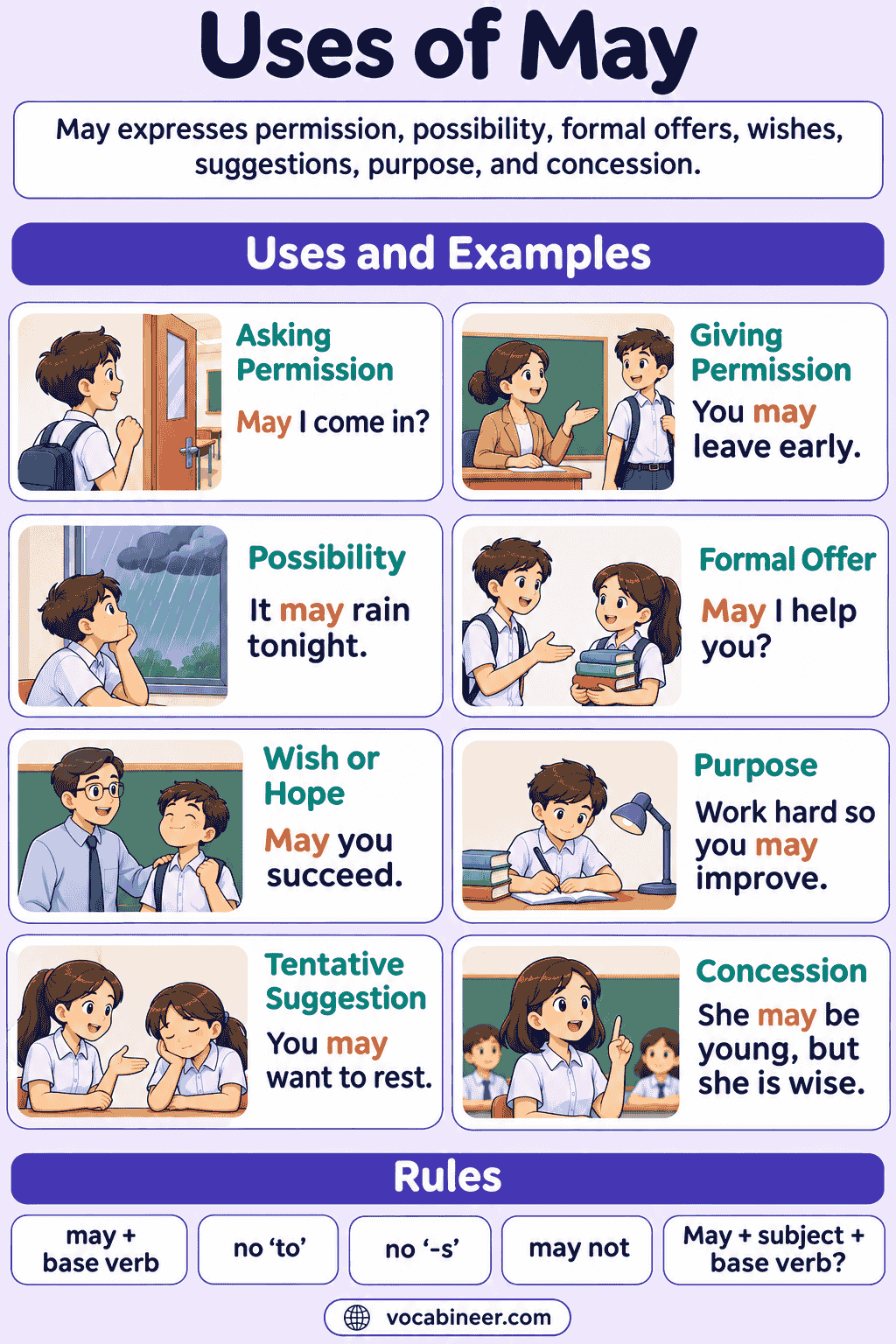
The modal verb may helps speakers express possibility, ask for or grant permission, state formal rules, and communicate wishes. For example, “It may rain tonight” presents rain as possible, while “May I come in?” asks for permission. Although these sentences use the same modal, their meanings depend on context.
Learning how may works also requires more than memorizing two uses. Its meaning changes in perfect, progressive, and passive structures, and expressions such as may well and may as well have special functions. This guide explains the forms, meanings, time references, comparisons, and common mistakes you need to use may accurately.
In This Page
May at a Glance
May is a modal auxiliary verb. It appears before the base form of another verb and adds meanings such as possibility, permission, concession, or a formal wish. It has the same form with every subject.
| Feature | Rule | Example |
|---|---|---|
| Grammatical class | Modal auxiliary verb | She may agree. |
| Main verb form | Use the base form without to | They may leave. |
| Third-person form | Do not add -s | He may join us. |
| Negative form | Place not after may | We may not attend. |
| Question form | Put may before the subject | May I enter? |
| Past possibility | Use may have + past participle | She may have forgotten. |
| Contraction | Mayn’t is extremely rare | Use may not instead. |
The major uses of may include:
- Present or future possibility
- Past possibility with may have
- Formal permission
- Wishes, hopes, and blessings
- Polite comments and interruptions
- Concession before a contrasting point
- Cautious claims in academic and formal writing
Grammatical Features of May
Like other central modal verbs, may does not behave like an ordinary lexical verb. It does not take endings for person, number, tense, or participle forms.
- Correct: She may arrive soon.
- Incorrect: She mays arrive soon.
- Correct: They may be ready.
- Incorrect: They may to be ready.
- Correct: May we begin?
- Incorrect: Do we may begin?
Moreover, may cannot normally follow another central modal. English therefore avoids combinations such as will may or might may.
- Incorrect: The plan will may change.
- Correct: The plan may change.
- Correct alternative: It will be possible for the plan to change.
Because may has no infinitive, participle, or ordinary past form, English sometimes uses an alternative expression.
| Needed Meaning or Form | Natural Alternative | Example |
|---|---|---|
| Infinitive of permission | to be allowed to | We hope to be allowed to enter. |
| Past permission | was/were allowed to | We were allowed to leave early. |
| Future permission after another modal | will be allowed to | Guests will be allowed to enter at noon. |
| Possibility after another verb | to be possible | The change appears to be possible. |
Sentence Structures with May
Affirmative Sentences
Use may after the subject and before the base form of the main verb.
Structure: Subject + may + base verb
- I may call later.
- She may need more time.
- The children may play outside.
- Our plans may change tomorrow.
Negative Sentences
Add not immediately after may. Do not use do not, does not, or did not.
Structure: Subject + may not + base verb
- I may not attend the meeting.
- He may not recognize us.
- The shop may not open today.
- Visitors may not enter this room.
The last example can express prohibition, whereas the others express negative possibility. Therefore, context matters.
Questions with May
Place may before the subject. Questions beginning with may usually ask for permission rather than possibility.
Structure: May + subject + base verb?
- May I sit here?
- May we start now?
- May she use your computer?
- May I ask another question?
Questions such as “May he be at home?” are grammatically possible but sound unusual in everyday English. Speakers generally prefer “Could he be at home?” or “Is it possible that he is at home?”
Short Answers
Short answers can repeat may, particularly in formal permission exchanges.
- “May I enter?” “Yes, you may.”
- “May we leave now?” “No, you may not.”
However, a warmer reply often sounds more natural:
- “May I borrow this chair?” “Yes, of course.”
- “May I open the window?” “Certainly.”
May for Present and Future Possibility
The most common epistemic use of may presents a situation as possible but uncertain. The speaker does not claim that it is definitely true.
Present Possibility
Use may + base verb or may be + complement for a possible present situation.
- Lina may know the answer.
- The keys may belong to Ahmed.
- The manager may be busy.
- This information may be incorrect.
In each case, the speaker considers the statement possible. However, the available evidence does not justify certainty.
Future Possibility
The same structure can refer to the future when the context or a time expression makes the reference clear.
- We may travel next month.
- The school may close early tomorrow.
- Prices may increase next year.
- I may see her this evening.
Thus, may does not need will to express a possible future event. In fact, will may is incorrect.
Negative Possibility
For a possible negative situation, use may not + base verb.
- He may not come tonight.
- The package may not arrive on time.
- They may not understand the instructions.
- The results may not support the original theory.
Here, may not means “perhaps not.” It does not mean that the event is impossible.
May for Ongoing Possibility
Use may be + verb-ing when an action may be in progress now or around a relevant time.
Structure: Subject + may be + present participle
- She may be sleeping.
- They may be waiting outside.
- The technicians may be checking the system.
- He may be working from home this week.
Do not confuse this pattern with may be + adjective or noun.
| Pattern | Function | Example |
|---|---|---|
| may be + adjective | Possible state | She may be tired. |
| may be + noun phrase | Possible identity or classification | He may be the new teacher. |
| may be + verb-ing | Possible ongoing action | She may be studying. |
May for Past Possibility
To make a present guess about a past event, use may have + past participle. This construction does not give may an ordinary past tense; instead, it places the possible event in the past.
May Have with a Past Participle
Structure: Subject + may have + past participle
- She may have missed the bus.
- They may have taken the wrong road.
- I may have left my phone at work.
- The storm may have damaged the roof.
The speaker does not know whether the event happened. Instead, each sentence offers a possible explanation.
May Have Been with a Complement
Use may have been before an adjective, noun phrase, or prepositional phrase to describe a possible past state.
- He may have been ill.
- That may have been the cause.
- They may have been at home.
- The instructions may have been unclear.
May Have Been with a Present Participle
Use may have been + verb-ing for an action that was possibly in progress during a past period.
- She may have been sleeping when you called.
- They may have been waiting for the wrong train.
- The company may have been testing the product at that time.
- He may have been driving, so he could not answer.
Negative Past Possibility
Place not after may to suggest that a past event possibly did not occur.
- She may not have received the email.
- They may not have understood the question.
- He may not have been paying attention.
- The payment may not have been processed.
These statements leave both possibilities open. For example, “She may not have received the email” means that perhaps she received it and perhaps she did not.
May for Permission
May can ask for, grant, or refuse permission. This use is polite and relatively formal, so it commonly appears in classrooms, workplaces, customer service, official rules, and respectful conversation.
Asking for Permission
- May I come in?
- May I use your phone?
- May we leave a little early?
- May I speak to the manager?
Although May I…? sounds courteous, Can I…? is more common in relaxed everyday conversation.
Giving Permission
- You may begin now.
- Students may use a calculator.
- You may take another copy.
- Guests may park behind the building.
Refusing Permission
- You may not enter this area.
- Candidates may not use dictionaries.
- Employees may not share their passwords.
- Visitors may not take photographs inside.
In these examples, may not means “are not permitted to,” not “perhaps do not.” The official context makes the intended meaning clear.
Permission Across Time
May works naturally for present or future permission. However, English usually uses was/were allowed to for permission in the past.
| Time | Natural Form | Example |
|---|---|---|
| Present | may | You may use this desk. |
| Future | may + future time expression | You may return tomorrow. |
| Past | was/were allowed to | We were allowed to leave early. |
| Future after will | will be allowed to | Members will be allowed to vote online. |
The Two Meanings of May Not
The phrase may not can express either negative possibility or prohibition. This ambiguity makes context especially important.
| Meaning | Example | Interpretation |
|---|---|---|
| Negative possibility | Sana may not attend. | Perhaps Sana will not attend. |
| Prohibition | Students may not leave early. | Students do not have permission to leave early. |
Statements about predictions, guesses, or uncertain plans usually express negative possibility. In contrast, rules, signs, instructions, and statements from an authority often express prohibition.
May for Wishes, Hopes, and Blessings
In formal wishes, may comes before the subject. Although this word order resembles a question, the sentence expresses a hope rather than asking anything.
Structure: May + subject + base verb
- May you succeed in everything you do.
- May your journey be safe.
- May they enjoy many happy years together.
- May peace prevail.
- May the best team win.
This pattern often appears in ceremonies, blessings, speeches, greetings, and literary language.
May for Polite Communication
Besides asking permission, may can introduce a respectful comment, question, suggestion, or interruption.
Polite Questions and Comments
- May I ask why the schedule changed?
- May I suggest a different approach?
- May I say how pleased we are to welcome you?
- If I may say so, the revised design looks stronger.
Polite Interruptions
- If I may interrupt, we need to check one figure.
- May I add something before we continue?
- If I may, I would like to clarify the final point.
Suggestions with You May Wish To
The expression you may wish to offers a formal, indirect suggestion.
- You may wish to save a copy of the document.
- You may wish to contact your bank first.
- Applicants may wish to review the requirements carefully.
This phrasing sounds less direct than you should, so it works well in professional correspondence and formal guidance.
May for Concession and Contrast
The pattern may … but accepts that one point is true or possible before introducing a contrasting, often more important point.
- The task may be difficult, but it is not impossible.
- He may lack experience, but he learns quickly.
- The apartment may be small, but it is comfortable.
- The method may cost more, but it produces better results.
Writers often use this structure to create a balanced argument. Related forms include may well … but and may have … but.
- She may well be disappointed, but she will remain professional.
- The team may have lost the match, but it played extremely well.
May in Academic and Formal Writing
Academic writers frequently use may as a hedge. A hedge limits the strength of a claim and shows that the writer recognizes uncertainty, variation, or incomplete evidence.
- These results may indicate a change in consumer behavior.
- The difference may arise from environmental factors.
- A larger sample may produce a different result.
- This approach may help researchers identify hidden patterns.
Without may, some claims would sound too absolute.
| Absolute Claim | Cautious Claim |
|---|---|
| The treatment causes fatigue. | The treatment may cause fatigue. |
| The difference results from age. | The difference may result from age. |
| This method improves accuracy. | This method may improve accuracy. |
Formal writing also uses may for general possibilities or situations that can occur under certain conditions.
- Excessive heat may damage the equipment.
- Some learners may find the final stage challenging.
- Delays may occur during periods of high demand.
May in Passive Constructions
Use a passive construction when the receiver of an action matters more than the performer or when the performer is unknown.
| Time | Structure | Example |
|---|---|---|
| Present or future | may be + past participle | The meeting may be postponed. |
| Past | may have been + past participle | The message may have been deleted. |
Additional examples include:
- Applications may be submitted online.
- The road may be closed tomorrow.
- Your order may be delayed by bad weather.
- The documents may have been sent to the wrong address.
- The error may have been caused by outdated software.
Notably, a passive sentence with may can express possibility or permission.
| Sentence | Meaning of May |
|---|---|
| The form may be incomplete. | It is possible that the form is incomplete. |
| The form may be submitted online. | Online submission is permitted. |
May in Conditional Sentences
May commonly appears in the result clause of a real or possible condition.
- If the weather improves, we may go outside.
- If you restart the device, it may work normally.
- If demand continues to rise, prices may increase.
- Unless we act soon, the problem may become worse.
These sentences present a possible result rather than a certain one. More remote or imaginary conditions often favor might.
| Type of Situation | Example |
|---|---|
| Open, realistic possibility | If she finishes early, she may join us. |
| More remote hypothesis | If she had more time, she might join us. |
May in Purpose Clauses
Formal English sometimes uses may after so that or in order that to express purpose.
- Speak clearly so that everyone may understand.
- The records are preserved so that future researchers may examine them.
- We have included a map so that visitors may find the building easily.
- The policy was revised in order that all applicants may receive fair treatment.
In everyday English, can often replaces may in present or future purpose clauses. Nevertheless, may remains common in formal, legal, ceremonial, and academic styles.
May in Relative and Indefinite Clauses
Formal language sometimes places may in clauses beginning with words such as whoever, whatever, and however.
- Whoever may be responsible should report the error.
- Whatever the cause may be, the machine needs inspection.
- However difficult it may seem, the problem has a solution.
- Whichever option you may choose, read the conditions first.
These patterns leave an identity, cause, degree, or choice open. In less formal English, speakers often omit may without changing the basic message.
May in Reported Speech
When a speaker reports earlier words, may often changes to might. This process is called backshift.
| Direct Speech | Reported Speech |
|---|---|
| She said, “I may leave early.” | She said that she might leave early. |
| He said, “It may rain.” | He said that it might rain. |
| They said, “We may need help.” | They said that they might need help. |
However, may can remain unchanged when the possibility is still current or when the reporter does not apply backshift.
- The doctor said that the treatment may take several weeks.
- The notice explained that delays may occur during repairs.
Therefore, the choice depends on time, viewpoint, and reporting style rather than on a mechanical rule alone.
Ellipsis with May
When the missing verb phrase is clear from context, speakers can omit it after may or may not.
- Some guests may attend, but others may not.
- “May I use this seat?” “Yes, you may.”
- Ali may join us, and Sara may too.
- I do not know whether she will call, but she may.
This omission prevents unnecessary repetition while preserving the meaning.
Common Expressions with May
May Well
May well can indicate a strong or reasonable possibility.
- She may well win the competition.
- The figures may well be inaccurate.
- This may well be our best option.
It can also show that a reaction is understandable or justified.
- You may well be disappointed after waiting so long.
- They may well feel concerned about the delay.
May As Well
May as well suggests that no better alternative exists or that an action is sensible in the circumstances.
- The bus is not coming, so we may as well walk.
- Since everyone is here, we may as well begin.
- We have finished our work, so we may as well go home.
The expression might as well is more common in many everyday contexts and can also create a stronger negative comparison: “You might as well talk to a wall.”
May or May Not
This expression emphasizes that either outcome remains possible.
- The plan may or may not succeed.
- She may or may not accept the offer.
- The change may or may not affect current customers.
If I May
If I may politely introduces a comment, objection, clarification, or action.
- If I may, I would like to offer another explanation.
- That conclusion is premature, if I may say so.
Come What May
Come what may means “whatever happens.”
- Come what may, we will support each other.
- She intends to finish the project, come what may.
Be That as It May
This formal expression means “despite what has just been said.”
- The task may be difficult. Be that as it may, we must complete it.
- His intentions were good. Be that as it may, the decision caused problems.
As the Case May Be
This expression means “whichever possibility applies.”
- Contact the manager or deputy, as the case may be.
- The applicant must provide a passport or identity card, as the case may be.
May Compared with Related Forms
May vs Might
Both modals express possibility, and their meanings often overlap. However, might can sound more tentative or remote, while may often sounds slightly more formal. Speakers do not follow a universal probability scale, so fixed percentage claims are misleading.
| Point | May | Might |
|---|---|---|
| Present or future possibility | It may rain. | It might rain. |
| Formality | Often slightly more formal | Often neutral or tentative |
| Hypothetical distance | Less commonly marks remoteness | Common in remote conditions |
| Reported speech | Original form | Often the backshifted form of may |
| Permission | Formal and current | Very formal or less common |
May vs Can
| Use | May | Can |
|---|---|---|
| Formal permission | May I enter? | Can I enter? sounds less formal. |
| Giving permission | You may begin. | You can begin. sounds more conversational. |
| Uncertain possibility | It may rain tonight. | Not normally used for the same uncertain prediction |
| General possibility | Mistakes may occur. | Mistakes can occur. |
| Ability | Not normally used | She can swim. |
For permission, both forms can be correct; context and formality determine the better choice. For ability, however, use can, not may.
May vs Could
| Use | May | Could |
|---|---|---|
| Uncertain possibility | The plan may work. | The plan could work. |
| Asking permission | May I leave? | Could I leave? |
| Requesting another person’s action | Unusual: May you help me? | Natural: Could you help me? |
| Past ability | Not used | She could swim at five. |
| Hypothetical option | Less common | We could take a taxi. |
May vs Must
| Meaning | May | Must |
|---|---|---|
| Uncertain deduction | She may be at work. | — |
| Strong deduction | — | She must be at work. |
| Permission | You may leave. | — |
| Obligation | — | You must leave. |
Thus, may leaves room for doubt, whereas deductive must expresses a strong conclusion. In rules, may grants permission, while must imposes an obligation.
May Not vs Cannot
| Form | Possible Meaning | Example |
|---|---|---|
| may not | Perhaps not | He may not agree. |
| may not | Is not permitted to | You may not enter. |
| cannot/can’t | Is impossible | That cannot be true. |
| cannot/can’t | Lacks ability | She cannot swim. |
| cannot/can’t | Is not permitted to | You can’t park here. |
May Have vs Might Have
Both forms can describe a possible past event. Might have sometimes sounds more tentative, but the distinction is not absolute.
| May Have | Might Have |
|---|---|
| She may have forgotten. | She might have forgotten. |
| The train may have left. | The train might have left. |
In other contexts, might have can describe an unrealized possibility: “We might have won if we had practiced more.” May have is generally less natural for that counterfactual meaning.
Maybe vs May Be
Maybe and may be sound similar, but they have different grammatical roles.
| Form | Role | Meaning | Example |
|---|---|---|---|
| maybe | One-word adverb | perhaps | Maybe she is busy. |
| may be | Modal + verb | is possibly | She may be busy. |
A simple test is to replace maybe with perhaps. If the sentence remains grammatical, the one-word adverb is likely correct.
Pronunciation of May
May is pronounced /meɪ/, rhyming with day and say. It may receive strong stress when the speaker emphasizes permission, contrast, or uncertainty.
- You may leave, but you do not have to.
- It may happen, although I doubt it.
The negative contraction mayn’t exists but is extremely rare in modern English. Therefore, use the full form may not in both speech and writing.
Common Mistakes with May
Using To After May
| Incorrect | Correct |
|---|---|
| She may to arrive late. | She may arrive late. |
| We may to need help. | We may need help. |
Adding S to the Main Verb
| Incorrect | Correct |
|---|---|
| He may comes tomorrow. | He may come tomorrow. |
| The price may increases. | The price may increase. |
Using Do, Does, or Did
| Incorrect | Correct |
|---|---|
| Do I may sit here? | May I sit here? |
| She does not may attend. | She may not attend. |
Combining May with Another Modal
| Incorrect | Correct |
|---|---|
| It will may happen. | It may happen. |
| She might may come. | She may come. / She might come. |
Confusing Maybe and May Be
| Incorrect | Correct |
|---|---|
| She maybe tired. | She may be tired. |
| May be she forgot. | Maybe she forgot. |
Writing May Of Instead of May Have
| Incorrect | Correct |
|---|---|
| He may of left. | He may have left. |
| They may of misunderstood. | They may have misunderstood. |
Using the Wrong Form After May Have
| Incorrect | Correct |
|---|---|
| She may have forget. | She may have forgotten. |
| They may have go home. | They may have gone home. |
Using May for Ability
| Incorrect or Unnatural | Natural |
|---|---|
| She may swim very well. | She can swim very well. |
| I may speak three languages. | I can speak three languages. |
Using May for a Direct Request
May I…? asks permission for the speaker’s action. It does not normally ask another person to perform an action.
| Unnatural Request | Natural Request |
|---|---|
| May you open the door? | Could you open the door? |
| May you send me the file? | Could you send me the file? |
Assigning Fixed Certainty Percentages
Do not assume that may always shows a higher probability than might or could. Context, stress, evidence, register, and speaker preference all affect the interpretation.
Practical Guide to Choosing May
| Intended Meaning | Recommended Form | Example |
|---|---|---|
| Uncertain present possibility | may + base verb | She may know. |
| Uncertain future possibility | may + base verb | We may travel next week. |
| Possible ongoing action | may be + verb-ing | He may be sleeping. |
| Possible past event | may have + past participle | They may have left. |
| Formal permission request | May I + base verb? | May I enter? |
| Formal authorization | may + base verb | Members may vote. |
| Past permission | was/were allowed to | We were allowed to leave. |
| Formal wish | May + subject + base verb | May you succeed. |
| Cautious academic claim | may + base verb | The findings may indicate change. |
| Direct request to another person | could/would + subject | Could you help me? |
| Ability | can/could | She can swim. |
FAQs
May mainly expresses possibility and formal permission. It can also introduce wishes, polite comments, concessions, purpose clauses, and cautious claims in formal writing.
Use subject + may + base verb in an affirmative sentence, as in “She may come.” Use may not for the negative and place may before the subject in a permission question: “May I come in?”
Both modals can express possibility. Might often sounds more tentative or remote, while may may sound more formal. However, their meanings overlap, and neither modal has a fixed probability percentage.
Use may have + past participle to make a present guess about a past event, as in “She may have forgotten.” For past permission, use was/were allowed to rather than treating may as an ordinary past-tense verb.
Maybe is one adverb meaning “perhaps,” as in “Maybe he is busy.” May be consists of the modal may and the verb be, as in “He may be busy.”
Final Summary
The modal verb may most often expresses uncertain possibility or formal permission. It always takes a base verb, keeps the same form with every subject, forms negatives with may not, and forms questions without do. In addition, may be, may be doing, may have done, and may have been doing allow speakers to describe possible states and actions across different times.
Beyond these basic uses, may expresses formal wishes, polite comments, concession, purpose, and cautious academic claims. Context also helps distinguish the two meanings of may not: “perhaps not” and “not permitted.” By learning these structures and comparing may with might, can, could, and related forms, you can choose it accurately in both everyday and formal English.
Read More
- Verbs in English
- Action Verbs
- Regular Verbs
- Irregular Verbs
- Transitive and Intransitive verbs
- Finite and Non-finite verbs
- Principal Parts of Verbs
- Forms of Verbs