

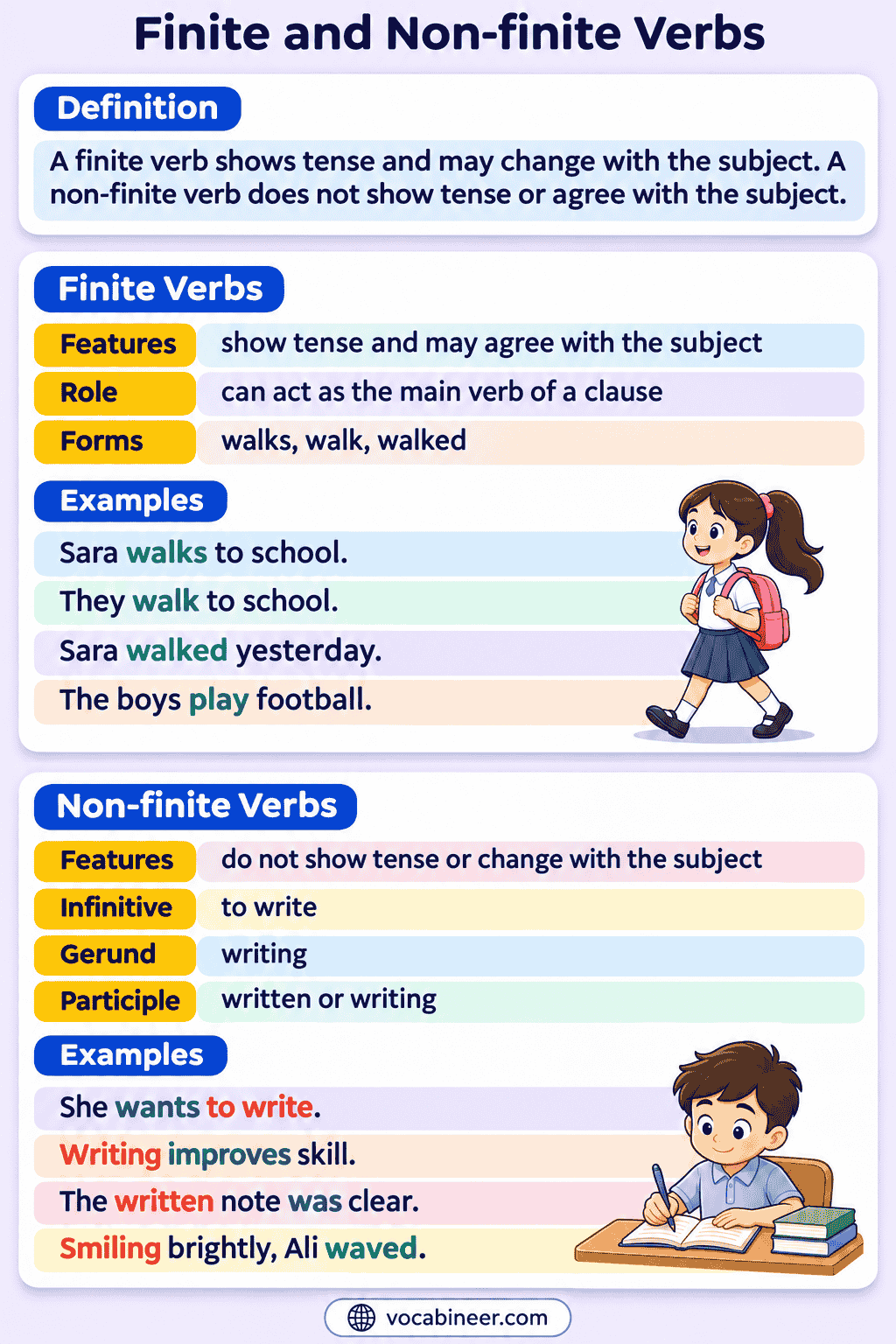
Finite and non-finite verbs differ in the grammatical work they perform. A finite verb anchors a finite clause and relates to a subject, tense, or finite modal meaning. A non-finite verb does not carry primary tense or agree with a subject, although it can still express an action, take an object, and form part of a larger verb phrase.
Understanding this distinction makes complex sentences easier to analyze. It also clarifies how auxiliaries, infinitives, gerunds, and participles work together. This guide explains the major forms, their functions, identification methods, verb chains, clause structures, common mistakes, and clear examples.
In This Page
Finite and Non-Finite Verbs at a Glance
A finite verb carries the grammatical information that anchors an ordinary finite clause. A non-finite verb depends on a finite clause or works inside a non-finite clause without carrying primary tense or subject agreement itself.
| Feature | Finite Verb | Non-Finite Verb |
|---|---|---|
| Primary tense | Carries present or past tense, or functions as a finite modal | Does not carry primary tense |
| Subject agreement | May show person or number agreement | Does not agree with a subject |
| Clause function | Anchors a finite clause | Appears in or heads a non-finite clause |
| Common forms | Present, past, finite auxiliaries, modal verbs | Infinitives, -ing forms, past participles |
| Example | She writes daily. | She likes to write. |
One sentence can contain both types:
She has decided to study abroad.
| Verb Form | Classification | Explanation |
|---|---|---|
| has | Finite | Carries present tense and agrees with she |
| decided | Non-finite | Past participle following has |
| to study | Non-finite | To-infinitive completing decided |
The complete finite verb phrase is has decided. Within that phrase, has is the finite auxiliary, while decided is the non-finite lexical verb. The phrase to study abroad forms a separate non-finite clause.
What Is a Finite Verb?
A finite verb is a verb form that anchors a finite clause. It usually carries present or past tense, relates to a grammatical subject, and may show agreement in person or number. Finite modal verbs such as can, should, and will also anchor clauses, although they do not display ordinary subject agreement.
Consider these examples:
- Ayesha works from home.
- They worked yesterday.
- Hamza is studying.
- We have completed the task.
- You should leave now.
In the first two sentences, the lexical verb itself is finite. In the final three, an auxiliary or modal carries finiteness, while another verb appears in a non-finite form.
Finite Verbs Carry Primary Tense
English finite verbs normally contrast present and past. English usually expresses future time with the finite modal will followed by a bare infinitive.
| Time Reference | Example | Finite Element |
|---|---|---|
| Present | She works here. | works |
| Past | She worked yesterday. | worked |
| Future meaning | She will work tomorrow. | will |
Therefore, work in will work does not carry future tense itself. The modal will anchors the clause, and work remains a non-finite bare infinitive.
Finite Verbs Relate to a Subject
A finite verb normally belongs to a clause with an expressed or understood subject.
- The student writes clearly.
- They have arrived.
- Close the door. — The imperative has the understood subject you.
The subject controls agreement where English displays it. However, English has less visible agreement than many other languages.
Finite Verbs May Show Agreement
Most present-tense lexical verbs show visible agreement only with a third-person singular subject.
| Subject | Present Form |
|---|---|
| I | work |
| You | work |
| He or she | works |
| We | work |
| They | work |
Consequently, the unchanged form work can still be finite in I work or they work. The absence of a visible ending does not automatically make a verb non-finite.
Finite Verbs Can Be Lexical Verbs, Auxiliaries, or Modals
| Type | Example | Finite Verb |
|---|---|---|
| Lexical verb | Sana teaches English. | teaches |
| Primary auxiliary | Sana is teaching English. | is |
| Perfect auxiliary | Sana has taught English for years. | has |
| Modal auxiliary | Sana may teach tomorrow. | may |
The finite verb is not always the word carrying the central dictionary meaning. In Sana has taught English, has carries finiteness, while taught supplies the main lexical meaning.
What Is a Non-Finite Verb?
A non-finite verb is a verb form that does not carry primary tense or show agreement with a subject. It cannot independently anchor an ordinary declarative clause, but it can form part of a finite verb phrase or head a non-finite clause.
The main non-finite forms are:
- To-infinitives: to read, to travel, to understand
- Bare infinitives: read, travel, understand
- -ing forms: reading, traveling, understanding
- Past participles: read, traveled, understood
Non-finite verbs remain verbal in important ways. They can take objects, complements, and adverbial modifiers.
| Non-Finite Construction | Verbal Property |
|---|---|
| reading the report | Takes the direct object the report |
| speaking clearly | Takes the adverb clearly |
| being extremely patient | Takes the adjective complement extremely patient |
| having completed the task | Expresses perfect aspect |
| being questioned by police | Expresses passive voice |
Non-finite forms do not carry primary tense, but they can express relative time, aspect, and voice. Context and the finite clause usually establish their time reference.
Types of Non-Finite Verbs
| Type | Structure | Example |
|---|---|---|
| To-infinitive | to + base verb | to write |
| Bare infinitive | Base verb without to | write |
| Gerund | -ing form in a noun-like position | Writing helps me relax. |
| Present participle | -ing form in a modifier or verb phrase | She is writing. |
| Past participle | Regular or irregular participle form | written, broken, played |
| Perfect infinitive | to have + past participle | to have written |
| Passive infinitive | to be + past participle | to be selected |
| Perfect participle | having + past participle | having finished |
| Passive participle | being + past participle | being questioned |
The categories overlap in form. For example, a gerund and a present participle both end in -ing, so their grammatical function—not their spelling—determines the label.
To-Infinitives
A to-infinitive contains the marker to followed by the base form of a verb. An infinitive clause can perform several functions.
| Function | Example |
|---|---|
| Subject | To learn a language takes time. |
| Verb complement | She wants to travel. |
| Purpose | He called to confirm the date. |
| Noun modifier | I have work to finish. |
| Adjective complement | We are ready to begin. |
In these constructions, to acts as an infinitive marker rather than an ordinary preposition.
Infinitive To Versus Prepositional To
Prepositional to must be followed by a noun, pronoun, or noun-like -ing construction. Infinitive to takes a base verb.
| Infinitive Marker To | Prepositional To |
|---|---|
| I want to leave. | I look forward to leaving. |
| She decided to apply. | She is committed to improving. |
| Followed by a base verb | Followed by a noun-like expression |
Therefore, I look forward to meeting you is correct because to belongs to the preposition in look forward to.
Negative Infinitives
Place not before a to-infinitive when the infinitive itself carries the negative meaning.
| Sentence | Meaning |
|---|---|
| She decided not to go. | Her decision was to avoid going. |
| She did not decide to go. | She made no decision to go. |
English also allows split infinitives when the placement improves clarity: to clearly explain the rule and to gradually improve. Avoiding every split infinitive can produce awkward or ambiguous writing.
Bare Infinitives
A bare infinitive uses the base verb without to. It commonly follows modal verbs and several specific constructions.
| Trigger | Example |
|---|---|
| Modal verb | She can swim. |
| Let | Let them enter. |
| Make | The teacher made us wait. |
| Perception verb | We saw him leave. |
| Help | Help me carry this box. |
| Had better | You had better call. |
| Would rather | I would rather stay home. |
The verb help permits either form in many contexts: Help me carry this box and Help me to carry this box.
Active and Passive Patterns with Make
An active construction with make takes a bare infinitive, but its passive equivalent normally takes a to-infinitive.
| Active Construction | Passive Construction |
|---|---|
| They made him leave. | He was made to leave. |
| The teacher made us wait. | We were made to wait. |
Gerunds
A gerund is an -ing form used in a noun-like position. Although the whole gerund clause can function as a subject or complement, the gerund retains verbal properties inside that clause.
- Reading every day improves vocabulary.
- She enjoys reading novels.
- He left without saying goodbye.
- We appreciated Sara’s helping us.
In reading novels, the gerund reading takes the direct object novels. In reading every day, it takes the time modifier every day.
Gerunds Versus Verbal Nouns
A gerund remains strongly verbal, while a verbal noun behaves more like an ordinary noun.
| Gerund Construction | Verbal Noun |
|---|---|
| Building the bridge took two years. | The building of the bridge took two years. |
| Takes a direct object | Usually takes an of phrase |
| Can take an adverb: building carefully | Can take an adjective: careful building |
| Normally lacks a plural in this use | Can sometimes take a plural form |
Present Participles
A present participle also ends in -ing. It can help form a progressive verb phrase, modify a noun, or head a participial clause.
| Use | Example |
|---|---|
| Progressive verb phrase | They are waiting. |
| Noun modifier | The woman standing outside is my aunt. |
| Adverbial participial clause | Feeling tired, he went home. |
| Complement after a perception verb | I heard the baby crying. |
Gerunds Versus Present Participles
| Gerund | Present Participle |
|---|---|
| Occupies a noun-like position | Modifies or helps form a verb phrase |
| Swimming improves fitness. | The children are swimming. |
| I enjoy reading. | The sleeping child woke up. |
| The clause acts as a subject or complement | The form contributes progressive or modifying meaning |
Some modern grammar frameworks use the combined term gerund-participle because both uses share the same verb form. The traditional distinction remains useful for explaining their different functions.
Past Participles
A past participle may have a regular -ed or -d ending, or it may take an irregular form such as written, broken, seen, made, or gone. Past participles appear in perfect constructions, passive constructions, modifiers, and participial clauses.
| Use | Example |
|---|---|
| Perfect construction | She has written a letter. |
| Passive construction | The window was broken. |
| Noun modifier | The damaged package arrived. |
| Participial clause | Exhausted by the journey, they rested. |
Simple Past Versus Past Participle
| Simple Past: Finite | Past Participle: Non-Finite |
|---|---|
| She wrote a letter. | She has written a letter. |
| The glass broke. | The glass was broken. |
| They finished early. | They had finished early. |
| He went home. | He has gone home. |
Regular simple-past and past-participle forms often look identical. In They finished early, finished is finite. In They had finished early, had is finite and finished is a non-finite past participle.
Perfect and Passive Non-Finite Forms
Non-finite constructions can express whether an event occurred earlier, continues over time, or receives an action.
| Form | Structure | Example |
|---|---|---|
| Perfect infinitive | to have + past participle | She appears to have forgotten. |
| Passive infinitive | to be + past participle | The forms need to be signed. |
| Progressive infinitive | to be + present participle | He seems to be sleeping. |
| Perfect progressive infinitive | to have been + present participle | She appears to have been waiting. |
| Perfect participle | having + past participle | Having finished, they left. |
| Passive participle | being + past participle | He disliked being questioned. |
| Perfect passive participle | having been + past participle | Having been warned, we acted carefully. |
These forms lack primary tense, but they establish a time or voice relationship with the finite clause.
| Construction | Interpretation |
|---|---|
| She hopes to leave. | Leaving is simultaneous with or later than hoping. |
| She appears to have left. | Leaving occurred before the present judgment. |
| Having finished, she went home. | Finishing occurred before going home. |
| She denied having taken the file. | Taking occurred before the denial. |
Finite and Non-Finite Forms in Verb Phrases
In an ordinary multiword English verb phrase, the first verb carries finiteness. The remaining verbs take non-finite forms.
| Verb Phrase | Finite Element | Non-Finite Elements |
|---|---|---|
| is working | is | working |
| has finished | has | finished |
| will leave | will | leave |
| may have arrived | may | have, arrived |
| was being repaired | was | being, repaired |
| could have been waiting | could | have, been, waiting |
The Order of an Auxiliary Chain
English auxiliary chains generally follow this order:
Modal + perfect have + progressive be + passive be + lexical verb
| Verb Phrase | Analysis |
|---|---|
| may have finished | Finite modal + perfect auxiliary + past participle |
| has been working | Finite perfect auxiliary + non-finite been + present participle |
| may have been working | Finite modal + perfect have + progressive been + present participle |
| may have been being watched | Finite modal + perfect + progressive + passive + lexical participle |
The final pattern is grammatical but heavy. Writers often rephrase it for clarity.
Forms of Be in Verb Phrases
| Form of Be | Usual Classification | Example |
|---|---|---|
| am, is, are | Finite present forms | She is working. |
| was, were | Finite past forms | They were waiting. |
| be | Usually a non-finite bare infinitive | She may be waiting. |
| being | Non-finite present participle | The bridge is being repaired. |
| been | Non-finite past participle | They have been waiting. |
Plain-form be also appears in imperatives and subjunctive clauses, which require separate analysis.
Finite Verb, Main Verb, and Verb Phrase
The labels finite verb and main verb do not always identify the same word.
| Term | Meaning | Example in She has completed the task |
|---|---|---|
| Finite verb | Carries finiteness | has |
| Main or lexical verb | Carries the central dictionary meaning | completed |
| Non-finite verb | Lacks primary tense and agreement | completed |
| Complete finite verb phrase | Contains the finite and non-finite elements | has completed |
This distinction becomes even clearer in She may have completed the task. The modal may is finite, have and completed are non-finite, completed is the lexical verb, and may have completed is the complete finite verb phrase.
Do-Support in Questions, Negatives, and Emphasis
When an English clause lacks another auxiliary, forms of do carry finiteness in simple-tense questions, negatives, and emphatic statements. The lexical verb then appears as a bare infinitive.
| Sentence | Finite Verb | Non-Finite Verb |
|---|---|---|
| Does she work here? | does | work |
| He does not understand. | does | understand |
| Did they leave early? | did | leave |
| She did finish the work. | did | finish |
Therefore, work in Does she work here? is not finite even though the same form is finite in They work here.
Finite and Non-Finite Clauses
A finite clause contains a finite verb or verb phrase. A non-finite clause centers on an infinitive, -ing form, or past participle.
| Finite Clause | Non-Finite Clause |
|---|---|
| Anchored by a finite verb | Centers on a non-finite form |
| Carries primary tense or finite modal meaning | Does not carry primary tense |
| Usually has an expressed subject | May have an understood or expressed subject |
| Because she felt tired | Feeling tired |
| After he completed the work | After completing the work |
| The files that were submitted yesterday | The files submitted yesterday |
Non-finite clauses often make writing more concise. However, writers must keep the intended subject clear.
Subjects of Non-Finite Clauses
Non-finite verbs do not agree with a subject, but their clauses can still have understood or expressed subjects.
| Type of Subject | Example |
|---|---|
| Understood from the main clause | Mia left early to catch the bus. |
| Object form before an infinitive | I expected her to arrive. |
| Noun before an -ing form | We disliked Tom arriving late. |
| Possessive form before a gerund | We appreciated Tom’s helping us. |
| Subject introduced by for | For everyone to agree would be unusual. |
| Subject in an absolute construction | Weather permitting, we will travel. |
Understood Subjects and Control
The main clause often determines who performs the non-finite action.
| Sentence | Understood Subject of the Non-Finite Verb |
|---|---|
| Sara hopes to win. | Sara |
| We asked Sara to wait. | Sara |
| Ali left early to catch the bus. | Ali |
| The teacher told the students to sit down. | The students |
In Sara hopes to win, Sara both hopes and may win. In We asked Sara to wait, the object Sara supplies the understood subject of to wait.
Functions of Non-Finite Clauses
| Function | Example |
|---|---|
| Subject | Reading daily improves vocabulary. |
| Verb complement | She enjoys reading novels. |
| Purpose | He called to confirm the booking. |
| Noun modifier | The man waiting outside is my uncle. |
| Adverbial | Feeling tired, she went home. |
| Reduced relative clause | The forms submitted yesterday are ready. |
| Object-related complement | We saw him leave. |
| Adjective complement | She is eager to begin. |
The non-finite clause can contain its own objects and modifiers even though it does not carry primary tense.
Modal Verbs and Finiteness
The central modal verbs are can, could, may, might, must, shall, should, will, and would. They function as finite verbs and take a bare infinitive.
- She can swim.
- You should leave.
- They might arrive soon.
Central modals do not normally have infinitive, gerund, or participle forms. Standard English does not use to can, modal canning, or musted.
Modal verbs often express ability, possibility, permission, obligation, prediction, or hypothetical meaning rather than straightforward time.
| Modal | Common Meaning |
|---|---|
| can | Ability or possibility |
| may | Possibility or permission |
| must | Obligation or deduction |
| will | Prediction, willingness, or future reference |
| could | Past ability, possibility, or hypothetical meaning |
Imperatives and Subjunctive Clauses
Visible tense and agreement provide useful identification clues, but they do not solve every case. Imperatives and subjunctive clauses use the plain verb form.
| Construction | Example | Important Point |
|---|---|---|
| Imperative | Be careful. | The subject you is normally understood. |
| Imperative | Close the door. | The plain form creates a complete command. |
| Subjunctive | I insist that he be present. | Be does not show ordinary agreement. |
| Subjunctive | They recommended that she arrive early. | Arrive remains unchanged after she. |
Grammar frameworks differ in how they analyze imperatives, but both examples form complete commands without an overt tense ending. Subjunctive clauses are finite clauses even though their plain-form verbs lack ordinary agreement. Therefore, sentence function and clause structure matter more than spelling alone.
How to Identify Finite and Non-Finite Verbs
Use this process:
- Divide the sentence into clauses.
- Find every verb and verb phrase.
- Locate the verb carrying primary tense or finite modal meaning.
- Check for subject agreement where English displays it.
- Identify the first auxiliary or modal in each verb phrase.
- Look for to-infinitives, bare infinitives, -ing forms, and past participles.
- Check whether do carries finiteness in a question or negative statement.
- Use context when finite and non-finite forms look identical.
- Distinguish the finite element from the lexical verb.
- Consider imperatives and subjunctives as special cases.
Analyzing Complete Sentences
| Sentence | Finite Verb or Verbs | Non-Finite Form or Forms |
|---|---|---|
| She wants to travel. | wants | to travel |
| They have been waiting. | have | been, waiting |
| Does he enjoy reading? | does | enjoy, reading |
| We saw the child cross the road. | saw | cross |
| Having finished, Sara went home. | went | having finished |
| The documents were being checked. | were | being, checked |
Identical Finite and Non-Finite Forms
Spelling alone cannot always reveal finiteness.
| Finite Use | Non-Finite Use |
|---|---|
| They walk every day. | They can walk home. |
| We put the boxes away yesterday. | We will put them away later. |
| They played yesterday. | They have played before. |
| The doors closed at six. | The doors were closed at six. |
| I read every evening. | I like to read every evening. |
The surrounding auxiliaries, clause structure, subject, and meaning reveal the function of each form.
Can a Clause Contain More Than One Finite Verb?
An ordinary verb phrase contains one finite element, but coordination and multiple clauses require careful analysis.
| Structure | Example | Analysis |
|---|---|---|
| One finite verb phrase | She has finished. | Has is the finite element. |
| Coordinated finite predicates | She sings and dances. | The predicates are coordinated. |
| Multiple finite clauses | She left because she felt tired. | Each clause has a finite verb. |
| Shared finite auxiliary | She has written and submitted the report. | Has applies across the coordinated participles. |
Therefore, “one finite verb per clause” works only as a starting guideline. Coordination can produce more complex patterns.
Common Mistakes with Finite and Non-Finite Verbs
Using a Non-Finite Form as the Only Verb
| Incorrect | Correct | Explanation |
|---|---|---|
| The students studying in the library. | The students are studying in the library. | The complete sentence needs a finite verb. |
| Sara to finish the report. | Sara finished the report. | A to-infinitive cannot independently anchor this declarative clause. |
Treating Every -ing Form as a Gerund
| Sentence | Correct Classification |
|---|---|
| Swimming is enjoyable. | Gerund in a subject position |
| The children are swimming. | Present participle in a progressive verb phrase |
| The swimming children waved. | Present participle modifying children |
Confusing Simple Past Forms with Past Participles
| Incorrect | Correct | Explanation |
|---|---|---|
| She has wrote a letter. | She has written a letter. | Has requires a past participle. |
| They had went home. | They had gone home. | Had requires the participle gone. |
Adding To After a Modal Verb
| Incorrect | Correct |
|---|---|
| She can to swim. | She can swim. |
| You must to leave. | You must leave. |
Omitting To Where It Is Required
| Incorrect | Correct |
|---|---|
| She wants leave. | She wants to leave. |
| They decided wait. | They decided to wait. |
Using the Wrong Form After Make or Let
| Incorrect | Correct |
|---|---|
| Let him to speak. | Let him speak. |
| They made us to wait. | They made us wait. |
| We were made wait. | We were made to wait. |
Confusing the Finite Verb with the Lexical Verb
| Sentence | Finite Verb | Lexical Verb |
|---|---|---|
| She has completed the task. | has | completed |
| They may have arrived. | may | arrived |
Creating a Dangling Participle
The understood subject of an introductory participial clause should normally match the subject of the main clause.
| Dangling Construction | Correct Construction |
|---|---|
| Walking to school, the rain started. | Walking to school, I noticed that it had started raining. |
| Having finished the report, the computer was turned off. | Having finished the report, Mina turned off the computer. |
Assuming Non-Finite Clauses Never Have Subjects
| Incorrect Claim | Correct Explanation |
|---|---|
| Non-finite clauses cannot have subjects. | They may have expressed subjects, as in for him to leave or Tom arriving late. |
Finite and Non-Finite Verb Examples
| Category | Example | Analysis |
|---|---|---|
| Simple finite present | She reads every evening. | Reads is finite. |
| Simple finite past | They arrived early. | Arrived is finite. |
| Finite auxiliary | He is working. | Is is finite; working is non-finite. |
| Perfect phrase | We have finished. | Have is finite; finished is non-finite. |
| Modal phrase | You should rest. | Should is finite; rest is a bare infinitive. |
| To-infinitive | She hopes to win. | Hopes is finite; to win is non-finite. |
| Bare infinitive | Let him speak. | Speak is a bare infinitive. |
| Gerund | Traveling broadens the mind. | Traveling heads the subject clause. |
| Present participle | The children are playing. | Playing forms part of the progressive phrase. |
| Past participle | The window was broken. | Broken forms part of a passive phrase. |
| Perfect infinitive | She seems to have forgotten. | The infinitive expresses earlier time. |
| Passive infinitive | The form needs to be signed. | The infinitive has passive meaning. |
| Perfect participle | Having eaten, they left. | Eating occurred before leaving. |
| Reduced relative | The files sent yesterday arrived. | Sent yesterday modifies files. |
| Expressed subject | I expected her to call. | Her is the subject of the infinitive clause. |
| Do-support | Did she call? | Did is finite; call is non-finite. |
| Auxiliary chain | They may have been waiting. | May is finite; the other verbs are non-finite. |
| Subjunctive | We require that he be present. | Be heads a finite subjunctive clause. |
| Imperative | Listen carefully. | The plain form creates a command with understood you. |
| Coordinated predicates | She writes and edits articles. | The finite predicates are coordinated. |
FAQs
A finite verb anchors a finite clause. It carries primary tense or finite modal meaning, relates to a subject, and may show person or number agreement. In She works here, works is finite.
A non-finite verb does not carry primary tense or agree with a subject. Infinitives, -ing forms, and past participles are the main non-finite forms. In She wants to leave, to leave is non-finite.
The main types are to-infinitives, bare infinitives, gerunds or gerund-participles, present participles, and past participles. These forms can also create perfect, progressive, and passive non-finite constructions.
Yes. In They have decided to leave, have is finite, while decided and to leave are non-finite. Complex sentences frequently contain both types.
Look for the first verb carrying tense, agreement, or finite modal meaning. In She may have been waiting, may is finite, while have, been, and waiting are non-finite.
Conclusion
Finite verbs anchor finite clauses by carrying primary tense or finite modal meaning and relating to a subject. Non-finite forms—including infinitives, -ing forms, and past participles—do not carry primary tense or agreement, but they can express actions, take complements, and build complex verb phrases and clauses. Because identical forms can perform different jobs, use clause structure, auxiliaries, agreement, and context—not spelling alone—to classify each verb correctly.
Read More
- Parts of Speech in English
- Nouns in English with Examples
- Common and Proper Nouns
- Countable and uncountable nouns
- Collective nouns
- Abstract and concrete nouns
- Gender nouns
- Compound nouns
- Possessive nouns
- Singular and plural nouns
- Plural noun rules