

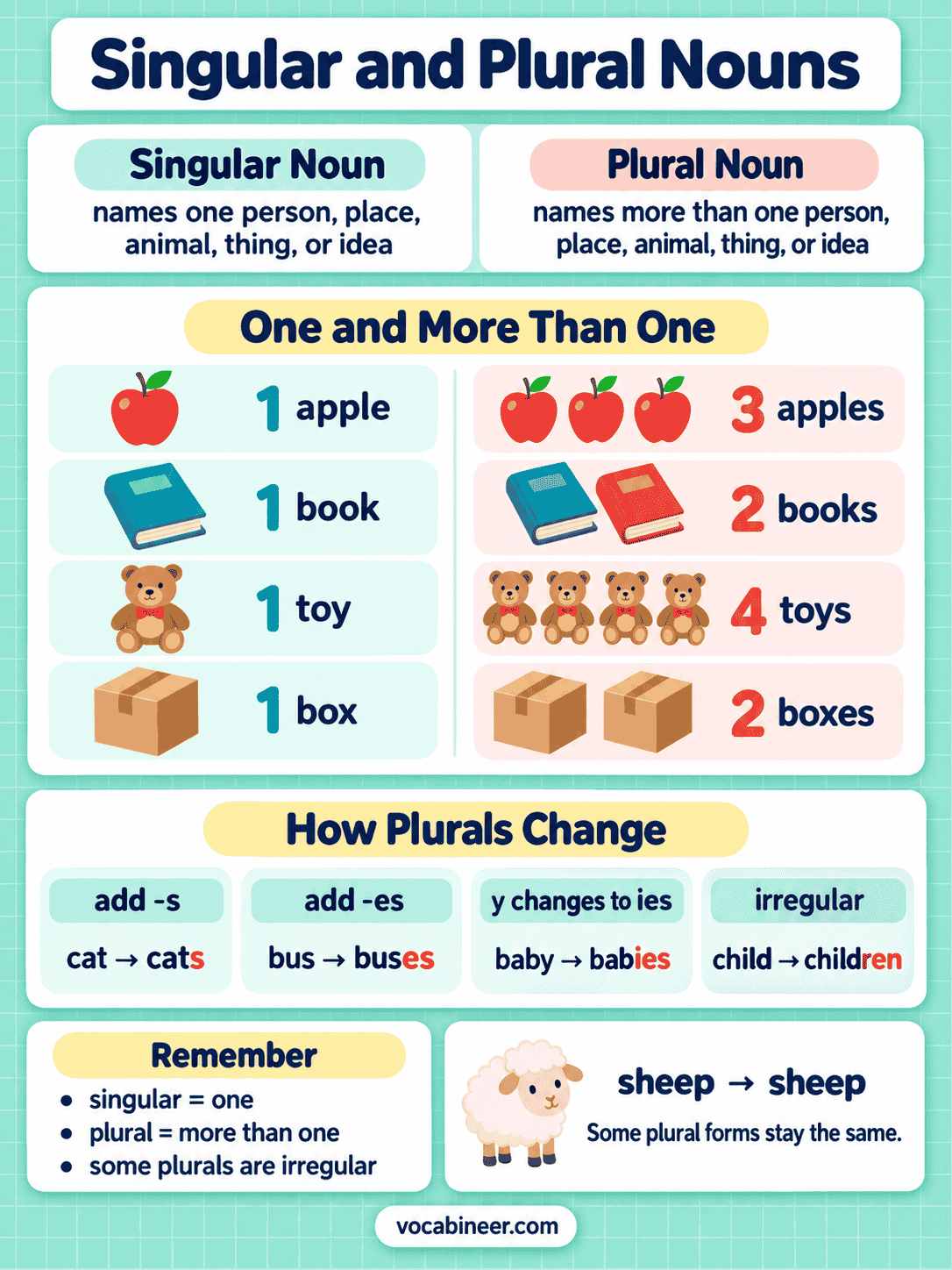
Singular and plural nouns show whether we are talking about one person, animal, place, thing, or idea, or more than one. A singular noun names one, such as book, child, or city, while a plural noun names more than one, such as books, children, or cities.
Learning singular and plural nouns helps students form words correctly, choose the right verb, and use determiners such as this, that, these, and those accurately. Most plurals follow regular spelling rules, but irregular nouns, unchanged plurals, and uncountable nouns need special attention.
In This Page
Singular and Plural Nouns: The Basic Difference
A singular noun refers to one person, animal, place, thing, or idea.
Examples:
- book
- dog
- child
- teacher
- city
A plural noun refers to more than one.
Examples:
- books
- dogs
- children
- teachers
- cities
The basic difference is:
Singular = one
Plural = more than one
Compare:
| Singular | Plural |
|---|---|
| book | books |
| box | boxes |
| baby | babies |
| wife | wives |
| child | children |
| sheep | sheep |
These examples show that English plurals do not all follow the same pattern.
How Regular Plural Nouns Are Formed
Most English nouns form their plurals through a small number of spelling patterns.
Add -s
Most nouns become plural by adding -s.
Examples:
- book → books
- car → cars
- apple → apples
- teacher → teachers
- school → schools
- chair → chairs
- flower → flowers
- table → tables
In sentences:
- One book is on the desk.
- Three books are on the desk.
- The teacher is speaking.
- The teachers are speaking.
Add -es
Nouns ending in s, sh, ch, x, or z usually form the plural with -es.
Examples:
- bus → buses
- dish → dishes
- watch → watches
- box → boxes
- quiz → quizzes
- class → classes
In sentences:
- This box is heavy.
- These boxes are heavy.
- The bus is late.
- The buses are late.
Nouns Ending in Y
The plural rule depends on the letter before y.
Consonant + Y
Change y to i and add -es.
Examples:
- baby → babies
- city → cities
- story → stories
- family → families
- country → countries
- party → parties
Vowel + Y
Keep the y and add -s.
Examples:
- boy → boys
- key → keys
- toy → toys
- day → days
- monkey → monkeys
Compare:
| Singular | Plural |
|---|---|
| baby | babies |
| city | cities |
| boy | boys |
| key | keys |
The rule changes because baby ends in consonant + y, while boy ends in vowel + y.
Nouns Ending in F or FE
Some nouns ending in f or fe change to -ves.
Examples:
- wife → wives
- knife → knives
- loaf → loaves
- thief → thieves
- leaf → leaves
- life → lives
However, some simply add -s.
Examples:
- roof → roofs
- belief → beliefs
- cliff → cliffs
- chief → chiefs
Therefore, f/fe → ves is a common pattern, not a universal rule.
Nouns Ending in O
Some nouns ending in o take -es.
Examples:
- potato → potatoes
- tomato → tomatoes
- hero → heroes
Others take only -s.
Examples:
- radio → radios
- video → videos
- piano → pianos
- photo → photos
Because this pattern has several exceptions, common forms are best learned individually.
Irregular Plural Nouns
Some nouns do not follow the regular -s or -es rules. Instead, their spelling changes in another way.
| Singular | Plural |
|---|---|
| child | children |
| man | men |
| woman | women |
| tooth | teeth |
| foot | feet |
| mouse | mice |
| goose | geese |
| person | people |
Sentence examples:
- One child is playing.
- Three children are playing.
- The man is waiting.
- The men are waiting.
- My tooth hurts.
- My teeth are clean.
These forms should be learned as complete singular-plural pairs.
Nouns That Stay the Same in Singular and Plural
Some nouns have the same form whether they refer to one or more than one.
Examples:
- sheep → sheep
- deer → deer
- fish → fish
- species → species
- series → series
Compare:
- One sheep is in the field.
- Five sheep are in the field.
- This series is popular.
- These series are popular.
The surrounding words and verb usually show whether the noun is singular or plural.
Singular-Only and Plural-Only Nouns
Some nouns do not follow the normal singular-plural pattern at all.
Nouns Usually Used as Singular
Some words end in -s but usually take a singular verb.
Examples:
- news
- mathematics
- physics
- economics
In sentences:
- The news is surprising.
- Mathematics is an important subject.
- Physics is difficult for some students.
Their endings may look plural, but their grammatical use is normally singular.
Nouns Usually Used as Plural
Some nouns normally appear only in plural form.
Examples:
- scissors
- trousers
- jeans
- glasses
- binoculars
- tweezers
- shorts
In sentences:
- These scissors are sharp.
- My jeans are new.
- Those binoculars are expensive.
For one item, English often uses a pair of:
- a pair of scissors
- a pair of trousers
- a pair of glasses
Then the verb agrees with pair:
- This pair of scissors is new.
Countable and Uncountable Nouns with Number
Singular and plural forms work most directly with countable nouns.
Countable Nouns
Countable nouns can normally appear in both singular and plural forms.
Examples:
- one book → three books
- one chair → several chairs
- a student → many students
- one apple → five apples
A singular countable noun often appears with words such as:
- a
- an
- this
- that
- my
Plural countable nouns can appear with:
- these
- those
- many
- several
- a few
Uncountable Nouns
Uncountable nouns usually do not take ordinary plural forms.
Examples:
- information
- furniture
- advice
- rice
- water
Correct:
- some information
- some furniture
- some advice
Usually incorrect:
- informations
- furnitures
- advices
So, not every English noun can simply change from singular to plural.
Singular and Plural Nouns with Verbs
Noun number affects subject-verb agreement.
Singular Subjects
Singular nouns usually take singular verbs.
Examples:
- The dog is sleeping.
- The child plays outside.
- My friend lives nearby.
- The book belongs to me.
Plural Subjects
Plural nouns usually take plural verbs.
Examples:
- The dogs are sleeping.
- The children play outside.
- My friends live nearby.
- The books belong to me.
Compare:
| Singular | Plural |
|---|---|
| The boy is reading. | The boys are reading. |
| The child plays outside. | The children play outside. |
| This dog runs fast. | These dogs run fast. |
Correct noun number and correct verb agreement work together.
Determiners Used with Singular and Plural Nouns
Words before nouns often change according to number.
| Singular | Plural |
|---|---|
| this book | these books |
| that car | those cars |
| a student | several students |
| an apple | many apples |
Examples:
- This book is interesting.
- These books are interesting.
- That child is playing.
- Those children are playing.
The noun, determiner, and verb should agree in number.
Plural Nouns vs Possessive Nouns
Plural nouns and possessive nouns are often confused because both may contain s.
| Form | Meaning |
|---|---|
| dogs | more than one dog |
| dog’s | belonging to one dog |
| dogs’ | belonging to several dogs |
Examples:
- The dogs are outside. → plural
- The dog’s bowl is outside. → singular possessive
- The dogs’ bowls are outside. → plural possessive
An apostrophe does not make a noun plural.
Compound Noun Plurals
Compound nouns usually form the plural on the main noun.
Examples:
- toothbrush → toothbrushes
- school bus → school buses
- mother-in-law → mothers-in-law
- passer-by → passers-by
Compare:
| Singular | Plural |
|---|---|
| school bus | school buses |
| toothbrush | toothbrushes |
| mother-in-law | mothers-in-law |
| passer-by | passers-by |
This rule is especially useful when the main noun does not appear at the end.
How Plural Endings Are Pronounced
The written plural ending -s/-es can have different sounds.
/s/
Examples:
- cats
- books
- cups
/z/
Examples:
- dogs
- cars
- bags
/ɪz/
Examples:
- buses
- boxes
- watches
These pronunciation patterns do not change the spelling rule, but they help learners speak plural nouns more naturally.
Common Singular and Plural Examples
These pairs show several important plural patterns together:
| Singular | Plural |
|---|---|
| cat | cats |
| box | boxes |
| baby | babies |
| wife | wives |
| tomato | tomatoes |
| child | children |
| foot | feet |
| mouse | mice |
| sheep | sheep |
| deer | deer |
Common Errors to Avoid
Adding -s to Every Noun
Incorrect: childs, foots, mouses
Correct: children, feet, mice
Changing Every Y to -ies
Incorrect: boies, keies
Correct: boys, keys
Only nouns ending in consonant + y usually change to -ies.
Changing Every F or FE to -ves
Incorrect: rooves, beliefves
Correct: roofs, beliefs
Adding -es to Every Noun Ending in O
Incorrect: pianoes, photoes
Correct: pianos, photos
Using a Singular Verb with a Plural Subject
Incorrect: The dogs is outside.
Correct: The dogs are outside.
Pluralizing Uncountable Nouns
Incorrect: informations, furnitures
Correct: information, furniture
Confusing Plurals with Possessives
Incorrect idea: dog’s means several dogs.
Correct: dogs = plural, dog’s = possessive.
FAQs
A singular noun refers to one person, animal, place, thing, or idea, while a plural noun refers to more than one.
Most nouns take -s or -es, but some require spelling changes or have irregular plural forms.
Irregular plural nouns do not follow the standard -s/-es pattern. Examples include child → children, foot → feet, and mouse → mice.
Examples include sheep, deer, fish, species, and series.
Singular subjects usually take singular verbs, while plural subjects usually take plural verbs, as in The dog is sleeping and The dogs are sleeping.
Read More
- Parts of Speech in English
- Nouns in English with Examples
- Common and Proper Nouns
- Countable and uncountable nouns
- Be Going To in English