Nouns are words that name or refer to people, places, animals, things, ideas, qualities, and concepts. They form one of the most important word classes in English because they help us identify who or what a sentence is about.
Learning nouns becomes easier when you understand their main types and how they work in sentences. This article explains common, proper, concrete, abstract, countable, uncountable, collective, compound, and possessive nouns, along with noun phrases, sentence roles, identification tips, and common mistakes.
In This Page
What Is a Noun?
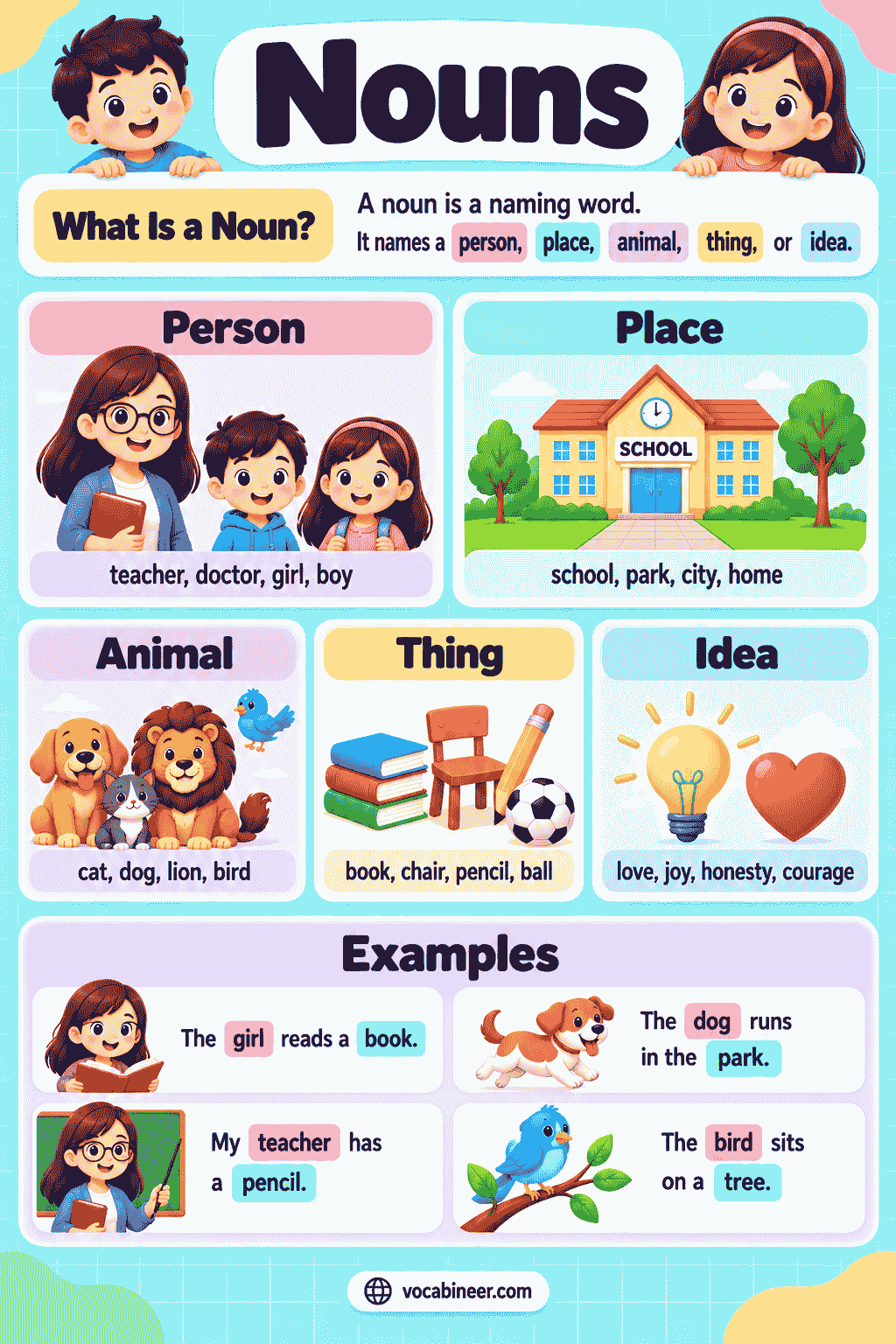
A noun is a word that names or refers to a person, place, animal, thing, idea, quality, or concept.
Examples:
- teacher
- city
- dog
- book
- water
- happiness
- honesty
Sentence examples:
- The teacher opened the door.
- Sara bought a book.
- The dog is sleeping.
- Honesty matters.
- We need some water.
Nouns can refer to physical things, such as chair and apple, or non-physical ideas, such as freedom and happiness.
Main Types of Nouns at a Glance
| Type of Noun | Meaning | Examples |
|---|---|---|
| Common Noun | general name | teacher, city |
| Proper Noun | specific name | Sara, London |
| Concrete Noun | physical thing | chair, apple |
| Abstract Noun | idea, quality, feeling | love, honesty |
| Countable Noun | can be counted | book, car |
| Uncountable Noun | treated as a mass or whole | water, information |
| Collective Noun | names a group | team, family |
| Compound Noun | formed from two or more words | bedroom, bus stop |
| Possessive Noun | shows ownership or relationship | Sara’s bag |
A noun can sometimes belong to more than one of these categories at the same time.
Common Nouns
A common noun gives a general name to a person, place, animal, thing, or idea.
Examples:
- girl
- teacher
- city
- river
- company
- dog
- book
Sentence examples:
- The teacher entered the classroom.
- We visited a city.
- The dog barked loudly.
- She opened the book.
Common nouns do not normally begin with capital letters unless they start a sentence.
Proper Nouns
A proper noun names a specific person, place, organization, day, month, or other particular entity.
Examples:
- Ayesha
- London
- Nile
- Microsoft
- Monday
- January
Sentence examples:
- Ayesha lives in London.
- We will meet on Monday.
- The Nile is a famous river.
Proper nouns normally begin with capital letters.
Common Nouns vs Proper Nouns
| Common Noun | Proper Noun |
|---|---|
| general name | specific name |
| girl | Ayesha |
| city | London |
| river | Nile |
| company | Microsoft |
| day | Monday |
The main difference is specificity. A common noun names a general class, while a proper noun identifies a particular person, place, or entity.
Concrete Nouns
A concrete noun refers to something physical that can usually be experienced through the senses.
Examples:
- table
- flower
- phone
- bread
- dog
- rain
Sentence examples:
- The phone is on the desk.
- She picked a flower.
- The dog is sleeping outside.
- I bought some bread.
Concrete nouns refer to things that exist physically.
Abstract Nouns
An abstract noun refers to an idea, quality, feeling, state, or concept rather than a physical object.
Examples:
- love
- honesty
- freedom
- happiness
- knowledge
- courage
Sentence examples:
- Honesty builds trust.
- Knowledge helps people make better decisions.
- Courage can grow through experience.
Abstract nouns name things we can understand or experience mentally rather than physically touch.
Concrete Nouns vs Abstract Nouns
| Concrete Nouns | Abstract Nouns |
|---|---|
| refer to physical things | refer to ideas, feelings, or qualities |
| chair | freedom |
| apple | happiness |
| dog | loyalty |
| book | knowledge |
| flower | beauty |
This distinction helps learners recognize whether a noun refers to something physical or conceptual.
Countable Nouns
A countable noun refers to something that can usually be counted as separate units.
Examples:
- book
- chair
- apple
- student
- car
- bottle
Sentence examples:
- I bought a book.
- She has three apples.
- There are five chairs in the room.
- We saw two cars outside.
Countable nouns can normally appear in singular or plural forms.
Common words used with countable nouns include:
- a/an
- one, two, three
- many
- a few
- several
Uncountable Nouns
An uncountable noun refers to something treated as a mass, substance, whole, or general concept.
Examples:
- water
- rice
- information
- furniture
- advice
- money
- traffic
Sentence examples:
- We need some water.
- She gave me useful information.
- The room has new furniture.
- He gave me good advice.
Uncountable nouns are not normally used directly with a/an or plural numbers.
Incorrect:
- an information
- two furnitures
- three advices
Correct:
- some information
- two pieces of furniture
- three pieces of advice
Countable Nouns vs Uncountable Nouns
| Countable Nouns | Uncountable Nouns |
|---|---|
| can usually be counted directly | not usually counted directly |
| book / books | information |
| chair / chairs | furniture |
| apple / apples | rice |
| many books | much information |
| a few chairs | a little water |
This is one of the most important noun distinctions because it affects articles, numbers, quantifiers, and plural forms.
Nouns That Can Be Countable or Uncountable
Some nouns change their countability depending on meaning.
Coffee
- I drink coffee every morning. → uncountable
- We ordered two coffees. → two servings
Experience
- She has a lot of experience. → general knowledge or skill
- It was an interesting experience. → one specific event
Time
- Time passes quickly. → general concept
- We had a good time. → specific experience
Chicken
- We ate chicken for dinner. → food, uncountable
- There are three chickens in the yard. → animals, countable
The meaning of the noun determines whether it is countable or uncountable.
Singular and Plural Nouns
Countable nouns can normally appear in singular and plural forms.
Regular examples:
- book → books
- car → cars
- chair → chairs
- apple → apples
Some nouns have irregular plurals:
- child → children
- foot → feet
- mouse → mice
- person → people
- tooth → teeth
The singular form usually refers to one, while the plural form refers to more than one.
Collective Nouns
A collective noun names a group of people, animals, or things as a unit.
Examples:
- team
- family
- class
- committee
- herd
- flock
- audience
Sentence examples:
- The team won the match.
- Our family lives nearby.
- A flock of birds crossed the sky.
- The class started early.
Collective nouns name a group while still functioning as nouns.
Compound Nouns
A compound noun combines two or more words to form a single noun with its own meaning.
Examples:
- toothbrush
- bedroom
- bus stop
- swimming pool
- mother-in-law
- school bus
Compound nouns can appear in different forms.
Closed Compound Nouns
Written as one word:
- bedroom
- toothpaste
- football
Open Compound Nouns
Written as separate words:
- bus stop
- dining room
- swimming pool
Hyphenated Compound Nouns
Joined with hyphens:
- mother-in-law
- check-in
- passer-by
Possessive Nouns
A possessive noun shows ownership, relationship, or association.
Examples:
- Sara’s bag
- the boy’s bicycle
- my brother’s room
- the students’ books
Basic patterns:
- singular noun → usually add ’s
- regular plural noun ending in s → usually add ’
Examples:
- the teacher’s desk
- the teachers’ room
- the child’s toy
- the children’s toys
Possessive nouns show who or what something belongs or relates to.
One Noun Can Belong to More Than One Type
Noun categories are not always mutually exclusive.
London
London can be:
- a proper noun
- a place noun
- a singular noun
Team
Team can be:
- a common noun
- a collective noun
- a countable noun
Happiness
Happiness can be:
- a common noun
- an abstract noun
- usually an uncountable noun
Book
Book can be:
- a common noun
- a concrete noun
- a countable noun
Therefore, one noun may fit several classifications at the same time.
Noun Phrases
A noun often appears as the main word inside a noun phrase.
Examples:
- the book
- a red car
- those three students
- my new English teacher
- the tall boy in the blue shirt
Consider:
The tall boy in the blue shirt is my cousin.
The head noun is boy. The other words provide more information about that noun.
Noun phrases can function in many of the same sentence roles as single nouns.
How Nouns Work in Sentences
Nouns can perform several grammatical functions.
Noun as the Subject
The subject tells us who or what the sentence is about.
- Sara opened the door.
- The dog barked.
Noun as the Direct Object
A direct object receives the action of the verb.
- Sara opened the door.
- He kicked the ball.
Noun as the Indirect Object
An indirect object can show who receives something.
- I gave Ahmed a book.
- She sent Maria a message.
Noun as a Subject Complement
A noun can identify or rename the subject after a linking verb.
- She is a teacher.
- Ahmed became the captain.
Noun as the Object of a Preposition
A noun can follow a preposition.
- The keys are on the table.
- We walked through the park.
These roles show that nouns do much more than simply name things.
How to Identify a Noun
There is no single test that works for every noun, so use several clues together.
A word may be a noun if it:
- names a person, place, animal, thing, idea, or quality
- acts as the subject or object of a sentence
- follows a determiner such as a, the, this, my
- can sometimes take singular and plural forms
- can sometimes take possessive ’s
Examples:
- The student opened the book.
- Happiness matters.
- My brother’s car is outside.
Always consider the word’s function in the sentence.
Nouns and Determiners
Determiners frequently appear before nouns.
Examples:
- a book
- the car
- my teacher
- some water
- these students
- those houses
The determiner partly depends on the type of noun.
Compare:
- a book → singular countable
- some books → plural countable
- some water → uncountable
- many students → plural countable
- much information → uncountable
Understanding noun type helps learners choose suitable determiners.
Common Noun Endings
Some word endings can help identify nouns.
-tion / -sion
- education
- decision
- discussion
-ment
- development
- agreement
- excitement
-ness
- happiness
- kindness
- darkness
-ity
- activity
- ability
- quality
-er / -or
- teacher
- writer
- actor
-ship
- friendship
- leadership
- relationship
These endings are useful clues, but they are not absolute rules.
Gerunds as Nouns
An -ing form can sometimes function as a noun.
Examples:
- Swimming is good exercise.
- Reading improves vocabulary.
- She enjoys painting.
- Walking helps me relax.
In these sentences, the -ing forms function in noun positions.
Not every -ing form is a noun, however.
Compare:
- Swimming is fun. → noun function
- She is swimming. → verb phrase
Context determines the function.
Noun vs Pronoun
A noun names or identifies, while a pronoun replaces a noun or noun phrase.
| Noun | Pronoun |
|---|---|
| Sara | she |
| Ahmed | he |
| the students | they |
| the book | it |
Example:
- Sara bought a book. She read it at home.
Pronouns help avoid repeated nouns.
Noun vs Adjective
A noun names something, while an adjective describes a noun or pronoun.
| Noun | Adjective |
|---|---|
| beauty | beautiful |
| danger | dangerous |
| strength | strong |
| success | successful |
| happiness | happy |
Examples:
- Her beauty was admired. → noun
- She is beautiful. → adjective
- His success surprised everyone. → noun
- He is successful. → adjective
Noun vs Verb
Some words can function as either nouns or verbs.
| Noun | Verb |
|---|---|
| I need some help. | Please help me. |
| Her work is difficult. | She works here. |
| We went for a walk. | We walk every day. |
| That was a good answer. | Please answer the question. |
The sentence context determines the word class.
Common Noun Mistakes
Using A/An with an Uncountable Noun
Incorrect: an information
Correct: some information / a piece of information
Pluralizing an Uncountable Noun
Incorrect: informations
Correct: information
Incorrect: furnitures
Correct: furniture
Incorrect: advices
Correct: advice
Forgetting Capital Letters with Proper Nouns
Incorrect: london
Correct: London
Incorrect: monday
Correct: Monday
Confusing Nouns with Adjectives
Incorrect classification: beautiful → noun
Correct: beauty → noun / beautiful → adjective
Treating Every -ing Word as a Verb
In Swimming is fun, swimming functions as a noun.
Assuming One Noun Has Only One Type
A noun may belong to several categories at once.
For example, team is both a common noun and a collective noun.
Nouns for Kids
For children and beginners, a simple definition is:
A noun is a naming word for a person, place, animal, thing, or idea.
Examples:
- girl
- school
- cat
- pencil
- happiness
Look at this sentence:
The girl carried a pencil to school.
Here:
- girl → person
- pencil → thing
- school → place
All three words are nouns.
FAQs
A noun is a word that names or refers to a person, place, animal, thing, idea, quality, or concept. Examples include teacher, London, dog, book, and happiness.
The main types include common, proper, concrete, abstract, countable, uncountable, collective, compound, and possessive nouns.
Look at the word’s function. A noun may name something, act as a subject or object, follow a determiner, take singular or plural forms, or show possession.
Countable nouns can usually be counted directly and have singular and plural forms, such as book/books. Uncountable nouns are treated as a mass or whole, such as water or information.
Yes. For example, team can be a common, collective, and countable noun at the same time.
Read More
- 12 English Tenses Chart
- All Tenses Rules and Formula
- English Tenses with Examples
- Present Tenses in English
- Past Tenses in English
- Future Tenses in English
- Be Going To in English